The Makonde people, who live primarily in northern Mozambique and southern Tanzania, developed one of the most distinctive tattoo traditions in this part of Africa. Their traditional tattoos, generally known as dinembo, were not simply decorative. They could communicate identity, adulthood, courage and beauty, while particular designs were also associated with marriage, fertility, protection and the spiritual world.
The relative isolation of the Mueda Plateau in northern Mozambique helped preserve many aspects of Makonde culture well into the twentieth century. The region’s geography limited outside influence for a long period, while Makonde oral traditions continued to place considerable importance on ancestors, inherited knowledge and the customs passed from one generation to another.
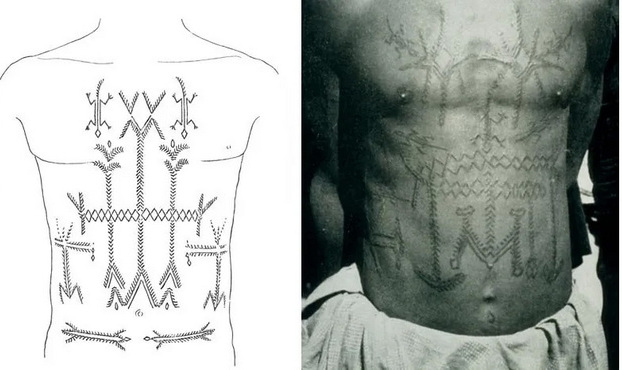
Traditional Makonde tattoos could also function as regional or community markers. The designs included angles, chevrons, straight and zigzag lines, dots, circles, diamonds and stylized representations of animals and plants. Although individual tattooists introduced variations, they worked within an established visual tradition.
The practice itself was a form of skin-cut tattooing. A traditional blade-like instrument known as a chipopo was used to make incisions in the skin, after which vegetable carbon was rubbed into them to create dark markings. Later practitioners also adopted razor blades. This description refers to a historical practice and should not be interpreted as a safe method for modern tattooing.
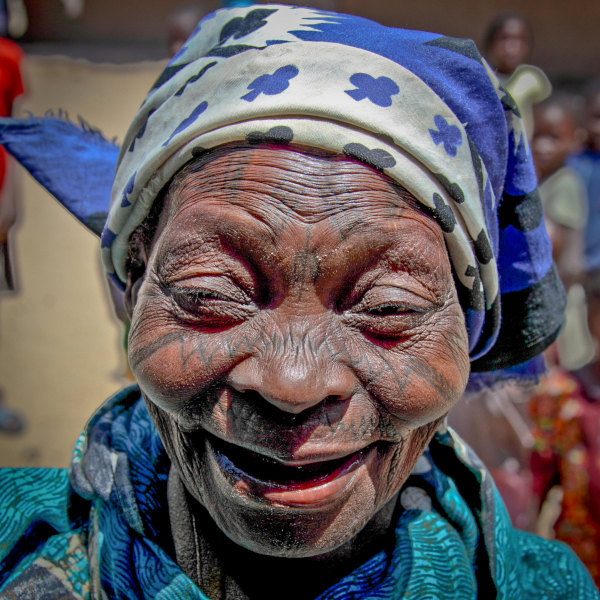
One important correction to older accounts is necessary. Traditional Makonde tattooing did not continue unchanged into the present day. On the Mueda Plateau, the practice declined dramatically during the twentieth century and largely ceased in the early 1960s. The old designs survived principally on members of the older generations and through Makonde cultural memory, art and ritual imagery.
Tattoo Motifs
Makonde tattoo designs included geometric patterns as well as motifs inspired by the natural world. The spider (lidangadanga) was among the designs recorded in older accounts, while plants, palm forms and various animals also appeared on the body.
The placement of a tattoo could be as significant as its design. Women traditionally wore elaborate markings on the abdomen (mankani) and inner thighs, areas that were closely associated in older ethnographic interpretations with sexuality, marriage and fertility. Palm-tree designs known as nadi were particularly prominent, while lizard motifs were associated with fertility in women and virility in men.
Tattooing around the navel and pubic region has also been interpreted as having a protective function. According to this interpretation, openings and symbolically vulnerable areas of the body required additional protection against illness or harmful spiritual forces.
This idea was not unique to the Makonde. Early ethnographic literature recorded comparable practices elsewhere in Africa. In 1924, C. H. Armitage described scarification around the navel among Gonja and Dagomba women in what is now Ghana, where such markings were associated with protection against sickness. Decades later, Joseph Nevadomsky and Ekhaguosa Aisien documented body markings among Bini women of the Benin Kingdom, including designs extending from the navel.
Among the Bini, charcoal and plant material also featured in body decoration, while mourners could mark their foreheads with black pigment in connection with beliefs surrounding the spirits of the dead. These parallels are interesting, but they represent different African peoples and traditions. They should therefore be understood as comparisons rather than as evidence that all of these cultures shared the same beliefs.
The Spiritual Life of the Makonde
Traditional Makonde cosmology included ancestors and a complex world of spiritual forces. Historical ethnographic descriptions refer to a powerful impersonal force called ntela, ancestral spirits known as mahoka, and spirits associated with the bush called nnandenga.
The mahoka occupied an especially important place in relationships between the living and their ancestors. They could be approached in connection with illness and were also associated with success in hunting and agriculture. Ancestors could act as intermediaries between people and Nnungu, a powerful deity invoked during periods of severe drought when communities prayed for rain.
Older accounts also describe beliefs concerning sorcery and lindandosa, invisible human servants believed to be controlled by sorcerers and sent into agricultural fields. Such accounts should, of course, be read as descriptions of a traditional spiritual worldview rather than as literal explanations of natural events.
The term mapiko also appears in discussions of Makonde spirituality. It is important not to reduce mapiko simply to “evil spirits.” The term belongs to a much broader Makonde tradition involving masked performance, initiation and representations of beings connected with the ancestral and social world.
Within such a worldview, permanent markings on the body could acquire meanings far beyond physical decoration. Tattooing helped express the wearer’s relationship with family, community, adulthood and inherited tradition. Certain designs could also embody ideas concerning fertility, protection and the continuing relationship between the living and their ancestors.
For Makonde women in particular, tattoos were closely connected with important stages of social life. They could signal maturity and readiness for adult responsibilities while simultaneously displaying the wearer’s endurance. Receiving extensive traditional tattoos was painful, and enduring the procedure itself could therefore demonstrate courage and commitment to Makonde identity.
In this sense, dinembo can be understood as a visual language. Patterns carried on the body communicated ideas that did not need to be expressed in words: belonging, maturity, beauty, courage and, in some circumstances, relationships with spiritual and ancestral forces.
Tattoo Patterns Beyond the Body
The visual vocabulary associated with Makonde tattooing was not restricted to human skin.
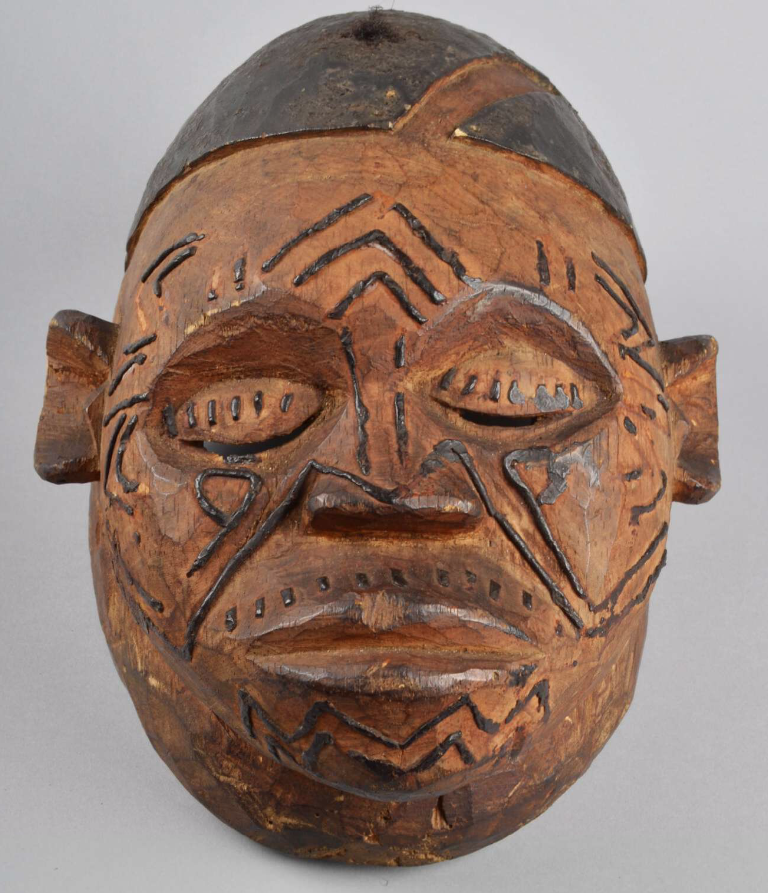
Similar patterns appeared on sculptures, masks and utilitarian objects. Gourds and vessels used for carrying water, beer, honey or seeds could be decorated with designs resembling those found on tattooed bodies. In older interpretations, such containers were associated with feminine and reproductive symbolism because they carried substances necessary for nourishment, cultivation and everyday life.
This created an interesting relationship between the decorated human body and decorated objects. A tattooed woman, a vessel containing seeds or water, and a carved figure could all participate in a wider visual system concerned with life, continuity and community.
Traditional Makonde masks provide another example of this connection. Tattoo-like patterns could be reproduced on masks, sometimes using blackened beeswax applied to the surface. The same visual forms that identified and decorated living people could therefore also appear within Makonde carving and performance traditions.
A Tradition That Has Largely Disappeared
One of the greatest changes to Makonde tattoo culture occurred during the political upheavals of the twentieth century.
Traditional tattooing on the Mueda Plateau declined rapidly around the period of Mozambique’s struggle against Portuguese colonial rule. Because elaborate facial tattoos made Makonde identity immediately recognizable, these markings could become dangerous during the conflict. Later political and social changes further discouraged the continuation of the practice.
One of the last documented Makonde tattoo masters, Pius, also known as Nãuka, had learned the craft from his father. He stopped tattooing in 1962, and the transmission of traditional tattoo knowledge between generations subsequently diminished.
The disappearance of widespread permanent tattooing did not mean that the designs themselves were immediately forgotten. Traditional dinembo patterns remained visible on older Makonde people and continued to appear in sculpture, masks and other forms of visual culture. In some initiation contexts, younger people have also worn painted versions of traditional facial designs rather than permanent tattoos.
Today, the old tattooed faces of the Makonde preserve the memory of a tradition that once formed an important part of personal and collective identity.
Dinembo was more than body decoration. Its patterns could mark adulthood and belonging, express beauty and courage, accompany initiation, and connect ideas of fertility and protection with a much broader Makonde understanding of community, ancestors and the continuity of life.