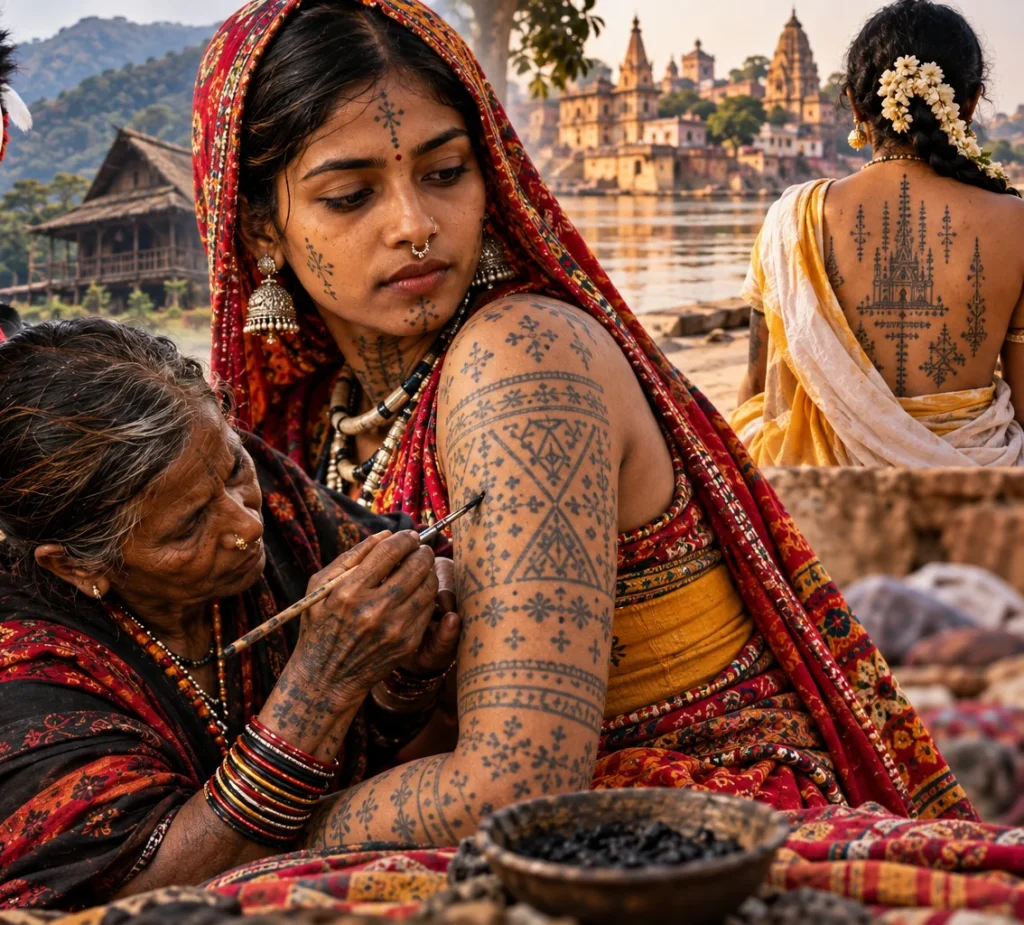
India has one of the world’s richest and most diverse traditions of tattooing. For centuries, permanent body markings have formed part of the spiritual, social and everyday lives of numerous communities across the subcontinent.
But there was never a single, universal form of “Indian tattooing.”
The tattoos of the Baiga of Central India, the pastoral communities of Gujarat and Rajasthan, or the Konyak of Nagaland could differ enormously in appearance, technique and meaning.
For some communities, tattoos represented beauty and permanent jewellery. For others, they identified family, tribe, social position or stages of life. They could be connected with marriage and fertility, serve as protective symbols, express religious devotion, or accompany a person on the journey into the afterlife.
In some traditions, the tattoo was considered something even gold and silver could not equal.
Jewellery, clothing and possessions had to be left behind at death.
The marks on the body remained.
Godna – Marks That Cannot Be Taken Away
Across parts of northern and central India, traditional tattooing is commonly known as godna, although terminology varies considerably between regions and communities.
Among the Baiga of Madhya Pradesh, godna became particularly important to women. Tattooing could begin in childhood and additional patterns were added as a woman passed through different stages of life.
The tattoos were permanent ornaments – something that poverty, loss or death itself could not take away. Contemporary Baiga accounts still preserve the belief that godna was more valuable in this sense than gold or silver because it remained with the person after death.
Similar ideas occur in other godna traditions. In Awadh, for example, tattoos have been understood as permanent ornamentation that survives death, while religious symbols or divine names could provide supernatural assistance to the wearer.
This helps explain why tattooing cannot simply be understood as an old Indian form of body decoration.
In some communities, the tattoo belonged as much to the next life as to this one.
Tattoos and the Journey After Death
One of the most fascinating beliefs connected with Indian tattoo traditions is that permanent body marks could identify a person after death.
Among some communities, tattoos were believed to allow ancestors or supernatural beings to recognise the deceased. In certain oral traditions, they were associated with Yama or Yamraj, the god of death, and the journey of the soul into the next world.
The idea appears in different forms rather than as one universal Indian belief.
For the Konyak of Nagaland, for example, tattoos were traditionally connected with identity, achievement and status, but they were also believed to make the deceased recognisable to ancestors in the afterlife.
The tattoo therefore became something extraordinarily powerful:
an identity that death could not erase.
Protection, Magic and Spiritual Power
Tattooing could also provide protection.
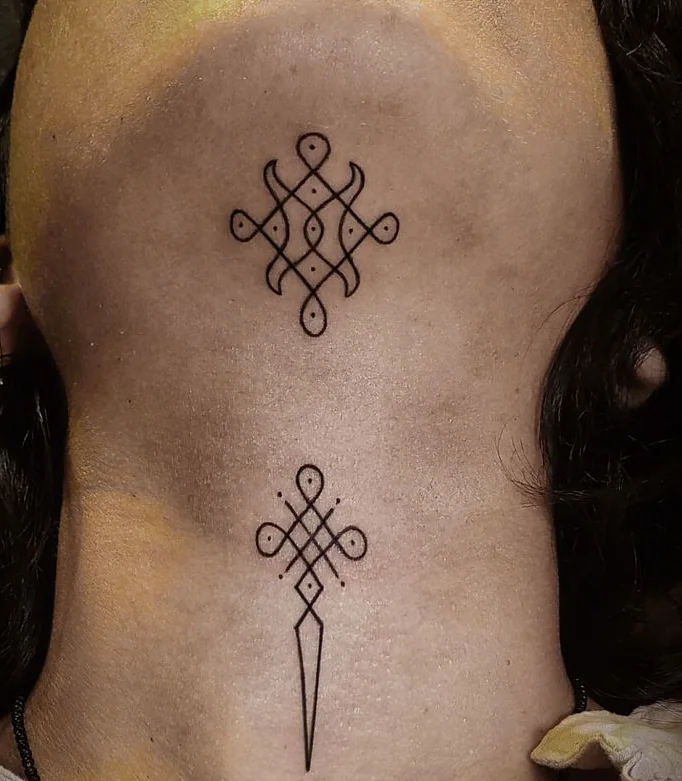
Different communities attributed protective properties to particular symbols, geometric patterns, animals and religious marks. Tattoos might guard against evil influences, misfortune or supernatural danger.
Religious symbols could similarly transform the body into a permanent expression of devotion.
Names and images associated with Hindu deities, sacred footprints, lotus flowers, conch shells, weapons and other religious symbols appeared in different regional traditions.
But these motifs should not be interpreted as having one fixed meaning throughout India. A symbol used by one community could have a very different significance in another.
The same is true of geometric patterns.
Dots, chains, steps, triangles, lines and labyrinth-like designs were not simply abstract decoration. Depending on the community, they could indicate identity, protection, social position, life stage or spiritual meaning.
Nature Written on the Skin
Animals and plants provided another enormous source of inspiration.
Tigers, lions, horses, camels, elephants, peacocks, snakes, scorpions, bees and other creatures appeared in traditional tattoo designs, alongside flowers, trees and agricultural plants.
These motifs reflected the environment in which people lived.
For pastoral communities, the animals surrounding everyday life could become part of the tattoo vocabulary. Elsewhere, plants or animals might carry religious, protective or totemic associations.
The lotus, for example, already possessed powerful religious symbolism in Indian culture, while snakes could be associated with protection and supernatural forces.
In other cases, the meaning was much more personal and practical.
Tattooing could depict objects familiar from everyday life: vessels, ornaments, tools, household objects or patterns resembling jewellery.
The body became, in effect, a permanent record of the world surrounding its owner.
Permanent Jewellery
This concept was particularly important in communities where material wealth could be lost, stolen or simply unavailable.
A necklace could disappear.
Silver could be sold.
Clothing eventually wore out.
A tattoo could not be taken away so easily.
Among Baiga women, this idea of tattooing as permanent ornamentation remains especially well documented. Godna could cover large portions of the body and was closely associated with female beauty and identity.
This gives an entirely different meaning to the expression body art.
The body itself became the place where a person’s ornaments were permanently stored.
Tattooing as a Record of Life
Tattoos could also mark important transitions.
Childhood, puberty, marriage, motherhood and other stages of life might each bring new markings.
Godna traditions among several Central Indian communities have been associated with rites of passage and different stages of a woman’s life.
The finished tattooed body therefore did not necessarily appear all at once.
It could develop over decades.
A young girl’s body might carry only a few marks. As she grew older, married and became a mother, additional tattoos could be added.
Seen this way, the skin became a kind of biography.
Instead of writing important moments into a book, they were written permanently onto the body.

Women as Keepers of Tattoo Knowledge
Another particularly important aspect of traditional Indian tattooing is the role of women.
In numerous communities, tattoo knowledge was preserved and transmitted by female tattoo practitioners.
These women could travel between villages, carrying with them knowledge of designs, techniques and the meanings associated with different markings.
Among the Baiga, this tradition has survived into the present. Contemporary Baiga tattoo artist Mangala Bai Maravi, for example, learned tattooing from her mother as a child and travelled with her while she tattooed women in different communities.
Traditional female tattooists are also documented in Jharkhand, where women travelled from village to village to perform godna, particularly for women from tribal communities.
This means that tattooing knowledge itself formed part of an intergenerational female tradition.
A mother could teach her daughter not only how to puncture the skin, but which pattern belonged where, who was permitted to wear it and what it meant.
Traditional Tools and Pigments
The equipment used for traditional tattooing was extremely simple compared with a modern tattoo studio.
Needles, thorns or sharpened plant materials could be grouped together and used to puncture the skin repeatedly. Different communities developed their own variations of these hand-tapping or hand-poking techniques.
Pigments were also made from locally available materials.
Soot, plant-derived substances, resins and other ingredients could produce the dark blue-black or greenish marks characteristic of many old tattoos.
Among the Konyak, for example, traditional tattooing involved hand-tapping techniques and plant-based pigment associated with red cedar.
These methods are historically fascinating, but they belong to their traditional cultural context. They should not be interpreted as modern tattooing or hygiene recommendations. Contemporary tattooing requires appropriate sterile equipment, regulated pigments and modern infection-control procedures.
Pain, Courage and Endurance
Traditional tattooing could be extremely painful.
Large areas of the body might be covered using hand tools, with the skin punctured repeatedly over long sessions.
Yet pain itself could acquire cultural meaning.
In societies where tattoos marked adulthood, bravery or achievement, enduring the process demonstrated self-control and courage.
Nowhere is this relationship between tattooing and courage more striking than among some peoples of northeastern India.
The Tattooed Warriors of Nagaland
The tattoo traditions of the Konyak Naga differed dramatically from the godna traditions of Central India.
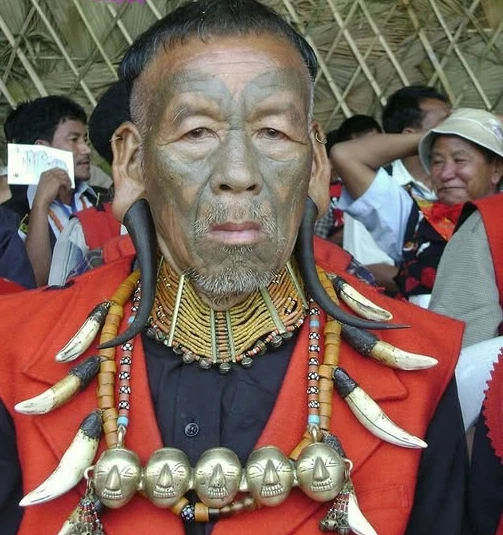
Historically, male Konyak tattooing was intimately connected with warfare and headhunting.
A warrior’s tattoos were not simply chosen because he liked a particular design.
They had to be earned.
Participation in warfare and the taking of an enemy head could qualify a man for particular markings, including highly visible tattoos on the face, neck and body. These tattoos communicated achievement and warrior status to other members of society.
In a world without identity cards, military medals or written biographies, the tattooed body could immediately tell others something about the man standing before them.
His skin recorded his status.
Tattoos That Could Be Read
Konyak tattooing also shows why it is misleading to treat traditional tattoos merely as decorative patterns.
Different markings could communicate distinctions between warriors and common men and could identify social or personal status. Women’s tattoos, meanwhile, were connected with stages such as puberty and motherhood.
The tattoo was therefore a form of visual language.
Someone who understood that language could look at another person’s body and read information from it.
This is one of the most remarkable recurring characteristics of traditional tattoo cultures around the world: before tattoos became primarily an individual choice, they could tell a community who you were.
Women and Konyak Tattooing
Women were central to this tradition as well.
Traditional Konyak tattoo artists were primarily women, and knowledge was passed between generations. Historical techniques included hand-tapping with groups of sharp points bound together into a tattooing implement.
Women themselves also received tattoos, although their markings carried different meanings from the warrior tattoos of men.
They could mark important stages in a woman’s life rather than military achievement.
Once again, the same society used tattooing differently according to gender, age, status and experience.
The Wancho and Other Northeastern Traditions
Similar tattooing traditions also existed among neighboring peoples of northeastern India, including the Wancho of Arunachal Pradesh.
These traditions should not simply be labelled collectively as “Naga tattooing,” because the peoples of the region maintained distinct customs, motifs and social rules.
What they demonstrate collectively is the extraordinary diversity found within the borders of modern India.
The tattoo traditions of a Baiga woman in Madhya Pradesh and a tattooed Konyak warrior in Nagaland belonged to profoundly different cultural worlds.
Yet both used the human body as a permanent carrier of identity.
Gujarat – Tattoos, Identity and Permanent Wealth
Western India developed yet another tattooing landscape.
Among communities of Gujarat, including pastoral and rural groups such as the Rabari and Mer, tattoos could be associated with beauty, identity, religious belief and protection.
Patterns included animals, religious symbols, geometric forms and designs resembling jewellery.
This is another reason the idea of permanent wealth appears so naturally in discussions of Indian tattooing.
Jewellery could be removed, lost or stolen.
A tattooed ornament remained on the body.
For people whose lives involved migration, pastoralism or limited material possessions, permanent body decoration could carry a meaning very different from that of modern fashion tattooing.
I would, however, be cautious with some of the very specific Gujarat claims in the older text – such as assigning particular designs universally to all Rabari or Mer – unless we have a source for the precise community and locality. India’s regional tattoo traditions varied even between neighboring groups.
Healing Tattoos
Your original text also mentions another fascinating function: tattooing as medicine.
This deserves to remain, but again with an important distinction.
In several traditional societies, tattoos were applied to particular parts of the body because they were believed to relieve pain or treat illness. Marks might be associated with rheumatism, joint pain, childbirth or the protection of internal organs.
These practices belong to traditional systems of healing and belief.
They should not be presented as evidence that tattooing actually treats these medical conditions.
For historians of tattooing, however, they are extremely important because they show that a tattoo could simultaneously function as decoration, identity, ritual and traditional medicine.
Fertility, Marriage and Beauty
Tattooing could also be intimately connected with ideas of womanhood, fertility and marriage.
Flowers, plants, animals and geometric symbols might be associated with fertility, prosperity or the hope of finding a suitable spouse.
Among some communities, a heavily tattooed woman could be considered especially beautiful.
This can be difficult to understand from the perspective of modern Western tattoo culture, where body art is generally treated as an individual aesthetic choice.
Traditional tattooing often worked differently.
Beauty itself was culturally defined.
The marks that identified a woman as belonging to her community could simultaneously make her beautiful because they demonstrated that belonging.
This may also help explain some older descriptions of tattoos as enhancing sexual attractiveness. Rather than simply calling traditional tattoos a “sexual stimulant,” as the old text does, it is more accurate to say that in certain communities tattooing formed part of culturally defined ideals of beauty, maturity, fertility and desirability.
The Decline of India’s Traditional Tattoo Cultures
Many of these traditions have changed dramatically.
Education, migration to cities, religious conversion, changing beauty ideals, modern medicine and the growing popularity of contemporary tattoo studios have all affected traditional tattooing.
Among the Konyak, the disappearance of headhunting removed one of the social institutions most closely connected with male warrior tattooing. Christianity and modernization also contributed to the decline of the older tattoo system. Today, the surviving heavily tattooed Konyak elders represent one of the last generations to have lived within that older cultural world.
Elsewhere, the story is not simply one of disappearance.
Traditional godna designs are being documented and sometimes transferred onto paper, canvas and other art forms, allowing artists to preserve the visual language even as the practice of permanently tattooing the body changes. Baiga artists such as Mangala Bai Maravi have also brought these traditions to international audiences.
And contemporary Indian tattoo artists are increasingly looking back toward Indigenous motifs and histories rather than seeing Indian tattooing only through the lens of imported Western styles.
A History Written on the Body
Perhaps the most important lesson from India’s tattoo traditions is that there is no single meaning of an Indian tattoo.
For one person, a tattoo could be jewellery.
For another, protection.
For another, a mark of marriage or motherhood.
For a warrior, it could record an achievement that had to be earned.
For others, the tattoo helped ensure that ancestors would recognise them after death.
Across these very different traditions, however, one idea appears repeatedly:
the human body could carry things that ordinary possessions could not.
Wealth disappears. Clothing decays. Jewellery can be lost. Social worlds change and traditions fade.
But the tattoo travels with its wearer for life.
And for some of India’s tattooed peoples, its journey did not end even there.