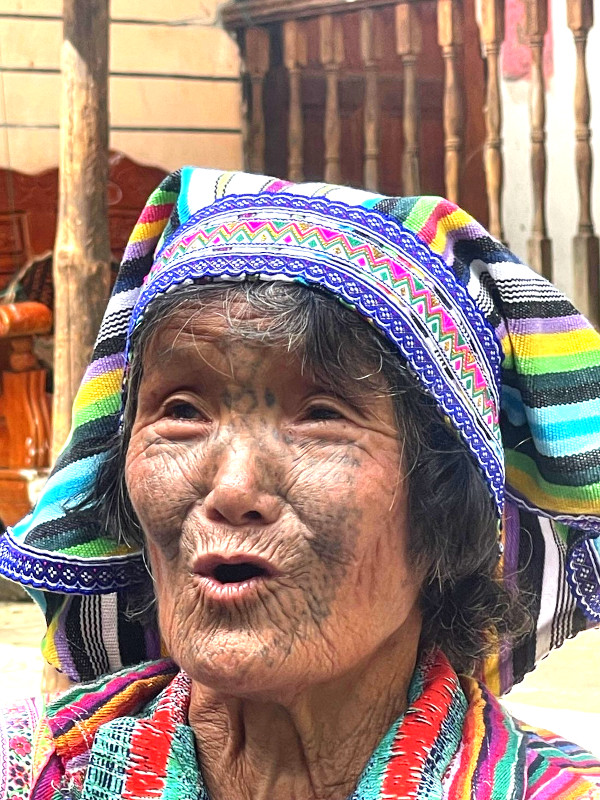
The history of tattooing in China is far more complex than the common idea that tattoos were simply marks of criminals and outcasts.
For more than two thousand years, Chinese written sources have described tattooing in very different contexts. Tattoos appeared among peoples living along the southern, eastern and western frontiers of the Chinese cultural world; they were used as punishment by the state; they later marked soldiers; and distinctive tattoo traditions survived among Indigenous and ethnic communities such as the Li of Hainan and the Dulong of Yunnan.
Even earlier evidence comes from the ancient populations buried in the deserts of what is now Xinjiang, where naturally preserved human remains provide remarkable evidence of body marking in prehistoric and early historic Inner Asia.
The history of Chinese tattooing is therefore not one tradition, but several very different histories written on the skin.
Wen Shen – Marking the Body
One of the historical Chinese expressions associated with tattooing is wen shen (文身), literally referring to patterning or marking the body.
References to wen and tattooing appear in texts associated with the Han period (206 BCE–220 CE), although several different terms were used for permanently marking the skin. Historical vocabulary also included expressions translated as inking, engraving the body, and embroidering the face.
The old interpretation of the Chinese character wen is particularly fascinating.
Some scholars historically interpreted its early pictographic form as representing a human figure bearing a pattern on the chest. This interpretation helped produce the idea that tattooing might lie very deep within the history of the character itself.
However, this should no longer be presented as established fact. Modern scholarship has questioned the pictographic interpretation, and other explanations of the character’s earliest form have been proposed.
It remains an intriguing connection between the concepts of pattern, writing and the marked human body, but not something we can state with certainty.
Tattoos Beyond the Han Cultural World
Early Chinese texts frequently described tattooing as a characteristic of peoples living beyond what their authors considered the civilized Chinese cultural center.
This distinction is important.
The writers who produced these descriptions were usually members of literate Chinese elites. When they described tattooed peoples as strange, uncivilized or barbarian, they were recording their own cultural perspective, not providing a neutral description of those societies.
The Yue peoples of southern and southeastern regions were particularly associated in early Chinese sources with practices including tattooing and cutting the hair. Scholarship on the ancient Yue confirms that wen shen appears in textual descriptions of these southern populations.
Tattooing could have very different meanings within those communities from the meanings assigned to it by Han observers.
What appeared to an imperial writer as a sign of being an outsider could represent identity, protection or cultural belonging to the people actually wearing the marks.
The Tattooed People of Wa – Ancient Japan
Chinese historical texts also provide some of the earliest written descriptions of tattooing in ancient Japan.
The people known in Chinese sources as Wa – rather than “Wo,” as in the old version of this article – were described as tattooing their faces and bodies.
These accounts are extremely valuable because they demonstrate that tattooing was already recognized by Chinese chroniclers as a distinctive cultural practice among neighboring peoples.
But there is an important correction here as well.
They were not necessarily “commanded to tattoo their faces and bodies.”
The Chinese sources were describing a custom they observed or had learned about among the Wa. We should therefore avoid turning that observation into an imperial command.
Tattooing as Punishment
Within ancient Chinese states, tattooing developed another, much darker meaning.
It could be imposed as judicial punishment.
One of the ancient punishments involved marking a convicted person’s skin, particularly the face, with permanent ink. The resulting mark did more than punish the body.
It made punishment visible.
Long after the physical wound had healed, everyone encountering the person could see that he or she had been condemned by the authorities.
Tattooing therefore became an instrument of social control.
The Chinese term mo (墨), meaning ink, became closely associated with punitive tattooing; the association was sufficiently strong that modern scholarship discussing the philosopher Mozi notes that mo could itself mean tattooing as an ancient punishment.
Depending on period and legal system, punitive marking could accompany other sentences such as forced labor, military service or exile.
And it did not simply disappear after antiquity.
Tattooing, together with other corporal punishments, remained part of Chinese penal practice for centuries. Historical research into late imperial criminal justice documents tattooing among the physical punishments used before major legal reforms of the early twentieth century.
A Mark That Could Not Be Hidden
The cruelty of punitive tattooing lay partly in its permanence.
Prison ends.
A fine can be paid.
But a mark placed prominently on the face can remain for life.
In later periods, the location and form of penal tattoos could communicate information about the offense or punishment. Song-period sources, for example, describe distinctions between markings used for bandits, repeat offenders and people sentenced to different forms of punishment.
The tattoo therefore functioned almost like a permanent criminal record written directly onto the body.
This helps explain why tattooing acquired such a powerful association with marginality in parts of Chinese society.
But there is an important complication.
The same Chinese state that marked criminals also began marking another enormous group of men:
soldiers.
The Tattooed Soldiers of the Song Dynasty
This is one of the most interesting parts missing from the original article.
During the Song Dynasty (960–1279), tattooing became deeply intertwined with military service.
Research by historian Elad Alyagon shows that tattooed soldiers formed a highly visible part of the Song military world. The practice was connected with a larger penal-military system in which convicts, hereditary military families and other socially marginalized groups could be drawn into military service.
The result complicates the simple statement that tattoos in mainstream China belonged only to criminals.
Millions of people lived within a social world in which tattooing could identify soldiers as well as convicts.
A tattoo could therefore indicate punishment, military status or the blurred boundary between the two.
The human body had become an administrative surface upon which the state could record identity.
Confucianism and the Untouched Body
Another reason traditionally given for the negative attitude toward tattooing in Chinese elite culture is Confucian thought.
A famous teaching associated with the Classic of Filial Piety emphasizes that the body, hair and skin are received from one’s parents and should not be carelessly damaged.
This idea certainly helps explain why deliberate permanent alteration of the body could be viewed negatively.
But the older version of our article went too far by making this a simple explanation for Chinese tattoo stigma.
Chinese society existed for thousands of years, and attitudes toward tattooing varied enormously according to period, social class, ethnicity and purpose.
Punitive tattoos, military tattoos and Indigenous tattoo traditions existed despite elite ideals concerning bodily integrity.
The relationship between Confucianism and tattooing was therefore more complicated than:
Confucianism prohibited tattoos.
It didn’t erase tattooing from China.
Buddhism and Tattooing
I would also remove the old sentence claiming that Buddhism generally required the body to remain pure so that a person could achieve a proper reincarnation.
That is too broad.
Buddhist traditions themselves have used permanent body marking in different religious contexts, and Chinese Buddhist attitudes cannot be reduced to a universal prohibition on tattooing.
For this article, the more important historical influence is the strong social association between tattooing, punishment, marginalized groups and peoples regarded as outsiders.
The Li People of Hainan
While tattooing carried negative associations among sections of Han society, some ethnic communities within what is now China developed elaborate tattoo traditions of their own.
One of the most important examples is the Li people of Hainan Island.
Traditional Li women could bear extensive tattoos on their faces, arms, hands, legs and other areas of the body. The designs varied among Li communities and formed part of a complex visual language connected with identity and tradition.
Their importance is considerable enough that contemporary scholarship on Indigenous tattooing identifies the heavily tattooed Li women of Hainan as one of China’s distinctive Indigenous tattoo traditions.
These tattoos cannot properly be understood through the old Han idea of tattooing as criminal stigma.
For the women who carried them, they belonged to their own cultural system.
This distinction is fundamental:
the same tattooed body could represent “barbarism” to an outside chronicler and cultural identity to the person wearing the tattoo.
The Dulong – Tattooed Faces of Yunnan
Another remarkable tradition survived among the Dulong, or Derung, people of southwestern China.
Historically, facial tattooing was practiced particularly among Dulong women.
The reasons for this practice have been explained in different ways in historical and modern accounts. Some stories connect facial tattooing with protection against abduction or enslavement, while other interpretations emphasize beauty, identity and cultural belonging.
We should therefore be cautious about reducing the tradition to a single origin story.
What is certain is that the distinctive tattooed faces of older Dulong women preserve evidence of a cultural practice that largely disappeared during the twentieth century.
As with the Li, modernization and profound social changes dramatically reduced the continuation of traditional tattooing.
Did Communist China Simply Ban Tribal Tattooing?
The original article states that after the establishment of the People’s Republic of China in 1949, government laws aimed at eliminating superstition almost destroyed tattooing among ethnic minorities.
I would soften that considerably.
Traditional practices certainly declined during the enormous political, economic and social transformations of twentieth-century China. Campaigns against customs classified as backward or superstitious, changing education, healthcare, settlement patterns, fashion and integration into wider Chinese society all contributed.
But saying that a single government prohibition caused the disappearance of Li and Dulong tattooing is too simplistic without stronger evidence.
The decline was a historical process involving several forces.
And remarkably, some of these tattoo traditions have survived in living memory.
The Ancient Tattooed Mummies of Xinjiang
Long before the Han Dynasty, people living in what is now western China were already marking their bodies.
The dry environment of the Tarim Basin in Xinjiang preserved ancient human remains, clothing and other organic materials extraordinarily well.
These remains became internationally famous as the Tarim mummies.
Older books and articles frequently described them as “Caucasian mummies.”
Today that terminology should be avoided.
Modern genetic research has transformed our understanding of the ancient populations of Xinjiang, and physical appearance alone cannot reliably establish ancestry.
The region was a crossroads where different populations and cultures interacted over thousands of years.
That story is considerably more interesting than simply describing the mummies as Europeans who wandered into China.
Cherchen Man
One of the most famous preserved individuals is commonly known as Cherchen Man, or the Chärchän man.
He lived roughly three thousand years ago and is famous for his remarkably preserved appearance, including reddish-brown hair and facial features that contributed to older theories about western Eurasian migration into the Tarim Basin.
Markings interpreted as tattoos have also been reported on ancient remains from the region.
But here our original article becomes too speculative.
It claimed that Cherchen Man’s markings were applied after death, represented a solar symbol and probably guided him through a purification ceremony into the afterlife.
Those are fascinating interpretations, but they should not be presented as established archaeological fact.
We do not know enough about the beliefs of these individuals to confidently assign such precise religious meanings to their body markings.
Tattoos Before Written Chinese History
What these ancient bodies can tell us is still remarkable.
Tattooing or permanent body marking existed among populations living within the territory of present-day China long before many surviving Chinese written descriptions of tattooing.
That does not mean these people belonged to Chinese civilization in the later political or cultural sense.
Modern national borders did not exist.
The ancient Tarim Basin was home to populations with their own languages, migrations, cultural contacts and traditions.
This distinction matters enormously when discussing “the oldest Chinese tattoos.”
A tattoo discovered in modern China is not automatically a tattoo created by an ancient Han Chinese person.
Were the Tattoos a Form of Writing?
The old article also mentions a roughly 3,500-year-old mummy whose complex hand tattoos have supposedly been interpreted as proto-writing.
I would remove that claim unless we can identify the exact mummy and the archaeological publication supporting it.
Geometric tattoos can certainly communicate identity, status, belief or symbolic meaning without being writing in the linguistic sense.
Calling an unidentified tattoo a form of proto-script is therefore much stronger than the surviving evidence allows.
Tattooing Was Never Just One Thing in China
The history of tattooing in China is fascinating precisely because there was no single Chinese attitude toward tattoos.
For elite writers, tattooing could symbolize peoples they considered uncivilized.
For the state, it could become a permanent punishment.
For a Song soldier, it could mark his position within a vast military system.
For Li and Dulong women, tattooing belonged to cultural traditions of identity and community.
And thousands of years earlier, people living in the deserts of what is now Xinjiang had already carried permanent markings on their bodies.
These histories occasionally intersected, but they were never identical.
That is why the history of tattooing in China should not simply be told as a story of an ancient society that rejected tattoos.
It is better understood as a history of different peoples assigning radically different meanings to permanent marks on human skin.

Read this: Maori Tattoos