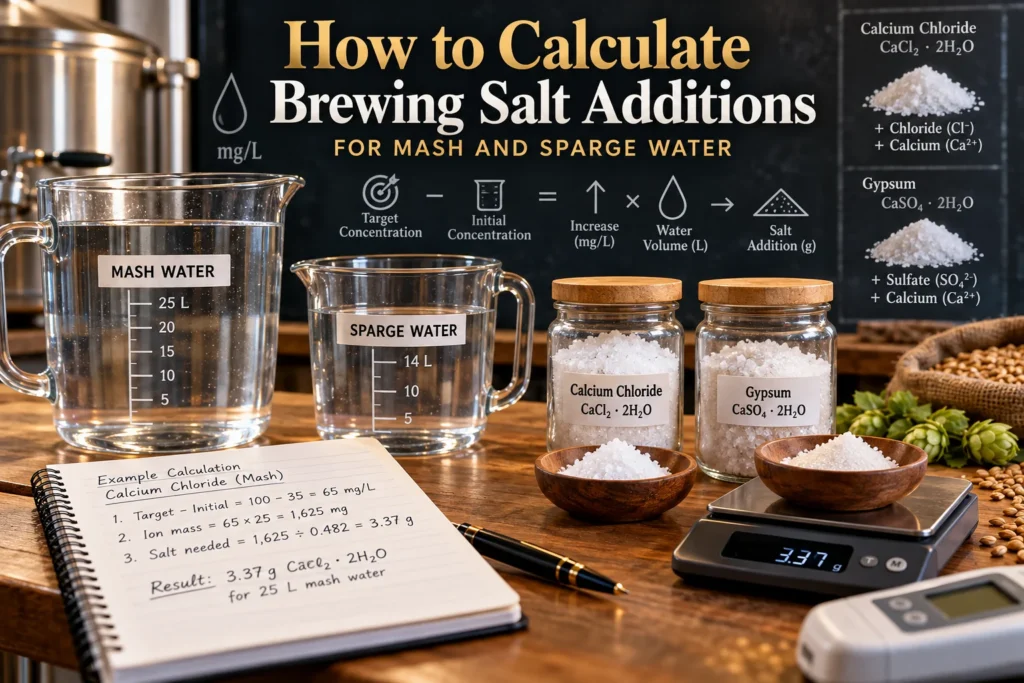
Brewing water adjustments can seem complicated when you first begin working with mineral profiles. You may know that calcium chloride increases chloride, gypsum increases sulfate, and that different beer styles benefit from different mineral balances.
But understanding what these salts do is only the beginning.
The next step is learning how much brewing salt to add, how to calculate the correct amounts, and how to distribute those additions between mash and sparge water.
This is where many homebrewers make mistakes.
A recipe may produce 25 liters of finished beer, but the brewing process could require 35, 40, or even 45 liters of water. Calculating salt additions for the finished beer volume instead of the actual water volume can result in a mineral profile that differs significantly from the intended target.
Another common mistake is adding all the brewing salts to the mash without considering the sparge water.
In this guide, we will examine practical mineral calculations, understand how brewing salts affect water chemistry, and work through step-by-step examples for different brewing situations.
By the end, you should be able to calculate basic calcium chloride and gypsum additions, understand separate mash and sparge water treatment, and avoid some of the most common water adjustment mistakes.
1. Why Brewing Water Volume Matters
Before calculating brewing salt additions, we need to distinguish between three different volumes:
- Mash water.
- Sparge water.
- Finished beer volume.
These are not interchangeable.
Mash water is mixed with crushed grain during mashing. Sparge water is used to rinse the grain bed and recover additional wort. Finished beer volume is the amount eventually collected after boiling, fermentation losses, and transfers.
For example, a homebrewer using an all-in-one brewing system might have the following process:
Example: 25-Liter Finished Beer Batch
Brewing Water Volume Example
A typical 25-liter homebrew batch
| Process | Volume |
|---|---|
| Mash water | 25 L |
| Sparge water | 14 L |
| Total brewing water | 39 L |
| Target finished beer | 25 L |
In this example, the total brewing water is:
25 + 14 = 39 liters
If we want to adjust all the brewing water to the same mineral profile, our calculations must account for 39 liters, not 25 liters.
However, there is another important consideration: mash and sparge water do not necessarily need identical mineral treatment.
The mash contains grain, enzymes, and buffering compounds that influence water chemistry. Sparge water has a different role, and its alkalinity and pH require particular attention.
We will return to this distinction later.
2. Understanding the Most Common Brewing Salts
Several mineral salts can be used to modify brewing water, but most homebrewers can accomplish many basic adjustments with just two:
Calcium chloride and gypsum.
Other salts may be useful when specific mineral concentrations or alkalinity adjustments are needed.
| Salt | Formula | Main Contribution | Typical Purpose |
|---|---|---|---|
| Calcium Chloride | CaCl₂ | Calcium + Chloride | Increase chloride and calcium |
| Gypsum | CaSO₄·2H₂O | Calcium + Sulfate | Increase sulfate and calcium |
| Epsom Salt | MgSO₄·7H₂O | Magnesium + Sulfate | Increase magnesium and sulfate |
| Baking Soda | NaHCO₃ | Sodium + Bicarbonate | Increase alkalinity |
| Non-Iodized Salt | NaCl | Sodium + Chloride | Increase sodium and chloride |
Calcium Chloride
Calcium chloride is commonly used when a brewer wants to increase chloride concentration and promote a rounder sensory impression.
It also contributes calcium.
However, calcium chloride is available in several forms, including anhydrous calcium chloride and calcium chloride dihydrate.
These forms contain different percentages of calcium and chloride.
For example, pure calcium chloride dihydrate (CaCl₂·2H₂O) contains approximately:
- 27.3% calcium by mass.
- 48.2% chloride by mass.
Anhydrous calcium chloride contains a higher percentage of both ions because it contains no water of crystallization.
This difference matters when calculating additions.
A brewing calculator configured for anhydrous calcium chloride will not give the correct result if you actually use the dihydrate form.
Gypsum
Gypsum is calcium sulfate dihydrate (CaSO₄·2H₂O).
It is commonly used to increase sulfate concentration, especially in hop-forward beers.
Pure gypsum contains approximately:
- 23.3% calcium by mass.
- 55.8% sulfate by mass.
Unlike calcium chloride, gypsum has limited solubility in water. At normal brewing additions it is often practical to add it directly to the mash, where it can dissolve and interact with the brewing liquor.
However, complete dissolution should not automatically be assumed in every water treatment situation, particularly with concentrated solutions or high additions.
Other Brewing Salts
Epsom salt can supply magnesium and sulfate, but excessive magnesium may contribute undesirable bitterness or mineral character.
Baking soda can increase alkalinity, making it potentially useful for some dark beer recipes where roasted malts lower mash pH too much.
Sodium chloride can increase chloride without adding calcium, but it also raises sodium.
These additions should be evaluated using the complete water profile.
3. What Does mg/L Mean in Brewing Water?
Water reports and brewing calculators commonly express mineral concentrations in milligrams per liter (mg/L).
For dilute water solutions, 1 mg/L is approximately equal to 1 part per million (ppm).
For example:
100 mg/L chloride means that one liter of water contains approximately 100 milligrams of dissolved chloride ions.
If we have 25 liters of water at 100 mg/L chloride, the total chloride mass is:
100 × 25 = 2,500 mg
That is 2.5 grams of chloride ions.
But this does not mean we should add 2.5 grams of calcium chloride.
Calcium chloride contains both calcium and chloride, and the salt’s total mass is greater than the mass of chloride it supplies.
To calculate the actual salt addition, we need to know the fraction of the salt represented by the target ion.
4. The Basic Formula for Brewing Salt Additions
The general calculation is straightforward.
First, determine the concentration increase required:
Required increase = Target concentration − Starting concentration
Then calculate the total mass of the ion needed:
Ion mass (mg) = Concentration increase (mg/L) × Water volume (L)
Finally, divide by the mass fraction of the target ion in the salt:
Salt required (g) = Ion mass (mg) ÷ (1,000 × Ion mass fraction)
For example, calcium chloride dihydrate contains approximately 48.2% chloride.
Its chloride mass fraction is therefore 0.482.
Gypsum contains approximately 55.8% sulfate.
Its sulfate mass fraction is 0.558.
These values allow us to calculate approximate salt additions without relying entirely on brewing software.
5. Step-by-Step Example: Adding Calcium Chloride to Mash Water
Suppose we have 25 liters of mash water with the following chloride concentration:
Starting chloride: 35 mg/L
We want to increase it to:
Target chloride: 100 mg/L
Step 1: Calculate the Required Increase
100 − 35 = 65 mg/L
We need an additional 65 mg of chloride per liter.
Step 2: Calculate the Total Chloride Mass
65 × 25 = 1,625 mg
That is 1.625 grams of chloride ions.
Step 3: Calculate the Calcium Chloride Dihydrate Addition
Using a chloride mass fraction of 0.482:
1,625 ÷ 0.482 = 3,371 mg
Therefore:
Approximately 3.37 g calcium chloride dihydrate
This theoretical addition raises the chloride concentration of 25 liters of water from 35 mg/L to approximately 100 mg/L.
But it also increases calcium.
Since calcium chloride dihydrate contains approximately 27.3% calcium:
3.37 × 0.273 = 0.92 g calcium
Distributed across 25 liters:
920 ÷ 25 = 36.8 mg/L additional calcium.
Therefore, if the starting calcium concentration was 40 mg/L, the new theoretical concentration would be approximately:
40 + 36.8 = 76.8 mg/L calcium
This demonstrates why calcium chloride additions must be evaluated as part of the complete mineral profile.
Calculation Summary
6. Step-by-Step Example: Adding Gypsum to Sparge Water
Now suppose we want to adjust 14 liters of sparge water.
Starting sulfate concentration:
15 mg/L
Target sulfate concentration:
150 mg/L
Step 1: Calculate the Increase
150 − 15 = 135 mg/L
Step 2: Calculate the Required Sulfate Mass
135 × 14 = 1,890 mg sulfate
Step 3: Calculate the Gypsum Addition
Gypsum contains approximately 55.8% sulfate.
1,890 ÷ 0.558 = 3,387 mg
Therefore:
Approximately 3.39 g gypsum
This is the theoretical gypsum quantity required to increase sulfate from 15 to 150 mg/L in 14 liters of water.
The addition also supplies calcium.
Using the calcium mass fraction of approximately 0.233:
3.39 × 0.233 = 0.79 g calcium
790 ÷ 14 = approximately 56.4 mg/L additional calcium.
If the starting calcium concentration is 25 mg/L, the theoretical resulting concentration is approximately 81.4 mg/L.
However, there is an important practical consideration.
Sparge water treatment should not focus on mineral concentration alone.
Sparge water alkalinity is often more important for controlling mash runoff pH and reducing the risk of extracting undesirable compounds from the grain bed.
Adding gypsum does not automatically guarantee appropriate sparge water alkalinity or pH.
If gypsum is added to sparge water, it must dissolve sufficiently to deliver the calculated mineral contribution. For some systems, adding the calculated sparge-water salts directly to the boil kettle is a more practical way to achieve a mineral contribution without requiring the salts to dissolve in a separate sparge tank.
In that case, the mineral addition affects the wort rather than establishing the calculated concentration in the sparge water itself.
These two approaches should not be treated as chemically identical.
7. Should Mash and Sparge Water Have the Same Mineral Profile?
Not necessarily.
Mash water and sparge water perform different functions.
Mash water interacts directly with crushed grain and influences mash chemistry.
Sparge water is primarily used to rinse the grain bed and recover sugars.
For mash water, important considerations include:
- Calcium concentration.
- Magnesium concentration.
- Alkalinity.
- Mash pH.
- Chloride and sulfate balance.
For sparge water, the most important concern is often its alkalinity and the effect of continued rinsing on grain-bed and runoff pH.
High-alkalinity sparge water can contribute to an undesirable rise in pH during sparging, particularly toward the end of runoff.
This can increase the risk of extracting excessive tannins and other compounds.
Reducing sparge water alkalinity with a suitable food-grade acid may therefore be more important than adding calcium chloride or gypsum.
A brewer can choose to add mineral salts primarily to the mash and use low-alkalinity sparge water, provided the final wort mineral balance is calculated appropriately.
Another brewer may treat both mash and sparge water to similar mineral targets.
Both approaches can work, but they require different calculations.
8. Three Practical Methods for Distributing Brewing Salts
There are several ways to organize brewing water additions.
Treat All Brewing Water
Calculate salts for the complete brewing liquor volume, then distribute the treated water between mash and sparge.
Treat Mash and Sparge Separately
Calculate each water volume independently, allowing different mineral or alkalinity adjustments.
Mash Salts + Kettle Additions
Add suitable salts to the mash and deliver other calculated mineral additions to the kettle while managing sparge alkalinity separately.
Method 1: Treat the Entire Brewing Water Volume
This is often the simplest approach when the starting water has low alkalinity and is suitable for both mash and sparge.
For example:
Mash water: 25 L
Sparge water: 14 L
Total: 39 L
If the target sulfate increase is 100 mg/L, the required sulfate mass is:
100 × 39 = 3,900 mg
The theoretical gypsum requirement is:
3,900 ÷ 0.558 = 6,989 mg
Therefore:
Approximately 7.0 g gypsum for 39 liters
If the water is mixed and treated as one volume, the mineral concentration can be distributed consistently.
However, treating the entire volume does not remove the need to evaluate mash pH and sparge water alkalinity.
Method 2: Treat Mash and Sparge Water Separately
This approach provides greater flexibility.
For example, a brewer may want:
- A mineral-adjusted mash.
- Low-alkalinity sparge water.
- Different salt concentrations in each water volume.
The calculations must be performed separately.
A 25-liter mash and a 14-liter sparge cannot simply receive identical salt weights if the intention is to achieve identical concentration increases.
The required salt mass is proportional to the treated water volume.
Method 3: Add Some Salts to the Mash and Others to the Kettle
Another approach is to add part of the brewing salts during mashing and the remainder to the boil kettle.
This can be useful when the brewer wants calcium available during mashing but does not need every mineral addition present in the sparge water.
For example, calcium chloride may be added to the mash, while some gypsum is added to the kettle.
However, kettle additions do not influence mash pH or mash reactions in the same way as additions made before or during mashing.
The complete mineral balance and the expected wort volume should still be considered.
9. Complete Example: A 25-Liter American Pale Ale
Let us work through a more complete brewing water calculation.
Suppose we are brewing a 25-liter American Pale Ale using:
- 25 L mash water.
- 14 L sparge water.
- 39 L total brewing water.
Our starting water contains:
- Calcium: 35 mg/L.
- Chloride: 35 mg/L.
- Sulfate: 15 mg/L.
We want a moderately sulfate-forward profile.
Our target concentrations are:
- Chloride: 75 mg/L.
- Sulfate: 135 mg/L.
For this simplified example, assume both water volumes are treated to the same mineral targets, using pure calcium chloride dihydrate and gypsum.
Step 1: Calculate Chloride Increase
75 − 35 = 40 mg/L
Across 39 liters:
40 × 39 = 1,560 mg chloride.
Required calcium chloride dihydrate:
1,560 ÷ 0.482 = 3,237 mg.
Total calcium chloride dihydrate: approximately 3.24 g.
Step 2: Calculate Sulfate Increase
135 − 15 = 120 mg/L
Across 39 liters:
120 × 39 = 4,680 mg sulfate.
Required gypsum:
4,680 ÷ 0.558 = 8,387 mg.
Total gypsum: approximately 8.39 g.
Step 3: Divide the Additions Between Mash and Sparge
The mash uses 25 of the total 39 liters.
Mash fraction:
25 ÷ 39 = 0.641
Sparge fraction:
14 ÷ 39 = 0.359
Calcium chloride dihydrate:
Mash: 3.24 × 0.641 ≈ 2.08 g
Sparge: 3.24 × 0.359 ≈ 1.16 g
Gypsum:
Mash: 8.39 × 0.641 ≈ 5.38 g
Sparge: 8.39 × 0.359 ≈ 3.01 g
Final Salt Distribution
American Pale Ale – Salt Distribution
| Water / Addition | Mash | Sparge | Total |
|---|---|---|---|
| Water volume | 25 L | 14 L | 39 L |
| Calcium chloride dihydrate | 2.08 g | 1.16 g | 3.24 g |
| Gypsum | 5.38 g | 3.01 g | 8.39 g |
| Target chloride | 75 mg/L | 75 mg/L | 75 mg/L |
| Target sulfate | 135 mg/L | 135 mg/L | 135 mg/L |
Step 4: Check the Calcium Contribution
The calcium chloride dihydrate contributes approximately:
3.24 × 0.273 = 0.885 g calcium.
The gypsum contributes approximately:
8.39 × 0.233 = 1.955 g calcium.
Total additional calcium:
0.885 + 1.955 = 2.840 g.
Across 39 liters:
2,840 ÷ 39 ≈ 72.8 mg/L additional calcium.
Starting calcium:
35 mg/L.
Theoretical final calcium concentration:
35 + 72.8 ≈ 108 mg/L.
This is a useful illustration of why we cannot calculate chloride and sulfate while ignoring calcium.
The target concentrations may be achieved, but the resulting calcium level must also be reviewed.
Step 5: Check Mash pH and Sparge Alkalinity
The mineral calculation is not finished until we consider the water’s alkalinity and the grain bill.
Calcium salts can affect mash pH, but their effect depends on the malt composition and the buffering capacity of the mash.
A mash pH calculator or a properly calibrated pH meter can help verify the result.
For sparge water, alkalinity should be evaluated separately.
If the water has substantial alkalinity, acidification may be necessary even after mineral additions.
The required acid amount cannot be calculated reliably from chloride, sulfate, and calcium concentrations alone.
We also need information about alkalinity, the acid used, its concentration, and the intended treatment endpoint.
10. Why Sparge Water Alkalinity Is So Important
During mashing, the grain contributes buffering compounds that influence pH.
During sparging, water continues passing through the grain bed while the concentration of dissolved wort compounds decreases.
If the sparge water has high alkalinity, it may cause the pH of the grain bed and runoff to rise.
Excessively high runoff pH, particularly late in sparging, can increase the risk of extracting undesirable tannins and other compounds.
This is why many brewers prefer low-alkalinity sparge water.
Some brewers acidify sparge water using phosphoric acid or lactic acid.
The amount of acid required depends primarily on the water’s alkalinity, the desired endpoint, and the acid concentration.
Simply knowing that the source water has a pH of 7.5 or 8.0 is not enough to determine the required acid dose.
Two waters with the same initial pH can require very different amounts of acid because their alkalinity differs.
For this reason, sparge water treatment should be based on alkalinity rather than pH alone.
11. Can You Use the Same Salt Calculation for Every Brewing System?
The chemistry is the same, but the process volumes can be different.
An all-in-one brewing system, a traditional three-vessel system, and a brew-in-a-bag setup may require different water management approaches.
For example:
Traditional Mash and Sparge
The brewer may treat mash and sparge water separately.
Salt calculations should be based on the actual volume of each water portion.
Full-Volume BIAB
Some brew-in-a-bag systems use all or nearly all brewing water during mashing.
In that case, the salt calculation may be based on the complete mash water volume.
There may be no separate sparge water treatment.
All-in-One Brewing Systems
Systems such as BrewZilla may use a substantial mash water volume followed by a separate sparge.
The same mineral calculation principles apply, but the actual water volumes should come from the brewer’s equipment profile.
A recipe calling for 25 liters of finished beer does not automatically imply a particular mash or sparge water volume.
12. Common Mistakes When Calculating Brewing Salt Additions
Mistake 1: Using Finished Beer Volume Instead of Water Volume
Calculating salts for 25 liters when the actual brewing water volume is 39 liters can lead to incorrect dosing.
Better approach: identify the water volume being treated before calculating any additions.
Mistake 2: Ignoring the Starting Mineral Concentrations
If the water already contains 100 mg/L sulfate, adding enough gypsum for a 150 mg/L increase will overshoot a 150 mg/L target.
Better approach: calculate the required increase, not the total target concentration.
Mistake 3: Using the Wrong Salt Form
Anhydrous calcium chloride and calcium chloride dihydrate do not have the same mineral composition by mass.
Better approach: confirm the exact product composition and configure the calculator accordingly.
Mistake 4: Forgetting Calcium Contributions
Both gypsum and calcium chloride increase calcium.
Better approach: calculate all affected ions, not only chloride and sulfate.
Mistake 5: Treating Sparge Water Like Mash Water
Sparge water alkalinity can be more important than matching the mash water’s mineral concentrations.
Better approach: evaluate sparge alkalinity and the intended mineral contribution separately.
Mistake 6: Assuming Salt Additions Automatically Correct pH
Calcium salts may influence mash pH, but they do not guarantee a suitable pH.
Better approach: calculate or measure mash pH and adjust alkalinity when necessary.
Mistake 7: Ignoring the Difference Between Theoretical and Actual Results
Mineral calculations assume specific salt compositions and dissolution behavior.
Real products may contain moisture, impurities, or different hydration states.
Better approach: use reliable brewing-grade salts, measure accurately, and treat calculated values as estimates that should be checked against the full process.
13. A Practical Brewing Water Adjustment Workflow
A consistent workflow makes water treatment easier and reduces mistakes.
Brewing Water Adjustment Checklist
Check calcium, magnesium, sodium, chloride, sulfate, and alkalinity.
Record mash water, sparge water, and total brewing liquor.
Select chloride and sulfate concentrations that support the intended beer character.
Use the required concentration increases, water volumes, and correct salt compositions.
Check calcium and all other ions affected by the additions.
Make separate acid or alkalinity adjustments when needed.
Measure salts accurately, verify mash pH, and record the results for future batches.
14. Should You Calculate Brewing Salts Manually or Use a Calculator?
Manual calculations are valuable because they help you understand what happens when minerals are added to brewing water.
Once you understand the formulas, you can quickly recognize when a brewing calculator produces an unexpected result.
However, complete brewing water calculations involve more than chloride and sulfate.
A good water calculator should also account for:
- Calcium and magnesium.
- Sodium.
- Bicarbonate or alkalinity.
- Water volumes.
- Brewing salt composition.
- Mash pH estimates.
- Acid additions.
Manual calculations are excellent for checking basic salt quantities.
For more complex water treatment, a dedicated brewing water calculator is usually more practical.
You can also use the Brewing Tools section on The Tattooist Craft website to explore brewing calculations and water profile adjustments.
15. Final Thoughts: Calculate the Water You Actually Treat
Brewing salt calculations do not need to be mysterious.
The essential principles are simple:
First, determine the actual water volume.
Second, measure or obtain the starting mineral concentrations.
Third, choose reasonable target concentrations.
Fourth, calculate the required increases using the correct chemical composition of each salt.
Finally, evaluate the complete mineral profile, mash pH, and sparge water alkalinity.
The most important lesson is that 25 liters of finished beer does not mean 25 liters of brewing water.
Mash water and sparge water can be treated together or separately, but the calculations must match the actual process.
When these principles are understood, brewing water adjustments become more predictable, repeatable, and easier to refine.
The goal is not to add as many minerals as possible.
It is to use the right amounts, in the right water volume, at the right stage of brewing, to support the beer you want to make.