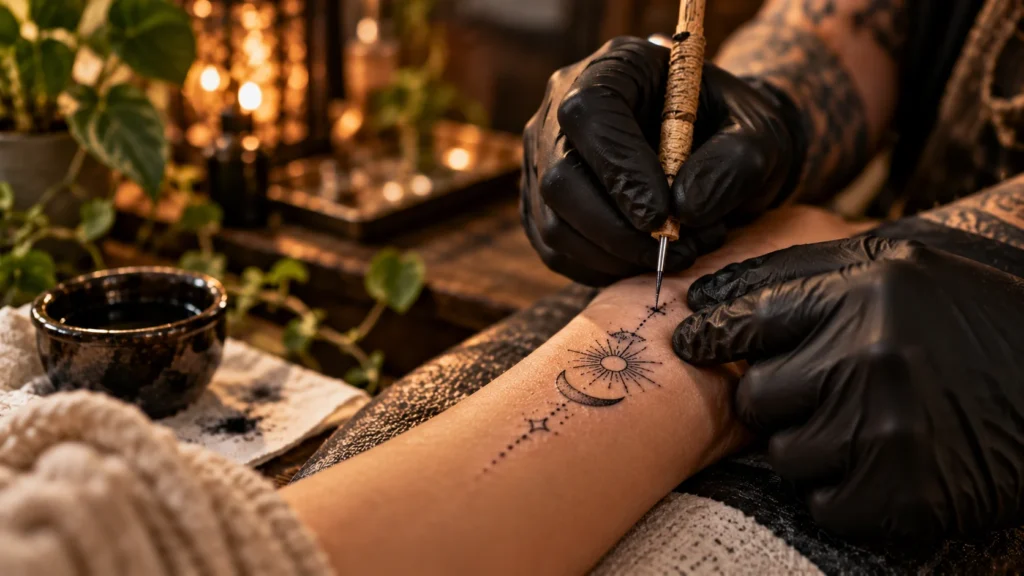
Stick and poke tattoos, also known as hand poke tattoos or hand-poked tattoos, have become a recognizable part of contemporary tattoo culture. From minimalist symbols and delicate botanical designs to ornamental patterns and expressive dotwork, this traditional method has found a place alongside modern machine tattooing.
Unlike conventional tattoo machines, hand poke tattooing relies on a tattoo artist manually guiding a needle to deposit pigment into the skin. The process is slower and more deliberate, with each mark contributing to the finished design.
But despite its apparently simple technique, stick and poke tattooing is not necessarily easier, safer, or less painful than machine tattooing.
A professionally executed hand poke tattoo requires artistic skill, an understanding of skin anatomy, appropriate equipment, strict hygiene practices, and careful aftercare.
In this guide, we explore the history of hand poke tattooing, how the technique works, current tattoo trends, the differences between hand poke and machine tattoos, pain levels, healing, longevity, and potential health risks.
What Is a Stick and Poke Tattoo?
A stick and poke tattoo is a permanent tattoo created without an electrically powered tattoo machine.
Instead, a tattoo artist uses a sterile tattoo needle attached to an appropriate hand-held tool to manually introduce tattoo pigment into the skin.
Each controlled puncture deposits a small amount of pigment. Through repeated movements, the artist creates lines, shapes, textures, and shading.
Although the technique is frequently associated with small, simple tattoos, hand poke tattooing is not limited to minimalist designs.
Experienced artists can create intricate ornamental compositions, botanical illustrations, geometric patterns, lettering, and complex dotwork.
It is important to understand that hand poke describes a tattooing technique, not a specific artistic style.
A fine-line tattoo can be made by hand or machine. Similarly, dotwork tattoos can be created using either method.
The final result depends on the artist’s experience, the design, the skin, and the quality of the execution.
The History of Hand Poke Tattooing
Hand tattooing existed thousands of years before the invention of the modern tattoo machine.
Across different cultures, people developed techniques for permanently marking the skin using manually operated tools and pigments.
Tattooing was often much more than decoration. It could communicate cultural identity, family relationships, social status, spiritual beliefs, or important stages of life.
Ancient Tattoos and Ötzi the Iceman
One of the most famous archaeological examples of early tattooing is Ötzi the Iceman, a naturally preserved mummy dating back more than 5,000 years.
His body bears numerous tattoo marks, demonstrating that permanent skin marking was practiced in prehistoric Europe.
Researchers have studied the location, appearance, and possible purpose of these markings.
However, the precise tools and methods used to create them remain subjects of scientific investigation.
Although Ötzi’s tattoos are frequently mentioned in discussions about hand poke tattooing, they should not automatically be considered identical to the modern technique.
Traditional Hand Tattooing Around the World
Several tattoo traditions developed independently in different regions.
In Japan, tebori is a traditional hand tattooing method associated with specialized tools and highly controlled techniques.
In Polynesian cultures, tattooing has historically played an important role in identity, genealogy, social relationships, and cultural heritage.
In parts of Southeast Asia, Sak Yant tattooing is connected to spiritual and cultural traditions and may involve hand-operated tattooing instruments.
These practices should not be reduced to variations of modern stick and poke tattooing.
Each tradition has its own history, symbolism, techniques, and cultural significance.
Modern hand poke tattooing shares the basic principle of manually introducing pigment into the skin, but its artistic context is often very different.
Why Are Hand Poke Tattoos Popular Today?
The renewed interest in hand poke tattoos reflects several broader directions in contemporary tattoo culture.
Many clients are increasingly interested in personalized designs, understated aesthetics, and the creative process behind their tattoos.
Hand poke tattooing appeals to people who appreciate the handmade character of the work and the individual approach of the artist.
Minimalist Tattoos and Fine-Line Designs
Minimalist tattoos remain an important part of modern tattoo aesthetics.
Small stars, flowers, abstract symbols, fine lettering, and delicate geometric shapes are commonly associated with hand poke tattooing.
However, minimalism does not necessarily mean simplicity from a technical perspective.
Very small designs can be difficult to execute correctly, and extremely fine details may become less distinct as the tattoo ages.
A professional artist should consider how the design will look not only immediately after the session but also several years later.
Botanical and Nature-Inspired Tattoos
Delicate leaves, flowers, branches, and botanical illustrations are particularly compatible with the visual character of hand poke tattooing.
These designs can combine fine outlines with subtle dotwork and carefully placed negative space.
Their popularity is also connected to the wider interest in organic shapes and nature-inspired body art.
Ornamental and Geometric Tattoos
Geometric patterns, decorative elements, and ornamental compositions are another important direction.
The controlled placement of individual marks can create intricate textures and visually balanced designs.
However, hand poke is not inherently superior for geometric tattooing.
Precise geometric work requires careful planning regardless of the technique used.
The Appeal of Handmade Tattooing
For some clients, the process itself is part of the attraction.
Hand poke tattooing can feel more personal because of the artist’s direct control over each movement.
Nevertheless, the quality of the tattoo should always take priority over the romantic image of a traditional or handmade technique.
A well-designed, professionally executed tattoo is more important than whether it was created by hand or machine.
Hand Poke vs. Machine Tattoos: What’s the Difference?
The fundamental difference lies in how the tattoo needle moves.
In hand poke tattooing, the artist manually controls the punctures.
In machine tattooing, an electrically powered mechanism repeatedly moves the needle.
Both methods introduce pigment into the skin and produce permanent tattoos.
| Feature | Hand Poke Tattoo | Machine Tattoo |
|---|---|---|
| Needle movement | Manually controlled | Electrically powered |
| Working speed | Often slower | Generally faster |
| Small designs | Suitable with proper technique | Suitable with proper technique |
| Large tattoos | Can be time-consuming | Usually more efficient |
| Pain | Varies by individual | Varies by individual |
| Healing | Depends on technique and skin response | Depends on technique and skin response |
| Longevity | Permanent when properly executed | Permanent when properly executed |
| Hygiene requirements | Strict professional standards | Strict professional standards |
Neither method is automatically better.
A skilled artist may prefer hand poke for a particular design and machine tattooing for another.
The choice should depend on the artwork, the placement, the desired visual result, and the artist’s expertise.
Do Stick and Poke Tattoos Hurt More or Less?
One of the most common questions is whether hand poke tattoos are less painful than machine tattoos.
There is no universal answer.
Some clients describe hand poke tattooing as more tolerable because there is no continuous machine vibration.
Others find the individual punctures more noticeable or uncomfortable.
Pain perception depends on several factors, including the tattoo’s location, the individual’s sensitivity, the size and complexity of the design, the length of the session, and the artist’s technique.
Certain areas of the body are naturally more sensitive than others.
The ribs, ankles, hands, feet, and areas close to bone may be particularly uncomfortable.
It is also worth remembering that a hand poke tattoo may take longer to complete.
Even if the sensation feels milder to one person, the extended duration can influence the overall experience.
Hand poke tattoos are not guaranteed to be less painful than machine tattoos.
Do Hand Poke Tattoos Heal Faster?
Another common claim is that hand poke tattoos heal faster because the technique is supposedly gentler on the skin.
This may be true in some individual cases, but it should not be treated as a universal rule.
Skin trauma depends on more than the equipment used.
The number of punctures, the artist’s technique, the size of the tattoo, the condition of the skin, and the overall execution all influence healing.
A poorly executed hand poke tattoo can cause unnecessary skin trauma, just as improper machine tattooing can.
During the initial healing period, mild redness, tenderness, itching, and peeling may occur.
The surface of the skin often settles within a few weeks, although deeper healing can take longer.
Healing times vary considerably between individuals.
Following professional aftercare instructions is essential regardless of the tattooing method.
How Long Do Stick and Poke Tattoos Last?
A professionally applied hand poke tattoo is permanent.
The idea that stick and poke tattoos automatically disappear after a few months is a misconception.
Like machine tattoos, hand poke tattoos can gradually fade or change in appearance over time.
Their longevity depends on the quality of the application, the pigment, the skin, the tattoo’s placement, sun exposure, and natural skin changes.
If pigment is deposited too superficially, parts of the tattoo may fade prematurely.
Poor technique can also lead to blurred lines, uneven pigment distribution, or scarring.
Extremely small lettering and closely spaced details may become harder to distinguish as the tattoo ages.
For this reason, thoughtful design and appropriate spacing are especially important.
Hand poke tattooing should never be considered a temporary alternative to conventional tattooing.
Are Stick and Poke Tattoos Safe?
Hand poke tattooing can be performed in a professional environment with appropriate safety precautions, but no tattooing procedure is completely risk-free.
All permanent tattooing involves puncturing the skin.
Potential complications include bacterial infections, allergic reactions, scarring, inflammatory reactions, and exposure to bloodborne pathogens when hygiene standards are inadequate.
Sterile Needles Are Only Part of Tattoo Safety
Using a sterile needle is essential, but it is not enough on its own.
Professional tattoo safety requires an entire system of infection prevention.
This includes appropriate hand hygiene, single-use sterile equipment, correct glove use, proper surface disinfection, prevention of cross-contamination, safe ink handling, and correct disposal of contaminated sharps.
Cross-contamination can occur even when the original needle was sterile.
For example, touching a contaminated surface and then returning to the tattooing area without appropriate precautions can introduce microorganisms.
Professional hygiene standards apply equally to hand poke and machine tattooing.
Tattoo Ink Safety
Tattoo pigments must be suitable for their intended use and comply with applicable regulations.
In the European Union, tattoo inks are subject to chemical restrictions under the REACH framework.
These regulations limit certain hazardous substances in tattoo and permanent makeup products.
However, chemical compliance does not automatically guarantee that an ink is free from microbial contamination.
Proper storage, handling, and professional sourcing remain important.
Why DIY Stick and Poke Tattoos Can Be Dangerous
Social media sometimes presents stick and poke tattooing as an inexpensive activity that can easily be performed at home.
This can create a misleading impression.
Tattooing requires more than a needle, pigment, and a simple design.
Without proper training, individuals may not understand skin anatomy, contamination risks, appropriate equipment, or the signs of complications.
Improvised needles, unsuitable inks, and unhygienic environments can increase the risk of infection and permanent skin damage.
Unsterile tattooing equipment may also transmit bloodborne infections, including hepatitis B, hepatitis C, and HIV.
An unsuccessful homemade tattoo may additionally require professional correction, cover-up work, or laser removal.
For these reasons, choosing a trained tattoo artist working in an appropriate professional environment is strongly recommended.
How Is a Professional Hand Poke Tattoo Created?
Although the technique does not use a tattoo machine, the professional process involves several important stages.
Consultation and Design
The artist discusses the client’s ideas, preferred style, tattoo placement, and expectations.
The design should be evaluated for its proportions, readability, and long-term appearance.
Preparation of the Working Area
The artist prepares the workspace according to professional hygiene procedures.
Appropriate sterile, single-use tools and protective materials are used, and work surfaces are managed to reduce contamination risks.
Skin Preparation
The skin is assessed and prepared using suitable professional products.
Tattooing should not routinely be performed over infected, inflamed, or damaged skin.
Design Placement
The artwork is transferred or marked onto the skin.
The client and artist can check its position, orientation, and proportions before tattooing begins.
Tattoo Application
The artist builds the design through carefully controlled manual movements.
Professional execution requires consistency, experience, and continuous attention to the skin’s response.
Completion and Aftercare
Once the tattoo is finished, the area is cleaned and protected according to the studio’s procedures.
The client receives appropriate aftercare guidance.
Used needles and contaminated materials are disposed of according to applicable safety requirements.
Hand Poke Tattoo Aftercare
Proper aftercare is essential for maintaining the appearance of the tattoo and reducing the risk of complications.
The tattoo artist should provide instructions appropriate to the type of dressing used and the condition of the skin.
General principles include keeping hands clean before touching the tattoo, gently cleaning the area as instructed, avoiding unnecessary friction, and not scratching or picking peeling skin.
During healing, prolonged soaking, swimming pools, and excessive sun exposure should be avoided.
Different dressings may require different care, so there is no single aftercare schedule that is suitable for every tattoo.
Signs of Possible Infection
Some redness and tenderness may be normal immediately after tattooing.
However, increasing pain, spreading redness, pus, fever, chills, or feeling generally unwell may indicate an infection or another complication.
Medical assessment is recommended if these symptoms develop.
Persistent rashes, swelling, or unusual skin reactions may also require professional medical attention.
What Designs Work Best for Hand Poke Tattoos?
Hand poke tattooing is especially well suited to designs where controlled marks and carefully planned details contribute to the overall aesthetic.
Popular possibilities include minimalist symbols, small botanical illustrations, simple lettering, geometric designs, ornamental patterns, and dotwork.
However, not every small tattoo is automatically better suited to hand poke.
Some complex designs, dense shading, or large compositions may be more practical to execute with a tattoo machine.
The best choice depends on the artist’s experience and the technical requirements of the artwork.
Frequently Asked Questions About Stick and Poke Tattoos
Are stick and poke tattoos permanent?
Yes. Properly executed hand poke tattoos are permanent, although they may gradually fade or change over time.
Do hand poke tattoos hurt less?
Not necessarily. Pain is subjective, and the sensation can differ from machine tattooing.
Can hand poke tattoos be colorful?
Yes. Hand poke tattooing is not limited to black ink, although color selection and application require professional judgment.
Do stick and poke tattoos fade faster?
Not inherently. Poor application, skin characteristics, placement, and environmental exposure can affect longevity with either technique.
Can stick and poke tattoos become infected?
Yes. Any tattoo can become infected if microorganisms enter damaged skin. Professional hygiene and appropriate aftercare are essential.
Can a stick and poke tattoo be removed?
Laser tattoo removal may reduce or remove tattoo pigment, but multiple sessions may be required and complete removal cannot always be guaranteed.
Are hand poke tattoos suitable for large designs?
They can be, but larger pieces may require considerably more time than machine tattooing.
Final Thoughts: Are Stick and Poke Tattoos Worth It?
Stick and poke tattooing combines an ancient approach to body art with contemporary artistic expression.
Its appeal lies in the controlled manual process, distinctive aesthetic possibilities, and connection to handmade craftsmanship.
However, the technique should not be confused with amateur or improvised tattooing.
Professional hand poke tattooing requires the same commitment to hygiene, technical knowledge, artistic quality, and client safety as machine tattooing.
Whether a tattoo is made by hand or machine, the most important considerations remain the quality of the design, the skill of the artist, and the long-term result.
A great hand poke tattoo is not defined simply by the absence of a machine, but by the knowledge, precision, and artistic intention behind every mark.