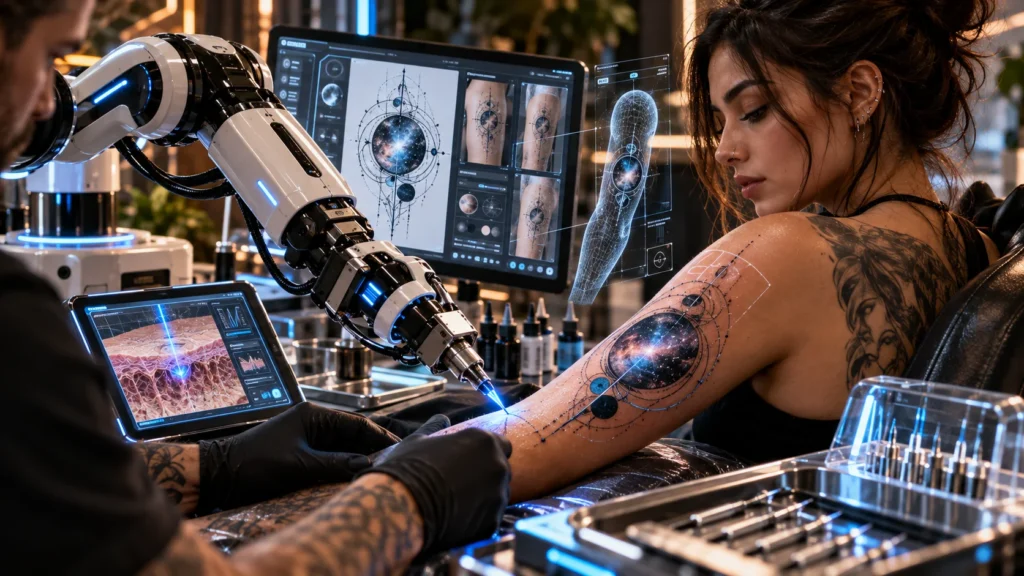
How artificial intelligence, automated tattoo machines, microneedle printing, augmented reality and programmable pigments could transform the tattoo industry.
For thousands of years, tattooing has remained one of humanity’s most personal forms of artistic expression. Techniques, tools and styles have changed dramatically, yet the essential principle has remained remarkably consistent: pigment is introduced into the skin to create a lasting image.
Today, that principle is being challenged and expanded by a new generation of technologies.
Robotic tattoo machines are beginning to reproduce digital artwork on human skin. Artificial intelligence can generate tattoo concepts in seconds. Researchers are developing pigments that change appearance when exposed to light. Microneedle patches are introducing an entirely different method of applying permanent designs, while electronic skin sensors are redefining what the word tattoo might mean.
Some of these technologies already exist outside the laboratory. Others remain experimental, and a few are still closer to science fiction than commercial reality.
But together, they raise a fascinating question:
What will tattooing look like in the future, and will tattoo artists still be essential in an increasingly automated industry?
To understand where tattoo technology is heading, we need to examine what is possible today, what researchers are developing, and which futuristic ideas still face major technical and safety challenges.
1. From Traditional Tattoo Machines to Intelligent Tattoo Technology
The modern tattoo industry has experienced continuous technological development since the introduction of electrically powered tattoo machines in the late nineteenth century.
Early machines were mechanical devices that converted electrical energy into repeated needle movements. Their operation required considerable experience, and artists relied heavily on sound, vibration, hand pressure and visual feedback.
Over time, rotary tattoo machines, cartridge needle systems, adjustable power supplies and improved motors transformed professional tattooing.
The arrival of wireless tattoo pens further changed the working environment.
Artists no longer necessarily need cables connecting their machines to external power supplies. Modern battery systems provide greater freedom of movement, particularly when working around larger areas of the body.
However, the most important technological shift is not simply the removal of wires.
It is the gradual movement from purely mechanical tools toward electronically controlled systems that can respond to changing working conditions.
Modern Wireless Tattoo Machines
Professional tattoo machines increasingly incorporate features such as adjustable stroke length, digital voltage controls, programmable operating modes, rechargeable batteries and motor-management electronics.
Some machines can respond to variations in resistance while the needle is operating.
For example, Cheyenne’s SOL Nova Unlimited includes an electronically controlled operating mode designed to adapt the machine’s response to working resistance.
Other manufacturers, including FK Irons, Bishop Rotary and Peak, have contributed to the development of professional wireless machines and increasingly versatile tattoo pen designs.
These developments improve convenience and offer artists more control over their equipment.
Nevertheless, an electronically regulated tattoo machine is not automatically an artificial intelligence system.
There is a major difference between a motor controller that responds to resistance and a machine capable of interpreting visual information, recognizing tissue characteristics and making complex decisions.
What Could the Next Generation of Tattoo Machines Do?
Future tattoo machines may incorporate more sophisticated sensor systems.
Potential developments include real-time force monitoring, needle-motion analysis, skin-contact feedback and automated recording of operating conditions.
A future machine might warn the artist when excessive pressure is detected or when its movement becomes inconsistent.
More advanced systems could combine optical sensors with software that helps estimate skin deformation or track the position of the tool.
However, these possibilities should not be confused with capabilities already established across today’s professional tattoo machines.
Human skin is highly variable. Thickness, elasticity, hydration, curvature and movement can all affect tattooing.
A machine that truly understands these differences would require extensive testing and reliable sensor technology.
The goal may not be to replace the artist’s judgment, but to provide more useful information during the procedure.
2. Robotic Tattoo Machines: Can Robots Really Tattoo Human Skin?
For decades, the idea of a robot creating a permanent tattoo seemed like a futuristic experiment.
Today, automated tattooing is no longer purely theoretical.
One of the most prominent examples is Blackdot, a company developing computer-controlled tattoo application technology.
Unlike conventional tattoo machines, which rely on the artist to manually guide every movement, Blackdot uses a larger automated system to reproduce specially prepared digital designs.
How Does a Robotic Tattoo Machine Work?
A robotic tattooing system must solve several complicated problems.
First, the artwork must be converted into instructions that the machine can interpret.
Second, the system needs to identify the tattooing area and maintain its position relative to the skin.
Third, it must control the application process while accounting for the fact that human skin is not a perfectly flat, motionless surface.
Blackdot’s technology uses digital image processing, machine vision and a controlled dot-based application method.
The system evaluates the working area and applies the design through many precisely positioned marks.
Human operators are still involved in preparing the client, positioning the body and supervising the procedure.
This distinction matters: an automated tattooing system is not necessarily a fully independent robot.
What Makes Blackdot Different?
The most interesting aspect of the Blackdot approach is its attempt to transform digital artwork into a reproducible physical procedure.
In traditional tattooing, even an identical design will contain subtle differences when executed by different artists.
An automated system aims to reduce certain variations through controlled positioning and repeatable movements.
This could be particularly useful for selected types of fine lettering, geometric patterns, micro tattoos and detailed grayscale images.
The technology has already been demonstrated in professional tattoo environments, including collaboration with Bang Bang Tattoo in New York.
However, robotic tattooing remains a specialized field rather than a universal replacement for traditional tattooing.
Current limitations include supported body areas, design formats, equipment size and the complexity of handling skin movement.
Claims about reduced pain, improved healing or superior long-term results also require careful evaluation rather than automatic acceptance.
Could Tattoo Robots Replace Human Artists?
The answer depends on what kind of tattooing we are discussing.
For a small, standardized design, automation may eventually become practical and commercially attractive.
For a large Japanese sleeve, realistic portrait, elaborate cover-up or custom freehand composition, the challenge is considerably greater.
Experienced tattoo artists continuously interpret anatomy, adjust designs, respond to the skin and make artistic decisions during the session.
These decisions are not always reducible to a predetermined digital file.
Robotic tattooing may therefore create a new category of service rather than eliminate traditional tattoo studios.
The future could include both human-led artistic tattooing and automated application of selected designs.
3. Tattoo Printers: Will We Be Able to Print Permanent Tattoos?
The idea of a tattoo printer is one of the most frequently imagined developments in futuristic body art.
Many people picture a compact device that scans the skin, receives a digital image and prints a permanent tattoo in minutes.
But the word printing can be misleading.
Printing ink onto the surface of the skin is relatively straightforward. Temporary tattoo printers and cosmetic skin-printing devices already demonstrate that concept.
Creating a permanent tattoo is fundamentally different.
The pigment must be delivered into the appropriate layer of the skin, not simply deposited on its surface.
This introduces challenges involving tissue penetration, pigment distribution, sterility, pain and healing.
Temporary Tattoo Printers vs. Permanent Tattoo Printers
Temporary tattoo printing typically involves placing pigments or dyes on the outer skin surface.
The design gradually disappears as the skin renews itself or as the material wears away.
Permanent tattooing requires pigment to remain within the skin over time.
Therefore, a permanent tattoo printer would need a reliable method of introducing pigment into living tissue.
Researchers and technology companies are exploring different approaches, including automated needle systems and microneedle patches.
These technologies do not necessarily resemble an ordinary inkjet printer.
4. Microneedle Tattoos: Permanent Body Art Applied With a Patch
One of the most unusual developments in tattoo technology involves microscopic needles integrated into specially manufactured patches.
Instead of repeatedly puncturing the skin with a conventional tattoo needle, a microneedle patch contains many extremely small structures that carry pigment.
When the patch is applied, these structures deliver the pigment into the skin.
Some designs use biodegradable materials that dissolve or break down after application.
This concept has attracted attention in medical research because microneedles can deliver substances through the skin without using conventional hypodermic needles.
Researchers have also investigated their use for permanent skin markings.
The Scientific Foundations of Microneedle Tattooing
Research published in 2022 demonstrated that microneedle patches could be used to create permanent skin markings.
The experimental work included different pigments and designs, showing that tattooing could potentially be performed through premanufactured microscopic structures.
This was an important proof of concept.
It suggested that certain small tattoos might eventually be manufactured as physical products rather than drawn directly onto the skin during a traditional tattoo session.
However, scientific demonstrations are not the same as mass-market tattoo products.
Long-term appearance, pigment safety, reproducibility and practical application all require further evaluation.
CipherX Microdot: A New Commercial Approach
A more recent example is CipherX, a London-based company developing Microdot tattoos.
The company’s system uses disposable microneedle patches and a specialized applicator.
Rather than manually constructing the tattoo line by line, the design is incorporated into a prepared patch.
The current format is designed for small tattoos within an approximately 15-millimeter circular area.
Available designs are limited, with black pigment as the initial color option.
The company has introduced the system through selected in-person events, where trained staff apply the patches.
It has also discussed potential future developments involving additional colors, designs and formats.
Are Microneedle Tattoos Really Painless?
Microneedle systems may produce less discomfort than some conventional tattooing procedures, but pain perception is individual.
Early demonstrations and user reports are encouraging, yet it would be premature to claim that every microneedle tattoo is completely painless.
It is also important to distinguish a relatively comfortable application from a procedure that is entirely risk-free.
Microneedles still interact with living skin.
Pigment compatibility, microbial contamination, allergic reactions and long-term tissue responses remain relevant considerations.
Could Tattoo Patches Change the Industry?
Imagine a future in which a customer selects a small design online.
The pattern is manufactured as a sterile, single-use microneedle patch.
A trained professional then applies it during a short appointment.
Such a model could create a new market for small, standardized tattoos.
It might appeal to people who want simple symbols but are uncomfortable with conventional tattoo sessions.
However, microneedle patches are not currently a realistic replacement for large, customized artwork.
A full sleeve or highly detailed realistic portrait involves challenges far beyond the capabilities of today’s small tattoo patches.
The more plausible near-term future is coexistence between traditional tattooing and specialized patch-based applications.
5. Artificial Intelligence and Tattoo Design: The Digital Revolution Is Already Here
While robotic tattooing is still developing, artificial intelligence is already changing the way tattoos are imagined, designed and discussed.
AI tattoo generators can produce visual concepts in seconds.
A client can describe a subject, select an artistic style and receive multiple variations without drawing anything manually.
For example, someone might request a black-and-grey realistic lion tattoo with ornamental elements, a fine-line botanical composition, or a futuristic cyberpunk sleeve.
Generative AI can quickly create images based on those descriptions.
This has changed the starting point of many tattoo consultations.
Instead of arriving with a rough idea, clients may bring highly detailed AI-generated references.
However, a visually impressive image is not necessarily a technically suitable tattoo design.
The Difference Between AI Art and Tattooable Artwork
Tattooing has physical limitations that digital image generation does not.
A computer can produce infinitely small details, complex textures and delicate gradients.
Human skin cannot reproduce every pixel of a digital image with permanent precision.
Pigment spreads and changes within the skin over time. Fine details may lose definition, while closely positioned lines can become less distinguishable.
This is particularly important for micro realism, fine-line tattoos, miniature portraits and complex ornamental compositions.
An AI-generated image may contain hundreds of details that would be impossible to preserve at the requested tattoo size.
A professional tattoo artist must interpret the design and decide which elements should be simplified, enlarged, removed or reconstructed.
This is where artistic experience becomes essential.
AI can generate an image, but it does not automatically understand how that image will age as a tattoo.
AI as a Creative Assistant
Used appropriately, artificial intelligence can become a powerful design tool.
It can help artists explore compositions, develop variations, experiment with visual styles and communicate ideas to clients.
For example, an artist working on a large back piece might use AI to compare several arrangements before developing the final design manually.
AI can also assist with photographic reference restoration, background removal, image enhancement and preliminary body-placement visualization.
These applications can save time during the early design process.
But the final artwork still requires artistic judgment, anatomical awareness and technical preparation.
Will AI Replace Tattoo Designers?
Artificial intelligence may reduce the demand for some forms of basic digital illustration.
However, tattoo design is not identical to general image creation.
Professional tattoo artists consider body movement, skin characteristics, existing tattoos, negative space, long-term readability and the practical requirements of application.
They also develop individual artistic styles and relationships with their clients.
These elements are difficult to reproduce through image generation alone.
Another important issue is originality.
AI-generated images may resemble existing artwork, and the legal status of AI-assisted designs can vary depending on jurisdiction and the creative process involved.
Tattoo artists should therefore pay attention to intellectual property, client expectations and the originality of their finished designs.
The future may belong not simply to artists who use AI, but to artists who understand when to use it and when to reject its suggestions.
6. Smart Tattoo Ink: Tattoos That Change Color or Become Invisible
For most of tattoo history, the appearance of a permanent tattoo has been relatively fixed.
Pigments can fade, and the skin can change, but the tattoo itself does not normally switch between different visual states on command.
New research into photochromic materials is challenging that limitation.
Photochromic substances change their optical properties when exposed to particular wavelengths of light.
Similar principles are already used in products such as light-responsive eyeglass lenses.
Applying these materials inside human skin introduces an entirely different set of scientific challenges.
Magic Ink: A Tattoo That Responds to Light
Researchers associated with the University of Colorado Boulder, including Carson Bruns, have developed photoresponsive tattoo pigments.
One of the earlier developments, known as Magic Ink, was designed to change appearance when exposed to specific light conditions.
The underlying idea is that the pigment can remain within the skin while its visible appearance changes.
This is fundamentally different from temporary tattoos, which gradually disappear as their materials are removed from the skin.
A photoresponsive permanent tattoo does not necessarily disappear physically.
Instead, the optical properties of its pigment change.
PhotoTat: A New Generation of Color-Changing Tattoos
In October 2026, researchers presented an important development called PhotoTat.
The system uses photochromic dyes encapsulated in extremely small particles.
The pigments can be activated by ultraviolet light and returned toward a colorless state using visible light.
The research demonstrated magenta, yellow and blue pigment systems.
By combining different color channels, the researchers explored the possibility of creating multicolored designs whose appearance could be changed with light.
This represents an important step beyond a single-color photoresponsive pigment.
The technology also suggests that a tattoo could eventually have multiple visual appearances without requiring new pigment to be introduced each time.
Could You Change Your Tattoo Whenever You Want?
Imagine a tattoo that appears only when activated by a particular light source.
Or a design that contains colored details that can be switched on and off.
A more advanced future system might allow selected parts of a tattoo to become visible while others remain hidden.
This would introduce a new concept: the programmable appearance of permanent body art.
However, it is important to distinguish what has actually been demonstrated from what remains speculative.
The current research does not establish that consumers can safely change any tattoo into any other image whenever they wish.
The pigment must already be present in the skin, and the achievable appearance depends on its physical distribution and chemical properties.
A photochromic tattoo is not a digital screen with freely addressable pixels.
What Are the Remaining Challenges?
Several problems must be solved before advanced color-changing tattoo inks can become widely available.
First, researchers need to establish long-term biological safety.
A material that performs well in artificial skin or laboratory experiments may behave differently after years inside living tissue.
Second, the pigments must remain chemically stable.
Repeated exposure to activating light can gradually affect some photochromic molecules, potentially reducing their ability to switch between states.
Third, the color range must improve.
The 2026 PhotoTat research demonstrated an important proof of concept, but the researchers identified limitations involving color accuracy and the durability of certain pigments.
Cost is another challenge, because specially engineered photochromic materials may be considerably more expensive than conventional tattoo inks.
Finally, the use of ultraviolet light raises questions about cumulative skin exposure.
A system that requires repeated light activation must be evaluated not only for the safety of the pigment but also for the safety of the activation process.
Could Smart Ink Make Tattoo Removal Obsolete?
Not necessarily.
A pigment that becomes nearly invisible is still physically present in the skin.
If the wearer wants the pigment completely removed, a separate removal procedure may still be required.
Nevertheless, reversible visibility could change the way some people think about permanent tattoos.
For certain applications, being able to temporarily conceal a design might become more useful than removing it entirely.
That possibility makes photoresponsive ink one of the most interesting areas of future tattoo research.
7. Augmented Reality Tattoos: Digital Stencils That Follow the Human Body
Another potential transformation involves augmented reality, commonly known as AR.
Augmented reality places digital information over a view of the physical world.
In tattooing, this could allow an artist or client to visualize a design directly on the body before the tattoo is created.
Basic tattoo-preview applications already offer some of these possibilities through smartphones and digital image editing.
But future systems could become considerably more sophisticated.
Three-Dimensional Tattoo Placement
Imagine scanning a client’s arm and creating a three-dimensional model of its surface.
The artist could position a design around the forearm, adjust its proportions and evaluate how it appears from different angles.
This could be particularly useful for sleeves, large ornamental compositions, back pieces and designs that must follow muscular or anatomical structures.
Instead of evaluating the tattoo only on a flat image, the artist could work with a digital representation of the actual body.
AR Glasses and Digital Tattoo Stencils
A more advanced system might use augmented reality glasses.
The artist could see the planned design projected over the client’s skin while maintaining a view of the real working area.
If the client moved slightly, the system would attempt to update the digital overlay.
In theory, this could help with alignment, symmetry and the positioning of complex designs.
However, accurate tracking is extremely difficult.
Human skin stretches, bends and changes shape. A small error in alignment could be unacceptable when creating permanent body art.
Therefore, a useful AR tattooing system would require much greater precision than an ordinary entertainment application.
Could Digital Stencils Replace Transfer Paper?
Perhaps in certain situations, but not immediately.
Traditional tattoo stencils are inexpensive, practical and familiar to professional artists.
A digital replacement would need to offer clear advantages without introducing new distractions or errors.
AR technology may initially be more valuable during consultations and planning than during the actual tattooing procedure.
In the longer term, improved tracking systems could support hybrid workflows that combine digital guidance with traditional tattoo application.
Research and patent proposals have already explored combinations of skin tracking, digital overlays and tattoo-tool positioning.
These developments are promising, but a patented concept should not be mistaken for a fully tested commercial product.
8. Electronic Tattoos: When Body Art Becomes Wearable Technology
The term electronic tattoo describes a different technological field.
Unlike traditional permanent tattoos, many electronic tattoos are thin, flexible electronic devices designed to conform to the skin.
They may contain conductive materials, miniature sensors and wireless communication components.
Some are applied like temporary patches.
Others are manufactured through specialized printing processes.
Their purpose is often functional rather than decorative.
What Can Electronic Tattoos Measure?
Researchers have investigated electronic skin systems capable of detecting physiological or mechanical signals.
Potential applications include monitoring skin movement, muscle activity, certain electrical signals and pulse-related changes.
Some experimental devices can transmit measurements wirelessly to external equipment.
This creates the possibility of extremely lightweight wearable sensors.
Instead of wearing a conventional wristband or bulky medical monitor, a person might use a thin device that moves with the skin.
Electronic Tattoos and Healthcare
Electronic skin technology could become valuable in healthcare, rehabilitation, sports science and human-machine interaction.
For example, flexible sensors may help researchers study movement patterns or monitor selected physiological signals.
In medical environments, comfortable long-term monitoring can be particularly important.
However, not every experimental electronic tattoo is a clinically approved medical device.
Accuracy, durability, skin compatibility, power supply and data security remain major considerations.
A prototype that measures a signal under controlled laboratory conditions may not perform equally well during everyday activity.
Can a Tattoo Display Your Blood Sugar Level?
This is a popular futuristic idea, but it requires careful explanation.
Researchers have explored chemical and optical sensing systems that respond to changes in biological conditions.
However, reliable glucose monitoring is technically demanding.
A decorative tattoo that changes color cannot automatically be assumed to provide accurate blood glucose measurements.
Clinical glucose monitoring requires validation, calibration and dependable performance across relevant physiological conditions.
Therefore, the idea of a permanent tattoo that replaces conventional glucose-monitoring devices remains a research challenge rather than an established consumer technology.
Will Electronic Tattoos Become Permanent?
Some future devices may combine implanted materials with external electronics, but many current electronic tattoo systems are removable.
Their flexible circuits are not equivalent to conventional tattoo pigments.
It is possible that permanent body art and electronic sensing technologies will eventually overlap.
For now, they should be understood as related but distinct fields.
9. Biometric Tattoos, Medical Tattoos and the Future of Smart Skin
As tattoo technology develops, the boundary between decoration and function may become increasingly blurred.
Traditional tattoos communicate identity, memory, culture and artistic preference.
Future tattoo-related technologies may also communicate information.
A medical skin marking might help identify a treatment location. A light-responsive pigment could potentially serve as a specialized indicator. A flexible electronic sensor could collect measurements without the bulk of conventional wearable equipment.
These possibilities are sometimes grouped under the expression smart tattoos, but they are not all the same technology.
A photochromic tattoo changes appearance in response to light. A chemical biosensor responds to a measurable substance or condition. An electronic tattoo uses electrical components to detect or transmit signals.
Understanding these differences is essential when evaluating claims about futuristic tattoos.
Tattoos That React to the Environment
One potential application involves pigments that respond to environmental conditions.
Researchers have investigated materials sensitive to light, temperature and chemical changes.
In theory, a tattoo might become more visible under particular lighting conditions or display a response when a relevant environmental variable changes.
However, achieving a visible reaction is not the same as producing a reliable measuring instrument.
For a sensor to be medically useful, it must provide consistent and interpretable results.
The skin itself is a complex biological environment, and its properties can influence measurements.
Medical Identification and Treatment Markings
Medical tattooing already has established applications, including certain reconstructive procedures and treatment-related markings.
Future pigment technologies could expand these uses.
For example, a light-activated marking might remain inconspicuous during everyday life while becoming visible under controlled conditions.
This could be useful where permanent identification is required but constant visibility is undesirable.
Such applications would still need appropriate safety evaluation and clinical validation.
Privacy and Digital Security
As electronic skin devices become more advanced, questions about personal data will become increasingly important.
A wearable sensor that records physiological signals may generate sensitive information.
Who owns those measurements? Where are they stored? Can they be transmitted without the wearer’s knowledge?
These questions do not apply to every tattoo technology, but they will matter if connected electronic skin systems become common.
The future of body technology will involve not only engineering and artistic design, but also privacy, consent and digital security.
10. Could Tattoos Become Interactive Digital Displays?
One of the most imaginative ideas is a tattoo that functions like a screen.
Science fiction frequently depicts characters whose skin displays moving images, messages or animated patterns.
From an engineering perspective, such a system would require much more than ordinary tattoo pigment.
A true electronic display needs individually controllable visual elements, some form of energy supply and a method of receiving instructions.
It must also remain safe and functional despite continuous skin movement, stretching, sweating and exposure to the environment.
The Difference Between Smart Ink and a Digital Screen
Photochromic pigments can change their appearance when exposed to suitable light.
This does not make them equivalent to a smartphone display.
The pigment particles cannot necessarily be controlled individually at arbitrary positions.
An image can only be modified within the limitations of the pigments and their placement.
A fully programmable tattoo display would require a different level of technological integration.
It might eventually involve flexible electronics, microscopic light-emitting elements or other advanced materials.
But an implanted, full-color, high-resolution tattoo display is not an established commercial technology in 2026.
Animated Tattoos: Science Fiction or Future Possibility?
Temporary electronic patches may eventually become capable of displaying changing visual information.
Such systems could create the appearance of animated body art without implanting electronic components permanently.
However, integrating an entire flexible display into living skin would raise major questions about power, heat, biocompatibility, maintenance and repair.
For now, animated permanent tattoos belong mainly to the speculative future.
They are interesting as a research direction, but should not be presented as an imminent replacement for conventional tattoos.
11. The Future of Tattoo Removal: Will Permanent Tattoos Become Easier to Change?
Tattoo technology is not developing only in the direction of application.
Tattoo removal is another area where improvements could influence the industry.
Modern laser tattoo removal works by delivering energy that interacts with pigment particles, allowing the body to gradually clear some of the fragmented material.
The effectiveness of treatment depends on several factors, including pigment composition, color, skin characteristics and the tattoo itself.
Multiple sessions are commonly required, and complete removal cannot always be guaranteed.
More Predictable Pigments
One possibility is the development of tattoo pigments specifically engineered for more predictable removal.
If the physical and chemical properties of a pigment are known, future removal systems might be better optimized for it.
However, a pigment designed to be easier to remove must still meet appropriate safety and stability requirements.
Easy removal is not automatically desirable if it compromises the tattoo’s longevity or introduces other risks.
Will Tattoos Become Reversible?
The idea of a reversible tattoo is attractive because permanence is one of the biggest concerns for potential clients.
But reversibility can mean several different things.
A temporary tattoo disappears from the skin surface. A photoresponsive tattoo can change its visibility while the pigment remains implanted. A laser-treated tattoo may be physically reduced or removed over several sessions.
These are fundamentally different processes.
The most realistic future may offer consumers more choices rather than one universal solution.
Some people will continue to prefer traditional permanent tattoos.
Others may choose designs made with special pigments or alternative application technologies.
12. The Future Tattoo Studio: What Could an Appointment Look Like in 2035?
Imagine entering a technologically advanced tattoo studio ten years from now.
The following scenario is speculative, but it combines several developments that are already being explored.
Step 1: AI-Assisted Consultation
The client explains their idea to the tattoo artist.
An AI design system generates several preliminary concepts, but the artist decides which are technically suitable and artistically worthwhile.
The design is then refined to account for the intended size, style and long-term readability.
Step 2: Three-Dimensional Body Scanning
A camera system captures the relevant body area.
The tattoo artist places the design onto a three-dimensional representation of the skin.
The client can view the proposed tattoo from several angles and evaluate how it fits their anatomy.
Step 3: Augmented Reality Preview
The design is displayed over the actual body through an AR interface.
The artist checks alignment, proportions and placement.
For complex projects, the software may help visualize how different sections connect around the body.
Step 4: Selecting the Application Method
The client and artist choose an appropriate technique.
A conventional professional tattoo machine may remain the best option for large artistic compositions.
A specialized robotic system might be available for certain precise, standardized designs.
A microneedle patch could be an option for a very small premanufactured symbol, provided the technology has become sufficiently established and appropriate for the client.
Step 5: Intelligent Equipment Assistance
During tattooing, future equipment could provide feedback about operating conditions.
The artist would remain responsible for the procedure and artistic decisions.
Sensor data might assist with consistency, but it would not eliminate the need to understand the skin.
Step 6: Digital Documentation and Aftercare
The studio could record the design, pigments used and relevant treatment information in a secure digital system.
The client might receive personalized aftercare guidance through an application.
With appropriate consent, follow-up photographs could help document healing and long-term changes.
This future studio would not necessarily look like a fully automated factory.
It could instead combine traditional artistic skills with more sophisticated digital tools.
13. The Biggest Challenges Facing Future Tattoo Technology
The most spectacular innovations are not always the easiest to introduce into everyday professional practice.
Several challenges will determine which technologies succeed.
Biological Safety
Any technology that introduces pigment or other materials into the skin must be evaluated for safety.
This is especially important for novel nanoparticles, photoresponsive chemicals and biodegradable microneedle materials.
Short-term demonstrations cannot establish safety over decades.
Long-Term Tattoo Appearance
A new technique must produce results that remain acceptable over time.
A tattoo that looks impressive immediately after application may behave differently after several years.
Pigment migration, fading, skin aging and changes in visual definition must all be considered.
Accuracy on Living Skin
Skin is not a rigid surface.
It stretches, moves and varies between individuals.
Robotic systems and digital guidance tools must account for these changes without creating unacceptable positioning errors.
Cost and Accessibility
Advanced tattoo robots and specialized pigment systems may initially be expensive.
Professional studios must consider equipment costs, maintenance, training, consumables and demand.
A technology can be scientifically impressive without being commercially practical for most tattoo businesses.
Regulation and Professional Responsibility
Different technologies may fall under different regulatory frameworks.
Tattoo inks, medical devices, electronic sensors and automated application equipment do not necessarily have identical legal requirements.
The development of new products may require additional testing, documentation and oversight.
Artistic Identity
Tattooing is not simply the reproduction of an image.
For many people, the experience of working with a particular artist is part of the meaning of the tattoo.
An automated machine may reproduce certain designs precisely, but that does not automatically replace the cultural and personal value of a human-created work.
14. Tattoo Technology in 2026: What Is Real and What Is Still Experimental?
The most important distinction is between a technology that exists, a technology that has been demonstrated experimentally, and a future concept that has not yet been proven.
| Technology | Status in 2026 | Main limitation |
|---|---|---|
| AI tattoo design | Widely accessible | Generated artwork may not be suitable for tattooing |
| Wireless tattoo machines | Established professional technology | Still require skilled manual operation |
| Adaptive motor control | Available in selected machines | Not equivalent to autonomous intelligence |
| Robotic tattooing | Demonstrated in specialized professional settings | Limited applications, equipment and placement constraints |
| Permanent microneedle tattoos | Early commercial applications and research | Small designs, limited customization and long-term evidence |
| Photoresponsive tattoo ink | Research and early human testing of selected formulations | Safety, color stability and regulatory requirements |
| Multicolor PhotoTat pigments | Laboratory-stage development | Further testing and improved pigment performance needed |
| AR tattoo previews | Existing visualization methods and developing concepts | Precise real-time skin tracking |
| AR-guided tattoo application | Experimental concepts and patent proposals | Accuracy and real-world validation |
| Electronic skin tattoos | Research prototypes and specialized sensing applications | Durability, reliability, power and clinical validation |
| Fully animated permanent tattoos | Speculative | Major unresolved engineering and biological challenges |
The table demonstrates why headlines about the future of tattooing require careful interpretation.
A successful laboratory experiment is an important achievement, but it does not necessarily mean the technology is ready for ordinary tattoo studios.
Likewise, an existing commercial product may still have significant limitations.
15. Will Tattoo Artists Become More Important or Less Important?
The future of tattooing is often discussed as a competition between humans and machines.
But that may be the wrong way to understand the transformation.
Tattoo artists have already adapted to major technological changes.
The transition from traditional coil machines to modern rotary systems did not eliminate artistic skill.
Digital drawing tablets did not eliminate the need for composition and design knowledge.
Wireless machines did not replace the ability to control linework, shading and skin trauma.
Artificial intelligence and automation may represent a more significant change, but the same fundamental principle remains relevant.
Technology can change how a task is performed without removing the need for professional judgment.
The Artist as a Designer and Technical Specialist
Future tattoo artists may spend more time evaluating digital artwork, preparing complex designs and choosing between different application technologies.
Understanding how a tattoo ages could become even more important as clients arrive with increasingly elaborate AI-generated references.
Artists may also need to understand new pigments, equipment interfaces and digital documentation systems.
The profession could become more technologically demanding while remaining deeply artistic.
The Value of Original Artwork
As AI-generated images become more common, truly original tattoo design may acquire a different kind of value.
A distinctive artistic style, developed through years of practice, cannot be reduced to the ability to generate attractive images quickly.
Clients seeking meaningful, custom body art may continue to value personal consultation and the artist’s interpretation.
In that sense, automation could increase the distinction between standardized tattoo products and individually commissioned tattoo art.
New Opportunities for Tattoo Artists
Some technologies may also create opportunities.
Artists could license original designs for robotic application, collaborate with companies developing tattoo products, or specialize in digitally assisted large-scale work.
Others may deliberately emphasize traditional handpoke, freehand or machine tattooing as a more personal alternative to automation.
The industry may become more diverse rather than moving toward a single technological model.
16. What Will Tattoos Look Like in 2050?
Predicting tattoo technology several decades into the future is uncertain.
Nevertheless, current research suggests several plausible directions.
Tattoo designs may become more closely integrated with digital visualization and three-dimensional body modeling.
Automated systems could perform a wider range of precise application tasks.
Novel pigments may offer more control over color, visibility and potentially removal.
Microneedle technologies could expand the range of small, standardized permanent markings.
Electronic skin devices may become thinner, more comfortable and more capable of measuring physiological signals.
But some of the most dramatic possibilities remain speculative.
A tattoo that changes into any image on command, displays animated videos or functions as a complete implanted computer would require breakthroughs far beyond today’s commercial tattoo equipment.
It is equally possible that future consumers will value traditional tattooing precisely because it remains a permanent, human-created art form.
Technological progress does not necessarily mean every older technique disappears.
Photography did not eliminate painting, and digital illustration did not eliminate drawing.
Tattooing may follow a similar path.
Conclusion: The Future of Tattoos Is Already Beginning
The tattoo industry is entering an unusual period in its history.
For thousands of years, the essential relationship between the artist, the tool, the pigment and the skin remained relatively stable.
Now, developments in robotics, artificial intelligence, material science and biotechnology are expanding the possibilities.
Robotic tattoo machines demonstrate that selected designs can be applied through automated systems.
Microneedle patches suggest that certain permanent tattoos may eventually be manufactured rather than drawn directly onto the skin.
Artificial intelligence is transforming the design process, while augmented reality could improve the way tattoos are planned and positioned.
Photoresponsive pigments introduce the possibility of changing a tattoo’s appearance without removing the pigment.
Electronic skin technologies go even further, exploring how the surface of the body might become part of a sensing or communication system.
Yet the most important question remains unanswered.
Will the future of tattooing be defined by increasingly sophisticated machines, or by the artists who learn to use them creatively?
Perhaps the answer is both.
The future of tattoos may not be about replacing the human artist. It may be about expanding what an artist can create, what a tattoo can do, and what permanent body art can mean.
Frequently Asked Questions About the Future of Tattoo Technology
Can a robot tattoo a person?
Yes. Specialized robotic tattooing systems have already been demonstrated on human skin. However, they are not universal replacements for professional tattoo artists and currently operate within specific technical limitations.
Are robotic tattoo machines available in 2026?
Yes, in limited professional settings. Blackdot is a notable example of automated tattoo application technology, but robotic tattooing is not yet a standard service in most tattoo studios.
Can AI create a professional tattoo design?
AI can generate tattoo concepts and reference images, but professional evaluation is necessary to ensure that the design is technically suitable and likely to remain readable over time.
Do permanent tattoo printers exist?
Certain technologies can apply permanent tattoos through automated systems or premanufactured microneedle patches. However, a universal printer capable of producing any permanent tattoo on any part of the body is not an established consumer product.
Are microneedle tattoos permanent?
Some microneedle tattoo technologies are designed to deposit permanent pigment. Their long-term performance depends on the particular product and application method.
Is there tattoo ink that changes color?
Yes. Researchers have developed photoresponsive tattoo pigments that change appearance under specific light conditions. Some formulations have undergone early human testing, while more advanced multicolor systems remain experimental.
Can a tattoo become invisible?
Experimental photochromic pigments can become nearly colorless under appropriate lighting conditions. However, the pigment remains in the skin, and the technology is not yet equivalent to an ordinary tattoo that can be freely erased.
Can tattoos monitor health?
Experimental electronic skin devices can measure selected physiological signals. These are generally distinct from conventional permanent decorative tattoos, and medical applications require appropriate validation.
Will tattoo robots replace tattoo artists?
Automation may change certain parts of the industry, particularly standardized designs. However, custom artistic work, anatomical judgment, consultation and complex tattooing continue to require significant human expertise.
What is the most futuristic tattoo technology currently being developed?
Among the most interesting developments are robotic tattoo application, microneedle tattoo patches, light-responsive pigments and flexible electronic skin sensors. Each represents a different technological direction, with different levels of maturity.
Research and Technology References
Organizations, companies and research programs mentioned in this article. Listed for editorial transparency, without external links.
- Blackdot — Automated and robotic tattoo application technology, United States.
- Bang Bang Tattoo, New York — Professional studio involved in early robotic tattoo applications.
- CipherX — Microdot permanent microneedle tattoo technology, United Kingdom.
- Georgia Institute of Technology — Research into permanent tattoos created using microneedle patches.
- University of Colorado Boulder — Research into photoresponsive tattoo pigments, including PhotoTat.
- Carson J. Bruns Research Group — Photochromic materials and light-responsive tattoo ink.
- HYPRSKN / Magic Ink — Development and commercialization of light-responsive tattoo pigments.
- Cheyenne, FK Irons, Bishop Rotary and Peak — Professional tattoo machine manufacturers.
- Flexible electronics and electronic skin research groups — Development of wearable sensors and electronic tattoo systems.
Editorial note: This article reflects publicly documented technologies and research developments available as of October 2026. Future applications described as possibilities are not presented as established commercial products. Product availability, regulatory status and scientific evidence may change.