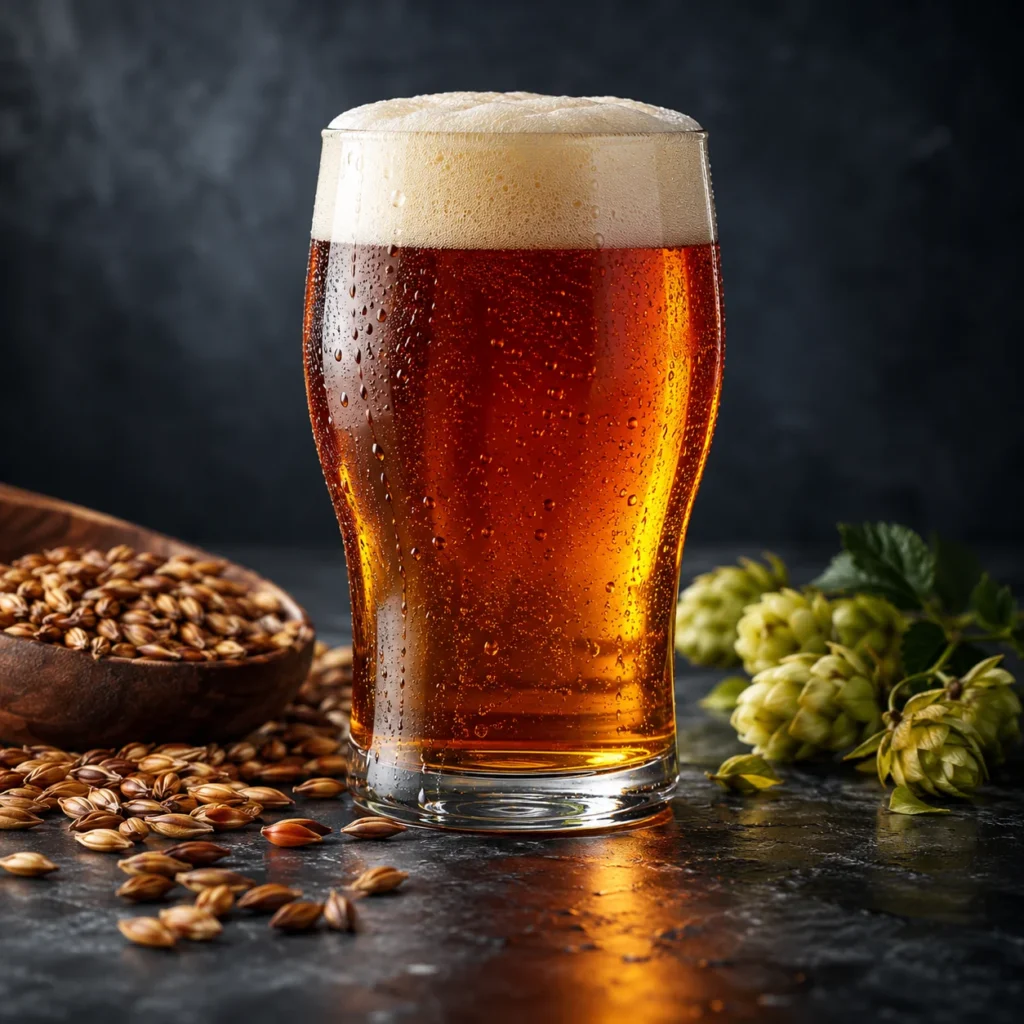
Tattooist Craft Beer / Original Recipe Series
Amber Heritage
VIENNA LAGER
A beautifully balanced amber lager with rich Vienna malt character, delicate toasted bread notes, restrained noble hops and a clean, refreshing finish. A classic brewing tradition interpreted through a carefully designed modern recipe.
A legacy of malt, balance and patience.
Amber Heritage – Vienna Lager Recipe (25 L / 6.6 Gal)
Some beers demand attention through powerful hop aromas or intense roasted flavors. Others achieve something more subtle: a remarkable balance between malt character, bitterness, fermentation, and drinkability.
Amber Heritage belongs to the second category.
This original Vienna Lager recipe celebrates the elegant, malt-forward brewing tradition associated with Vienna-style amber lagers. Its character is built around freshly baked bread, gentle toast, subtle malt sweetness, and a clean finish that invites another sip.
The intention is not to create a heavy Märzen, a sweet caramel lager, or a dark, roasted beer. Instead, we want a classic amber lager with an unmistakable Vienna malt identity and just enough bitterness to maintain balance.
The recipe produces approximately 25 liters (6.6 US gallons) of wort into the fermenter and is designed around an assumed 75% brewhouse efficiency.
All specifications are calculated brewing targets. Actual results will depend on the malts, hops, brewing system, yeast performance, and fermentation management.
What Makes a Great Vienna Lager?
Vienna Lager originated in nineteenth-century Austria, where amber malts and evolving lager brewing techniques helped establish a distinctive continental beer style.
Today, the best examples remain recognizable for their restrained complexity.
A well-made Vienna Lager should display a light reddish-amber to copper appearance, a persistent off-white head, and a smooth malt profile with notes of toasted bread and gentle grain richness.
The bitterness should be sufficient to prevent excessive sweetness, while the hop aroma should remain subtle.
Most importantly, the beer should finish relatively dry despite its pronounced malt character.
Unlike a heavily caramelized amber ale, Vienna Lager develops much of its flavor through carefully chosen base malts.
That distinction is central to Amber Heritage.
We use Vienna Malt as the dominant ingredient, Munich Malt for additional bread-like complexity, a small amount of Pilsner Malt, and a restrained addition of Caramunich III to support the desired color.
The result is intended to be characterful without becoming heavy.
Beer Profile: Amber Heritage
| Beer Parameter | Recipe Target |
|---|---|
| Style | Vienna Lager |
| Batch Volume | 25 L / 6.6 US gal |
| Original Gravity | 1.050–1.052 |
| Final Gravity | 1.011–1.013 |
| Alcohol | ~5.1% ABV |
| Bitterness | ~24 IBU |
| Color | ~18–22 EBC / 9–11 SRM |
| Boil Time | 60 minutes |
| Assumed Efficiency | 75% |
| Carbonation | 2.4–2.5 volumes CO₂ |
The recipe is designed within the traditional Vienna Lager style range.
Its estimated original gravity is approximately 1.050–1.052, with an anticipated final gravity of 1.011–1.013.
Depending on the actual fermentation result, this should produce approximately 5.0–5.3% ABV, with a central target around 5.1%.
The expected bitterness is approximately 23–26 IBU, and the intended color is around 18–22 EBC (9–11 SRM).
This profile should yield a moderate-strength amber lager with a soft malt richness, balanced bitterness, and a refreshing finish.
Expected Appearance, Aroma, and Flavor
Appearance: Deep golden-amber to copper, with excellent clarity after cold conditioning and a dense, off-white foam head.
Aroma: Fresh bread crust, gentle toasted malt, a subtle nutty impression, and restrained floral or herbal hop notes.
Flavor: Vienna malt leads the palate, supported by Munich malt richness and moderate bitterness. Sweetness should be subtle rather than dominant.
Mouthfeel: Medium-light to medium body, smooth texture, and moderate carbonation.
Finish: Clean, balanced, slightly dry, and inviting.
A successful Amber Heritage should be flavorful enough to enjoy slowly but refreshing enough to make a second glass appealing.
1. Designing the Malt Bill
| Fermentable | Amount | Share |
|---|---|---|
| Vienna Malt | 3.95 kg / 8.71 lb | 74.5% |
| Munich II Malt | 0.95 kg / 2.09 lb | 17.9% |
| Pilsner Malt | 0.25 kg / 0.55 lb | 4.7% |
| Caramunich III | 0.15 kg / 0.33 lb | 2.8% |
| Total | 5.30 kg / 11.68 lb | 100% |
| Hop | Amount | Timing |
|---|---|---|
| Tettnanger · 4.5% AA | 50 g / 1.76 oz | 60 min |
| Tettnanger · 4.5% AA | 15 g / 0.53 oz | 10 min |
| Total | 65 g / 2.29 oz | ~24 IBU |
The grain bill is the most important part of this Vienna Lager recipe.
Rather than combining numerous specialty malts, we build complexity through a deliberate combination of a few ingredients.
Vienna Malt – The Foundation
Vienna Malt accounts for most of the grain bill.
It delivers a warm, bread-like flavor with delicate toasted characteristics and a distinctive amber-gold contribution.
A Vienna Lager should taste like malt rather than caramel syrup, and Vienna Malt makes that possible.
Munich II Malt – Toasted Depth
A controlled addition of Munich II increases malt intensity and introduces deeper bread-crust notes.
Munich II can contribute considerable richness, so it must remain subordinate to the Vienna Malt.
Too much can make the beer feel closer to a stronger, heavier amber lager.
Pilsner Malt – Fermentable Balance
A small quantity of Pilsner Malt adds a light grainy foundation while helping maintain a relatively clean malt profile.
It is not necessary to dominate the recipe with Pilsner Malt, because doing so would reduce the distinctiveness of the Vienna character.
Caramunich III – Color Adjustment
Caramunich III is included at a low percentage.
Its purpose is to help develop the amber color and contribute a subtle layer of malt complexity.
This is not intended to become a caramel-heavy recipe. Because Caramunich III varies by maltster and batch, its exact influence should be checked using the malt’s actual color specification.
The complete grain bill is shown in the table below.
For readers interested in understanding how base and specialty malts influence recipes, our guide to building a malt bill explains the underlying principles in more detail.
2. Noble Hops: Balance Without Dominance
Unlike an American IPA, Vienna Lager does not need large late-hop additions or dry hopping.
The hops have a supporting role.
For Amber Heritage, the primary variety is Tettnanger, a traditional continental hop known for its gentle herbal, spicy, and floral characteristics.
Most of the bitterness comes from the 60-minute addition.
A smaller addition near the end of the boil contributes a restrained layer of hop flavor.
The expected bitterness is around 23–26 IBU, depending on the actual alpha-acid content, boil gravity, and utilization.
The recipe assumes Tettnanger at approximately 4.5% alpha acids.
If your hops contain more or less alpha acid, adjust the quantity to preserve the intended bitterness.
Why Not Add More Hops?
Vienna Lager is primarily a malt-driven style.
Excessive late hopping could obscure the characteristic toasted-grain profile and pull the beer toward a different interpretation.
We want enough bitterness to finish cleanly, not a beer dominated by hop aroma.
For a deeper explanation of how addition timing changes bitterness and aroma, see our hop addition timing guide.
3. Brewing Water for Vienna Lager
| Mineral / Addition | Target / Amount |
|---|---|
| Total RO Water | 35 L / 9.25 US gal |
| Mash Water | 21 L / 5.55 US gal |
| Sparge Water | 14 L / 3.70 US gal |
| Gypsum (CaSO₄·2H₂O) | 4.0 g total |
| Calcium Chloride (CaCl₂·2H₂O) | 7.0 g total |
| Calcium (Ca) | ~56 mg/L |
| Chloride (Cl) | ~69 mg/L |
| Sulfate (SO₄) | ~27 mg/L |
| Suggested Room-Temp Mash pH | 5.3–5.4 |
| Mash Step | Temperature | Duration |
|---|---|---|
| Single-Infusion Mash | 66°C / 151°F | 60 min |
| Optional Mash-Out | 76°C / 169°F | 10 min |
| Sparge | 76–77°C / 169–171°F | As required |
The water profile should support the malt rather than sharpen the bitterness excessively.
For this recipe, we favor a chloride-forward profile with moderate calcium and relatively low sulfate.
This encourages a rounded perception of malt flavor while preserving the clean finish expected from a well-made lager.
Option A: Reverse Osmosis Water
RO water provides a useful low-mineral starting point.
For approximately 35 liters (9.25 US gallons) of low-mineral water, the suggested additions are:
- Calcium Chloride Dihydrate (CaCl₂·2H₂O): 7 g total
- Gypsum (CaSO₄·2H₂O): 4 g total
Assuming negligible minerals in the starting water, these additions yield an approximate profile of:
- Calcium: 55–56 mg/L
- Chloride: 68–69 mg/L
- Sulfate: 27 mg/L
The resulting balance is intentionally different from a West Coast IPA.
Chloride takes the lead, supporting the malt-rich character, while sulfate remains restrained.
These additions assume the specified hydrated salt forms. Other products require different quantities.
The mineral additions do not automatically guarantee the correct mash pH.
Aim for a room-temperature mash pH around 5.3–5.4, measuring a cooled sample with a calibrated meter.
Only add brewing acid when the water composition and measured or predicted mash pH justify it.
Option B: Tap, Well, or Spring Water
If you brew with local tap water, well water, or spring water, the first step is understanding its mineral composition.
Pay particular attention to calcium, magnesium, sodium, sulfate, chloride, and bicarbonate or alkalinity.
Do not add the full RO-water salt quantities to mineral-rich water without recalculating.
Our Brewing Water Calculator allows you to enter your own source-water values and compare them with a target brewing profile.
You can also explore our chloride versus sulfate guide to understand how these minerals affect perceived balance.
Water treatment should refine the beer, not overwhelm it.
4. Mash Schedule: Developing Malt Flavor and Fermentability
Amber Heritage uses a simple, repeatable mash schedule.
Mash at 66°C (151°F) for 60 minutes.
This temperature provides a reasonable balance between fermentability and malt-supported body.
The yeast and fermentation conditions will ultimately determine the actual final gravity.
An optional mash-out at 76°C (169°F) for 10 minutes can be used if appropriate for your equipment.
Sparge at approximately 76–77°C (169–171°F), while keeping an eye on the actual wort and mash conditions.
Should Vienna Lager Use a Step Mash?
A step mash or decoction can be used for traditional brewing experiments, but neither is a requirement for producing an excellent Vienna Lager from modern, well-modified malts.
A single-infusion mash is easier to reproduce and is a sensible starting point for this recipe.
Once the base recipe has been brewed and evaluated, a more traditional mashing schedule can become a separate experiment.
Consistency is more valuable than complexity during the first batch.
5. Boil, Hop Additions, and Chilling
Boil the wort for 60 minutes, adding Tettnanger at the beginning and again during the final 10 minutes.
Maintain a controlled boil rather than an unnecessarily violent one.
The intensity of the boil affects evaporation, final gravity, and hop utilization.
Measure the actual pre-boil and post-boil volumes to refine your brewing system profile.
After the boil, chill the wort promptly to your yeast’s intended pitching temperature.
The target is approximately 25 liters into the fermenter, accounting for normal wort losses.
Because the recipe contains Pilsner Malt, pay attention to proper wort boiling and good fermentation management. Extending the boil may be reasonable if malt specifications or your system indicate that it is necessary; the water volumes would then need recalculation.
6. Choosing the Right Lager Yeast
For Amber Heritage, the preferred yeast is LalBrew NovaLager.
It is a practical modern lager yeast that can produce a clean fermentation profile while offering useful temperature flexibility.
A traditional alternative is SafLager W-34/70.
Our primary recipe is designed around NovaLager, rather than mixing strains or changing yeast during fermentation.
For a 25-liter batch, approximately 20 g of dry NovaLager is an appropriate planning amount within the manufacturer’s published dosage range for typical wort, assuming fresh, properly stored yeast.
A larger pitch may be preferable under more demanding fermentation conditions.
Fermentation Temperature
Start at approximately 14–16°C (57–61°F), with the beer temperature carefully controlled.
Maintain steady conditions during active fermentation.
As gravity approaches the expected final value, a gradual increase toward 18–19°C (64–66°F) can help the yeast complete fermentation and reduce remaining diacetyl.
Do not rely on a fixed fermentation calendar alone.
Check gravity, allow the yeast to finish its work, and confirm the gravity is stable.
Depending on yeast health, pitching rate, oxygenation, and temperature, the main fermentation may take approximately 7–12 days, sometimes longer.
What About Pressure Fermentation?
NovaLager can also be used in pressure-capable systems, but pressure is not required for this recipe.
For the first batch, a controlled, conventional fermentation is preferable because it provides a straightforward reference for subsequent experiments.
If pressure fermentation is used, remember that carbonation pressure, fermentation temperature, and vessel safety limits all affect the process.
Always follow your fermenter’s rated pressure and pressure-relief requirements.
7. Cold Conditioning: Where Vienna Lager Comes Together
Vienna Lager benefits from cold conditioning.
Once fermentation has finished, gradually cool the beer and hold it around 1–3°C (34–37°F).
For Amber Heritage, a conditioning period of approximately 3–5 weeks is an excellent initial target.
This gives yeast and suspended particles time to settle and allows the flavor profile to develop a smoother impression.
The exact conditioning time is not a guarantee of clarity, but cold storage can significantly improve the beer’s presentation.
A successful Vienna Lager should be bright and visually inviting.
Avoid unnecessary oxygen exposure when transferring the beer.
Closed transfers into a purged keg are especially useful when suitable equipment is available.
8. Carbonation and Packaging
Target approximately 2.4–2.5 volumes of CO₂.
This provides enough carbonation to keep the beer crisp and lively without making the mouthfeel unnecessarily aggressive.
For kegging, use a carbonation pressure appropriate for the measured beer temperature and desired CO₂ level.
For bottling, calculate priming sugar from the actual packaged volume, the beer’s relevant temperature history, and the desired carbonation.
Our Priming Sugar Calculator can help with bottle-conditioning quantities.
Never bottle a beer before gravity has stabilized.
Once carbonated and properly conditioned, serve the lager cool, ideally around 5–7°C (41–45°F), adjusting according to preference.
A slightly warmer serving temperature than ice-cold lager can help reveal the malt character.
9. What Should the Finished Amber Heritage Taste Like?
Imagine a clear amber lager with subtle copper reflections, a creamy white head, and a gentle aroma of fresh bread and toasted malt.
The first sip introduces the Vienna Malt, followed by a slightly richer Munich malt character.
A moderate, elegant bitterness prevents the beer from becoming sweet or heavy.
The finish remains clean, restrained, and satisfying.
This is the sort of beer that rewards careful ingredients and patient fermentation rather than elaborate additions.
If the First Batch Is Too Sweet
Check the actual final gravity, mash temperature, attenuation, and malt composition.
Do not immediately increase the bitterness without first understanding whether the sweetness is a fermentation issue or a recipe balance issue.
If the Beer Is Too Dark or Caramel-Heavy
Reduce the Caramunich III addition in the next batch, or reconsider its malt color specification.
A Vienna Lager should not taste roasted or dominated by caramel.
If the Malt Character Is Too Weak
Confirm the quality and proportions of Vienna and Munich Malt.
Small recipe refinements are preferable to adding several new specialty malts at once.
If the Beer Remains Hazy
Check fermentation completion, yeast settling, cold-conditioning time, and possible sources of permanent haze.
Lager clarity can require time and consistent cold storage.
10. Brewing Amber Heritage as a Repeatable Recipe
The first brew should be treated as a baseline.
Measure the actual pre-boil volume, gravity, original gravity, final gravity, mash pH, fermentation conditions, and packaged volume.
Record the malt flavor, bitterness, sweetness, clarity, and head retention.
If the result is close to your target, change only one or two variables during the next brew.
The purpose is to develop a reliable house Vienna Lager that can be reproduced with confidence.
Amber Heritage is an original recipe concept designed for balance, malt depth, and refreshing drinkability. It has not yet been independently brewed or tested.
The complete brewing measurements and ingredient schedule can be placed in the printable recipe card at the end of the article.
A legacy of malt, balance and patience.
Tattooist Craft Beer · Recipe Card
Amber Heritage
Vienna Lager · All-Grain · 25 L
| Malt | Amount | Percent |
|---|---|---|
| Vienna Malt | 3.95 kg / 8.71 lb | 74.5% |
| Munich II Malt | 0.95 kg / 2.09 lb | 17.9% |
| Pilsner Malt | 0.25 kg / 0.55 lb | 4.7% |
| Caramunich III | 0.15 kg / 0.33 lb | 2.8% |
| Total | 5.30 kg / 11.68 lb | 100% |
| Total brewing water | 35 L / 9.25 US gal |
| Mash water | 21 L |
| Sparge water | 14 L |
| Expected pre-boil volume | 29.7 L |
| Expected post-boil volume | 26.0 L |
| Into fermenter | 25 L |
| RO Water Salts | Mash | Sparge |
|---|---|---|
| Gypsum (CaSO₄·2H₂O) | 2.4 g | 1.6 g |
| Calcium Chloride (CaCl₂·2H₂O) | 4.2 g | 2.8 g |
| Step | Temperature | Time |
|---|---|---|
| Single infusion | 66°C / 151°F | 60 min |
| Optional mash-out | 76°C / 169°F | 10 min |
| Sparge | 76–77°C / 169–171°F | As required |
| Hop | Amount | Timing |
|---|---|---|
| Tettnanger · 4.5% AA | 50 g / 1.76 oz | 60 min |
| Tettnanger · 4.5% AA | 15 g / 0.53 oz | 10 min |
| Yeast | LalBrew NovaLager or suitable lager yeast |
| Pitch | Approximately 20 g; verify manufacturer guidance |
| Main fermentation | 14–16°C / 57–61°F |
| Finishing stage | 18–19°C / 64–66°F |
| Diacetyl rest | 18–19°C / 64–66°F as fermentation slows |
| Cold conditioning (lagering) | 1–3°C / 34–37°F, approximately 3–5 weeks after stable gravity |
| Carbonation | 2.4–2.5 volumes CO₂ |
- Prepare 35 L of brewing water; add salts calculated for RO water.
- Mash at 66°C / 151°F for 60 minutes.
- Measure mash pH using a cooled sample; adjust only if needed.
- Optionally mash out at 76°C / 169°F for 10 minutes.
- Sparge and collect approximately 29.7 L pre-boil wort.
- Record pre-boil gravity and volume.
- Boil for 60 minutes; add Tettnanger at 60 and 10 minutes remaining.
- Chill promptly to 14–16°C / 57–61°F.
- Transfer about 25 L to the fermenter and measure OG.
- Pitch approximately 20 g NovaLager; control beer temperature.
- Ferment at 14–16°C; raise toward 18–19°C as fermentation slows.
- Confirm stable FG and completion of fermentation.
- Gradually cool and lager at 1–3°C / 34–37°F for 3–5 weeks.
- Package with minimal oxygen exposure; carbonate to 2.4–2.5 vol CO₂.