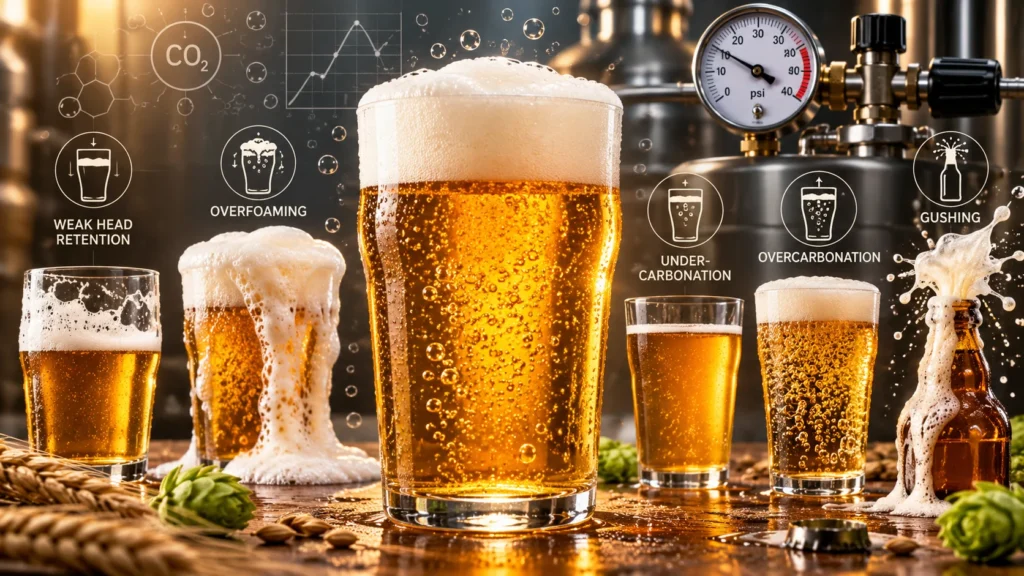
Beer foam and carbonation are closely connected, but they are not the same thing.
A beer can be highly carbonated and still have poor head retention. Another beer can develop a large, attractive foam head but collapse within seconds. Excessive foaming can originate from too much dissolved CO₂, an unbalanced draft system, warm beer, nucleation sites, microbial activity or suspended particles.
And gushing — the sudden uncontrolled eruption of foam when a bottle or can is opened — is not simply another name for overcarbonation.
Understanding beer foam therefore requires separating several different phenomena:
- foam formation — how easily a head forms;
- foam stability — how long the head remains;
- carbonation level — how much CO₂ is dissolved in the beer;
- foam texture — bubble size, density and creaminess;
- overfoaming — excessive foam during pouring;
- gushing — uncontrolled foam release immediately after opening.
Good foam depends on the interaction between proteins, hop compounds, carbonation, fermentation, alcohol, lipids, glass cleanliness, temperature and serving conditions.
This guide explains the science behind beer foam and carbonation, how to diagnose weak head retention, undercarbonation, overcarbonation and gushing, and how to correct the process rather than simply treating the symptom.
1. Foam and Carbonation Are Related but Different
Carbon dioxide provides the gas required to create bubbles.
But CO₂ alone does not create stable beer foam.
For a persistent foam head, the beer also needs compounds that can form and stabilize the thin liquid films surrounding each bubble.
Important foam-active components include:
- hydrophobic polypeptides and proteins;
- hop-derived iso-alpha acids;
- certain malt-derived compounds;
- appropriate carbonation;
- suitable beer viscosity.
Foam can be damaged by:
- oils and fats;
- detergent residues;
- certain lipids;
- excessive alcohol;
- proteolytic degradation;
- dirty or poorly rinsed glassware.
A useful principle is:
carbonation creates the bubbles; beer chemistry determines whether those bubbles survive.
2. Quick Beer Foam and Carbonation Diagnostic Guide
3. How Beer Foam Forms
Foam forms when dissolved gas leaves the beer and creates bubbles.
CO₂ is held in beer under pressure.
When the pressure decreases — for example when:
- a bottle is opened;
- a keg faucet is opened;
- beer is poured into a glass;
the equilibrium changes.
Some dissolved CO₂ begins to escape.
However, gas bubbles do not normally appear everywhere at the same time.
They preferentially form at nucleation sites.
These may include:
- microscopic scratches in glass;
- fibers;
- dust;
- hop particles;
- yeast;
- mineral crystals;
- deliberately etched nucleation points in beer glasses.
Once a bubble begins to form, CO₂ diffuses into it from the surrounding beer.
The bubble grows and rises.
When many bubbles accumulate at the top of the beer, a foam head forms.
4. Why Beer Foam Does Not Immediately Collapse
A bubble consists of gas surrounded by a thin liquid film.
Pure water cannot maintain stable foam very effectively.
Beer can because it contains surface-active compounds capable of accumulating at the gas–liquid interface.
Important foam-positive compounds include certain:
- polypeptides;
- proteins;
- hop-derived bitter compounds.
These compounds form a stabilizing layer around bubbles.
A particularly important interaction occurs between hydrophobic polypeptides and iso-alpha acids.
Together they help strengthen the bubble wall and improve foam persistence.
This explains why foam quality depends on much more than carbonation.
5. Foam Formation vs Foam Retention
These are often confused.
Foam formation
This describes how easily foam is created.
It is strongly affected by:
- carbonation;
- pouring technique;
- temperature;
- nucleation.
Foam retention
This describes how long the foam remains after formation.
It depends much more strongly on:
- foam-active proteins;
- hop compounds;
- lipids;
- alcohol;
- glass cleanliness;
- beer composition.
A highly carbonated beer may create a huge initial head and still lose it almost immediately.
A moderately carbonated beer with excellent foam-active chemistry may form a smaller but much more persistent head.
Foam Formation vs Foam Stability
6. What Is a “Volume” of CO₂?
Carbonation is commonly expressed in volumes of CO₂.
One volume means approximately:
1 liter of CO₂ gas dissolved in 1 liter of beer
when the gas volume is referenced to standard conditions.
In mass terms:
1 volume of CO₂ ≈ 1.96–1.98 g/L dissolved CO₂
depending on the exact reference conditions.
This means that beer at:
2.5 volumes CO₂
contains roughly:
2.5 × 1.97 ≈ 4.9 g/L CO₂
This unit is convenient because it allows carbonation levels to be compared across different beer styles.
7. Typical Carbonation Levels by Beer Style
The values below are practical ranges rather than absolute legal or stylistic limits.
8. Residual CO₂ Before Packaging
Beer already contains CO₂ before priming sugar or force carbonation is applied.
During fermentation, yeast produces CO₂.
Some escapes through the airlock or spunding system, while some remains dissolved.
The amount retained depends strongly on:
- temperature;
- pressure;
- fermentation history.
Colder beer retains more CO₂.
Approximate residual carbonation values for normally fermented, unpressurized beer are:
A common mistake is to treat a beer that was cold crashed under pressure as if it contained the same residual CO₂ as an atmospheric fermentation.
It may not.
If the beer fermented or conditioned under pressure, the existing carbonation must be estimated from the actual:
temperature + pressure history.
9. Bottle Priming: The Basic Calculation
Bottle conditioning uses a controlled amount of fermentable sugar.
Yeast converts that sugar into:
- ethanol;
- CO₂.
Because the bottle is sealed, the CO₂ cannot escape and dissolves into the beer.
The basic logic is:
additional CO₂ required = target carbonation − residual carbonation
Then calculate how much priming sugar is required to produce that additional CO₂.
10. Priming Sugar Formula
For practical homebrewing calculations:
Dextrose monohydrate
Priming sugar (g) ≈
beer volume (L) × required additional CO₂ volumes × 4.45
Sucrose
Priming sugar (g) ≈
beer volume (L) × required additional CO₂ volumes × 3.84
These factors are based on fermentation stoichiometry and the amount of CO₂ produced from each sugar.
Dextrose sold for brewing is often dextrose monohydrate, but product form should be checked because anhydrous glucose has a different molecular mass.
11. Example: Priming a 25 L Pale Ale
Assume:
- beer volume: 25 L;
- maximum post-fermentation temperature: 20°C;
- residual carbonation: approximately 0.85 volumes;
- target carbonation: 2.50 volumes.
Step 1 – Additional carbonation required
2.50 − 0.85 = 1.65 volumes
Step 2 – Dextrose monohydrate
25 × 1.65 × 4.45 = 183.6 g
Rounded:
≈ 184 g dextrose monohydrate
Step 3 – If using sucrose instead
25 × 1.65 × 3.84 = 158.4 g
Rounded:
≈ 158 g sucrose
This is a theoretical calculation.
Real carbonation may differ slightly because of:
- sugar purity;
- measurement error;
- actual beer volume;
- residual CO₂ estimation;
- yeast condition;
- package leakage.
12. Why Bottles Become Undercarbonated
Common causes include:
- insufficient priming sugar;
- incorrect beer-volume estimate;
- poor sugar mixing;
- bottle-cap leakage;
- exhausted or very low yeast population;
- insufficient conditioning time;
- conditioning temperature too low;
- inaccurate residual-CO₂ assumption.
High-alcohol beers can take considerably longer to carbonate because the yeast is working under more stressful conditions.
A beer that is flat after five days is not necessarily defective.
Bottle conditioning often requires:
several weeks, depending on yeast, beer strength and temperature.
13. Why Bottles Become Overcarbonated
Overcarbonation is potentially more serious because pressure continues to increase inside a sealed package.
Common causes include:
- too much priming sugar;
- packaging before fermentation was complete;
- incorrect batch-volume calculation;
- uneven priming sugar distribution;
- renewed fermentation from hop creep;
- microbial contamination;
- addition of fermentable fruit or sugar without recalculation.
The most dangerous assumption is:
“The airlock stopped, therefore fermentation is complete.”
Airlock activity is not a reliable measurement of attenuation.
Stable gravity is much more meaningful.
14. Hop Creep and Unexpected Carbonation
Dry hopping can sometimes cause renewed fermentation.
Hop material contains enzymes capable of breaking certain residual carbohydrates into smaller fermentable sugars.
If active yeast remains present:
- gravity may decrease;
- CO₂ production can restart;
- diacetyl may be produced again;
- packaged beer may become overcarbonated.
This is especially important when beer is bottled soon after a large dry-hop addition.
The safest approach is to ensure that after dry hopping:
- gravity has stabilized;
- fermentation has finished again;
- diacetyl cleanup is complete
before final packaging.
15. Force Carbonation in a Keg
Force carbonation uses external CO₂ pressure instead of priming sugar.
The amount of CO₂ dissolved at equilibrium depends mainly on:
- beer temperature;
- CO₂ pressure.
Colder beer requires less pressure to reach the same carbonation level.
This is why a keg at 2°C carbonates much more easily than a keg at room temperature.
16. Approximate Equilibrium Carbonation Pressures
The following values are approximate equilibrium settings.
For example, beer held around:
2°C and 11–12 psi
will settle near approximately:
2.6–2.7 volumes CO₂
after sufficient time.
17. Set-and-Forget vs Burst Carbonation
Set-and-forget
The regulator is set near the desired equilibrium pressure and left there.
Advantages:
- predictable;
- low risk of overshooting;
- easy to reproduce.
Disadvantage:
- requires several days to approach equilibrium.
Burst carbonation
A higher pressure is applied temporarily.
This can speed carbonation, but the result depends strongly on:
- pressure;
- temperature;
- duration;
- headspace;
- beer movement.
Shaking or rolling the keg accelerates gas absorption dramatically.
It also makes overshooting much easier.
For repeatable beer production, set-and-forget carbonation is generally easier to control.
18. Why Force-Carbonated Beer Can Still Pour Flat
A keg can contain sufficient CO₂ and still pour badly.
Possible causes:
- gas escaping in the line;
- warm serving line;
- very slow pour;
- excessive pressure drop;
- dirty glass;
- faucet problems;
- inadequate nucleation during pouring.
Perceived carbonation also depends on temperature.
The same beer can feel significantly more carbonated when cold because more CO₂ remains dissolved until it reaches the mouth.
19. Why a Keg Can Produce Mostly Foam
A foamy keg is not automatically overcarbonated.
Common causes include:
- beer too warm;
- warm faucet tower;
- short beer line;
- insufficient line resistance;
- sudden pressure drop;
- dirty faucet;
- partially blocked dip tube or poppet;
- hop particles;
- keg pressure inconsistent with carbonation level.
A draft system should be balanced so that beer loses pressure gradually between the keg and faucet.
If pressure falls too abruptly, CO₂ breaks out of solution inside the beer line.
The result is:
foam before the beer even reaches the glass.
20. Draft-System Balance
At equilibrium, keg pressure should first be selected to maintain the desired carbonation at the beer’s actual temperature.
Then the dispensing system must provide enough resistance to control flow.
Important factors include:
- beer-line internal diameter;
- line length;
- line material;
- vertical lift;
- faucet resistance;
- desired flow rate.
There is no universal statement such as:
“Use exactly X meters of beer line.”
Different line materials and internal diameters have different resistance.
Manufacturer-specific resistance data should therefore be used when balancing a system.
Draft Foam Diagnostic Table
21. Poor Foam Retention
Poor head retention occurs when foam initially forms but rapidly collapses.
This can originate from the recipe, process, glass or serving conditions.
Common causes include:
- grease or oil contamination;
- detergent residues;
- excessive lipid carryover;
- very high alcohol content;
- excessive proteolysis;
- weak foam-positive protein content;
- insufficient hop-derived foam stabilizers;
- unsuitable glassware.
22. Malt Proteins and Head Retention
Certain malt proteins and polypeptides contribute strongly to beer foam.
Foam-active proteins survive mashing, boiling and fermentation to varying degrees.
The relationship is complex because not every protein is beneficial.
Some contribute to:
- foam;
- body;
while others contribute more strongly to:
- haze;
- instability.
The goal is therefore not simply to maximize total protein.
23. Wheat and Foam
Wheat malt is frequently associated with excellent head retention.
It contains significant levels of foam-active proteins and can contribute to:
- dense foam;
- stable foam;
- increased body.
However, wheat is not mandatory for good head retention.
A well-made all-barley beer can also maintain excellent foam.
Adding wheat cannot correct problems caused by:
- grease;
- dirty glassware;
- detergent;
- severely poor fermentation;
- excessive alcohol.
24. Oats and Foam
Oats are useful for mouthfeel and body, especially in:
- stout;
- NEIPA;
- some Pale Ales.
They contain proteins and beta-glucans, but also contain more lipids than typical barley malt.
At moderate levels this is not necessarily a problem.
Very large amounts combined with poor process control can contribute to:
- excessive viscosity;
- haze;
- potentially less predictable foam behavior.
Oats should therefore be considered primarily a texture ingredient rather than a universal foam-retention additive.
25. Carapils and Dextrin Malts
Dextrin-type malts are often added because brewers want:
- more body;
- improved foam;
- greater fullness.
Their actual effect depends on the complete recipe and process.
A small addition may contribute useful foam-active material, but it cannot compensate for:
- dirty glassware;
- oil contamination;
- overcarbonation;
- poor beer-line balance.
Foam quality should be built through the entire brewing process.
26. Protein Rest and Foam
Traditional multi-step mashing may include a protein rest.
With highly modified modern malt, an unnecessarily long or aggressive protein rest can break larger proteins into smaller fractions.
This may reduce some foam-positive material.
Therefore:
more protein breakdown is not automatically better.
A protein rest should be used because the malt and recipe require it, not simply because it appears in an old mash schedule.
27. Hops and Foam Stability
Hop-derived iso-alpha acids have an important positive effect on foam.
They interact with foam-active proteins at the gas–liquid interface.
This can improve:
- foam strength;
- foam adhesion;
- lacing.
This helps explain why moderately or strongly hopped beers can often show excellent foam stability.
However, hops can also introduce:
- polyphenols;
- particles;
- plant material.
Extremely heavy dry hopping can therefore create other issues such as:
- gushing;
- rough foam;
- sediment;
- nucleation.
28. Lipids: One of Foam’s Biggest Enemies
Fats and oils destabilize foam.
Even a very small amount on a glass can cause the head to collapse rapidly.
Possible sources include:
- greasy food residue;
- lipstick;
- skin oils;
- poorly rinsed glass-cleaning products;
- fatty brewing ingredients;
- excessive lipid carryover from certain adjuncts.
This is why a beer can show excellent foam in one glass and poor foam in another.
Before changing the recipe, always test the beer in a known beer-clean glass.
29. The Beer-Clean Glass Test
A beer glass should be completely free from:
- grease;
- oil;
- detergent film;
- rinse aid;
- food residue.
A clean glass often shows characteristic lacing as the beer is consumed.
Foam adheres to the glass in rings or patches.
If bubbles cling randomly to the inner glass surface below the liquid line, contamination or nucleation sites may be present.
Proper beer glass cleaning is therefore part of foam management.
30. Alcohol and Foam
Ethanol changes surface tension and affects foam stability.
As alcohol concentration increases, maintaining persistent foam generally becomes more difficult.
This is one reason very strong beers can produce:
- large initial foam;
- comparatively rapid foam collapse.
High-gravity beer also creates additional challenges through:
- different protein balance;
- higher ester levels;
- higher alcohol;
- increased residual extract.
A barleywine should not necessarily be expected to behave like a 5% Pilsner.
31. Temperature and Foam
Warm beer releases CO₂ more easily than cold beer.
This can cause:
- aggressive foaming;
- CO₂ breakout in draft lines;
- rapid carbonation loss during pouring.
Very cold beer retains CO₂ more strongly.
Serving temperature therefore changes both:
- actual gas behavior;
- perceived carbonation.
A beer that pours perfectly at 3°C may become very foamy if the keg warms significantly.
32. What Is Gushing?
Gushing is the sudden, uncontrolled release of foam when a bottle, can or other package is opened.
The beer may erupt from the container even without being poured.
Gushing is often associated with overcarbonation, but they are not identical.
A beer can be:
overcarbonated without immediately gushing
and it can sometimes:
gush even when total carbonation is not unusually high.
The key factor is rapid nucleation and CO₂ release.
33. Common Causes of Gushing
For homebrewers, important causes include:
- excessive priming sugar;
- incomplete fermentation;
- microbial contamination;
- hop particles;
- yeast sediment;
- mineral crystals;
- disturbed sediment;
- warm beer;
- recently shaken bottles;
- excessive carbonation.
Commercial brewing also recognizes more specialized gushing mechanisms associated with malt quality and fungal-derived surface-active compounds.
For most homebrewers, however, the first investigation should focus on:
fermentation completeness, package pressure, particles and contamination.
Gushing vs Overcarbonation
34. Why Particles Promote Gushing
Bubble formation requires nucleation.
Suspended particles can provide extremely effective nucleation sites.
Examples include:
- hop fragments;
- yeast particles;
- mineral crystals;
- protein aggregates.
When the package is opened, pressure rapidly decreases.
If many nucleation sites are available, CO₂ can escape from solution at many points simultaneously.
This creates rapid foam expansion.
That is why heavily dry-hopped bottle-conditioned beer requires particularly careful sediment management.
35. Gushing After Dry Hopping
Large dry-hop additions can contribute to gushing through several mechanisms:
- hop particles provide nucleation sites;
- hop creep can restart fermentation;
- additional fermentable sugar can increase CO₂;
- sediment load increases.
This combination makes dry-hopped bottled beer especially sensitive.
Before bottling, confirm:
- stable final gravity;
- no renewed fermentation;
- adequate settling of hop material;
- correct priming calculation.
36. Microbial Overcarbonation and Gushing
Microorganisms can consume carbohydrates that the brewer’s yeast did not ferment.
This may cause:
- further attenuation;
- additional CO₂ production;
- increasing package pressure;
- progressive gushing.
Important warning signs include:
- beer becomes increasingly carbonated over time;
- flavor changes;
- acidity increases;
- gravity continues to fall;
- bottles that were initially normal become highly pressurized later.
This pattern is very different from a simple one-time priming calculation error.
37. Nitrogen and Beer Foam
Nitrogenated beer behaves differently from conventionally carbonated beer.
Nitrogen is far less soluble in beer than CO₂.
When dispensed through an appropriate restrictor faucet, nitrogen produces:
- very small bubbles;
- dense foam;
- creamy mouthfeel;
- characteristic cascading.
Nitro stout often contains less CO₂ than a conventionally carbonated lager.
Its thick head does not mean it contains more dissolved gas.
This is another demonstration that:
foam appearance and CO₂ carbonation level are not the same measurement.
38. Why Foam Can Collapse Even with Perfect Carbonation
If carbonation is correct but head retention is poor, investigate:
- glassware;
- recipe protein structure;
- oils;
- detergent;
- alcohol level;
- mashing;
- ingredient selection.
Do not automatically increase carbonation.
More CO₂ may create a larger initial head but will not necessarily solve poor foam stability.
It may simply create:
more foam that collapses just as quickly.
39. Why Increasing Carapils Is Not Always the Answer
A common homebrew response to poor foam is:
“Add more Carapils.”
Sometimes recipe adjustment can help.
But before changing the grain bill, check:
- Is the glass beer-clean?
- Is carbonation correct?
- Is the beer contaminated with oil?
- Was an unnecessary long protein rest used?
- Is alcohol very high?
- Is draft service causing violent degassing?
Only after these factors are considered should the recipe be modified.
40. Practical Troubleshooting Workflow
41. Final Troubleshooting Matrix
42. Conclusion: Good Foam Begins Long Before the Beer Reaches the Glass
Beer foam is the result of the entire brewing process.
It begins with:
- malt selection;
- mashing;
- protein management;
- hopping;
- fermentation;
- carbonation;
- packaging;
- serving.
Carbonation supplies the gas needed to create bubbles.
But persistent, attractive foam depends on the chemical structure of the beer.
A beer with poor head retention does not automatically need more carbonation.
An aggressively foaming keg is not automatically overcarbonated.
And a gushing bottle does not necessarily contain an abnormally high amount of CO₂.
Correct diagnosis requires separating:
foam formation, foam retention, carbonation level, dispensing behavior and gushing.
For bottle conditioning, accurate priming calculations require:
- actual beer volume;
- correct sugar type;
- residual CO₂ estimation;
- stable final gravity.
For kegging, stable carbonation requires matching:
temperature and equilibrium pressure.
And good draft performance requires the serving system to be balanced around that pressure rather than reducing the regulator simply because the beer pours too fast.
Strong foam retention depends on preserving useful foam-active compounds while avoiding:
- oils;
- detergents;
- unnecessary protein degradation;
- poor glass hygiene.
Gushing requires a separate diagnosis involving:
- carbonation;
- nucleation;
- suspended particles;
- hop creep;
- contamination;
- package handling.
The central principle is simple:
good foam is not created by one ingredient or one number.
It is the result of a well-balanced beer and a controlled process from mash tun to glass.