In recent years, Celtic tattoos have attracted particular interest. Knots, spirals and ornaments inspired by natural elements have brought Celtic art back to life. Because these motifs can easily be adapted into many different forms, they have become extremely popular among tattoo enthusiasts.
Perhaps no other artistic style allows such versatility in tattoo design as Celtic art. Many people wear Celtic tattoos, symbols or Celtic figures without knowing where they actually come from. This is exactly why a short introduction to this art form may be useful. Celtic styles generally originate from several different cultures that influenced one another, eventually intertwining and creating a unique form of art.
Although there is no concrete evidence that the ancient Celts wore tattoos in the modern sense of the word, ancient sources mention body painting and various forms of body decoration. Celtic and British warriors may have decorated their bodies and faces with animal and other motifs, while some groups painted their bodies blue before battle. Roman sources also described warriors with painted bodies. Some historians believe that the Celts may also have worn various permanent markings on their skin.
Body decorations could vary according to the individual and social status and could appear on the limbs as well as other parts of the body. What is certain is that these decorations could create a powerful emotional and visual effect rather than accurately depicting scenes from everyday life. The Celts revered the Sun, the Moon, the stars and the forces of nature, while also being talented poets and skilled craftsmen. Their craftsmanship can be seen in carved stone and wood, as well as in decorated metal objects. This is exactly why Celtic tattoo designs require particular attention: their motifs can be extremely complex and precise.
Celtic Tattoos
Playing with shapes can result in extraordinary works of art. Celtic tattoos generally do not attempt to portray nature or the world realistically or with absolute accuracy. This is why many people interpret these tattoos as a kind of spiritual or meditative symbolism through which a person may find inner peace and explore their own inner world.
Celtic Knots
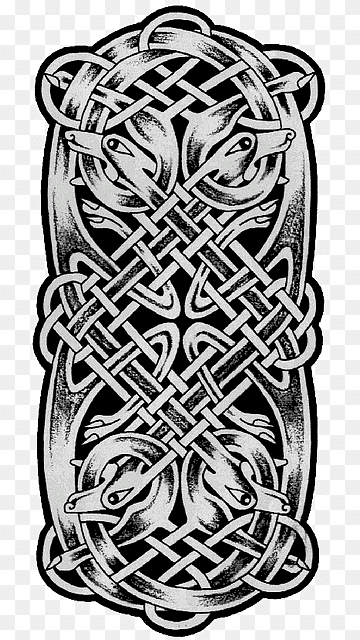
In many cases, traditional knot designs are considered complete when their interwoven lines end in a zoomorphic element or a spiral. In other cases, they may continue into legs, heads or tails.
The meaning of Celtic knots does not follow rules comparable to those of written letters, so their significance must be sought on a deeper, symbolic level. The connection between the physical and spiritual worlds is often interpreted through the meeting and intertwining of the knots. Endless lines may symbolize the cycle of life: birth, death, rebirth, love and faith.
Simpler interlaced patterns also appear, resembling woven or braided ribbons twisting around one another. These knots can be created from one or several strands. One of the best-known forms is the three-part knot, the triquetra, consisting of three outer curves joined together in an interwoven design.
The Celtic Cross
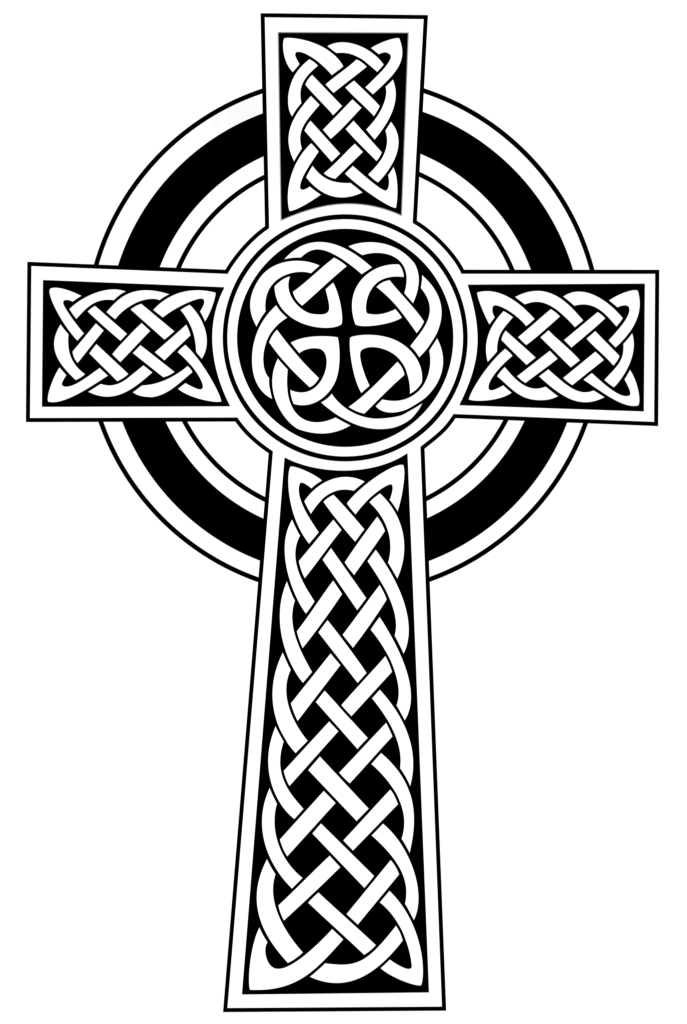
The Celtic cross is one of the best-known elements of Celtic art and one of the characteristic symbols of Irish and British Celtic culture. Although today it is primarily regarded as a Christian symbol, the visual language of the Celtic cross may combine Christian elements with motifs rooted in earlier pagan traditions.
In ancient Irish tradition, the circle can be interpreted as a symbol of eternity, completeness and the cyclical nature of existence. The four directions of the cross have also later been associated with the four cardinal directions and with important periods of the Celtic year.
The four best-known festivals of the Celtic year were Imbolc, Beltane, Lughnasadh and Samhain.
Imbolc was celebrated at the beginning of February and was associated with the approach of spring, purification and the figure of Brigid. Beltane, celebrated at the beginning of May, marked the beginning of summer and was associated with fire. Lughnasadh, at the beginning of August, was connected with the beginning of the harvest and the god Lugh. Samhain, in autumn, marked the end of the summer season and the beginning of the darker half of the year.
Today, the Celtic cross is also frequently interpreted as a symbol of eternity and infinity.
The Tree of Life
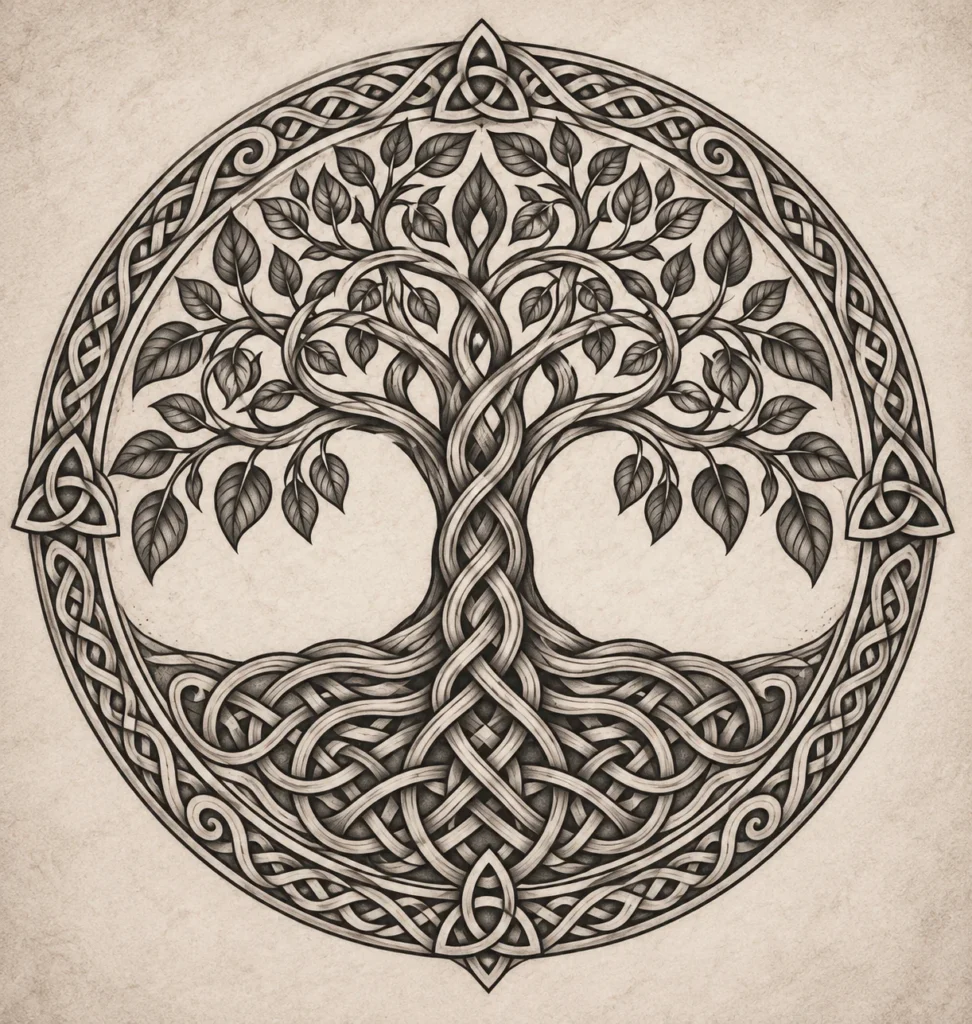
The Tree of Life is one of the most recognizable symbols in modern Celtic symbolism. Its roots reach deep into the earth while its branches stretch toward the sky, and for this reason it is often interpreted as a symbol of the connection between the earthly and spiritual worlds.
It may also symbolize the cycles of nature, life, death and rebirth, as well as the relationship between humanity and the natural world. In modern Celtic tattoos, the branches and roots of the Tree of Life are often formed from interwoven, endless knotwork.
Magical Celtic Numbers
The number three held particular significance in Celtic tradition. The triad, or a structure consisting of three elements, appears frequently in Celtic thought and symbolism. Earth, sea and sky, for example, could represent three important realms of the world.
The number five also played an important role in Irish tradition. Ireland was traditionally divided into five provinces, with the fifth representing the central province.
The number nine, being three multiplied by three, also acquired special significance and appears in numerous Celtic stories, myths and traditions.
Meanings associated with the numbers 17, 27 and 33 also appear in some later interpretations, although these are not as clearly established as historically documented Celtic symbols as the numbers three or nine.
Other Symbols
Numerous animals appear in Celtic and later Celtic-inspired symbolism. The dog is often associated with loyalty and hunting, the lion with nobility and strength, and the snake with rebirth and renewal. Birds may symbolize freedom and the spiritual world, while the salmon is one of the best-known Irish-Celtic symbols of wisdom. The bull represents strength, while the wild boar may symbolize ferocity, courage and martial power.
Modern Symbols
Among the best-known Irish symbols are the shamrock and the harp, the latter being one of Ireland’s national emblems. Scotland’s best-known plant symbol is the thistle, while the distinctive checked fabric known as tartan is closely associated with Scottish culture.
Among the best-known symbols of Wales are the red dragon, which appears on the Welsh national flag, as well as the leek and the daffodil.
A Brief History of Celtic Art
The early centres of Celtic culture developed in Central Europe. During the first millennium BC, Celtic culture spread across a vast territory stretching from Western Europe to the Balkans.
Much of what we know about Celtic history comes from Greek and Roman sources, as the Celts themselves passed down much of their history and religion through oral tradition rather than written records.
The Celts were polytheistic, and gods, heroes, supernatural beings and animals played important roles in their mythology. Druids performed religious, educational and social functions. Courage, honour, poetry and knowledge were highly valued within Celtic culture.
Because relatively few written sources of their own have survived, Celtic art is particularly important to our understanding of their culture. One of the most significant archaeological sources of early Celtic culture comes from the area around Hallstatt in present-day Austria. The main period of the Hallstatt culture dates approximately from 800 to 450 BC.
Its artefacts feature geometric patterns, decorated lines and various ornamental elements, particularly on weapons, jewellery and everyday objects.
The later La Tène culture, which developed from around 450 BC, displayed a much richer and more dynamic visual language. Curved lines, spirals, plant and animal forms and interconnected decorative elements became increasingly prominent.
Over time, circular spirals and complex forms developed in which human and animal features could sometimes be concealed. These motifs later came into contact with other cultures and influenced one another.
In the British Isles, Celtic, Anglo-Saxon and later Viking artistic traditions also came into contact. Spirals, animal motifs, snakes, dogs and birds appeared in different forms across the decorative art of several cultures.
With the spread of Christianity, earlier decorative elements acquired new meanings in Irish and British art. Interlaced patterns, spirals and animal motifs appeared in Christian manuscripts, stone crosses and other religious objects.
Manuscripts were produced on parchment – specially prepared animal skin – and decorated using a variety of natural, mineral and plant-based pigments.
One of the most famous surviving examples of this artistic tradition is the Book of Kells, produced around AD 800. Its pages contain extraordinarily intricate interlaced patterns, spirals, animal figures, geometric designs and Christian symbols.
Many of these motifs, more than a thousand years old, continue to live on today – including in the visual language of modern Celtic tattoos.