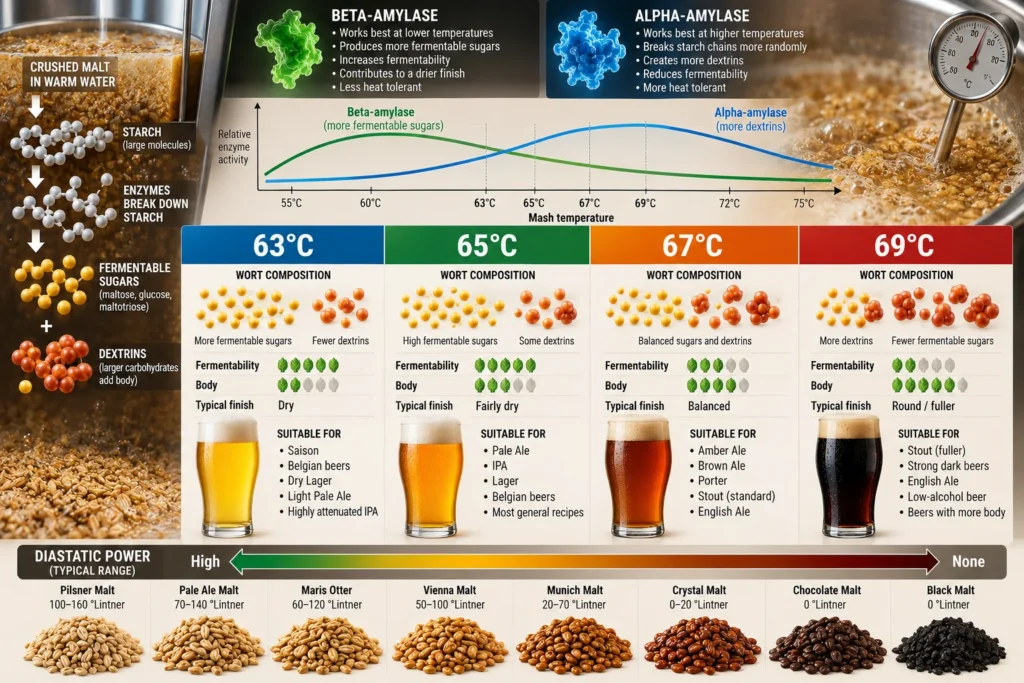
When crushed malt is mixed with warm water, one of the most important processes in brewing begins.
The starch stored inside the grain is converted into sugars.
Some of these sugars can be fermented easily by brewing yeast. Others remain in the finished beer and contribute to body and mouthfeel.
This conversion is driven primarily by enzymes naturally present in malt, and two factors are especially important:
- the diastatic power of the malt;
- the temperature of the mash.
These subjects are often discussed separately, but they are closely connected.
Diastatic power tells us whether the grain bill contains enough enzymatic potential to convert starch.
Mash temperature influences how those enzymes work and what kind of wort they produce.
Together they affect:
- starch conversion;
- fermentability;
- final gravity;
- alcohol potential;
- body;
- dryness;
- mouthfeel.
Understanding this relationship makes it much easier to design a beer intentionally instead of simply following a mash temperature written in a recipe.
What Happens During the Mash?
Malted grain contains starch.
Brewing yeast cannot efficiently ferment starch directly.
Before fermentation, that starch must be broken down into smaller carbohydrates and sugars.
During the mash, enzymes in the malt perform this job.
In simplified form:
Starch → smaller carbohydrates → fermentable sugars + dextrins
The resulting wort contains a mixture of sugars and carbohydrates.
Among the important sugars are:
- maltose;
- glucose;
- maltotriose.
The wort also contains larger dextrins that normal brewing yeast cannot completely ferment.
The balance between these compounds has an important influence on how the finished beer tastes and feels.
What Is Diastatic Power?
Diastatic power describes the enzymatic ability of malt to convert starch into smaller sugars.
A malt with high diastatic power contains enough active enzymes to convert:
- its own starch;
- and potentially starch from other grains with little or no enzymatic power.
A malt with low diastatic power may be able to convert only part of its own starch—or may contribute essentially no useful starch-converting enzymes at all.
This becomes particularly important when recipes contain large amounts of:
- specialty malt;
- unmalted grain;
- flaked grain;
- adjuncts.
The entire grain bill needs sufficient enzymatic power for efficient conversion.
Where Do the Enzymes Come From?
During malting, barley is allowed to germinate under controlled conditions.
This activates and develops enzymes that the plant would naturally use to access the energy stored in the grain.
The maltster then stops germination by drying and kilning the malt.
Some enzymes survive this process.
How many remain active depends partly on how the malt was produced and how intensely it was heated.
This creates an important general relationship:
Lightly kilned base malts usually retain more enzymatic power.
Heavily kilned, caramelized and roasted malts generally retain less—or none.
The Two Main Mash Enzymes
Several enzymes are active during mashing, but two are especially important for starch conversion:
- beta-amylase;
- alpha-amylase.
Understanding their different roles explains much of what happens when mash temperature changes.
Beta-Amylase
Beta-amylase works primarily by breaking starch chains into smaller fermentable sugars, especially maltose.
For practical brewing purposes, beta-amylase is associated with:
- higher wort fermentability;
- lower final gravity;
- a drier finish.
It performs well in the lower portion of the normal saccharification temperature range.
However, beta-amylase is relatively sensitive to higher temperatures.
As mash temperature rises, it becomes less stable and loses activity more quickly.
This is one reason lower mash temperatures generally favor a more fermentable wort.
Alpha-Amylase
Alpha-amylase works differently.
Instead of mainly working from the ends of starch chains, it can break bonds within larger starch molecules.
This rapidly creates smaller carbohydrate chains and dextrins that can then be processed further.
For practical brewing purposes, alpha-amylase is associated with:
- efficient starch breakdown;
- greater activity at somewhat higher mash temperatures;
- wort containing more larger carbohydrates when higher temperatures dominate.
Alpha-amylase is more heat tolerant than beta-amylase.
This helps explain why warmer mash temperatures tend to produce a less fermentable wort.
Alpha-Amylase and Beta-Amylase Work Together
It would be misleading to imagine that only one enzyme works at one temperature and the other suddenly starts at another.
Their activity ranges overlap.
During a normal mash, both enzymes may be active simultaneously.
The mash temperature changes the balance of their activity and stability.
Therefore:
63°C does not mean “only beta-amylase.”
and:
69°C does not mean “only alpha-amylase.”
Brewing is more gradual than that.
Temperature shifts the balance.
Mash Temperature Is Not an On/Off Switch
Mash temperature is often presented too simply:
Low temperature = dry beer
High temperature = sweet beer
There is some truth behind this, but the real process is more complex.
Mash temperature influences:
- enzyme activity;
- enzyme stability;
- conversion speed;
- wort fermentability;
- carbohydrate composition.
The effect is gradual.
Moving from:
65°C to 66°C
does not suddenly create a completely different wort.
But moving from:
63°C to 69°C
can produce a meaningful difference.
63°C Mash Temperature
A mash around 63°C strongly favors the conditions in which beta-amylase can remain active.
The resulting wort generally has high fermentability.
Typical effects may include:
- lower final gravity;
- drier finish;
- lighter body;
- high attenuation potential.
This can be useful for beers where a crisp or dry finish is desirable.
Examples may include:
- Saison;
- some Belgian beers;
- dry Lager;
- highly attenuated IPA;
- strong beers where excessive residual body would become heavy.
However, conversion may take somewhat longer than at warmer mash temperatures.
A low mash temperature is therefore often combined with sufficient mash time.
65°C Mash Temperature
Around 65°C is an extremely useful mash temperature.
It still favors good fermentability while allowing strong overall enzymatic activity.
Typical results:
- good attenuation;
- relatively dry finish;
- moderate body;
- efficient conversion.
This temperature works very well for many:
- Pale Ales;
- IPAs;
- Lagers;
- Belgian beers;
- general-purpose recipes.
If you want a beer that finishes relatively clean and dry without becoming excessively thin, 65°C is an excellent starting point.
67°C Mash Temperature
Around 67°C provides a very useful middle ground.
Compared with 63–65°C, the wort will generally be somewhat less fermentable.
Typical effects:
- moderate attenuation;
- slightly higher final gravity;
- more body;
- rounder mouthfeel.
This makes 67°C useful for many:
- Amber Ales;
- Brown Ales;
- Porters;
- Stouts;
- English Ales;
- malt-forward beers.
It is also a very safe general-purpose mash temperature when neither extreme dryness nor strong fullness is desired.
69°C Mash Temperature
At approximately 69°C, beta-amylase loses activity relatively quickly while alpha-amylase remains more effective.
The wort therefore tends to contain a greater proportion of larger carbohydrates and dextrins.
Typical effects:
- lower fermentability;
- higher final gravity;
- fuller body;
- rounder mouthfeel.
This may be useful for beers where significant body is desired.
Examples can include:
- some Stouts;
- strong dark beers;
- certain English Ales;
- low-alcohol beers where additional body is needed.
But higher mash temperature should be used intentionally.
A beer mashed too warm can finish heavier than expected.
63°C vs 65°C vs 67°C vs 69°C
A practical comparison:
| Mash Temperature | Fermentability | Expected Body | Typical Finish |
| 63°C | Very high | Light | Dry |
| 65°C | High | Light–medium | Clean / fairly dry |
| 67°C | Medium | Medium | Balanced |
| 69°C | Lower | Medium–full | Round / fuller |
These are tendencies, not guarantees.
Final beer character also depends on:
- yeast strain;
- original gravity;
- grain bill;
- mash duration;
- mash pH;
- fermentation conditions.
Mash Temperature Does Not Directly Determine Final Gravity
It is tempting to think:
63°C = FG 1.008
and:
69°C = FG 1.014
Brewing does not work that precisely.
Final gravity also depends heavily on the yeast.
A highly attenuative yeast may still produce a relatively low FG from a warmer mash.
A low-attenuating yeast may leave significant residual extract even after a cooler mash.
Therefore:
Mash temperature controls wort fermentability. Yeast determines how much of that wort it can actually ferment.
The two must be considered together.
Mash Temperature Does Not Directly Control Sweetness
A higher mash temperature can increase residual extract and body.
But that does not automatically mean the beer will taste obviously sweet.
Perceived sweetness also depends on:
- malt character;
- bitterness;
- alcohol;
- carbonation;
- acidity;
- yeast;
- final gravity.
Likewise, a dry beer can still taste strongly malty.
Body, maltiness, final gravity and sweetness are related, but they are not the same thing.
What Is Fermentability?
Fermentability describes how much of the wort extract can be consumed by yeast.
A highly fermentable wort contains a larger proportion of sugars that normal brewing yeast can use.
This generally allows:
- higher attenuation;
- lower final gravity;
- a drier beer.
A less fermentable wort contains a larger proportion of carbohydrates that yeast cannot completely consume.
This generally produces:
- higher final gravity;
- greater fullness;
- more residual body.
Mash temperature is one important way to influence this balance.
Diastatic Power and Fermentability Are Not the Same Thing
These two concepts are sometimes confused.
Diastatic power describes the enzyme potential of the malt.
Fermentability describes how much of the resulting wort can be fermented by yeast.
A grain bill can have plenty of diastatic power and still produce a less fermentable wort if mashed at a relatively high temperature.
Likewise, a mash at a low temperature cannot work properly if the grain bill does not contain enough enzymes to convert its starch.
You need both:
sufficient enzymatic power + appropriate mash conditions.
How Is Diastatic Power Measured?
Two systems are commonly encountered.
Degrees Lintner
Commonly used in North America.
Usually written as:
°Lintner
or:
°L
Do not confuse this with degrees Lovibond, which also uses an L in malt color descriptions.
They measure completely different things.
Windisch-Kolbach
Commonly encountered in European specifications.
Usually written:
WK
The two systems describe enzymatic power using different scales.
Lintner and Windisch-Kolbach Conversion
A commonly used approximate conversion is:
°Lintner = (WK + 16) ÷ 3.5
and:
WK = (°Lintner × 3.5) − 16
For most homebrewers, memorizing the formula is unnecessary.
What matters more is understanding whether the malt has:
- high;
- moderate;
- low;
- essentially no
diastatic power.
Typical Diastatic Power of Base Malts
Exact values vary significantly by maltster and barley variety.
Very broadly:
| Malt Type | Typical Diastatic Character |
| Pilsner Malt | High |
| Pale / Two-Row Malt | High |
| Pale Ale Malt | Moderate–high |
| Maris Otter | Moderate |
| Golden Promise | Moderate |
| Vienna Malt | Moderate |
| Munich Malt | Low–moderate |
| Dark Munich Malt | Low |
| Crystal / Caramel Malt | Essentially none |
| Roasted Malt | None |
Always check the maltster’s specification if enzyme capacity matters to the recipe.
Why Pilsner Malt Usually Has Strong Enzymatic Power
Pilsner Malt receives relatively gentle kilning.
This preserves a large amount of its enzymatic activity.
Therefore, Pilsner Malt usually has enough power to convert itself easily and can often help convert additional enzymatically weak ingredients.
This makes it useful not only because of its:
- pale color;
- clean flavor;
but also because of its strong enzymatic potential.
Pale Ale Malt and Diastatic Power
Pale Ale Malt is kilned somewhat more strongly than very pale Pilsner-type malt.
Nevertheless, modern Pale Ale Malt normally retains enough enzymatic power to convert itself comfortably.
In ordinary recipes containing mostly Pale Ale Malt, enzyme capacity is rarely a concern.
Problems become more likely only when a large percentage of the grain bill consists of ingredients with little or no diastatic power.
Maris Otter and Golden Promise
Traditional British base malts such as:
- Maris Otter;
- Golden Promise
generally provide enough enzymatic power for normal all-malt recipes.
Their diastatic power may be lower than that of some modern high-enzyme base malts, but that does not make them poor base malts.
For a normal Pale Ale, Bitter, Porter or IPA grain bill, they are usually entirely capable of converting the mash.
The issue becomes more relevant when large quantities of adjuncts are introduced.
Vienna Malt and Diastatic Power
Vienna Malt receives more kilning than very pale base malt.
It therefore tends to have less enzymatic power.
Modern Vienna Malt is usually still capable of converting itself and can often be used as a very large percentage of the grain bill.
This is one reason 100% Vienna Malt beers are possible.
However, its enzyme reserve is generally smaller than that of highly enzymatic Pilsner Malt.
Munich Malt and Diastatic Power
Munich Malt is more heavily kilned.
As a result, its enzymatic power is generally lower.
Some modern Munich Malts can still convert themselves.
Others—especially darker varieties—may have relatively little enzymatic reserve.
If you are planning a recipe with:
- very high Munich percentages;
- Dark Munich;
- large quantities of adjuncts;
checking the manufacturer’s specification is worthwhile.
Specialty Malts and Diastatic Power
Many specialty malts contribute little or no useful diastatic power.
Examples include:
- Crystal Malt;
- Caramel Malt;
- Biscuit Malt;
- highly toasted malts;
- Chocolate Malt;
- Black Malt.
These malts are used mainly for:
- flavor;
- aroma;
- color;
- body.
They depend on the enzymatic base of the recipe when starch conversion is required.
This is another reason specialty malts normally represent only part of the grain bill.
Roasted Malts
Strong roasting destroys starch-converting enzymes.
Therefore:
- Chocolate Malt;
- Black Malt;
- heavily roasted grains
should not be expected to provide meaningful diastatic power.
They are flavor and color ingredients, not enzymatic engines.
What About Flaked Grains?
Flaked grains are generally pre-gelatinized during manufacturing, which makes their starch accessible during a normal mash.
But they usually provide little or no diastatic power themselves.
Examples include:
- Flaked Oats;
- Flaked Wheat;
- Flaked Barley;
- Flaked Corn;
- Flaked Rice.
They therefore rely on enzymes from the malted portion of the grain bill.
A recipe containing:
80% Pale Ale Malt + 20% Flaked Oats
normally has plenty of enzymatic capacity.
A recipe containing:
30% weak base malt + 70% enzyme-free adjuncts
requires much more careful consideration.
Malted Wheat vs Flaked Wheat
This distinction is particularly useful.
Wheat Malt has been malted and contains enzymes.
Flaked Wheat has not been malted and contributes essentially no useful diastatic power.
Therefore, they may contribute similar wheat character in some recipes, but they behave differently enzymatically.
This becomes increasingly important as their percentage in the grain bill rises.
How Much Diastatic Power Does a Mash Need?
There is no single perfect number for every mash.
A commonly used practical guideline is that a grain bill averaging roughly 30–35 °Lintner or more should generally have enough enzymatic power for self-conversion under normal mash conditions.
However, treating this as an absolute threshold would be misleading.
Conversion also depends on:
- mash time;
- temperature;
- pH;
- crush;
- water-to-grain ratio;
- malt condition.
A grain bill only slightly above the minimum has less enzymatic reserve than one built mostly from strong base malt.
For ordinary homebrewing, the easiest rule is:
If most of the grain bill is modern base malt, diastatic power is rarely a problem.
Calculating the Diastatic Power of a Grain Bill
If the maltster provides °Lintner values, you can estimate the average diastatic power of the entire grain bill.
For example:
4 kg Pale Malt at 120 °Lintner
plus:
1 kg Flaked Oats at 0 °Lintner
Total grain:
5 kg
Weighted average:
(4 × 120 + 1 × 0) ÷ 5 = 96 °Lintner
This mash has plenty of enzymatic power.
Now imagine:
2 kg Munich Malt at 40 °Lintner
plus:
3 kg enzyme-free adjuncts
Weighted average:
(2 × 40 + 3 × 0) ÷ 5 = 16 °Lintner
That recipe may have insufficient enzymatic strength for reliable conversion.
The exact values depend on the actual products, but the calculation demonstrates the principle.
Why Percentage Alone Can Be Misleading
A statement such as:
“Never use more than 20% adjuncts.”
is too simplistic.
Suppose one recipe contains an extremely high-diastatic base malt.
It may comfortably convert a substantial adjunct percentage.
Another recipe may use a low-diastatic base malt and have far less enzymatic reserve.
The better question is:
How much total enzymatic power does the grain bill contain?
Mash pH and Enzyme Activity
Temperature is not the only condition that affects mash enzymes.
Mash pH is also important.
A practical target for many beers is approximately:
pH 5.2–5.6 measured at room temperature.
Within this general range:
- enzyme activity is supported;
- conversion works efficiently;
- wort quality is usually good.
The ideal exact value depends on the beer and process, but extreme mash pH can reduce enzymatic performance.
This is why water chemistry and mash chemistry are connected to fermentability.
Does a Lower Mash pH Make the Beer More Fermentable?
Not in the simple way that lower mash temperature does.
Mash pH influences enzyme behavior and overall mash performance, but it should not be used as the main control for making a beer dry or full.
For practical recipe design:
Use mash temperature primarily to influence wort fermentability.
Use mash pH to maintain a healthy environment for conversion and overall wort quality.
Mash Time Matters Too
Temperature tells us how enzymes behave.
Time tells us how long they are allowed to work.
A mash at:
63°C for 30 minutes
is not necessarily equivalent to:
63°C for 90 minutes.
At lower temperatures, extending the mash can allow more complete conversion and greater fermentability.
This is one reason very dry beers are sometimes mashed cooler and longer.
Is 60 Minutes Always Enough?
For most modern, well-modified malt bills:
60 minutes is usually sufficient.
Many mashes may complete starch conversion considerably sooner.
However, longer mash times can be useful when:
- using a low mash temperature;
- working with a low-diastatic grain bill;
- using a large adjunct percentage;
- trying to maximize fermentability.
There is little benefit in extending every mash indefinitely.
What About a 90-Minute Mash?
A 90-minute mash is not automatically better.
It may be useful when:
- mashing around 62–64°C;
- seeking very high fermentability;
- using unusual grain bills;
- conversion is known to be slow.
For an ordinary Pale Ale mashed at 66°C with modern base malt, a 90-minute mash may produce little practical advantage over 60 minutes.
Does Longer Mashing Always Produce a Drier Beer?
Not indefinitely.
Once conversion and the relevant enzymatic work are essentially complete, additional time produces diminishing returns.
A mash cannot become infinitely fermentable simply because it remains at temperature for several hours.
The carbohydrate composition of the wort and the stability of the enzymes impose limits.
What Is Starch Conversion?
Starch conversion means that large starch molecules have been broken down into smaller carbohydrates.
This is not exactly the same as creating a maximally fermentable wort.
A mash can achieve complete starch conversion while still containing substantial dextrins.
Therefore:
Converted does not mean completely fermentable.
This distinction is important.
The Iodine Test
A traditional method for checking starch conversion is the iodine test.
A small sample of mash liquid is exposed to iodine.
If significant starch remains, iodine can produce a dark blue-black reaction.
If the starch has been converted, this reaction is absent.
The test can be useful, but it has limitations.
Grain particles in the sample can cause misleading results.
And again:
The iodine test indicates the presence of starch—it does not tell you how fermentable the wort will be.
Mash Thickness and Enzymes
The ratio of water to grain can also influence mash behavior.
Modern homebrewing systems often use relatively thin mashes compared with some traditional brewing methods.
Within normal brewing ranges, modern malts generally perform well across a broad range of mash thicknesses.
Therefore, mash thickness is usually a secondary tool compared with:
- temperature;
- pH;
- grain bill;
- mash time.
It matters, but most homebrewers do not need to obsess over small differences.
Single-Infusion Mashing
Most modern malts are well modified.
For this reason, many beers can be brewed successfully with a simple single-infusion mash.
For example:
65°C for 60 minutes
or:
67°C for 60 minutes
may be all that is required.
Complex mash schedules are not automatically superior.
A simple mash with:
- good malt;
- correct pH;
- appropriate temperature;
- sufficient time
can produce excellent beer.
Step Mashing
Step mashing uses multiple temperature rests.
For example:
63°C → 68°C → mash-out
This can allow the brewer to emphasize different enzymatic conditions during the mash.
A possible schedule might be:
63°C for 30–40 minutes
followed by:
68–70°C for 20–30 minutes.
The lower rest supports beta-amylase activity.
The higher rest promotes rapid alpha-amylase activity and completion of starch breakdown.
Step mashing can be useful, but it is not necessary for every recipe.
Does Step Mashing Produce Better Beer?
Not automatically.
With modern well-modified malt, a single-infusion mash can produce excellent results.
Step mashing is useful when there is a specific reason for it.
Possible reasons include:
- traditional brewing methods;
- particular malt characteristics;
- specific wort composition targets;
- high percentages of certain grains;
- experimentation.
More steps do not automatically mean better beer.
What Is Mash-Out?
Mash-out usually raises the mash to approximately:
75–78°C
near the end of mashing.
Its main purposes include:
- reducing wort viscosity;
- making lautering easier;
- largely stopping further enzymatic changes.
Mash-out is not intended as another major saccharification rest.
The exact temperature should remain below levels that create unnecessary extraction problems during lautering.
Can Mash-Out Change Fermentability?
Potentially, but usually only slightly if conversion is already complete.
Once the mash is raised rapidly into mash-out territory, enzyme activity declines significantly.
Therefore, mash-out effectively helps preserve the carbohydrate profile already created during the mash.
If you want a highly fermentable wort, create it before mash-out through the appropriate mash temperature and time.
What Happens If Mash Temperature Is Too Low?
If the mash accidentally falls somewhat below the intended temperature, the beer is not automatically ruined.
Possible effects include:
- slower conversion;
- increased beta-amylase influence;
- potentially greater fermentability;
- potentially lighter body.
If the temperature is far too low, conversion may become inefficient or extremely slow.
Small deviations are usually much less dramatic than homebrewers fear.
What Happens If Mash Temperature Is Too High?
This can be more problematic.
If the mash rises significantly above the intended saccharification range, beta-amylase can denature quickly.
At sufficiently high temperatures, alpha-amylase will also lose activity.
The result may be:
- lower fermentability;
- high final gravity;
- incomplete conversion if enzymes are destroyed too early.
A short temperature overshoot is not always disastrous.
But holding the mash excessively hot can permanently change its enzymatic potential.
Once enzymes are denatured, cooling the mash does not restore them.
Why Accurate Mash Temperature Matters
A thermometer that is inaccurate by:
2–3°C
can create meaningful recipe differences.
You may believe you are mashing at:
65°C
while the real mash is:
68°C.
Then the beer repeatedly finishes fuller than expected.
Before blaming:
- yeast;
- malt;
- recipe software;
verify the thermometer.
Mash temperature is only useful as a recipe-control tool if the measurement is accurate.
Measure the Mash in More Than One Place
Mash temperature may not be perfectly uniform.
This is particularly relevant in:
- large mash tuns;
- electric all-in-one systems;
- recirculating systems.
The temperature displayed by the controller may not exactly match the temperature throughout the grain bed.
Good practices include:
- stirring thoroughly after mash-in;
- allowing temperature to stabilize;
- checking different areas;
- maintaining appropriate recirculation where applicable.
The actual grain-bed temperature matters more than the number displayed on the controller.
Recirculation and Mash Temperature
Recirculation can help:
- distribute heat;
- stabilize temperature;
- clarify wort;
- improve consistency.
But aggressive recirculation through a compacted grain bed can cause problems.
The goal is a stable, evenly heated mash—not maximum pump speed.
This becomes especially relevant with grain bills containing large amounts of:
- wheat;
- oats;
- rye.
Rice hulls can help maintain grain-bed permeability without contributing meaningful extract.
Mash Temperature and Brewing Efficiency
Mash temperature can influence efficiency, but it should not be confused with brewhouse efficiency.
A mash can achieve excellent starch conversion and still produce poor brewhouse efficiency because of:
- poor crushing;
- inadequate lautering;
- excessive dead space;
- poor sparging;
- volume losses.
Likewise, high brewhouse efficiency does not tell you whether the wort is highly fermentable.
Efficiency and fermentability are different measurements.
Does Higher Mash Temperature Create More Sugar?
This is a very common question.
Not in the simple sense.
Both lower and higher normal saccharification temperatures convert starch into soluble carbohydrates.
The major difference is what kinds of carbohydrates are produced and retained.
A lower mash temperature generally favors a larger proportion of fermentable sugars.
A higher mash temperature generally favors a larger proportion of dextrins and less-fermentable material.
So the better question is not:
“Which temperature makes more sugar?”
but:
“Which temperature creates the carbohydrate profile I want?”
65°C vs 67°C: Which Produces More Fermentable Sugar?
In general:
65°C produces a more fermentable wort than 67°C.
At 65°C, beta-amylase remains active longer and contributes more strongly to maltose production.
At 67°C, alpha-amylase becomes relatively more dominant and beta-amylase is less stable.
The difference may not always be dramatic, but it can be noticeable in final gravity and mouthfeel.
If the goal is:
drier and more attenuated → choose closer to 65°C.
If the goal is:
rounder and slightly fuller → choose closer to 67°C.
Choosing Mash Temperature by Beer Style
There is no mandatory temperature for any beer style, but these are useful starting points.
| Beer Type | Useful Starting Range |
| Dry Saison | 63–65°C |
| Crisp Lager | 64–65°C |
| West Coast IPA | 64–66°C |
| Pale Ale | 65–67°C |
| Hazy IPA / NEIPA | 66–68°C |
| English Bitter | 66–68°C |
| Brown Ale | 66–68°C |
| Porter | 66–68°C |
| Stout | 66–69°C |
| Low-Alcohol Beer | 68–72°C |
These are recipe-design tools, not rules.
Yeast choice and grain bill must also be considered.
Mash Temperature for IPA
For a modern IPA, a common target is around:
64–66°C
when the goal is:
- good attenuation;
- clean finish;
- avoiding excessive sweetness;
- allowing hops to remain prominent.
For a softer Hazy IPA or NEIPA:
66–68°C
may help provide a rounder mouthfeel.
However, body in Hazy IPA should not come only from high mash temperature.
Ingredients such as:
- oats;
- wheat;
- dextrin-rich malts
also influence mouthfeel.
Mash Temperature for Stout
There is no universal Stout mash temperature.
A Dry Stout may benefit from:
64–66°C
to maintain a dry finish despite the dark malt character.
A richer Stout may use:
67–69°C
for greater fullness.
An Imperial Stout may require careful balance.
Because the original gravity is already high, mashing excessively warm can produce a beer that finishes too heavy.
Strong beer does not automatically need a high mash temperature.
Mash Temperature for Lager
Many Lagers benefit from a highly fermentable wort.
A range around:
64–66°C
is a useful starting point for:
- Pilsner;
- Helles;
- many pale Lagers.
More malt-forward Lagers can be mashed somewhat warmer depending on the desired body.
Again, yeast attenuation and fermentation management remain important.
Mash Temperature for Low-Alcohol Beer
Low-alcohol beer presents the opposite problem.
Because there is relatively little malt, the beer can become thin.
A relatively high mash temperature—sometimes:
69–72°C
—can intentionally produce a less fermentable wort with more residual body.
This can help create fullness while limiting alcohol production.
This is one situation where very high mash temperatures can be used deliberately as a recipe tool.
Mash Temperature and Yeast Attenuation Must Match
Imagine two recipes.
Beer A
Mash:
64°C
Yeast attenuation:
high
Likely result:
- low FG;
- dry finish.
Beer B
Mash:
69°C
Yeast attenuation:
moderate
Likely result:
- higher FG;
- fuller finish.
But there are many combinations between these extremes.
The brewer controls fermentability with the mash and then chooses a yeast capable of producing the desired final result.
Can Yeast Ferment Dextrins?
Most standard brewing strains cannot efficiently ferment larger dextrins.
However, some yeast strains behave differently.
For example, certain diastatic yeast strains produce enzymes that allow them to break down carbohydrates that ordinary brewing yeast cannot ferment.
This means a beer mashed relatively warm can still finish extremely dry when fermented with a strongly diastatic strain.
This is particularly relevant with some Saison yeasts.
Therefore, mash temperature predictions must always be considered alongside yeast behavior.
A Note About Diastatic Malt and Diastatic Yeast
These terms sound similar but describe different things.
Diastatic power of malt = enzymes in the malt that convert starch during mashing.
Diastatic yeast = yeast capable of producing enzymes that break down additional carbohydrates during fermentation.
They are not the same phenomenon.
Keeping this distinction clear prevents a lot of confusion.
Common Mistake: Choosing Mash Temperature Without Considering Yeast
If you mash at 69°C for body but then use an extremely attenuative yeast, the beer may still finish drier than expected.
Likewise, mashing at 64°C cannot guarantee a dry beer if the yeast stops early.
Recipe design should consider:
grain bill + mash + yeast + fermentation
as one system.
Common Mistake: Assuming Every Base Malt Has the Same Diastatic Power
Pilsner, Pale Ale, Vienna and Munich can all function as base malts.
That does not mean their enzymatic power is identical.
A recipe containing:
80% Pilsner + 20% adjunct
may have a very large enzymatic reserve.
A recipe containing:
80% Dark Munich + 20% adjunct
may behave differently.
Check malt specifications when pushing unusual grain bills.
Common Mistake: Treating 67°C as a Universal Mash Temperature
There is nothing wrong with 67°C.
It is an excellent general-purpose temperature.
But using it for every beer ignores one of the easiest tools available to the brewer.
A Saison and a sweet Stout do not necessarily need the same wort fermentability.
Mash temperature should support the intended beer.
Common Mistake: Trying to Fix Fermentation Problems With Mash Temperature
Suppose a beer stops at:
1.018
when the expected FG was:
1.010.
It is tempting to conclude:
“I mashed too warm.”
Maybe.
But other possibilities include:
- inaccurate hydrometer or refractometer reading;
- unhealthy yeast;
- underpitching;
- inappropriate yeast strain;
- poor fermentation temperature;
- premature pressure;
- insufficient oxygen before fermentation;
- genuinely low wort fermentability.
Mash temperature is only one possible cause.
Common Mistake: Trusting the Controller Instead of the Mash
Especially in electrically heated brewing systems, the temperature sensor measures one location.
The grain bed may be warmer or cooler.
If repeatability matters, verify actual mash temperature.
Consistency is more valuable than chasing theoretical precision while measuring inaccurately.
Common Mistake: Adding Enzymes When They Are Not Needed
Commercial brewing enzymes are available and can be extremely useful for special applications.
But a normal all-malt recipe based primarily on modern Pilsner or Pale Ale Malt generally does not need additional enzymes.
Do not solve a problem that does not exist.
First evaluate the diastatic power already present in the grain bill.
A Practical Mash Temperature Strategy
Instead of using the same temperature for every beer, decide what you want the finished beer to do.
If you want a dry, crisp beer
Start around:
63–65°C
and consider sufficient mash time.
If you want balanced attenuation and body
Start around:
65–67°C.
If you want a fuller beer
Start around:
67–69°C.
If you intentionally want high residual body
For certain recipes, especially low-alcohol beer:
69–72°C
may be appropriate.
Then consider whether your yeast choice supports the same goal.
A Practical Grain Bill Strategy
Before worrying about exact enzyme calculations, ask:
Is most of the grain bill modern base malt?
If yes, enzyme capacity is probably sufficient.
Does the recipe contain a large percentage of flaked or unmalted grain?
If yes, check the enzymatic strength of the base malt.
Is the recipe based heavily on Munich or another relatively low-diastatic malt?
Check the maltster’s specification.
Does the recipe contain mostly Crystal, roasted or specialty malt?
You need an enzymatically capable base malt to support conversion.
This simple approach covers the vast majority of homebrew recipes.
Example 1: Pale Ale
Grain bill:
90% Pale Ale Malt
5% Crystal Malt
5% Wheat Malt
There is plenty of enzymatic power.
Mash at:
65°C
for a relatively dry, hop-friendly Pale Ale.
Mash at:
67°C
for a somewhat rounder Pale Ale.
The grain bill can support either choice.
Example 2: Hazy IPA
Grain bill:
70% Pale Ale Malt
15% Wheat Malt
10% Flaked Oats
5% Flaked Wheat
The Pale Ale and Wheat Malt provide enzymatic power.
The flaked grains rely on those enzymes.
A mash around:
66–67°C
can provide good conversion while maintaining a soft, balanced body.
There is generally no reason to mash extremely warm simply because the beer should feel soft.
Example 3: Dry Stout
Grain bill:
70% Pale Ale Malt
20% Flaked Barley
10% Roasted Barley
The Pale Ale Malt provides the enzymes.
The Flaked Barley and Roasted Barley contribute little or no useful diastatic power.
A mash around:
64–66°C
can help maintain a dry finish despite the dark grain character.
This is a good example of a dark beer that does not require a high mash temperature.
Example 4: Munich-Heavy Lager
Grain bill:
80% Munich Malt
20% Pilsner Malt
This may convert successfully depending on the Munich Malt used.
The Pilsner Malt adds additional enzymatic reserve.
If the beer should remain malty but not sweet, a mash around:
65–67°C
may provide a useful balance.
Always check the Munich malt specification when using it as the dominant base malt.
Example 5: Low-Alcohol Beer
Grain bill:
85% Pale Ale Malt
10% Munich Malt
5% Crystal Malt
The grain bill contains sufficient enzymatic power.
But the goal is deliberately low fermentability.
A mash around:
69–72°C
can help retain more body and limit the amount of fermentable sugar produced.
Here, high mash temperature is not a mistake.
It is part of the design.
Should You Always Measure Diastatic Power?
No.
For an ordinary recipe such as:
90% Pale Ale Malt + 10% specialty malt
there is little reason to calculate it.
Modern base malt provides more than enough enzyme capacity.
Diastatic power becomes especially useful when:
- large adjunct percentages are used;
- Munich dominates the recipe;
- unusual grains are used;
- historical recipes are recreated;
- enzyme problems are suspected.
Knowing when a calculation matters is more useful than calculating every batch.
Should You Always Use the Same Mash Temperature?
No.
Mash temperature is one of the simplest recipe-design tools available.
Changing from:
64°C
to:
68°C
costs nothing.
No extra ingredient is required.
Yet it can noticeably alter the way the finished beer ferments and feels.
That makes mash temperature one of the most powerful adjustments available to a homebrewer.
Keep Brewing Notes
Record:
- grain bill;
- maltster;
- mash temperature;
- mash duration;
- mash pH;
- original gravity;
- yeast;
- fermentation temperature;
- final gravity.
Without these notes, it is difficult to understand why one batch finished at:
1.008
and another at:
1.016.
With good records, patterns become visible.
You can then adjust future recipes deliberately instead of guessing.
A Simple Homebrew Experiment
One of the best ways to understand mash temperature is to test it.
Brew the same wort and divide the grain bill or process into two comparable batches.
Mash one at:
64°C
and the other at:
68°C.
Use:
- the same malt;
- the same water;
- the same yeast;
- the same fermentation temperature.
Then compare:
- original gravity;
- final gravity;
- attenuation;
- body;
- sweetness;
- mouthfeel.
The difference may be much more educational than reading another theoretical table.
Diastatic Power and Mash Temperature: Quick Reference
| Question | Practical Answer |
| What is diastatic power? | The malt’s enzymatic ability to convert starch |
| Which malts usually have the most? | Lightly kilned base malts |
| Do Crystal malts provide useful diastatic power? | Generally no |
| Do roasted malts provide it? | No meaningful amount |
| Do flaked grains provide it? | Generally little or none |
| What does beta-amylase favor? | More fermentable wort |
| What does alpha-amylase do? | Rapidly breaks larger starch chains |
| Lower mash temperature? | Generally more fermentable wort |
| Higher mash temperature? | Generally less fermentable, fuller wort |
| Does high mash temperature make beer sweet automatically? | No |
| Does low mash temperature guarantee low FG? | No |
| Does yeast matter? | Very much |
| Does mash pH matter? | Yes |
| Is 60 minutes normally enough? | Usually, with modern malt |
| Is step mashing required? | Usually not |
| Is 67°C always best? | No—choose temperature for the beer |
The Most Important Relationship
The easiest way to understand the whole subject is:
Malt provides enzymes.
Enzymes convert starch.
Mash conditions influence what those enzymes produce.
Wort composition determines what is available to yeast.
Yeast determines what it can ferment.
And together these determine much of the beer’s:
- attenuation;
- final gravity;
- alcohol;
- body;
- dryness;
- mouthfeel.
No single number controls the final beer.
Final Thoughts
Diastatic power and mash temperature are two sides of the same brewing process.
Diastatic power tells you whether the malt contains enough enzymatic capacity to convert starch.
Mash temperature helps determine how those enzymes behave and what kind of wort they create.
The most useful practical rule is:
63–65°C → more fermentable, drier wort
65–67°C → balanced fermentability and body
67–69°C → fuller, less fermentable wort
69–72°C → deliberately low fermentability and greater residual body
But these temperatures are not magic switches.
The final result also depends on:
- malt selection;
- diastatic power;
- mash time;
- mash pH;
- yeast strain;
- fermentation health;
- original gravity.
For most ordinary recipes based on modern base malt, you do not need to worry constantly about enzyme calculations.
But once you start designing recipes with:
- large adjunct percentages;
- large amounts of Munich Malt;
- unusual grains;
- very dry or very full finishing targets;
understanding diastatic power becomes extremely valuable.
And once you understand mash temperature, you stop choosing:
65°C, 67°C or 69°C
because a recipe simply told you to.
You choose the temperature because you understand what kind of wort—and ultimately what kind of beer—you want to create.