When we think of Nepal, the first images that usually come to mind are the Himalayas, Mount Everest, Buddhist monasteries, Hindu temples, prayer flags, and the bustling streets of Kathmandu.
Yet Nepal’s cultural heritage also has another, lesser-known story — one written on human skin.
For generations, different peoples of Nepal have used tattooing as decoration, an expression of identity, a spiritual or religious symbol, and sometimes as something permanent that, according to traditional beliefs, could accompany a person even after death.
However, there has never been one single “Nepalese tattoo tradition.”
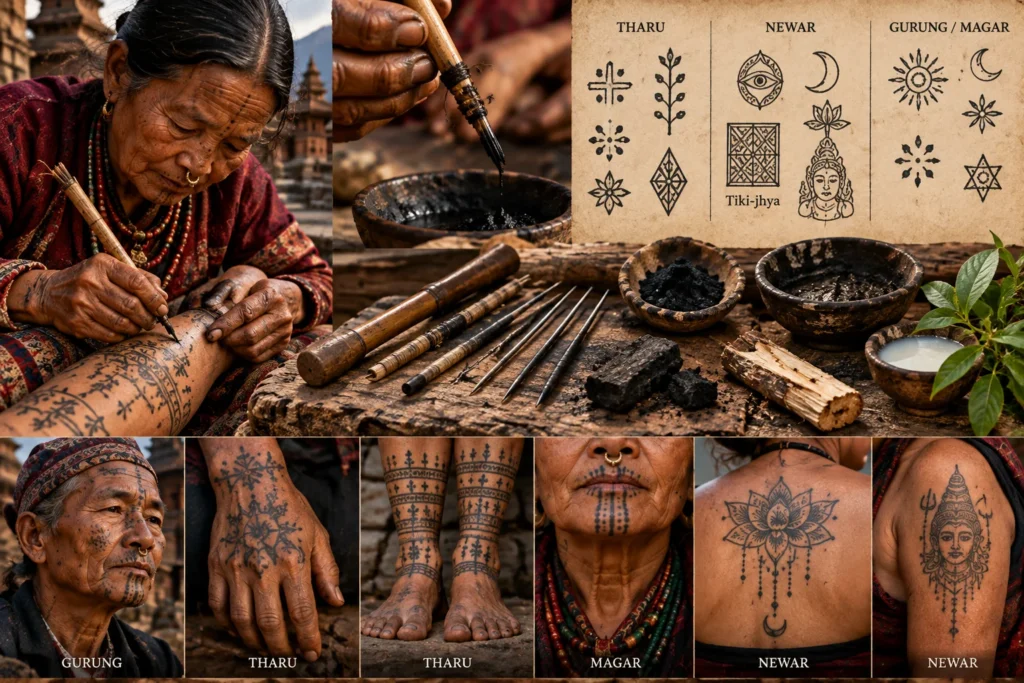
The Newar, Tharu, Gurung, Magar, Tamang, Sunuwar, and other communities developed their own customs, motifs, meanings, and tattooing practices. Many of these traditions were particularly associated with women.
Some of them have now almost disappeared.
Others still survive on the skin of elderly women.
When Tattoos Were More Than Decoration
In some Nepalese communities, traditional tattooing could serve several purposes at once: aesthetic, social, spiritual, and cultural.
Designs could include plants, animals, geometric forms, religious symbols, deities, and objects inspired by everyday life and the surrounding landscape.
Some tattoos were believed to provide protection.
Others represented beauty.
Some expressed belonging to a community.
And there was another particularly beautiful idea:
what a person carries on their skin cannot be taken away by death.
Versions of this belief can be found in several Nepalese tattoo traditions. Among some Tharu communities, for example, jewelry and material possessions were believed to remain behind after death, while tattoos would accompany their wearer into the next world.
In some traditions, tattoos could even help the soul on its journey into the afterlife.
Newar Tattoos – Writing on the Body
The Indigenous Newar people of the Kathmandu Valley also developed their own tattooing traditions.
One traditional term associated with Newar tattooing is Lha-Chyogu, which can roughly be understood as the idea of “writing on the body” or “writing on the flesh.”
Traditional Newar tattoos included crescent moons, plants, animals, birds, religious symbols, and representations associated with deities.
Bhairab, Ganesh, Shiva, and other sacred imagery could appear in these designs.
The placement of the motifs could also matter. Certain religious designs were placed on the upper parts of the body, while plant and animal motifs could appear on the lower limbs.
Once again, tattooing was not simply decoration.
Tattoos could be considered protective signs and permanent treasures — something that might remain with a person beyond this life.
Tattooing During Festivals
In old Kathmandu, tattooing was also connected with the world of festivals and public celebrations.
It was particularly popular among women to receive tattoos during fairs and major religious festivals.
Historical accounts and modern documentation mention celebrations such as Rato Machindranath Jatra and Indra Jatra in connection with tattooing traditions.
Imagine the streets of old Kathmandu.
Crowds, music, religious ceremonies, processions, merchants, images of gods — and among them, people receiving permanent marks on their skin.
Indra Jatra remains one of Kathmandu’s most important Newar festivals today, with processions, masked dances, and the ceremonial appearance of Kumari, the living goddess.
Tiki-Jhya – A Window That Protects Even in the Afterlife
One particularly fascinating motif in Newar tradition is the tiki-jhya, inspired by the beautifully carved lattice windows characteristic of the architecture of the Kathmandu Valley.
According to recollections associated with older tattooed women from Bhaktapur, this symbolic “window” could offer protection even in the afterlife: the wearer would be able to observe what was happening outside while remaining hidden herself.
The tiki-jhya is such a distinctive element of Nepalese visual culture that some contemporary Nepalese tattoo artists have begun incorporating it into modern tattoo designs.
It is a beautiful example of how an old cultural symbol can find a new life in an entirely different environment.
Tharu – Godna, Heritage Written on the Skin
Across the southern plains of Nepal live the Tharu people, whose tattooing traditions are among the country’s best documented.
Depending on the community and transcription, tattooing may be referred to as godna, godana, khodna, or khodaha.
Women in particular traditionally wore tattoos on their arms, legs, and chest.
Many of the patterns were inspired directly by the world around them.
Dots.
Lines.
Crosses.
Plants.
Sunrays.
Peacocks.
Betel palms.
And many other natural forms.
Individual motifs could have their own names. Suruj ke daali, for example, was associated with rays of the sun, supari ke gachh with the betel palm, while majur referred to the peacock.
This reveals something important about traditional tattooing.
What an outsider might dismiss as a simple geometric or “tribal” pattern may have a name, a history, and a specific meaning within the culture that created it.
Jewelry That Cannot Be Stolen
Among Tharu women, tattooing cannot be separated entirely from traditional ideas of beauty.
According to one old interpretation, a tattoo was like a piece of permanent jewelry.
It could not be lost.
It could not be stolen.
And it would not be left behind after death.
In some Tharu communities, tattooing was also connected with marriage. Young women might receive tattoos as part of beautification traditions, while in certain communities married women were expected to have tattoos on their legs before marriage.
Tattooing could therefore represent beauty, social custom, and identity at the same time.
Tikaniya – Keepers of Tattooing Knowledge
The knowledge of traditional Tharu tattooing was often preserved by experienced older women.
Some sources refer to skilled female tattoo practitioners as Tikaniya.
There were no modern tattoo flash sheets from which clients simply selected a design.
The tattooist knew the patterns.
She knew how they were constructed.
And this knowledge was passed from one generation to another.
Traditional tattooing methods were naturally very different from those used in a modern studio.
Documented Tharu practices mention black pigments made from soot, plant-derived substances, oils, and needles or thorns. Exact techniques could differ between communities.
From a modern perspective, such procedures obviously do not correspond to today’s professional hygiene standards.
Historically and culturally, however, they are extremely important.
Tattoos for the Afterlife
One of the most fascinating aspects of Tharu tattoo culture concerns beliefs surrounding life after death.
According to tradition, when people die, they cannot take their money, clothing, or jewelry with them.
Their tattoos, however, remain.
Some beliefs go even further: if the soul encounters difficulties on its journey toward heaven or the next world, its tattoos may possess value and help it continue on its way.
Whether understood literally or symbolically, the underlying idea is striking:
we may lose every material possession we own, but what has become part of our skin remains with us.
The Facial Tattoos of Gurung and Magar Women
Female tattooing traditions also existed among some of Nepal’s mountain communities.
Among Gurung and Magar women, tattoos have been documented on the face, chin, hands, and other parts of the body. Some accounts describe markings around the mouth as well as motifs associated with the sun, moon, and stars.
These tattoos could have an aesthetic role and were sometimes associated with good fortune or the well-being of the woman and her family.
There is also a traditional story that needs to be treated with some caution.
According to a widely repeated local explanation, powerful rulers or men once abducted beautiful women, and facial tattooing was therefore used to make women appear less desirable to outsiders.
Versions of this story still appear in modern accounts.
However, it is better preserved as oral tradition or a local explanation rather than presented as established historical fact.
That does not make the story worthless.
A legend can tell us something important about how a community remembers and explains its own past, even when historians cannot prove that the event literally occurred.
When Old Tattoos Begin to Disappear
The social changes of the 20th and 21st centuries have deeply affected Nepal’s traditional tattoo cultures.
Urbanisation, changing lifestyles, education, migration, and modern beauty ideals have led many younger people to abandon the tattooing customs of their parents and grandparents.
This is particularly visible in Tharu tattoo traditions.
Old godna designs can still be seen on the bodies of elderly women, while the practice has declined significantly among younger generations.
A tattoo is a very unusual form of cultural heritage.
An old building can be restored.
A sculpture can be placed in a museum.
A manuscript can survive for centuries inside an archive.
But when the last person carrying a traditional tattoo dies, the original tattooed skin disappears with them.
This is why documenting these traditions is so important.
Meanwhile, a Modern Nepalese Tattoo Scene Was Born
While traditional tattooing declined, an entirely different tattoo culture began to grow in Nepal.
Modern tattoo studios appeared in Kathmandu, Pokhara, Lalitpur, and other urban areas.
Tattoo machines, international styles, travel, tattoo conventions, and eventually the internet transformed the profession.
Some contemporary Nepalese tattoo artists have also begun consciously reconnecting modern tattooing with older Tharu, Newar, Magar, and Gurung motifs.
This creates an interesting reversal.
Traditional tattooing may be disappearing from villages, while elements of the same visual heritage are beginning a second life inside modern tattoo studios.
From the Himalayas to Realism
Contemporary Nepalese tattooing is, of course, no longer limited to traditional designs.
Realism, blackwork, geometric tattooing, minimalism, Japanese influences, and many other international styles can now be found alongside local traditions.
At the same time, Nepal’s own visual culture provides an almost endless source of inspiration.
Buddhist and Hindu symbolism.
Mandalas.
Lotus flowers.
Deities.
Himalayan imagery.
Newar architectural ornamentation.
Traditional Tharu patterns.
Modern tattoo artists can transform these elements into entirely new compositions.
But this also raises an important question:
How can a traditional motif be transformed into a modern tattoo without losing the story that originally gave it meaning?
A Strange Contradiction
Two very different things are happening in Nepal at the same time.
Modern tattooing is becoming increasingly visible.
Traditional tattooing is becoming increasingly rare.
The future of Nepalese tattoo culture may therefore depend on more than simply having successful modern tattoo studios.
Those will almost certainly continue to exist.
The more difficult question is:
will the stories behind Nepal’s traditional tattoos survive as well?
What Remains on the Skin
The history of tattooing in Nepal is not the history of a single style.
It is a peacock on the leg of a Tharu woman.
A protective mark carried by a Newar woman.
The facial tattoos of a Gurung or Magar woman.
A tiki-jhya that, according to tradition, could become a protective window even in the afterlife.
And beside all of them stands a modern tattoo studio in Kathmandu, where the next generation receives tattoos made with electric machines.
At first glance, these seem like two completely different worlds.
Yet they belong to the same story.
Techniques change.
Styles change.
Meanings change.
But people continue to do something remarkably familiar:
they place something important to them permanently upon their skin.
And perhaps that is why the old Nepalese idea remains so beautiful:
when everything else must be left behind, the tattoo remains with us.