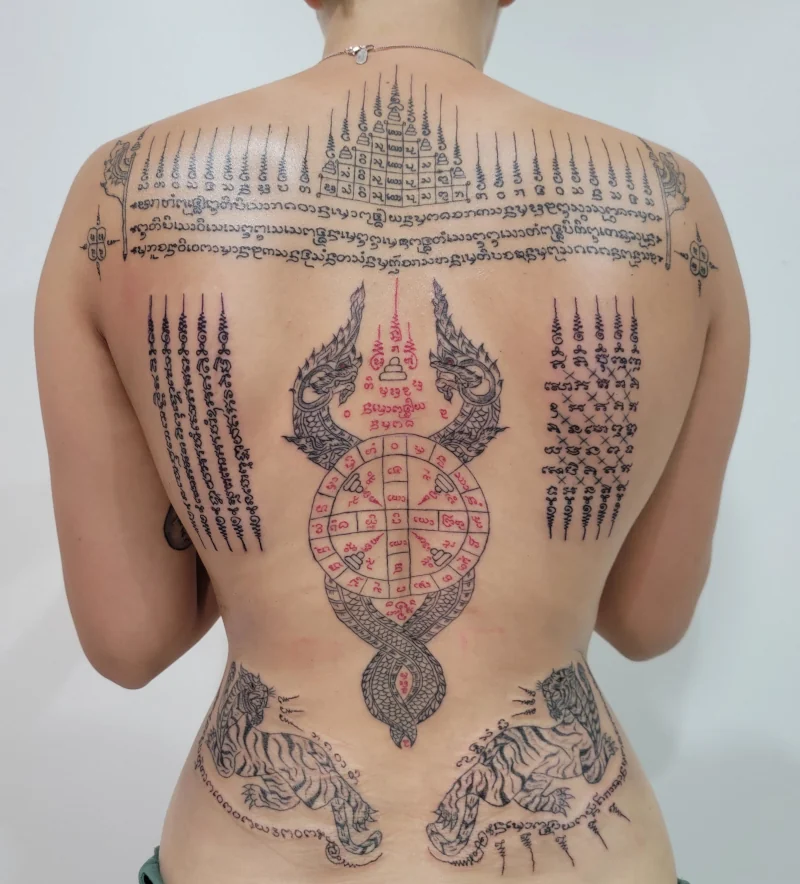
The complex of traditional Thai Buddhist monasteries and temples called Wat Bang Phra showcases the city’s magical tattoos, known as Sak Yant. Located 48 kilometers from Bangkok, in Nakhon Pathom in central Thailand, Wat Bang Phra is the Mecca for aspiring magical tattoos and hosts the world’s largest tattoo festival annually. On the fourth day of the festival, usually held in early March, thousands of believers in the power of tattoos from all over Thailand, and even visitors from abroad, are present.
Luang Pi Nunn created 29 types of magical tattoos, which he calls U Na Lome. All 29 models feature Buddha. The monk said of the tattoos: “They will not only protect you but also stop bad thoughts before they turn into deeds.”
This festival is not just for men who want to get tattooed. Families come just to see the various amulets, sample the different foods, participate in various games, and listen to the speeches of the Buddhist monks.
Monks tattoo in different temples and use the tools they wish. Some monks work on porches outside the temple, called a Wat, while others prefer to work inside the temple in a darker place. Some like to work alone, but there are those who prefer to work in company, with several monks in one room.
Believers come to the Wat Bang Phra festival every year to get tattoos that bring good luck in business or bring them good fortune. Others want to strengthen their charisma to better attract the opposite sex. Some tattoos can turn enemies into friends.
The tattooing monks’ tool is a metal rod, about 60 centimeters long, and sharp; one end is split about 5 cm to form a hook shape, and the other end is pointed like a needle. Its shape is very similar to a fork.
In Thailand, the population uses amulets and tattoos to realize their dreams.
Many devoted attendees of the Wat Bang Phra festival come here to get the dreamed-of tattoo of Hanuman, who was the king of the monkeys, because they believe that this figure is invincible and will never die.
Some monks use a straightforward dotting style, while others work with fine lines. The ink is used depending on the person; others believe it has special protective abilities due to working with unconventional materials and using them magically. For example, some use Arjan sandalwood soaked in grass or white sesame oil. They are also said to use animal fats such as elephant, tiger, bear, or even cobra fat. Others claim that a layer of Chinese pigment was added to an Arjan mixed with holy water.
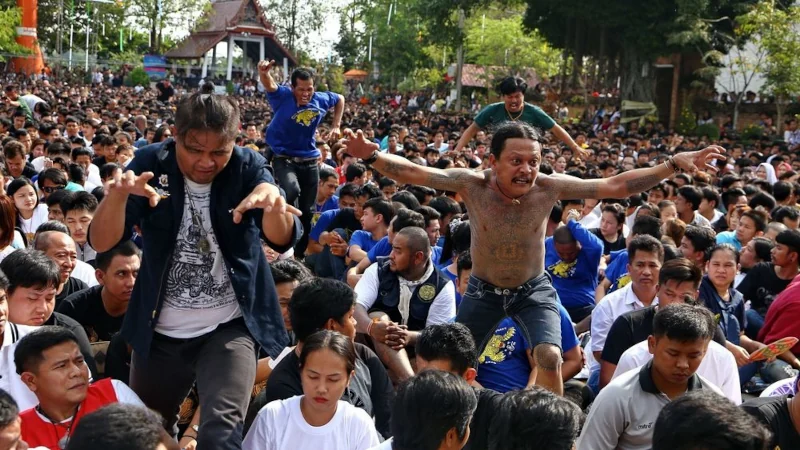
In Thailand, there is a way to increase protection by gaining personal power. Every tattoo has a spirit that the owner can wear. The monks are known for being able to tattoo people, but also for being able to test the tattoos. They are Buddha’s substitutes, who are very strong personalities.
Indian hermits, the Ruesi Arjans, are loved by them and their clients; they say that these people brought tattooing to Thailand in the distant past. Ruesi is also important because, in traditional Indian mythology, he was the intermediary between man and deity.
Generally, there are three types of tattoos at Wat Bang Phra: those that influence each other, which create friendships, can express admiration or fear, and which act on the tattooed person, increasing their speaking ability, giving more courage; and there are tattoos that protect their owner, not allowing the wearer to be bitten. Magical tattoos for the mentioned purposes or others (e.g., eternal health) act in such a way as to precede medicine and can be interpreted as a vaccination against various diseases or accidents.
There are tattoos that are not visible. These tattoos are made with oils but have the same power as the visible ones drawn with pigment.
Some monks use sesame or coconut oil mixed with plants and sandalwood. The strongest Arjans belonging to Wat Bang Phra, like Luang Pi Nunn, are covered in such tattoos. Amazingly, Luang Pi Nunn tattooed Lars from 8 in the morning until 4 in the afternoon during the first days of the festival, with short breaks for eating. On the last two days of the festival, he tattooed a marathon, extending his program by 12 hours or more, all in one day.
Most of Luang Pi Nunn’s tattoos were ready in 10 or 15 minutes, but the more refined drawings could take twice as long. “My tattoo,” Lars recounted, “which was done in two parts, took about 40 minutes to complete, and cost about 0.75 dollars, a lotus flower, a bundle of incense sticks, and two boxes of menthol cigarettes.” Live, these monks work very fast; in a second, a tiger’s eye, a magical tattoo on the skin, takes shape. The monks work in different ways. Some use the same brush again and again, cleaning it with alcohol each time. Others use different tools for each person. But there are also those who exchange components. “Like every country, Thailand has problems with hepatitis or AIDS. I also like to have my own tool that I can work with, tattoo with, which I clean every time.
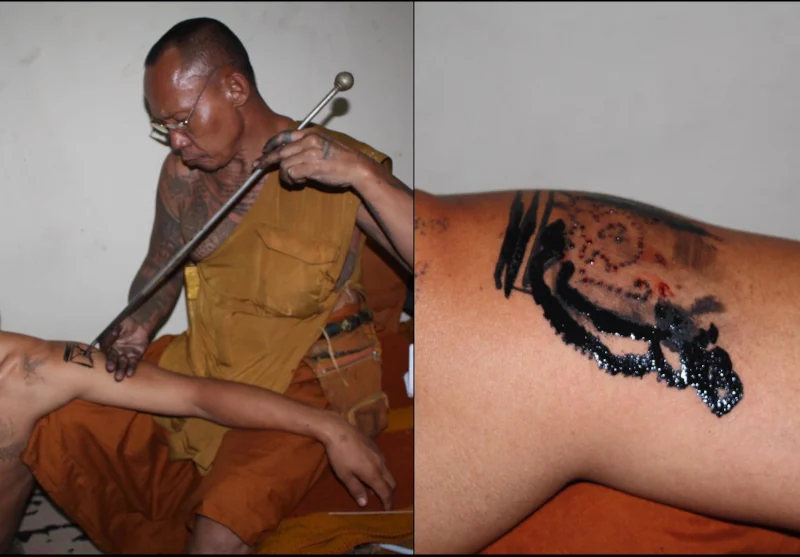
No young person who enters this room is tortured by the desire to converse; usually, two friends hold the skin taut for the monk. There are people who fall into a trance during the tattooing, others enter a meditative state during this time; the monk often remains so silent that nothing can be heard. Regardless of the person, whether dependent or not, the monk continues to inject the pigment under the skin and only stops to wipe the blood, or to drink an energy drink, or to take a puff from a cigarette. After the tattoo is finished, the monk begins to mumble a prayer. This action is a superficial conversation between the monk and the spirits, or powers.
I met Matthew Sung from Hong Kong while looking around at the Wat Bang Phra festival. Considering he is from China, he received a series of tattoos during the 4 days he spent at the temple.
He said, “When I start speaking from now on, everyone will listen, because my voice will be very beautiful, it will be like the song of birds.” The circle on his back looks like a labyrinth on a tic-tac-toe board; he explained that it means “it is not easy to die at all,” Lars recounted.
Luang Pi Nunn said that to understand the power of tattoos, you must believe in them like the locals; you cannot learn about them in books. Many people come here for magical tattoos. They use their faith in Buddha, because he is a role model for heaven. They force you to do only good. You must believe in them, otherwise they have no value. In addition, you must understand the Dharma, or good behavior, before getting a tattoo. Simple things, like cleaning the floor with a broom, are easy to use. These simple things help to concentrate on good things, to be able to help society. And these things build a pure heart. And these are the fundamental things that are important in Buddhism.
At the Wat Bang Phra festival, there are many amulet sellers; these accessories include amulets made from tiger skin to protect against bullets, objects made of wood, and black coral, which is believed to bring good luck in business.
“It is clear that when I trained to be a tattoo artist, I had to train my body, heart, and mind. I helped with the daily tasks around the temple: for example, I collected garbage, cleaned up after the dogs, fed the fish, and went out every night to beg—otherwise, I earned my daily bread. All this helped me to feel this world. Otherwise, I cannot easily give or receive Sak Yan: you must be physically and mentally prepared when you do it. It took me ten years to perfect this art and learn the Katha prayers. Every monk must learn this.”
During the festival, all the monks from Thailand came to tattoo at Wat Bang Phra. They say that there are only 6 tattooing monks at Wat Bang Phra, and a few of them only work with oil.
People seeking tattoos come from all over Thailand and other countries. Matthew Sung, a person working in the Chinese parliament, mentioned that he heard about this festival for the second time in Hong Kong.
“I have been here for four days now, and this temple really helped. I think these tattoos will allow me to live, to do everything I want, because I really believe in their power. You can buy amulets here to protect you, but the tattoos protect you 24 hours a day, which the amulet cannot do; I cannot leave this at home.”
Speaking about his tattoos, he said: “The god Rahu, who swallowed the Moon, is on my hand; it means that whatever bad thing comes, I will overcome everything. My other Hanuman tattoo is a real Superman tattoo, because he will never die, no one will defeat him. The tiger tattoo symbolizes that everyone will listen to me, which gives me strength to be more resourceful in all areas.”
A Great Tattooed Family:
The climax of the Wat Bang Phra festival is Saturday, and every year on the same day as Makkha Bucha, the most celebrated Buddhist holiday. Programmed for 3 months completely, the event marks the occasion when Buddha outlined the principles to his disciples: to stop all evil, to do all good, and to purify our minds.
On this day, believers usually stay in one of the 30,000 temples in Thailand. The faithful devotees of the Wat Bang Phra tattoo festival were there that day like a large family, grateful to the tattooed monks who make our lives better with the sacred signs and the precepts of Buddhism.