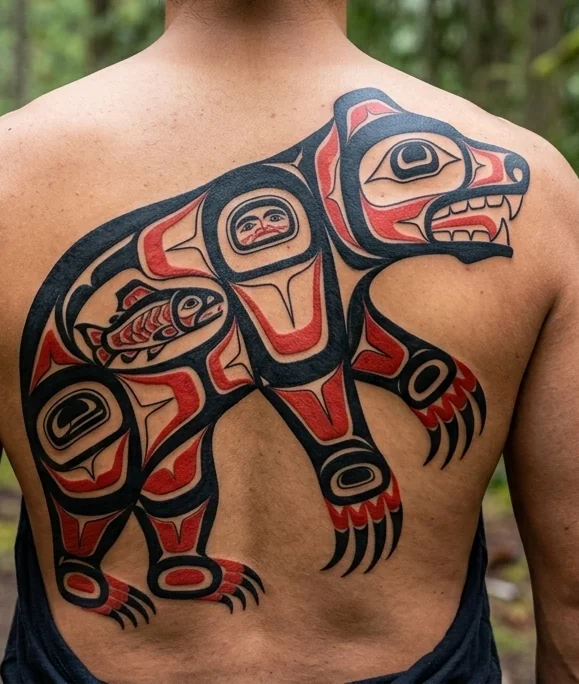
Totems as Cultural Identity
Those who have not heard much about Alaska might believe that there are only icebergs and Eskimos living in igloos. Well, we would not have mentioned this region in a magazine dealing with tattoos if something else were not hiding in the culture of the ancient tribes on the Northeastern coastal areas of Canada.
The Pacific part, the northern part of America—more precisely the area between the Rocky Mountains and the ocean—is very important regarding the history of totems. The indigenous peoples who created these are heirs to more than 25,000 years of development. The most well-known tribes—Yurok, Chinook, Nootka, Haida, or Tlingit literally passed down their traditions, beliefs, and symbols to people through their tattoos. At the same time, the erection of statues and monuments totem poles started with them, through which they managed to immortalize and pass on their spirituality, even if their lives and bodies have already faded into oblivion.
Sense and Emotion
Totems were symbols of the people living there, with which they identified themselves with the entire universe from all existing perspectives: socially and spiritually. Among the Haida and Tlingit tribes, we also find commemorative totems that contained protective patterns and were erected upon the death of a deeply respected, admirable ruler. Besides these commemorative poles, there are also storytelling poles that tell legends or local stories. The possession of totems passed from generation to generation, from mouth to mouth, and history contributed to preserving their identity of belonging to a certain group.
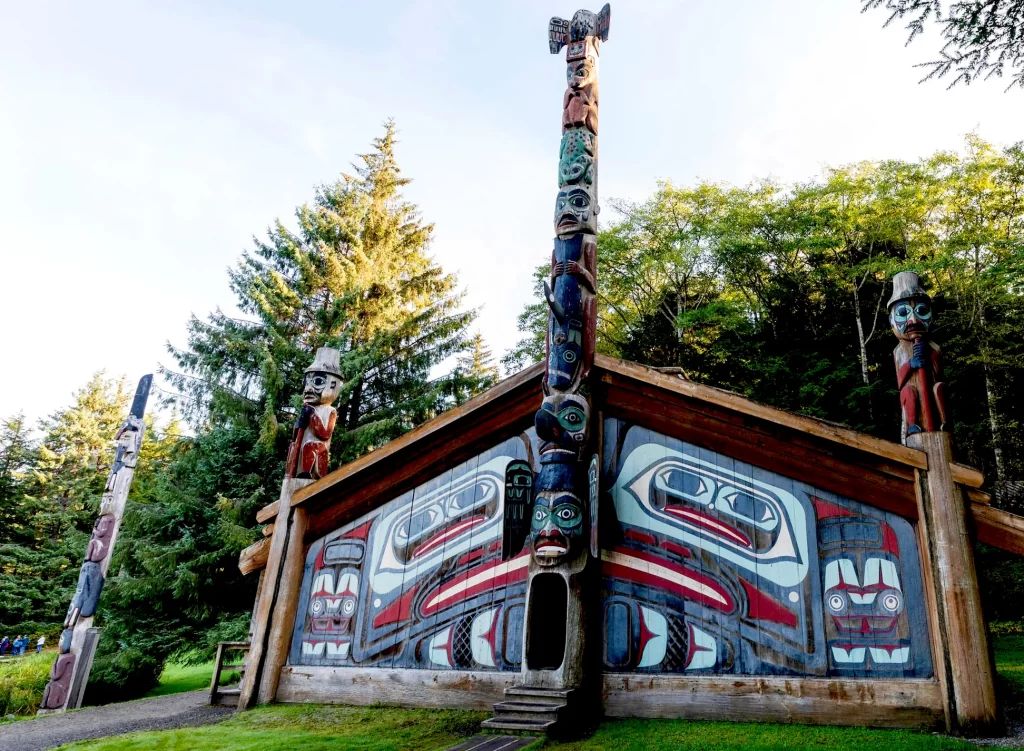
Identification with Totems
Among the Tlingit people, symbols explain the existence of the world, the relationship of a group or an individual with the universe in which they live, and connect all members of the group with nature, while also delineating their social rank. The origin of totems is attributed to superhuman powers and symbolizes the history of the given tribe. The animal appearing on the totem becomes the spirit itself, which also points to social rank. The right to use a certain symbol was worth much more than a tangible object, family wealth, or being the owner of an actual totem pole.
Every clan or family had the right to possess one or more totems; however, they first had to win them, and then they had to keep them. Claims were now contestable, attackable, and re-analyzable; sometimes actual wars broke out because one clan considered itself superior to other families who possessed totems similar to theirs. Victory obliged the winners to pay a certain debt or to humiliate a rival clan. Despite this, wealth played an important role in their lives, so much so that a saying spread that “some are so rich that they can use any totem”.
Among Tlingit residents, symbols lend value to the objects on which they were found and also to those places and geographical regions where the events occurred. Totemic elements were found on all kinds of objects: blankets, tools, weapons, totem poles, statues, helmets, tattoos, and also on the tools used for tattooing. Everything that appeared on the totems had to be exhibited in order to gain recognition and prestige at various ceremonies. The more it was shown, the more valuable it became, and those who participated in these ceremonies received rewards, as they contributed to and promoted the popularization of these totems and thereby increased the good reputation and prestige of their owners—especially if it was found on the body of the owner’s daughter or son in the form of a fresh tattoo.
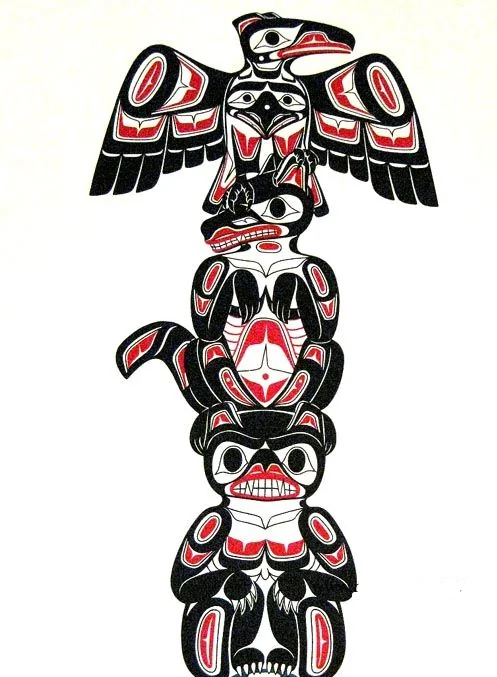
The Tlingit and Haida Tattoos
The Tlingit and Haida peoples are mainly known for the totemistic elements tattooed on their skin. The most well-known and popular symbols included land animals (wolf, bear), aquatic animals (killer whale, shark), and birds (eagle, owl). Yet, they frequently used geographical elements (mountains, icebergs) and celestial bodies (sun, moon, the Big Dipper) as well.
Potlatch
Among the Tlingit and Haida, tattooing coincided with festivals. The highest-ranking members were busy ensuring others recognized the clan’s wealth, status, and history. Because of this, the host publicly distributed material and spiritual wealth during the festivities. They distributed names, ranks, privileges, titles, and wealth acquired through hereditary lines, which was meaningless without the fundamental host ritual and the guest’s acceptance of the gift.
The largest commemorative and giving ceremony is known as Potlatch, where anyone can be in the role of the host (the population, the invitees, or even clans from other tribes). The climax of the ceremony is when the host—in honor of their ancestors—rewards the services of the invitees provided during the funeral ritual. “The word Potlatch originates from the dialect of the Nootka natives and means giving. This custom has existed on the Pacific coasts since ancient times. It often happened that there were too many gifts, and when they could no longer be carried away, the surplus goods were destroyed; the destroyed gifts became worthless,” tells Corneliu Florea. Only the wealthiest had the opportunity to organize such ceremonies, as often 1,000 people had to be expected. However, with their contribution, even the poorest could pay their respects before the memories of their ancestors. Totem poles were often erected at such times.
Piercing & Tattooing
At this time, the heir and the new owner of the house took their name, placed the totems, gave respectable names to the youngest members of the clan, or pierced their children’s ears. This ceremony is a process by which they made the clan’s status official, known, and accepted by everyone during the time of commemoration.
Often, the wealthiest tribal chiefs organized similar ceremonies to elevate and honor their own children. These events were mainly for the first-born, despite other children of noble descent being present. For most such festivals among the Tlingit and Haida tribes, the invitees came from other clans—especially on the father’s side—but residents of other villages or other tribes also appeared. After long days of dancing and revelry, the chiefs or the women pierced the children’s ears and had their bodies tattooed.
According to witnesses, a ritual existed among the Tlingit at the time of ear piercing and the tattooing of the noblest children. “The host’s eldest son stood before the greatest invited chief, while his eldest daughter stood before the village’s greatest host. At a certain signal, each of the chiefs took the earlobe of the child sitting before them and pierced it. At such times, everyone made a long and loud ‘shhh’ sound. They did the same with the children’s other ear. For some children, the tattoo was a substitute for piercing. The girls’ hands were tattooed, and the boys’ chest and hands were tattooed”. According to witnesses, this lasted for days.
Based on memoirs, initially, certain children or every child received a new name. Every name was accompanied by the family history and the great deeds of those ancestors who bore the same name. At the same time, the host distributed their possessions, much of which went to tattooed women of noble descent or tribal chiefs. They gave 50 of the most mediocre blankets for each piercing or tattoo on the hand, while 100 blankets were given for a chest tattoo.
One of the most recent ceremonies of the Haida civilization that included tattoos dates back to the winter of 1900-1901 and took place in the village of Skidegate. The anthropologist was followed by another anthropologist, John R. Swanton, who described this ceremony, which was similar to that of the Tlingit.
“On the second day, they were called to mark their bodies with tattoos. Suddenly, they began to paint their faces. Those in the house started shouting to people to come and see what was happening. When the spectators gathered, they began to dance and sing. Those who were to be tattooed burst into dance. The house owner’s wife stood behind the line with a totem-patterned helmet on her head. When they started dancing, the dancers touched them with an eagle feather to purify them. The house was full of eagle feathers. After a short time, they stopped. Those who touched the feathers also received cotton clothes. Those whose tattoos were already finished sat before the chiefs. Sometimes, two people were tattooed by the same artist. Then they began to tap the ground with a stick while saying the chief’s name and the following: ‘Behold, here I stand before you to be tattooed.’ Then the tattooing begins. An entire day is spent on this. The nose, the lower lip, and the ear were equally pierced by members of the opposite clan. For each pierced part, one blanket was the payment”.
Traditional Haida tattooing (ki-da) covered the hands, chest, thighs, the back of the arm, the legs, and sometimes the back. The ink used for tattooing was mixed in a stone vessel to combine the pigment with black magnetite and red hematite. The brushes were made of cedar, with incised totems on each handle. The kits further contained four or five cedar rods with different types of needles depending on the desired effect: shadows, contours, and fills. Before metal needles appeared, sharp thorns, various fish spines, or bone shards were used.
A Vancouver tattooist proved that the Haida tribe’s tattooing tools were similar to the pocket tools of contemporary Japanese. Upon seeing pictures of Haida tattooing tools, he was quite surprised by the similarities to Japanese tools, especially the brushes used for painting. The Japanese used a stick about one foot long (30.5 cm) from which needles protruded. One end had to be held with the right hand, using the thumb as a support, then they pierced the skin. The brush was held under the wrist with the left hand; by pulling the brush hair over the tattoo to assist the tattooer’s work, a little ink was sprinkled under the artist’s hand, with which they could work later. Yet, the sticks used by the Haida civilization were much shorter than those of the Japanese. Probably half the length of the other, and the needles were not lined up but grouped. “We assumed that the Haida held the stick in their right hand, just as we would hold a spoon, with the difference that they pierce the skin with a small wrist movement,” tells the tattooist.
Similar tools were used by the Tlingit tribe, but only after they came into contact with European traders. “After obtaining the needles, a machine was created consisting of four connected needles tied to a wooden handle”. This tool replaced the original tattooing tool, which consisted of a simple bone needle and a piece of sinew.
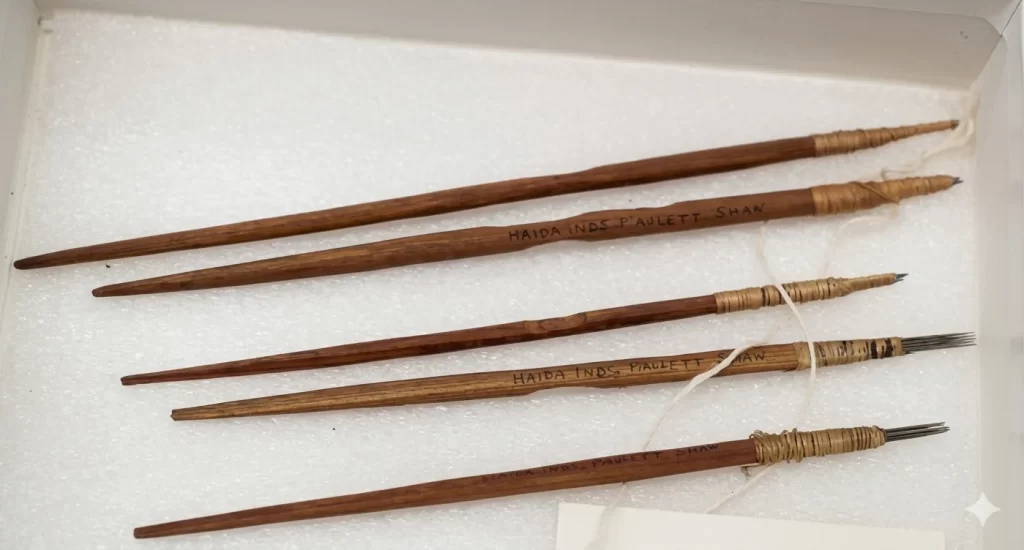
With all this, there are no witnesses to Tlingit skin painting, but linguistic evidence claims that at the beginning of the ceremony, these artists embroidered the skin with the needle and the sinew thread. The oldest word for tattooing is kuy-kay-chul, which means stitching on the body. Despite the stitching of the skin proving to be a painful operation, it was still very popular, especially in the Arctic, where it was used for three millennia.
Read this: Tribal Tattoos of the Makonde People