Today, as in the past, the traditional culture of the Li people of Hainan Island is closely connected with ancestor worship and the natural world. In their traditional animistic beliefs, many elements of the visible and invisible universe were regarded as possessing spiritual qualities or being associated with supernatural forces.
Stones held particular significance and were associated with deities and spirits of the earth. Traditional settlements could contain sacred places where stones of different shapes and sizes were gathered. Mountains also possessed a powerful spiritual significance. One particularly important place is Five Finger Mountain, or Wuzhishan, in central Hainan, which is regarded as one of the symbolic landscapes of Li culture.
Ethnographic accounts from the first half of the twentieth century describe numerous ritual rules associated with travelling through or climbing such sacred places. People avoided loud noises, shouting and behaviour that could be considered offensive, as these actions were believed to disturb the mountain spirits and potentially bring misfortune.
The origins of the Li people have long been the subject of different traditions and theories. Li communities are considered among the oldest populations of Hainan Island, and their oral traditions preserve various stories concerning their ancestors and their arrival on the island. Some accounts recorded during the twentieth century mention ancestral connections with regions to the south and southwest of China, including mainland Southeast Asia.
These traditions are particularly interesting in the context of tattooing because similar practices existed among numerous populations of southern China and Southeast Asia.
Traditional Tattoos of the Li People
Traditional Li tattooing tools were relatively simple. In different communities, needles or sharp points attached to a handle were used, and pigment was introduced into the skin through repeated tapping with a small wooden implement.
The pigment could be produced from plant-based substances and other natural materials available locally. Designs were first drawn or marked on the skin, after which the tattoo practitioner introduced the pigment through repeated puncturing of the skin.
In many communities, the people responsible for performing tattoos were experienced women, and the healing process could take several days.
The tattoos worn by Li women varied considerably from one community to another. Their designs were not merely decorative but could also represent community identity and traditions transmitted from one generation to the next.
Motifs included geometric forms, stylized representations inspired by plants and animals, as well as symbols associated with clans and ancestors.
Tattoos could appear on the face, arms, hands, legs and other parts of the body, while their placement and form differed among Li groups. In this sense, tattooing functioned almost like a visual language through which belonging, identity and the continuity of tradition could be expressed.
Tattooed Head-Hunters of Taiwan
Early Chinese historical sources describe island populations living near the southeastern coast of China who practiced different forms of body modification and tattooing. However, identifying all of these early descriptions directly with the Indigenous peoples of modern Taiwan requires caution, because the names and territories recorded in ancient texts do not always correspond clearly to communities known today.
What is much better documented is that several Indigenous peoples of Taiwan developed complex tattooing traditions.
Among them were the Paiwan people.
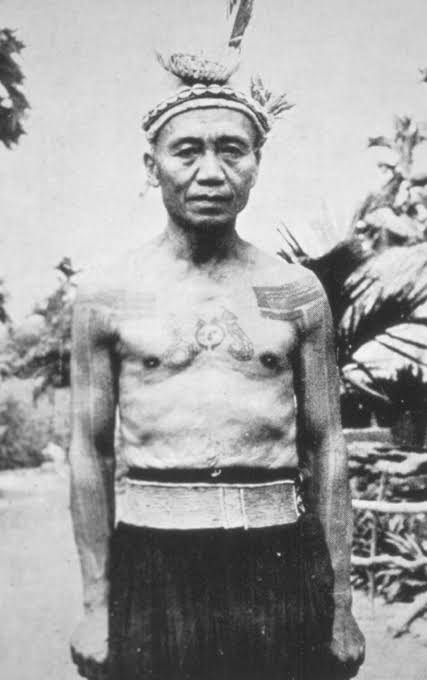
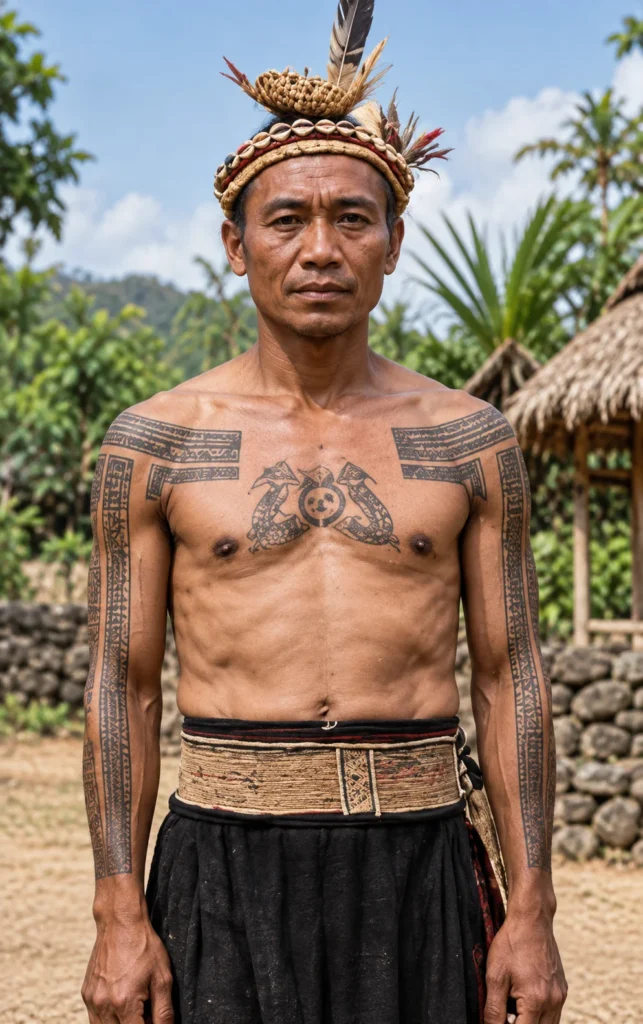
In traditional Paiwan society, tattooing was closely associated with rank, prestige and social identity. Paiwan society had a clearly defined hierarchical structure, and certain images and ornaments were reserved for chiefs and members of the nobility.
Among the prestigious motifs were representations of human heads and the snake commonly known as the hundred-pacer (Deinagkistrodon acutus), an animal with profound mythological significance in Paiwan culture. The right to wear particular motifs could depend upon social status and the traditions of the community.
Snakes occupied a particularly important position in Paiwan mythology and art. The hundred-pacer motif appeared not only in tattoos but also in sculpture, house decoration and other forms of traditional art.
Its association with ancestors, nobility and spiritual protection gave the image a significance far beyond that of simple ornamentation.
The motifs worn by men and women varied according to gender, community and social position. Tattooing could constitute a privilege of people of particular rank, while the right to display certain designs could be granted or acquired according to traditional rules.
Historical and cultural sources concerning Paiwan heritage document this relationship between tattooing, rank, maturity and honour. Men could receive traditional tattoos on the chest, back and arms, while tattoos on the backs of women’s hands became one of the best-known forms of Paiwan tattooing.
Paiwan tattoo practitioners were often specialized women, and knowledge of the art could be passed down within families. Tattooing was an important activity surrounded by social and ritual rules, while payment for a tattoo could consist of valuable goods, animals, metal objects, textiles or other products.
Traditional tattooing implements were made from materials available locally. In later periods, metal needles attached to bamboo or wooden handles were used, while before metal became widely available various naturally occurring sharp points could be employed.
Dark pigment was introduced into the skin by repeatedly striking the tattooing instrument.
The process could be long and painful. A section of the design might be punctured repeatedly to ensure that sufficient pigment remained visible in the skin. Blood and excess pigment were removed throughout the procedure, after which the tattooed area was allowed to heal.
In some communities, tattooing was carried out during seasons considered favourable for healing, and the ceremony could take place in a separate space. Such conditions emphasized that tattooing was not merely a form of body modification but an important social event.
Paiwan women particularly tattooed their hands and, in some communities, other parts of the limbs. Men could wear tattoos on the chest, back, arms and limbs.
The designs included geometric forms, lines, dots, human figures, human heads, snakes and other symbols associated with Paiwan tradition.
Facial Tattoos of the Atayal People
Another remarkable tattooing tradition in Taiwan existed among the Atayal people. Here, facial tattooing—known as ptasan—held particular importance and was associated with the transition to adulthood, identity, prestige and the relationship between the living and their ancestors.
Both men and women could wear tattoos on the forehead. In traditional Atayal society, men could receive tattoos associated with adult status after demonstrating abilities required by their community, including hunting skills and, historically, participation in head-hunting.
Women were expected to demonstrate mastery of weaving before earning the right to receive their characteristic facial tattoos.
For women, some of the most striking designs extended across the cheeks, often consisting of diagonal or intersecting lines running from the area near the ears toward the mouth. Men could have vertical lines tattooed on the chin, while forehead tattoos could be worn by both men and women.
The exact patterns varied according to region and community.
Tattooing, however, represented more than skill or courage. In traditional Atayal belief, tattoos also possessed an important spiritual dimension.
It was believed that after death, ancestral spirits could recognize a person’s belonging to the community through their tattoos. The marks carried on the face therefore became a connection between the world of the living and the world of the ancestors.
The traditional technique involved an instrument fitted with several needles or sharp points that was struck with a small wooden hammer. Black pigment could be produced from soot or charcoal. Through repeated tapping, the pigment was gradually introduced into the skin, creating the characteristic lines of the facial tattoo.
Head-hunting practices historically found among some Indigenous peoples of Taiwan possessed complex ritual, social and spiritual meanings. Among the Atayal, success in warfare or hunting could be connected with the right to wear particular tattoos.
However, reducing the entire Atayal tattooing tradition to head-hunting would be misleading. For women, for example, proficiency in weaving was one of the essential conditions for receiving facial tattoos.
Similar traditions of facial tattooing existed among the Truku and Sediq peoples, who are culturally related to the Atayal. Among the Sediq, for example, tattoos represented maturity and also possessed spiritual significance. Men and women wore different patterns, and a woman’s proficiency in weaving was again an important criterion.
During Japanese rule over Taiwan, between 1895 and 1945, colonial authorities attempted to suppress a number of Indigenous customs, and traditional facial tattooing was prohibited.
As a result, the continuous transmission of the practice was disrupted, and during the twentieth century the number of people who still carried traditional facial tattoos declined dramatically.
Nevertheless, the designs did not disappear from cultural memory.
Today, the tattoo traditions of the Paiwan, Atayal, Truku and Sediq peoples are documented and studied as important elements of Taiwan’s Indigenous cultural heritage, while their symbols continue to appear in cultural projects and efforts to revitalize Indigenous identity.