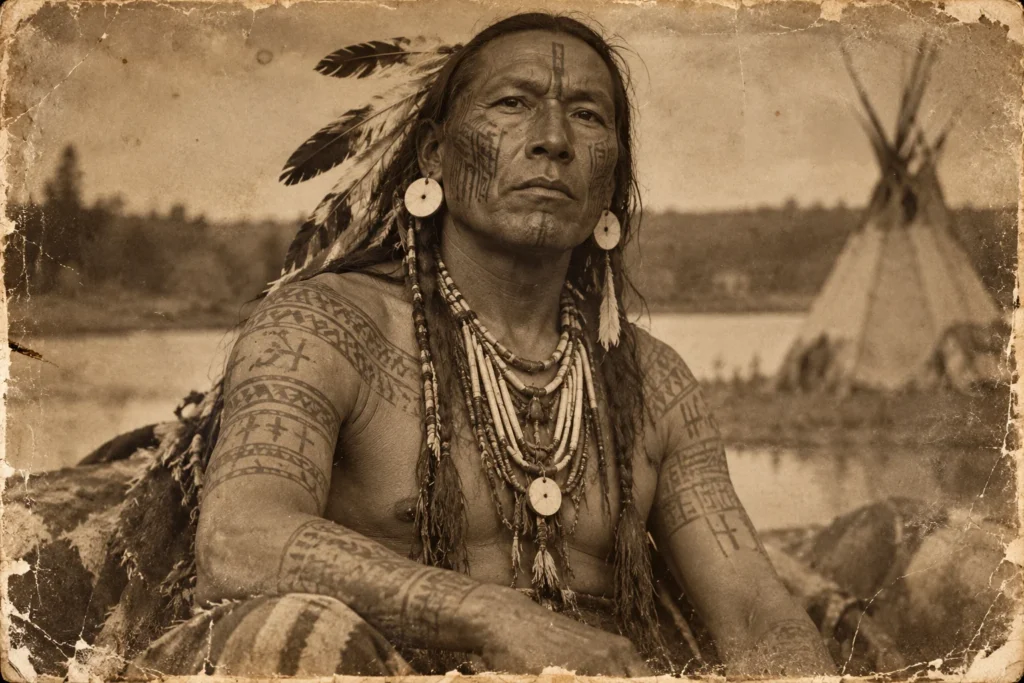
The tattooing traditions of North America are a fascinating and almost inexhaustible subject. The customs of different Indigenous peoples show that permanent forms of body marking existed across the continent long before European colonization.
However, there was no single, unified tradition that could simply be described as “Native American tattooing.” The appearance, techniques and meanings of tattoos varied considerably between peoples and regions. Tattoos could represent social status, achievements in warfare or belonging to a community. They could also be connected to spiritual beliefs and important stages of life, while in some communities they were even believed to have healing purposes.
Following the arrival of Europeans, explorers and missionaries left behind numerous accounts describing these traditions.
Early European Accounts of Indigenous Tattooing
By the late nineteenth century, many traditional tattooing practices had already changed or declined. For later researchers, the accounts written by travellers and missionaries during the seventeenth and eighteenth centuries therefore became particularly valuable historical sources.
In 1909, researcher A. T. Sinclair published Tattooing of the North American Indians in the journal American Anthropologist. Sinclair collected a considerable amount of information from earlier historical sources and attempted to document and organize tattooing practices from different regions of North America.
Among the most interesting early descriptions are those written by French travellers and missionaries who entered New France and encountered the Indigenous peoples living there.
Gabriel Sagard, a Recollect missionary, wrote during the first half of the seventeenth century about the body-marking practices of the Huron-Wendat and neighbouring peoples.
In his accounts, Sagard described some men as having permanent images of snakes, lizards, squirrels and other animals marked on their faces and bodies. He considered the practice particularly widespread among the people whom the French called the “Tobacco Nation,” today generally identified with the Petun.
The skin was worked with numerous small punctures, after which dark pigment was introduced into the wounds. Sagard was particularly struck by the endurance with which people underwent this painful process.
European descriptions from this period often used dismissive language, describing unfamiliar Indigenous practices as strange, vain or even savage. Such comments tell us as much about the worldview and prejudices of seventeenth-century European observers as they do about the Indigenous traditions they attempted to describe.
The Accounts of Jesuit Missionaries
Further detailed descriptions of tattooing survive in the reports written by French Jesuit missionaries during the seventeenth century. Many of these documents were later collected and published in the extensive body of writings commonly known as the Jesuit Relations.
Missionaries worked throughout different areas of New France and therefore recorded customs belonging to a number of Indigenous peoples.
Their reports make it clear that tattooing was practised in several Native North American communities, although its frequency, techniques and meanings differed considerably from one people to another.
In 1653, the Jesuit missionary Francesco Giuseppe Bressani gave a detailed description of permanent body marking among the people he encountered.
According to his account, needles, pointed instruments or thorns were used to puncture the skin. The designs could represent animals and other figures, including eagles and snakes.
While the punctures were still fresh, powdered charcoal or another dark pigment was rubbed into the skin. The pigment entered the wounds and created a permanent design.
Bressani also noted that tattooing was extremely widespread within some of the communities he encountered.
Tattooing large areas of the body could be a lengthy and painful process. Historical accounts occasionally describe illness, fever and serious complications following extensive tattooing. Such reports should nevertheless be interpreted carefully, taking into account the cultural and religious perspective of the missionaries who recorded them.
The Spiritual Meaning of Tattoos
For many Indigenous peoples of North America, tattooing could represent far more than simple body decoration.
In certain traditions, tattoos possessed religious or spiritual significance and could be associated with important stages of life, social roles, personal achievements or beliefs concerning the afterlife.
A particularly interesting example can be found in traditions recorded among the Lakota.
According to an account documented during the late nineteenth century, tattooing could play a role in the journey after death.
The story describes the spirit of the deceased travelling toward the “Many Lodges.” Along the road, the spirit encountered an old woman who examined the traveller for the appropriate markings.
Tattoos placed on the forehead, wrists or chin could demonstrate that the spirit was permitted to continue its journey. A person who lacked the necessary markings could be turned back toward the world of the living and condemned to wander as a restless spirit.
Whether interpreted literally or symbolically, such traditions demonstrate an important point: in some Indigenous cultures, tattooing was not merely an aesthetic modification of the body. It could become part of a person’s spiritual and cultural identity.
Tattoos Used for Healing
Tattooing was also associated with healing practices among several Indigenous communities of North America.
Nineteenth-century ethnographic accounts concerning the Ojibwe, for example, describe tattooing being used in connection with headaches, neuralgia and toothache.
The skin could be punctured using small needles, while earlier methods reportedly involved fish bones or sharpened pieces of bone. Finely powdered charcoal, soot or, in later periods, gunpowder could then be introduced into the punctures.
For headaches, markings were sometimes placed around the temples. For toothache or neuralgia, small dots or lines could be tattooed onto the appropriate area of the face.
These treatments could also have a spiritual dimension. In some traditional belief systems, illness might be understood as involving supernatural forces, and healing therefore included both physical and spiritual elements.
From the perspective of modern medicine, these practices should not be regarded as scientifically proven treatments. Historically, however, they provide an important example of the many different functions that tattooing could fulfil within a community.
Tattoos of Warriors
Among some Indigenous peoples, tattoos could also commemorate the achievements of warriors and contribute to their social prestige.
Early European sources describe permanent body markings connected with accomplishments in warfare, encounters with enemies and other important events in a warrior’s life.
Seventeenth-century Jesuit accounts also contain descriptions suggesting that some Haudenosaunee warriors carried markings associated with military expeditions and defeated enemies.
These tattoos should not simply be understood as a kind of historical “scoreboard.”
Their meanings could be considerably more complex, connecting a warrior’s personal history with his status, social responsibilities, achievements and spiritual world.
A tattoo could therefore preserve the memory of an event while simultaneously communicating something about the identity of the person who carried it.
More Than Body Decoration
The tattooing traditions of the Indigenous peoples of North America were extraordinarily diverse.
There was never a single form of “Native American tattooing.” Different peoples developed their own designs, techniques, customs and meanings.
A tattoo could serve as decoration, indicate social status or community identity, commemorate achievements in warfare, form part of a healing ritual, or express a person’s relationship with the spiritual world.
Despite the often prejudiced language used by early European observers, their surviving accounts remain valuable historical sources. They provide glimpses into tattooing traditions that later declined, disappeared or were profoundly transformed as a consequence of colonization and assimilation.
At the same time, these records remind us that tattooing in North America is far from a modern phenomenon.
For many Indigenous communities, permanent markings on the body formed part of a much older relationship between identity, belief, memory and the human body.