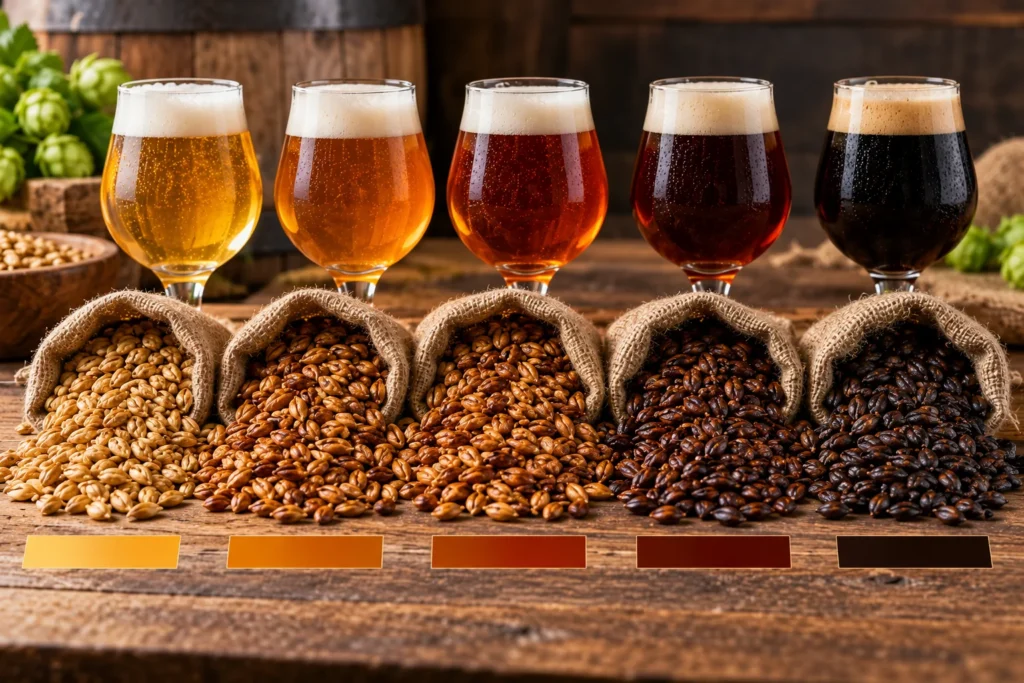
Crystal and caramel malts are among the most recognizable specialty malts in brewing.
They can add sweetness, caramel, honey, toffee, dried fruit, deeper color, body, and complexity to beer. Used carefully, they can transform a simple malt bill into something layered and distinctive.
Used excessively, however, they can make a beer heavy, overly sweet, muddy, or tiring to drink.
This is why understanding crystal and caramel malts is more useful than simply knowing that they “add caramel flavor.”
A light crystal malt is very different from a dark crystal malt.
Crystal 20 is not simply a weaker version of Crystal 120.
As the malt becomes darker, its flavor changes dramatically—from light honey and caramel toward burnt sugar, raisins, dark fruit, and almost molasses-like complexity.
Learning how these malts behave gives the homebrewer another powerful tool for designing beer rather than simply following recipes.
What Are Crystal and Caramel Malts?
Crystal and caramel malts are specialty malts produced using a process that allows sugars to develop inside the grain before the malt is dried or roasted to its final color.
Unlike standard base malt, where much of the starch remains available for conversion during the mash, crystal and caramel malts undergo an additional transformation during production.
The moist malt is heated so that enzymes convert starches inside the kernel into sugars.
The malt is then heated further.
These sugars undergo caramelization and other heat-driven reactions, creating the characteristic flavors and colors associated with crystal and caramel malt.
The result is a malt containing compounds that can contribute:
- sweetness
- caramel flavor
- body
- color
- dried-fruit character
- toasted sugar flavors
- foam-supporting compounds
- greater malt complexity
The exact result depends heavily on how dark the malt is produced.
Crystal Malt vs Caramel Malt: Is There a Difference?
This is one of the most common questions surrounding specialty malt.
The terms crystal malt and caramel malt are often used almost interchangeably, especially in homebrewing recipes.
Historically and technically, differences can exist in production methods depending on the maltster.
Some maltsters use roasting drums to create crystal malt, while some caramel malts may be produced using different stewing and kilning processes.
However, the terminology is not completely standardized across every malt producer.
For practical homebrewing purposes, it is usually more useful to look at:
- maltster
- color rating
- flavor description
- recommended usage percentage
- actual product specification
rather than relying only on whether the bag says “Crystal” or “Caramel.”
Two malts with similar color values from different maltsters may still taste noticeably different.
How Are Crystal Malts Made?
The process begins with malted grain that still contains moisture.
Instead of simply drying the grain like a normal pale base malt, the maltster allows the grain to undergo a controlled heating process while moisture remains inside the kernel.
This creates something similar to a miniature mash inside each grain.
Enzymes break down starch into sugars.
Once these sugars have formed, the temperature is increased.
The sugars begin to caramelize and react with amino compounds, producing progressively darker colors and more intense flavors.
The longer and hotter this process becomes, the darker and more intensely flavored the malt becomes.
This is why the crystal malt family can range from:
light honey and caramel
all the way to:
toffee, raisin, burnt sugar, dark fruit, and molasses-like flavors.
Why Are Crystal Malts Sweet?
Crystal malts contain sugars and dextrin-like compounds created during the malting and heating process.
Some of these compounds are less fermentable than the sugars produced from ordinary base malt during mashing.
As a result, crystal malt can contribute to the perception of:
- residual sweetness
- fuller body
- rounder mouthfeel
- richer malt flavor
But there is an important distinction.
Adding crystal malt does not simply mean that the Final Gravity will increase dramatically.
The sensory impression of sweetness depends on the entire recipe.
Hop bitterness, yeast attenuation, mash temperature, alcohol, water chemistry, carbonation, and other malts all influence whether the finished beer actually tastes sweet.
A beer can contain crystal malt without tasting obviously sweet.
And a beer can taste sweet for reasons other than crystal malt.
Understanding Crystal Malt Numbers
You may encounter crystal malts labeled:
- Crystal 10
- Crystal 20
- Crystal 40
- Crystal 60
- Crystal 80
- Crystal 120
- Crystal 150
These numbers traditionally refer to malt color expressed in degrees Lovibond (°L).
As the number increases, the malt generally becomes darker and its flavor becomes more intense.
However, European maltsters commonly express malt color using EBC instead.
This is important because:
Lovibond and EBC are not the same scale.
For example, Crystal 60L does not mean 60 EBC.
Always check which color system is being used.
Light Crystal Malts
Light crystal malts typically occupy the lower end of the color range.
Examples include products around:
10–30°L
depending on the maltster.
Typical Flavor
Light crystal malts can contribute:
- light caramel
- honey
- mild sweetness
- biscuit
- subtle candy-like notes
Their character is usually much softer than medium or dark crystal malt.
Typical Uses
They can work well in:
- Blonde Ale
- Golden Ale
- Pale Ale
- IPA
- American Amber Ale
- light English ales
They can add malt depth without introducing strong dark-fruit or burnt-sugar character.
Typical Usage
A practical starting range is often approximately:
2–8% of the grain bill.
Higher percentages can be used intentionally, but even relatively light crystal malt can become noticeable when used heavily.
Crystal 20
Crystal 20 is one of the classic lighter crystal malts.
Its character is generally much gentler than Crystal 60 or Crystal 120.
Typical impressions include:
- light caramel
- honey
- mild candy sweetness
- light biscuit
- subtle malt richness
It can work well when you want to increase malt complexity without making the beer taste strongly caramelized.
For Pale Ale and certain IPA recipes, small amounts can add background sweetness and color.
However, modern hop-forward beers often use little or no crystal malt.
Whether Crystal 20 belongs in an IPA therefore depends on the character you are trying to create.
Medium Crystal Malts
As crystal malt becomes darker, caramel flavors become more obvious and complex.
The medium range often includes malts around:
40–60°L.
Typical Flavor
Expect more pronounced:
- caramel
- toffee
- toasted sugar
- biscuit
- light dried fruit
These malts can quickly become a major part of the beer’s flavor profile.
Typical Uses
Medium crystal malts are common in:
- American Amber Ale
- Red Ale
- English Bitter
- ESB
- Brown Ale
- Porter
- traditional Pale Ale
- older-style IPA recipes
Typical Usage
A useful general range is approximately:
3–10% of the grain bill.
The exact percentage depends heavily on the beer style and the rest of the malt bill.
Crystal 40
Crystal 40 sits in a useful middle area.
It generally produces more obvious caramel than Crystal 20 while remaining lighter and less fruit-driven than darker crystal malts.
Common flavors include:
- caramel
- light toffee
- biscuit
- toasted sugar
- mild dried fruit
Crystal 40 can work especially well in Amber Ale, Pale Ale, English-style beers, and malt-balanced American ales.
A relatively small percentage can noticeably change both color and flavor.
Crystal 60
Crystal 60 produces a deeper caramel profile.
Compared with lighter crystal malts, it can bring stronger:
- caramel
- toffee
- dark sugar
- toasted sweetness
- light raisin
- dried-fruit notes
It is particularly useful when the malt character needs to be clearly noticeable.
Common applications include:
- Amber Ale
- Red Ale
- ESB
- Brown Ale
- Porter
- stronger English ales
Because its flavor is stronger, it should generally be used with more restraint than very light crystal malt.
Dark Crystal Malts
Dark crystal malts move beyond simple caramel sweetness.
At higher color levels, the flavor profile begins to include increasingly intense dark-sugar and dried-fruit characteristics.
Typical examples may fall around:
80–150°L or higher.
Typical Flavor
Dark crystal malt can contribute:
- dark caramel
- burnt sugar
- raisins
- dates
- figs
- prunes
- molasses
- dark toffee
At this point, the malt is no longer simply adding sweetness.
It becomes a strong flavor ingredient.
Typical Uses
Dark crystal malts are particularly useful in:
- Brown Ale
- Porter
- Stout
- Old Ale
- Barley Wine
- Belgian Dark Strong Ale
- strong English ales
Typical Usage
Often:
1–8% of the grain bill
is enough to make a significant contribution.
In some strong, malt-focused styles, larger percentages may be appropriate.
Crystal 80
Crystal 80 begins moving clearly toward the dark end of the crystal spectrum.
Typical characteristics may include:
- dark caramel
- toffee
- raisin
- toasted sugar
- light dark-fruit character
It can be very useful when a beer needs more depth than Crystal 40 or Crystal 60 can provide.
It is especially suitable for Brown Ale, Porter, stronger Amber Ale, and certain English styles.
Crystal 120
Crystal 120 is a very different ingredient from Crystal 20.
It should not be thought of simply as “stronger caramel malt.”
Its character can include:
- raisins
- dates
- dark fruit
- burnt sugar
- dark caramel
- molasses
- intense toffee
Even a small quantity can have a noticeable effect.
This makes Crystal 120 particularly useful in complex malt-forward beers.
It can work beautifully in:
- Old Ale
- Barley Wine
- Porter
- strong Brown Ale
- Belgian-inspired dark beer
- strong English ale
But it can easily dominate lighter styles.
Light vs Medium vs Dark Crystal Malt
A simple way to understand the progression is:
Light Crystal → honey, light caramel, gentle sweetness
Medium Crystal → caramel, toffee, toasted sugar
Dark Crystal → raisin, dark fruit, burnt sugar, molasses
This progression is important.
Choosing crystal malt should not be based only on how much color you want.
If you replace a light crystal malt with a dark crystal malt simply to make the beer darker, you will also change the flavor substantially.
Color and flavor develop together.
Crystal Malt and Beer Color
Crystal malt is an effective way to deepen beer color.
Small quantities can shift a beer from pale gold toward:
- deep gold
- amber
- copper
- red
- brown
depending on the malt and percentage used.
However, crystal malt should not be used merely as food coloring.
If your only goal is to adjust color, remember that every crystal malt also adds flavor.
The best recipe design considers both simultaneously.
Ask:
What color do I want?
but also:
What flavor will this malt introduce while creating that color?
Crystal Malt and Body
Crystal malt is often described as increasing body.
This is generally true, but the effect should not be oversimplified.
The compounds contributed by crystal malt can increase the perception of:
- fullness
- roundness
- sweetness
- malt richness
But body is also affected by:
- mash temperature
- yeast attenuation
- Original Gravity
- Final Gravity
- proteins
- oats and wheat
- carbonation
- alcohol
Crystal malt is therefore only one part of mouthfeel design.
If a beer feels too thin, adding large quantities of crystal malt is not necessarily the best solution.
Does Crystal Malt Improve Head Retention?
Crystal malt can contribute compounds that support body and foam, but it should not be treated primarily as a head-retention ingredient.
If foam stability is the main goal, ingredients such as:
- wheat malt
- flaked wheat
- Carapils or dextrin malt
- certain protein-rich grains
may often be more appropriate.
Good head retention also depends on brewing process, fermentation, carbonation, glass cleanliness, and recipe balance.
Use crystal malt because you want its flavor, color, and malt character—not simply because you want more foam.
How Much Crystal Malt Should You Use?
There is no universal percentage that works for every beer.
However, practical starting ranges can help.
For subtle background character:
2–5%
For clearly noticeable caramel character:
5–10%
For strongly malt-driven beers:
10–15%
can sometimes be appropriate.
Beyond this level, the crystal character can become very dominant depending on the specific malt.
These percentages are guidelines, not rules.
A recipe containing 8% Crystal 20 will behave very differently from one containing 8% Crystal 120.
The darker the crystal malt, the more carefully its percentage should generally be considered.
Can You Use Too Much Crystal Malt?
Yes.
This is one of the most common problems in malt recipe design.
Too much crystal malt can create a beer that tastes:
- excessively sweet
- syrupy
- heavy
- sticky
- muddy
- dominated by caramel
The beer may taste pleasant for the first few sips but become tiring before the glass is empty.
This is particularly important in highly drinkable styles.
A beer does not need to taste thin to be refreshing.
Likewise, it does not need large quantities of caramel malt to taste malty.
The Old-School IPA Problem
Crystal malt was once extremely common in American IPA recipes.
Many older IPA recipes combined a Pale Ale or Two-Row base with a noticeable percentage of medium crystal malt.
This created the classic combination of:
- citrus and pine hops
- firm bitterness
- caramel malt
- amber-gold color
There is nothing inherently wrong with this profile.
It is part of the history of American craft IPA.
However, modern IPA has generally moved toward:
- paler malt bills
- less crystal malt
- drier finishes
- stronger hop expression
- lighter malt sweetness
Modern West Coast IPA may contain very little crystal malt—or none at all.
Hazy IPA also often relies more on pale malt, wheat, oats, and dextrin-producing ingredients rather than obvious caramel malt.
This demonstrates an important principle:
Ingredients should follow the desired beer character, not habit.
Do not add crystal malt to an IPA simply because old recipes always contained it.
Ask whether caramel flavor actually helps the hops you are using.
Crystal Malt in Pale Ale
Pale Ale is more forgiving.
A small amount of light or medium crystal malt can provide:
- color
- subtle caramel
- malt balance
- additional depth
A traditional American Pale Ale may benefit from this.
However, if the goal is a very bright, modern, hop-driven Pale Ale, reducing crystal malt may allow the hop character to become cleaner and more expressive.
Crystal Malt in Amber and Red Ale
Amber Ale and Red Ale are natural homes for crystal malt.
Medium crystal malts can provide:
- caramel
- copper color
- red tones
- toffee
- malt sweetness
Combining more than one crystal malt can create additional depth.
For example, a brewer might use:
a lighter crystal malt for caramel
plus
a small amount of dark crystal for dried-fruit complexity.
But restraint still matters.
A complex malt bill should taste layered—not confused.
Crystal Malt in English Beer
Crystal malt plays an important role in many British beer styles.
It can complement characterful British base malts such as Maris Otter beautifully.
In styles such as:
- Bitter
- Best Bitter
- ESB
- Brown Ale
- Old Ale
- Barley Wine
crystal malt can provide caramel, toffee, color, and dried-fruit complexity.
The interaction between a rich base malt and carefully chosen crystal malt can create remarkable depth without requiring a long list of ingredients.
Crystal Malt in Porter and Stout
Dark beers already contain strong roasted flavors, so crystal malt behaves differently here than in Pale Ale.
Medium or dark crystal can contribute:
- caramel
- toffee
- dark sugar
- raisin
- plum
- dried fruit
These flavors can bridge the gap between pale base malt and heavily roasted ingredients.
For example, a Porter containing Pale Ale Malt, Chocolate Malt, and a carefully selected dark crystal malt can develop much greater depth than color alone would suggest.
However, roasted malts already contribute substantial intensity.
Adding too many strongly flavored specialty malts can make the beer muddy.
Can You Combine Different Crystal Malts?
Yes.
Combining crystal malts can be very effective.
For example:
Crystal 20 + Crystal 60
can combine light caramel with deeper toffee.
Crystal 40 + Crystal 120
can combine caramel with dark-fruit complexity.
But using several crystal malts does not automatically make the beer better.
Before adding another malt, ask:
What specific flavor am I trying to add?
If there is no clear answer, the malt may not be necessary.
Recipe complexity should have a purpose.
Crystal Malt vs Carapils
Crystal malt and Carapils are sometimes confused because both can influence body and mouthfeel.
But they are not interchangeable.
Crystal malt is generally used primarily for:
- caramel flavor
- sweetness
- color
- malt complexity
Carapils or dextrin malt is typically used more for:
- body
- foam stability
- mouthfeel
while contributing relatively little color and much less obvious caramel flavor.
If you want caramel flavor, choose an appropriate crystal malt.
If you primarily want body and foam without adding strong caramel character, a dextrin-type malt may be a better tool.
Crystal Malt vs Munich Malt
Crystal Malt and Munich Malt can both increase malt character, but they do so in very different ways.
Crystal Malt tends toward:
- caramel
- sugar sweetness
- toffee
- dried fruit
Munich Malt tends toward:
- bread
- bread crust
- toast
- rich malt
This distinction is extremely important.
If you want a beer to taste more malty, crystal malt is not automatically the answer.
Sometimes Munich or Vienna Malt will create a deeper malt character while keeping the beer less sweet.
Crystal Malt vs Vienna Malt
The same principle applies to Vienna Malt.
Vienna generally provides:
- bread
- light toast
- honey-like malt
- warm grain character
Crystal provides more:
- caramel
- sweetness
- toffee
- sugar-derived flavors
For a clean, malt-forward lager, Vienna may be a better way to increase malt complexity.
For an Amber Ale where caramel is part of the desired profile, crystal malt may be more appropriate.
Should Crystal Malt Be Mashed?
Crystal malt can be mashed together with the rest of the grain bill.
This is the normal approach in all-grain brewing.
Because many of its characteristic sugars and flavor compounds have already been developed during malting, crystal malt does not depend on mash conversion in the same way as base malt.
This is why crystal malt can also be used in extract brewing through steeping.
The soluble color and flavor compounds can be extracted without relying entirely on enzymatic conversion.
Can Crystal Malt Replace Base Malt?
Not in normal recipe design.
Crystal malt lacks the same enzymatic function and fermentable extract profile as base malt.
It is a specialty malt designed to modify the beer, not usually to provide the main fermentable foundation.
The majority of most recipes should still come from a suitable base malt.
Think of base malt as the structure of the beer.
Crystal malt is one of the tools used to shape that structure.
A Practical Crystal Malt Comparison
| Crystal Malt | Typical Character | Intensity | Common Uses | Typical Starting Range |
|---|---|---|---|---|
| Crystal 10–20L | Honey, light caramel, mild sweetness | Light | Blonde, Pale Ale, IPA | 2–8% |
| Crystal 40L | Caramel, biscuit, light toffee | Medium | Pale Ale, Amber, Bitter | 3–10% |
| Crystal 60L | Caramel, toffee, toasted sugar | Medium–High | Amber, ESB, Brown Ale | 3–10% |
| Crystal 80L | Dark caramel, raisin, dark sugar | High | Brown Ale, Porter, strong ale | 2–8% |
| Crystal 120L | Raisin, dates, burnt sugar, dark fruit | Very High | Porter, Old Ale, Barley Wine | 1–6% |
These ranges are starting points rather than strict limits.
Always consider the actual maltster’s product specifications.
How to Choose the Right Crystal Malt
Instead of asking:
“Which crystal malt should I use?”
ask:
“What flavor am I trying to create?”
If you want:
light caramel and honey
→ choose a light crystal malt.
If you want:
caramel and toffee
→ move toward a medium crystal malt.
If you want:
raisins, dark fruit, and dark sugar
→ choose a darker crystal malt.
If you want:
bread and toast rather than caramel
→ perhaps you do not need crystal malt at all. Vienna or Munich may be the better choice.
This way of thinking makes recipe design much easier.
A Simple Homebrewing Experiment
Crystal malt is particularly easy to learn through tasting experiments.
Prepare several small wort samples using the same base malt.
For example:
Sample 1 – 100% Pale Ale Malt
Sample 2 – 95% Pale Ale + 5% Crystal 20
Sample 3 – 95% Pale Ale + 5% Crystal 60
Sample 4 – 95% Pale Ale + 5% Crystal 120
Keep everything else identical.
Even before fermentation, the differences in color and aroma can be striking.
After fermentation, compare the beers side by side.
You will quickly discover that crystal malt color is not merely about appearance.
Each step toward darker crystal malt changes the flavor as well.
The Most Important Rule: Use Crystal Malt With Purpose
Crystal malt became so common in homebrew recipes that for many years it was almost treated as a default ingredient.
Pale Ale?
Add crystal.
IPA?
Add crystal.
Amber?
Add more crystal.
Porter?
Add another crystal malt.
But good recipe design does not begin with ingredients.
It begins with the desired beer.
Ask what the finished beer should taste like.
Then choose the ingredients capable of creating that result.
If the beer needs caramel, toffee, dark sugar, raisins, or additional malt sweetness, crystal malt may be exactly the right ingredient.
If it does not, there is no reason to add it simply because a recipe traditionally contains it.
Sometimes the best crystal malt percentage is:
0%.
Final Thoughts
Crystal and caramel malts are among the most powerful specialty malts available to the homebrewer.
Light versions can provide gentle honey and caramel.
Medium crystal malts bring stronger caramel and toffee.
Dark crystal malts can create raisins, dates, dark fruit, burnt sugar, and molasses-like complexity.
But their power is precisely why they should be used carefully.
More crystal malt does not automatically mean more malt character.
Sometimes it simply means more sweetness.
If you want bread, toast, or rich grain character, Vienna or Munich Malt may be the better tool.
If you want caramel, toffee, dark sugar, or dried fruit, crystal malt becomes extremely useful.
The goal is not to ask how much crystal malt a recipe is supposed to contain.
The better question is:
What exactly do I want this malt to contribute to the finished beer?
Once you can answer that question, crystal malt stops being a default recipe ingredient and becomes what it should be:
a precise tool for designing flavor.