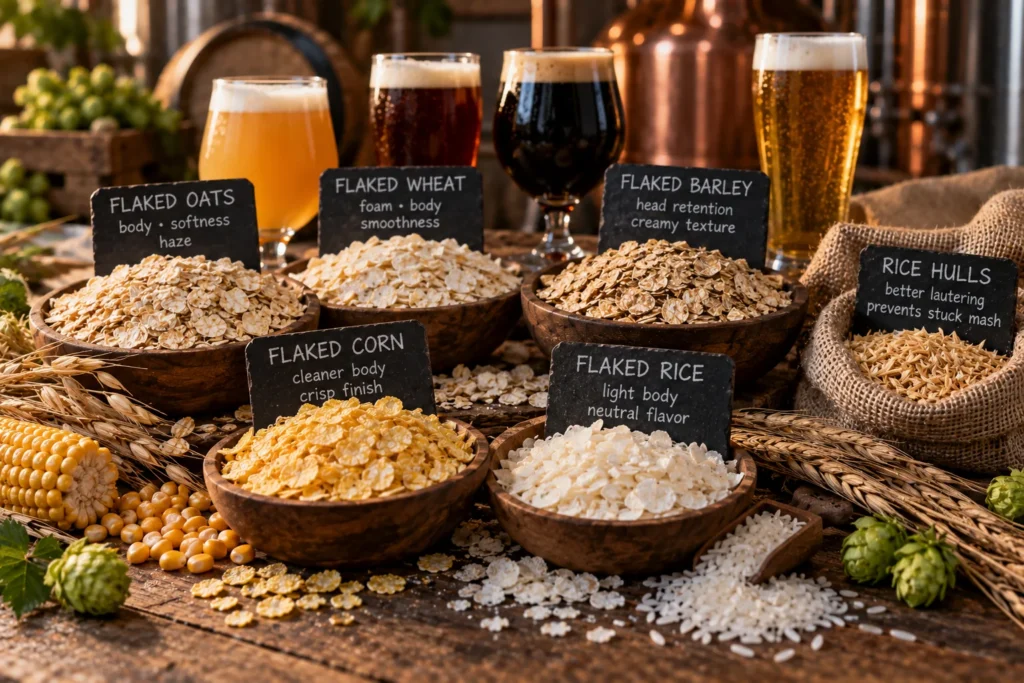
Malted barley may be the foundation of most beer recipes, but it is far from the only grain available to homebrewers.
Flaked oats can make a beer softer and fuller.
Wheat can improve foam and add a smooth grain character.
Flaked barley can create a dense, creamy head.
Corn can lighten the body and flavor of a beer.
Rice can produce an exceptionally clean and crisp result.
These ingredients are often called adjuncts, but that word can be misleading.
An adjunct is not automatically a cheap substitute for malt.
Used correctly, flaked and unmalted grains are powerful recipe-design tools.
They can change:
- body;
- mouthfeel;
- foam retention;
- haze;
- fermentability;
- flavor;
- color;
- dryness;
- overall drinkability.
Some of the world’s most recognizable beer styles depend on them.
The key is understanding what each grain contributes and how much to use.
What Are Flaked Grains?
Flaked grains are cereal grains that have usually been heated, softened and passed through rollers.
The process produces the familiar flattened flakes.
More importantly for brewing, the heat treatment gelatinizes much of the starch inside the grain.
Gelatinization makes the starch accessible to the enzymes in the mash.
This is important because yeast cannot directly ferment starch.
The starch first needs to be converted into simpler sugars.
Flaked grains generally contain little or no useful diastatic power of their own, so they normally depend on enzymes from base malt for conversion.
This means a recipe containing flaked oats, wheat, barley, corn or rice should usually also contain enough enzymatically active base malt.
Flaked Grain vs Malted Grain
Flaked grain and malted grain are not the same thing.
Malting involves allowing the grain to germinate under controlled conditions before drying or kilning it.
This process develops enzymes and changes the structure of the grain.
Flaking primarily makes the starch physically accessible through heat and pressure.
Therefore:
Malted grain can provide enzymes as well as starch.
Flaked grain generally provides starch and other grain components but depends on enzymes from malt for conversion.
This difference becomes especially important when adjuncts make up a large percentage of the recipe.
Do Flaked Grains Need to Be Milled?
Usually not in the same way as whole malt.
The rolling process has already broken down much of the physical structure of the grain.
Flaked oats, wheat and barley can generally be added directly to the mash.
Running them through a grain mill is normally unnecessary.
In some systems, milling flakes may actually make the mash more compact and increase the risk of slow lautering.
Simply mix them thoroughly with the crushed malt.
Do Flaked Grains Need a Cereal Mash?
Most commercially produced brewing flakes are already pre-gelatinized.
That means they can normally be added directly to the main mash.
This is one of their major advantages.
Raw corn or raw rice can be different.
Their starch may require cooking or a separate cereal mash before the malt enzymes can efficiently convert it.
For homebrewers, pre-gelatinized flaked products are therefore much easier to use.
Always check the manufacturer’s instructions if you are unsure.
Flaked Oats
Flaked oats have become extremely popular in modern craft brewing.
They are particularly associated with:
- Hazy IPA;
- NEIPA;
- Oatmeal Stout;
- Porter;
- creamy Pale Ale;
- some modern sour beers.
Their main contribution is not a strong oat flavor.
Their greatest effect is usually on mouthfeel.
What Do Flaked Oats Add to Beer?
Flaked oats can contribute:
- fuller body;
- soft mouthfeel;
- creamy texture;
- smoothness;
- haze;
- improved foam texture;
- subtle grain flavor.
They contain relatively high levels of beta-glucans and proteins.
These compounds can increase viscosity and create the soft, almost silky mouthfeel associated with many modern hazy beers.
How Much Flaked Oats Should You Use?
A useful general range is:
5–20% of the grain bill.
At around 5%, the effect can be subtle.
At 10–15%, the increased softness and body usually become much more noticeable.
At 20% or more, oats can have a major impact on both mouthfeel and lautering.
Some specialty beers use even larger amounts, but the mash becomes increasingly difficult to handle.
For a first experiment, 5–10% is a very practical range.
Flaked Oats in NEIPA and Hazy IPA
Flaked oats are strongly associated with Hazy IPA because they support the soft, full mouthfeel expected in the style.
A typical grain bill might contain:
- Pale Ale Malt;
- wheat malt;
- flaked oats.
The base malt provides the enzymes and most of the fermentable extract.
Wheat contributes protein and foam.
Oats add softness and body.
Together, they create an excellent foundation for intense hop aroma.
However, more oats do not automatically create a better Hazy IPA.
Excessive oats can make the beer:
- too thick;
- heavy;
- gummy;
- difficult to lauter.
Balance is more important than simply maximizing the amount of oats.
Flaked Oats in Stout
Oats have a much longer brewing history than modern Hazy IPA might suggest.
Oatmeal Stout is the obvious example.
In dark beer, oats can soften the impression of roasted grain and create a fuller, smoother mouthfeel.
This can be especially useful when the recipe contains:
- Roasted Barley;
- Chocolate Malt;
- Black Malt.
The roast provides dryness and intensity.
The oats help create body and softness.
This contrast can produce a beautifully balanced Stout.
Can Oats Hurt Head Retention?
This question often creates confusion.
Oats contain lipids, and fats are normally associated with poor foam stability.
However, oats also contain proteins and beta-glucans that can support body and foam texture.
In practical brewing, moderate amounts of flaked oats usually do not destroy head retention.
A well-designed beer containing oats can have excellent foam.
Problems are more likely when extremely high percentages are used or when other parts of the brewing process are unfavorable to foam.
Wheat in Homebrewing
Wheat is one of the most important grains after barley.
It appears in traditional wheat beers as well as modern Pale Ale, IPA, Saison and sour beer.
Wheat can contribute:
- excellent foam;
- high protein;
- smooth grain flavor;
- body;
- haze;
- a slightly bread-like character.
However, there is an important distinction between wheat malt and flaked wheat.
They are related ingredients, but they are not identical.
Flaked Wheat
Flaked wheat is unmalted wheat that has been processed into flakes.
It contains plenty of starch and protein but little useful enzymatic power.
It therefore relies on the base malt for conversion.
What Does Flaked Wheat Add?
Flaked wheat can provide:
- strong foam retention;
- fuller mouthfeel;
- protein haze;
- soft grain character;
- body.
It is particularly useful in:
- Witbier;
- Hazy IPA;
- NEIPA;
- Saison;
- sour beer;
- certain Pale Ales.
The protein content can help create a persistent head and can also contribute to haze.
In a clear beer, this needs to be considered.
In a deliberately hazy beer, it can be an advantage.
How Much Flaked Wheat Should You Use?
A useful starting range is:
5–20% of the grain bill.
Small amounts can improve foam without making the wheat character obvious.
Higher percentages contribute more strongly to mouthfeel, haze and grain flavor.
Traditional styles such as Witbier may use very large amounts of unmalted wheat.
For an IPA or Pale Ale, however, 5–10% is often enough to make a noticeable difference.
Wheat Malt vs Flaked Wheat
Wheat Malt has been malted.
Flaked Wheat has not.
This affects both enzymes and flavor.
Wheat Malt generally provides:
- some enzymatic power;
- clean wheat flavor;
- bread and dough notes;
- protein;
- foam support.
Flaked Wheat generally provides:
- softer raw-grain character;
- high protein;
- haze;
- body;
- strong foam support.
Both can be excellent ingredients.
Which one is better depends on the beer.
We will examine this difference in greater detail in the dedicated Wheat Malt vs Flaked Wheat article.
Flaked Barley
Flaked barley is unmalted barley that has been processed so its starch is accessible during mashing.
It is strongly associated with Stout brewing.
Its most famous use is in Irish Dry Stout.
What Does Flaked Barley Add?
Flaked barley can contribute:
- creamy body;
- dense foam;
- excellent head retention;
- grainy flavor;
- fuller mouthfeel.
Unlike oats, the character is usually less silky and more grain-like.
One of its greatest strengths is foam.
A Stout made with a significant percentage of flaked barley can develop a dense, persistent creamy head.
Flaked Barley in Irish Stout
One of the classic grain combinations for Irish Dry Stout is remarkably simple:
- Pale Ale Malt;
- Flaked Barley;
- Roasted Barley.
Each ingredient has a clear job.
Pale Ale Malt provides enzymes and fermentable extract.
Flaked Barley provides body and foam.
Roasted Barley provides color, coffee and dry roast.
This is an excellent example of why a good beer does not need a complicated malt bill.
Three carefully chosen ingredients can create enormous complexity.
How Much Flaked Barley Should You Use?
A useful general range is:
5–20% of the grain bill.
At lower levels, it can improve body and foam.
At higher levels, its grain character and effect on mouthfeel become much more noticeable.
Traditional Stout recipes can use substantial quantities.
As with oats and wheat, higher percentages can make lautering more difficult.
Corn in Homebrewing
Corn has sometimes developed an unfair reputation among craft brewers.
Because large commercial breweries have historically used corn as an adjunct, it is occasionally described simply as a cheap substitute for barley malt.
That interpretation misses its real brewing value.
Corn can be used intentionally to create a beer that is:
- lighter;
- cleaner;
- drier;
- less malty;
- highly drinkable.
Used correctly, it is a legitimate brewing ingredient rather than a sign of poor-quality beer.
What Does Corn Add to Beer?
Corn can contribute:
- fermentable extract;
- lighter body;
- lighter malt flavor;
- subtle sweetness;
- increased drinkability.
Compared with using 100% barley malt, replacing part of the malt with corn can reduce the intensity of the malt character.
This can be desirable in:
- American Lager;
- Cream Ale;
- historical American beer;
- certain light ales and lagers.
The goal is often a clean, refreshing beer rather than a strongly malty one.
Flaked Maize
For homebrewers, flaked maize is one of the easiest ways to use corn.
Because it has already been processed and gelatinized, it can generally be added directly to the mash.
The enzymes from the base malt convert its starch.
A common range is approximately:
5–25% of the grain bill.
The exact amount depends on how much you want to lighten the beer’s body and malt character.
Does Corn Make Beer Taste Like Corn?
Not necessarily.
Properly used flaked maize can be surprisingly neutral.
At moderate percentages, its main effect may be to lighten the body and malt profile rather than create an obvious corn flavor.
There is also an important distinction between the flavor of corn as an ingredient and the cooked-corn aroma associated with DMS — dimethyl sulfide.
They are not the same thing.
DMS is a brewing-process issue and should not automatically be blamed on the use of corn.
Rice in Homebrewing
Rice is another adjunct strongly associated with very light, crisp lagers.
Like corn, it is sometimes dismissed because of its association with large commercial breweries.
But rice can be extremely useful when the brewer intentionally wants a very clean beer.
Rice can help produce:
- light body;
- dry finish;
- very neutral flavor;
- pale color;
- high drinkability.
It allows the hop and fermentation character to remain clean and subtle.
Flaked Rice
Flaked rice has been processed so it can generally be added directly to the mash.
Like other unmalted adjuncts, it depends on enzymes from the malt for conversion.
Rice itself contributes very little strong flavor.
That neutrality is exactly why brewers use it.
If corn can provide a faint sweetness or grain character, rice is often even more neutral.
How Much Rice Should You Use?
A practical range is:
5–30% of the grain bill.
Small quantities subtly lighten the beer.
At larger percentages, the effect becomes much more obvious.
The beer can become:
- lighter;
- crisper;
- less malty;
- more highly attenuated in impression.
When very large percentages of adjuncts are used, the diastatic power of the remaining malt becomes increasingly important.
Corn vs Rice
Both ingredients can lighten a beer, but they are not identical.
Corn can provide:
- light sweetness;
- subtle grain character;
- lighter body;
- high drinkability.
Rice generally provides:
- very neutral flavor;
- very pale color;
- crispness;
- lighter body.
If you want a little more character, corn can be useful.
If you want maximum neutrality, rice is often the better choice.
Do Corn and Rice Make Beer Lower Quality?
No.
Ingredient quality and recipe design determine beer quality—not whether every fermentable ingredient is malted barley.
A poorly designed all-malt beer can be worse than an expertly brewed beer containing rice or corn.
The important question is:
Why is the ingredient in the recipe?
If corn or rice is used deliberately to create the desired body, flavor and drinkability, it is doing exactly what a brewing ingredient should do.
What Are Rice Hulls?
Rice hulls are completely different from rice used as a fermentable adjunct.
They are the outer husks of rice grains.
They contribute essentially no meaningful:
- sugar;
- flavor;
- color;
- alcohol.
Instead, rice hulls are a physical aid for the mash.
They create structure in the grain bed and improve wort flow.
This makes them particularly useful when brewing with large quantities of grains that do not contain barley husks.
When Should You Use Rice Hulls?
Rice hulls are especially useful with large amounts of:
- wheat;
- oats;
- rye;
- flaked grains.
Barley malt naturally contains husks that help create a filter bed during lautering.
Wheat and rye do not provide the same structure.
Oats and flakes can also make the mash thick and sticky.
Without enough structure, the grain bed can compact.
The result may be:
- slow recirculation;
- poor wort flow;
- stuck mash;
- stuck sparge.
Rice hulls help prevent this.
How Much Rice Hull Should You Use?
For many homebrew batches, approximately:
2–5% of the grain weight
is enough to improve the grain bed.
You do not need to calculate them as fermentable grain because they contribute essentially no extract.
If a recipe contains a very high percentage of wheat, rye or oats, using more may be helpful.
Rice hulls are cheap insurance against a frustrating stuck mash.
Should Rice Hulls Be Washed?
They can contain dust.
A quick rinse before adding them to the mash can remove some of that dust.
Some brewers also soak them briefly in hot water.
Neither approach needs to be complicated.
The important thing is that the hulls remain loose enough to create structure in the grain bed.
Flaked Grains and Lautering Problems
The biggest practical disadvantage of large flaked-grain additions is not flavor.
It is mash consistency.
Oats, wheat and rye can increase the amount of:
- beta-glucans;
- gums;
- proteins.
The mash can become thick and sticky.
This can slow down:
- recirculation;
- lautering;
- sparging.
On systems that continuously recirculate wort, this can become especially noticeable.
The solution can include:
- using rice hulls;
- avoiding excessively fine crush;
- reducing recirculation speed;
- mixing the mash thoroughly;
- not using unnecessary amounts of flakes.
More adjunct is not automatically better.
Beta-Glucans and Mouthfeel
Beta-glucans are polysaccharides found in cereal grains.
Oats and barley can contain significant amounts.
In moderate concentrations, they can contribute positively to:
- body;
- viscosity;
- mouthfeel;
- foam texture.
At excessive levels, however, they can make the mash difficult to process.
This illustrates an important brewing principle:
The same compound that creates a desirable effect in the finished beer can create a practical problem during brewing if used excessively.
Do Flaked Grains Increase Haze?
They can.
Wheat and oats contain substantial amounts of proteins and other haze-forming compounds.
In a Hazy IPA, this may be desirable.
In a crystal-clear lager, it may not be.
The final clarity of beer depends on many factors, including:
- grain bill;
- mash;
- boil;
- yeast;
- fermentation;
- finings;
- cold conditioning.
But the choice of grain certainly plays a role.
If brilliant clarity is a priority, very high percentages of oats and wheat may work against that goal.
Do Flaked Grains Increase Original Gravity?
Yes.
Flaked grains contain starch that can be converted into fermentable sugars during mashing.
They therefore contribute extract and can increase original gravity.
However, they need sufficient enzymatic power in the mash for effective conversion.
This is why the amount and type of base malt matter when using large percentages of adjuncts.
Do Flaked Grains Make Beer Sweeter?
Not automatically.
This is a common misconception.
Flaked oats may make a beer feel fuller and softer, but that does not necessarily mean the beer contains significantly more residual sugar.
Body, sweetness and final gravity are related, but they are not the same thing.
Likewise, corn and rice can contribute plenty of starch-derived fermentable extract while creating a beer that tastes lighter and drier.
Perceived sweetness depends on the entire recipe and fermentation.
Flaked Oats vs Flaked Wheat
These two ingredients frequently appear together in modern IPA recipes.
They perform overlapping but different roles.
Flaked Oats tend to emphasize:
- softness;
- creaminess;
- body;
- silky mouthfeel.
Flaked Wheat tends to emphasize:
- foam;
- protein;
- haze;
- grain structure in the flavor.
For a Hazy IPA, using both can work very well.
For example, instead of using a very large amount of oats, a brewer might use moderate quantities of oats and wheat.
This can create a balanced combination of softness, foam and haze.
Flaked Barley vs Flaked Oats
These are also easy to confuse.
Both can increase body and improve foam texture.
However:
Flaked Oats generally produce a softer, silkier impression.
Flaked Barley often produces a grainier character and particularly strong foam retention.
This is one reason oats are strongly associated with Oatmeal Stout and Hazy IPA, while flaked barley is so closely associated with Irish Dry Stout.
Can You Combine Several Flaked Grains?
Yes.
But there should be a reason for each one.
A Hazy IPA might use:
- wheat malt;
- flaked oats.
A Stout might use:
- flaked barley;
- oats.
A Witbier might use:
- Pilsner Malt;
- unmalted or flaked wheat.
The important question is not:
“How many different grains can I put into this beer?”
The better question is:
“What job does each grain perform?”
If two ingredients perform essentially the same job, you may not need both.
How Much Flaked Grain Is Too Much?
There is no universal maximum.
It depends on:
- the grain;
- the beer style;
- the base malt;
- mash thickness;
- equipment;
- lautering method.
For many normal recipes, 5–15% of a particular flaked grain is easy to work with.
At 20–30%, its effect becomes much more significant and mash performance deserves more attention.
At even higher percentages, conversion and lautering need to be considered carefully.
Traditional recipes can exceed these numbers, especially wheat-based beers.
The percentages are therefore guidelines rather than limits.
A Practical Comparison of Flaked Grains
| Grain | Main Contribution | Typical Effect | Common Beer Styles | Typical Range |
| Flaked Oats | Softness, body | Creamy, silky mouthfeel | NEIPA, Hazy IPA, Oatmeal Stout | 5–20% |
| Flaked Wheat | Protein, foam | Haze, body, strong head retention | Witbier, NEIPA, Saison, Sour | 5–20% |
| Flaked Barley | Body, foam | Creamy head, grain character | Irish Stout, Porter | 5–20% |
| Flaked Maize | Fermentable extract | Lighter body, subtle sweetness | Cream Ale, American Lager | 5–25% |
| Flaked Rice | Neutral extract | Crisp, light, neutral | Light Lager, American Lager | 5–30% |
| Rice Hulls | Mash structure | Improves wort flow | Wheat, Rye, Oat-heavy beers | 2–5% of grain weight |
These numbers are practical starting points rather than strict recipe rules.
Which Flaked Grain Should You Choose?
Choose according to the result you want.
If you want:
soft, creamy mouthfeel
→ Flaked Oats.
If you want:
foam, protein and haze
→ Flaked Wheat.
If you want:
dense foam and creamy Stout texture
→ Flaked Barley.
If you want:
lighter body with a little grain character
→ Flaked Maize.
If you want:
very clean, light and neutral fermentable extract
→ Flaked Rice.
If you want:
better mash flow without adding fermentable extract
→ Rice Hulls.
This is much more useful than thinking of all adjuncts as one category.
Do Not Add Adjuncts Without a Purpose
Modern homebrew recipes can easily become unnecessarily complicated.
A recipe might contain:
- Pale Malt;
- Wheat Malt;
- Flaked Wheat;
- Flaked Oats;
- Flaked Barley;
- Carapils.
That does not automatically mean the beer will have better body or foam.
Several ingredients may be trying to solve the same problem.
A simpler grain bill is often easier to predict.
Before adding an adjunct, ask:
What exactly do I want this ingredient to change?
Body?
Foam?
Haze?
Dryness?
Fermentability?
Flavor?
If you know the answer, the ingredient has a purpose.
If you do not know the answer, it may not need to be there.
A Simple Homebrewing Experiment
A useful way to understand adjuncts is to brew the same simple Pale Ale several times.
Start with a basic recipe containing mostly Pale Ale Malt.
Then replace approximately 10% of the grain bill with:
Batch 1 → Flaked Oats
Batch 2 → Flaked Wheat
Batch 3 → Flaked Barley
Keep the hops, yeast, mash temperature and fermentation as similar as possible.
Compare:
- body;
- foam;
- haze;
- mouthfeel;
- grain flavor.
The differences are much easier to understand when everything else remains the same.
You can learn more from this experiment than from memorizing dozens of descriptions.
Final Thoughts
Flaked grains are not simply cheap substitutes for malt.
They are useful brewing tools with very different purposes.
Flaked Oats can create softness and a creamy mouthfeel.
Flaked Wheat can improve foam, protein content and haze.
Flaked Barley can create a dense head and fuller texture, especially in Stout.
Corn can lighten the malt profile and increase drinkability.
Rice can produce an exceptionally clean, crisp and neutral beer.
Rice hulls do something completely different: they improve the physical structure of the mash without meaningfully changing the beer itself.
The key is understanding why an ingredient is in the recipe.
Do not add oats simply because you are brewing an IPA.
Do not add wheat simply because you want better foam.
Do not reject corn or rice simply because large breweries use them.
Every grain is a tool.
Once you understand what that tool does, you can decide whether your beer actually needs it.
And that is one of the most important steps in moving from following recipes to designing your own.