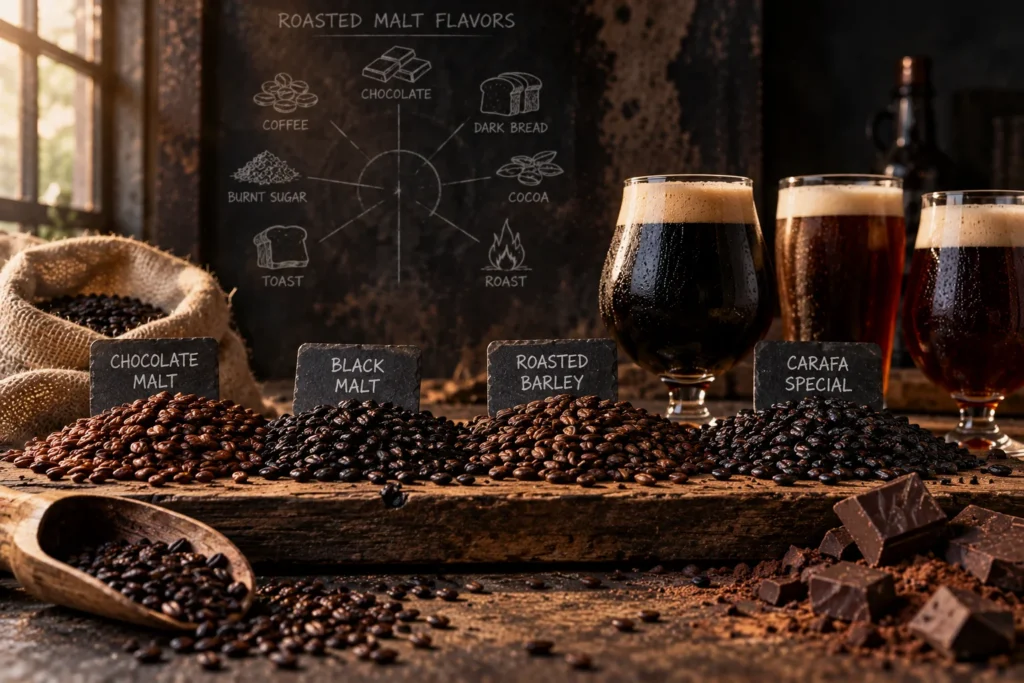
Roasted malts and grains create some of the most distinctive flavors and colors in beer.
Chocolate, coffee, cocoa, toast, dark bread, espresso, burnt sugar and deep roasted flavors can all come from relatively small amounts of dark grain.
They are essential ingredients in many Porters, Stouts and other dark beers.
But roasted grains are not interchangeable.
Chocolate Malt does not taste like Black Malt.
Black Malt does not behave like Roasted Barley.
Carafa can produce a completely different impression from traditional roasted grain, especially when using dehusked versions designed to reduce harshness.
Understanding these differences is important because roasted grains are powerful ingredients.
A small percentage can transform a beer.
Too much—or the wrong type—can create harsh bitterness, burnt flavors, excessive dryness or an unpleasant astringent finish.
The goal is therefore not simply to make beer darker.
The goal is to choose the roasted ingredient that creates the exact flavor, color and intensity the beer needs.
What Are Roasted Malts?
Roasted malts are grains that have been exposed to much higher temperatures than standard base malts.
During roasting, the grain becomes progressively darker while developing increasingly intense flavors.
Depending on the roasting level, these flavors can include:
- toast
- biscuit
- nuts
- cocoa
- chocolate
- coffee
- espresso
- burnt sugar
- char
- intense roast
At the darkest end of the spectrum, the malt can become nearly black.
Roasting also dramatically reduces or destroys enzymatic activity.
This means roasted malts generally cannot provide the enzymatic foundation of a mash.
Instead, they are used alongside base malt.
A typical dark beer may still contain 80–90% or more pale base malt, with only a relatively small percentage of roasted grains creating much of its dark color and characteristic flavor.
This is an important lesson:
A black beer does not require a grain bill made mostly from dark malt.
A little roasted grain can have an enormous effect.
Roasted Malt vs Roasted Grain
Not every dark brewing grain is technically a malt.
This distinction is particularly important when discussing Roasted Barley.
Chocolate Malt and Black Malt are produced from malted barley.
Roasted Barley is generally made from unmalted barley that is roasted at high temperature.
This difference affects flavor.
Roasted Barley often produces a sharper, drier and more coffee-like character than many roasted malts.
That character is one of the defining elements of traditional Irish Stout.
So while brewers often group all these ingredients together as “roasted malts,” technically some are roasted grains rather than malt.
How Are Roasted Malts Made?
After malting, grain can be placed into roasting equipment similar in principle to the equipment used for roasting coffee.
The maltster carefully controls:
- temperature
- roasting time
- moisture
- airflow
- cooling
As temperature increases, the grain undergoes a series of chemical reactions.
Sugars and amino compounds react to create increasingly dark colors and complex flavors.
At moderate roasting levels, the malt may develop:
- toast
- nuts
- cocoa
- chocolate
At more intense roasting levels, the profile shifts toward:
- dark chocolate
- coffee
- espresso
- burnt sugar
- char
The exact process varies between maltsters, which is why two products sold under similar names can taste noticeably different.
Always check the manufacturer’s specifications when designing a precise recipe.
Chocolate Malt
Chocolate Malt is one of the most useful dark specialty malts in brewing.
Despite its name, it does not contain chocolate.
The name refers to its dark color and the cocoa- and chocolate-like flavors created during roasting.
Typical Flavor
Chocolate Malt can contribute:
- cocoa
- dark chocolate
- coffee
- toast
- nuts
- dark bread
- light roasted bitterness
Compared with very dark Black Malt or Roasted Barley, Chocolate Malt is generally softer and more rounded.
This makes it extremely versatile.
Typical Uses
Chocolate Malt works particularly well in:
- Porter
- Brown Ale
- Stout
- Dark Mild
- Baltic Porter
- Old Ale
- certain Belgian dark beers
Small amounts can also be used in lighter beers when subtle color or complexity is desired.
How Much Chocolate Malt Should You Use?
A useful general range is:
1–8% of the grain bill.
At approximately 1–3%, Chocolate Malt can add color and subtle cocoa or toast.
At 3–6%, the chocolate and coffee character becomes much more obvious.
At higher percentages, it can become strongly roasted and increasingly dry.
The exact intensity depends on the particular Chocolate Malt.
Pale Chocolate Malt
Pale Chocolate Malt is lighter than traditional Chocolate Malt.
It can be particularly useful when you want:
- cocoa
- nuts
- toast
- light coffee
without introducing as much dark color or aggressive roast.
It works beautifully in Brown Ale, Porter and other malt-focused beers where a softer chocolate character is desirable.
Pale Chocolate is also useful when traditional Chocolate Malt feels too intense for the recipe.
Chocolate Rye
Chocolate Rye is produced from rye rather than barley.
It can contribute:
- dark chocolate
- cocoa
- coffee
- spicy grain character
- dark bread
Because rye does not have the same husk structure as barley, roasted rye can sometimes produce a smoother roast impression.
It can be an excellent specialty ingredient in:
- Porter
- Stout
- Rye Beer
- strong dark ales
It is usually used in relatively small percentages because its character can become intense quickly.
Black Malt
Black Malt—also called Black Patent Malt in some brewing traditions—is roasted much darker than Chocolate Malt.
It is one of the darkest brewing malts available.
Its primary contributions are intense color and strong roasted character.
Typical Flavor
Black Malt may contribute:
- burnt toast
- intense roast
- coffee
- char
- burnt sugar
- bitter chocolate
At higher levels, it can become sharp and aggressive.
This is not necessarily a defect.
In the right beer, that sharp roast can provide important complexity and structure.
But Black Malt should generally be treated as a powerful seasoning rather than a major part of the grain bill.
Typical Uses
Black Malt can be used in:
- Porter
- Stout
- Baltic Porter
- Black IPA
- dark lager
- Schwarzbier
- strong dark ale
It is also useful in very small amounts when the primary goal is darkening the beer.
How Much Black Malt Should You Use?
A practical range is often:
0.5–5% of the grain bill.
At very low percentages, it can deepen color without becoming strongly obvious.
As the percentage increases, burnt and roasted flavors become increasingly prominent.
Black Malt for Color Adjustment
One of the useful properties of Black Malt is its enormous coloring power.
A very small quantity can noticeably darken beer.
For example, a brewer creating a dark lager may want deep brown or black color without producing the intense roast character of a Stout.
A small amount of Black Malt can help achieve this.
However, even small quantities can contribute flavor.
If the goal is primarily color with minimal roast character, dehusked dark malts such as certain Carafa products may be more appropriate.
Roasted Barley
Roasted Barley is one of the most important grains in Stout brewing.
Unlike Chocolate Malt and Black Malt, traditional Roasted Barley is made from unmalted barley.
It is roasted very dark, creating an intense, dry roasted character.
Typical Flavor
Roasted Barley can contribute:
- coffee
- espresso
- burnt grain
- dark chocolate
- char
- dry roast
- slightly bitter roast
It often produces a sharper and drier impression than Chocolate Malt.
This dry roast is a defining feature of many traditional Stouts.
Typical Uses
Roasted Barley is especially associated with:
- Irish Dry Stout
- Foreign Extra Stout
- Imperial Stout
- other robust Stout styles
It can also appear in Porter and other dark beers, but its strongest historical association is with Stout.
How Much Roasted Barley Should You Use?
A typical starting range might be:
2–8% of the grain bill.
Lower levels provide subtle roast.
Higher levels create unmistakable coffee, dark roast and dryness.
Traditional Stout recipes may use enough Roasted Barley for it to become one of the defining flavors of the beer.
Chocolate Malt vs Roasted Barley
These two ingredients are often used together, but they create different effects.
Chocolate Malt tends toward:
- cocoa
- chocolate
- nuts
- softer coffee
- rounded roast
Roasted Barley tends toward:
- coffee
- espresso
- burnt grain
- sharper roast
- drier finish
A Porter might rely more heavily on Chocolate Malt.
A traditional Irish Stout may rely more strongly on Roasted Barley.
Combining them can create layers of roast rather than one-dimensional darkness.
Black Malt vs Roasted Barley
Both are extremely dark ingredients, but they are not identical.
Black Malt is made from malted barley.
Roasted Barley is normally made from unmalted barley.
Black Malt can produce:
- burnt toast
- char
- intense roast
- strong coloring power
Roasted Barley often produces:
- coffee
- espresso
- dry roast
- burnt grain
The difference can be subtle in complex recipes, but becomes easier to recognize when the ingredients are tasted separately.
What Is Carafa?
Carafa is a family of dark roasted malts produced by Weyermann in Germany.
Several versions exist, typically including:
- Carafa I
- Carafa II
- Carafa III
As the number increases, the malt generally becomes darker.
Carafa malts can provide dark color and roasted flavors and are commonly used in German dark beer as well as many modern craft recipes.
However, there is an especially important distinction:
Carafa and Carafa Special are not exactly the same thing.
What Is Carafa Special?
Carafa Special is produced using dehusked barley.
Removing much of the husk before roasting reduces some of the harsher roasted and astringent compounds associated with very dark grain.
As a result, Carafa Special can provide:
- deep brown or black color
- dark chocolate
- mild coffee
- gentle roast
with less aggressive burnt or acrid character.
This makes it particularly useful when a brewer wants a very dark beer without making it taste like a Stout.
Carafa I, II and III
The three common Carafa levels provide progressively greater color intensity.
Carafa I
The lightest of the three.
It can provide:
- dark bread
- cocoa
- mild coffee
- gentle roast
It works well when moderate dark color and relatively restrained roast are desired.
Carafa II
A middle option.
It can contribute:
- chocolate
- coffee
- dark bread
- deeper roast
It is very useful in dark lagers, Porters and Black IPA.
Carafa III
The darkest common version.
It has extremely strong coloring power.
It can provide:
- dark chocolate
- coffee
- deep roast
- very dark color
The dehusked Carafa Special III is particularly popular when brewers want black color with less harsh roast.
Carafa Special vs Black Malt
This comparison is particularly useful when designing dark beers.
Black Malt can produce intense:
- char
- burnt toast
- sharp roast
Carafa Special generally produces a smoother impression.
It can create very dark color while reducing some of the harshness associated with husk-heavy roasted malt.
For this reason:
Black Malt may be preferable when aggressive roast is part of the desired flavor.
Carafa Special may be preferable when the goal is dark color with smoother roast.
Neither is automatically better.
They solve different problems.
Why Can Roasted Malt Taste Harsh?
Dark roasted grains contain compounds created during intense heating.
The husk can contribute:
- bitterness
- dryness
- tannic sensations
- astringency
When used excessively—or extracted under unfavorable conditions—these characteristics can become unpleasant.
A beer may then taste:
- burnt
- acrid
- excessively bitter
- rough
- drying
The solution is not necessarily to eliminate roasted grain.
Instead, the brewer can control:
- roasted malt percentage
- type of roasted malt
- mash pH
- water chemistry
- extraction method
This is where recipe design and water chemistry begin to interact strongly.
Roasted Malts and Mash pH
Dark roasted grains are acidic.
They can lower mash pH more strongly than pale malt.
This is particularly important in beers containing significant amounts of roasted malt.
If brewing water already has low alkalinity, a large roasted grain addition may push mash pH lower than desired.
On the other hand, water with higher alkalinity can sometimes work well for dark beers because that alkalinity helps counteract the acidity of roasted grains.
This is one reason historical beer styles often developed around local water chemistry.
Modern brewers can adjust water directly, but the underlying relationship remains important.
Do not automatically use the same water treatment for a pale IPA and a heavily roasted Stout.
The grain bill itself changes the chemistry of the mash.
Why Dark Beer Can Taste Sour
Sometimes brewers describe a Stout or Porter as slightly sour even when the beer is not infected.
One possible reason is excessive acidity from the dark grain combined with the water profile.
Roasted malt naturally introduces acidity.
If mash pH becomes too low, the beer can develop a sharper character that may be perceived as:
- tart
- acidic
- thin
- harsh
This is different from microbial sourness.
Correct mash pH and appropriate water chemistry can produce a much smoother dark beer.
How to Make Roasted Flavor Smoother
Several techniques can help create smoother dark beer.
One is simply choosing a less aggressive roasted ingredient.
For example:
Carafa Special instead of Black Malt
can reduce harshness while retaining dark color.
Another option is reducing the total percentage of highly roasted grain.
The brewer can also balance dark grain with:
- Munich Malt
- Crystal Malt
- oats
- appropriate chloride levels
- suitable mash pH
However, smooth does not mean sweet.
A well-made Stout can be dry and highly roasted while still avoiding harshness.
Adding Roasted Grain Late in the Mash
Some brewers add dark roasted grains only during the later part of the mash.
The idea is to extract color and some flavor while reducing prolonged contact with the husk.
This technique can create a softer roasted profile.
It can be useful in:
- Schwarzbier
- dark lager
- Black IPA
- smoother Porter
where deep color is desired without an aggressive Stout-like roast.
It is not necessary for every dark beer.
If strong roast is part of the intended character, adding roasted grains normally at mash-in may be completely appropriate.
Cold Steeping Roasted Malt
Another technique is cold steeping.
Dark grains are crushed and soaked in cold water for several hours or overnight.
The dark liquid is then separated from the grain and added to the wort.
Cold steeping can extract:
- color
- chocolate
- coffee-like flavors
while potentially reducing some harshness and astringency.
The result can be smoother than traditional full-mash extraction.
However, it also changes extraction efficiency and flavor intensity, so recipes may need adjustment.
Cold steeping is a technique—not automatically a superior method.
Roasted Malt in Porter
Porter often benefits from layered dark malt character.
A classic approach may combine:
- Pale Ale Malt
- Chocolate Malt
- Crystal Malt
- a small amount of Black Malt
This can create:
- chocolate
- caramel
- coffee
- toast
- dark fruit
- roast
without allowing any single flavor to dominate.
Porter is a particularly good style for learning how different dark malts interact.
Roasted Grain in Stout
Stout generally places more emphasis on roast.
Roasted Barley is especially important in traditional Irish-style Stout.
A simple Stout malt bill might contain:
- Pale Ale Malt
- Roasted Barley
- flaked barley
and very little else.
This demonstrates an important brewing principle:
Complex flavor does not require a complicated recipe.
Roasted Barley can provide enough coffee, color and dry roast to define the beer.
Other Stout styles may add Chocolate Malt, Crystal Malt, oats or other specialty grains for greater complexity.
Roasted Malt in Imperial Stout
Imperial Stout provides much more room for complexity.
A malt bill might contain:
- Pale Ale Malt
- Munich Malt
- Chocolate Malt
- Roasted Barley
- Black Malt
- Crystal Malt
- oats
But this does not mean all of them are required.
Imperial Stout can become muddy very easily if too many powerful malts compete with one another.
A good approach is to assign each ingredient a purpose.
For example:
Chocolate Malt → cocoa
Roasted Barley → coffee and dry roast
Dark Crystal → raisins and dark sugar
Oats → body
When every malt has a clear role, the recipe becomes easier to control.
Roasted Malt in Schwarzbier
Schwarzbier is a dark German lager, but it should not normally taste like a Stout.
This is an important distinction.
The goal is typically:
- very dark color
- smooth malt
- light chocolate
- gentle roast
- clean lager fermentation
rather than:
- aggressive coffee
- burnt grain
- heavy char
Dehusked roasted malts such as Carafa Special are therefore particularly useful.
They allow the brewer to create a black or very dark beer while keeping the roasted character restrained.
Roasted Malt in Black IPA
Black IPA creates an interesting challenge.
The beer should look dark, but strong roasted flavors can clash with modern hop character.
Large amounts of Roasted Barley or Black Malt may introduce coffee and burnt flavors that compete with citrus, tropical fruit and resinous hops.
For this reason, Black IPA often benefits from:
- Carafa Special
- other dehusked dark malt
- carefully controlled amounts of Chocolate Malt
The goal is often dark color with just enough roast to support the beer without overwhelming the hops.
Can You Use Too Much Roasted Malt?
Absolutely.
Roasted malt is powerful.
Excessive quantities can produce:
- burnt flavor
- harsh bitterness
- excessive dryness
- astringency
- charcoal-like character
- overwhelming coffee
This is especially important when combining several dark malts.
For example, a recipe containing Chocolate Malt, Black Malt, Roasted Barley and Carafa does not automatically become more complex.
It may simply become too roasted.
Ask the same question for every ingredient:
What is this malt contributing that the others are not?
If you cannot answer that question, you may not need it.
A Practical Roasted Malt Comparison
| Roasted Ingredient | Typical Character | Roast Intensity | Common Uses | Typical Starting Range |
| Pale Chocolate | Cocoa, nuts, light coffee | Low–Medium | Brown Ale, Porter | 1–6% |
| Chocolate Malt | Chocolate, cocoa, coffee, toast | Medium | Porter, Stout, Brown Ale | 1–8% |
| Black Malt | Burnt toast, char, intense roast | High | Porter, Stout, Black IPA | 0.5–5% |
| Roasted Barley | Coffee, espresso, dry roast | High | Stout, Imperial Stout | 2–8% |
| Carafa Special I | Cocoa, dark bread, mild roast | Low–Medium | Dark lager, Porter | 1–5% |
| Carafa Special II | Chocolate, coffee, smooth roast | Medium | Schwarzbier, Porter, Black IPA | 1–5% |
| Carafa Special III | Deep color, dark chocolate, restrained roast | Medium–High | Schwarzbier, Black IPA, dark lager | 0.5–4% |
These percentages are practical starting points rather than strict rules.
Always check the specifications of the exact malt you are using.
Which Roasted Malt Should You Choose?
Instead of asking:
“Which dark malt is best?”
ask what flavor you need.
If you want:
cocoa and chocolate
→ Chocolate Malt.
If you want:
coffee and dry roast
→ Roasted Barley.
If you want:
burnt toast, char and powerful color
→ Black Malt.
If you want:
very dark color with smoother roast
→ Carafa Special.
If you want:
gentle cocoa and nutty roast
→ Pale Chocolate Malt.
The correct ingredient depends on the beer.
A Simple Homebrewing Experiment
One of the best ways to understand roasted malts is to taste them side by side.
Take small samples of:
- Chocolate Malt
- Black Malt
- Roasted Barley
- Carafa Special
First smell the dry grain.
Then chew a few kernels.
You will immediately notice that “dark malt” is not one single flavor.
Chocolate Malt may seem cocoa-like and rounded.
Roasted Barley can be sharper and more coffee-like.
Black Malt may appear burnt or charred.
Carafa Special can feel noticeably smoother.
You can take the experiment further by steeping equal amounts of each malt separately in hot water and comparing the resulting liquids.
This is one of the fastest ways to build a practical understanding of roasted grain.
Do Not Choose Roasted Malt Only by Color
A common recipe-design mistake is choosing a dark malt solely because the beer needs to become darker.
Color matters, but flavor matters more.
Two malts capable of producing a similar dark color may create completely different beers.
For example:
Black Malt and Carafa Special III can both create very dark beer.
But the first may contribute much stronger burnt and charred character.
The second can produce a smoother result.
Therefore, when adjusting beer color, always consider:
What flavor comes with that color?
Final Thoughts
Roasted malts and grains are among the most powerful ingredients in brewing.
Chocolate Malt can create cocoa, chocolate and coffee.
Black Malt can provide intense color, burnt toast and char.
Roasted Barley creates the dry coffee-like roast that defines many Stouts.
Carafa—especially the dehusked Carafa Special versions—can produce deep color and dark malt complexity with a smoother roasted character.
None of these ingredients is universally better than the others.
They perform different jobs.
The key is to stop thinking of them simply as “dark malts.”
Instead, think of each one as a different flavor tool.
Chocolate.
Coffee.
Espresso.
Toast.
Char.
Dark bread.
Color.
Dryness.
Smooth roast.
Once you begin choosing roasted malt according to the exact contribution you need, designing Porter, Stout, Schwarzbier and other dark beers becomes much more predictable.
And as with Crystal Malt, one principle remains extremely important:
More specialty malt does not automatically make a better beer.
Use enough to create the character you want—and no more.