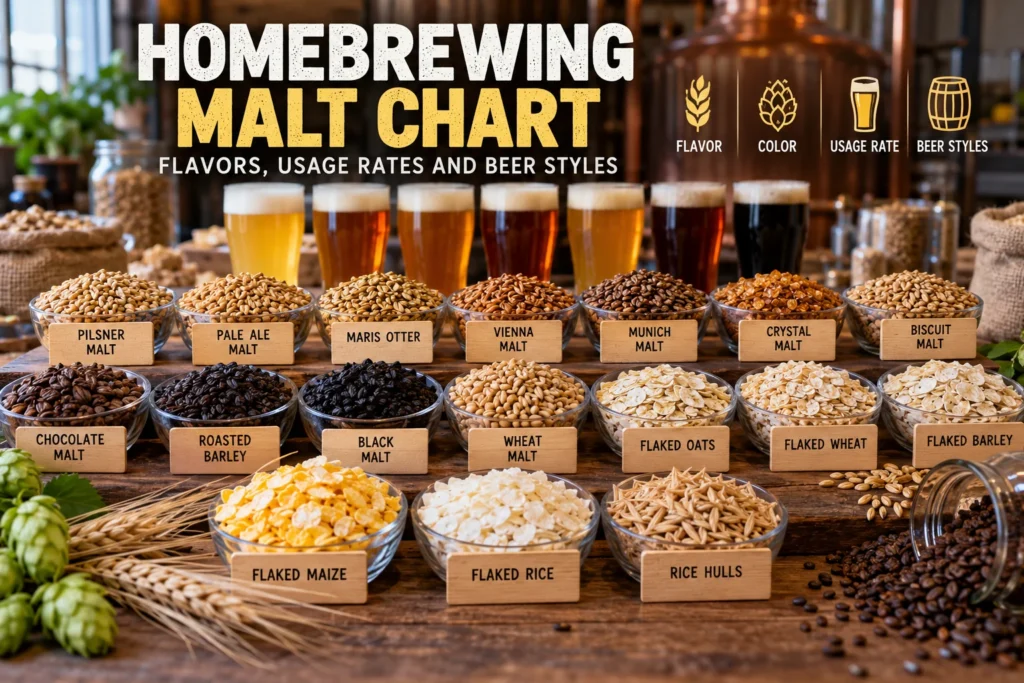
Choosing malt becomes much easier when you understand what each ingredient is actually supposed to do.
Some malts provide most of the fermentable sugars.
Others add bread, toast, biscuit, caramel, coffee or chocolate flavors.
Some improve body and foam.
Others are primarily used to adjust color.
And ingredients such as oats, wheat, corn and rice can change mouthfeel, haze, dryness and overall drinkability.
This guide brings the most important brewing malts and grains together in one practical reference.
Instead of looking at malt only by name, we will compare:
- malt type;
- typical flavor;
- color;
- common usage rate;
- brewing purpose;
- suitable beer styles.
The percentages in this guide are practical starting points, not strict rules.
Maltsters produce slightly different products, beer styles overlap, and experienced brewers often deliberately work outside normal ranges.
The goal is not to memorize every number.
The goal is to understand what each ingredient contributes so you can build better beer recipes.
How to Read This Malt Chart
Before looking at individual malts, it helps to understand four basic pieces of information.
Malt Type
Most brewing grains can be placed into broad groups:
Base Malts
Provide most of the fermentable extract and usually enough enzymes for starch conversion.
Crystal and Caramel Malts
Add sweetness, caramelized flavors, color and body.
Specialty Malts
Used primarily for specific flavors such as biscuit, toast, bread crust, honey or intense maltiness.
Roasted Malts and Grains
Provide dark color and flavors ranging from chocolate and coffee to intense roast and burnt notes.
Wheat and Other Grains
Used for foam, mouthfeel, haze, grain character or fermentable extract.
Understanding which group an ingredient belongs to already tells you a great deal about how it should be used.
What Does Usage Rate Mean?
If a malt is listed at 5–10%, that means approximately 5–10% of the total grain bill by weight.
For example, in a 5 kg grain bill:
5% = 250 g
10% = 500 g
20% = 1 kg
These percentages are more useful than fixed gram amounts because they work for almost any batch size.
A 10-liter brewer and a 50-liter brewer can therefore use the same recipe concept.
Base Malt Quick Reference
Base malts normally make up the majority of the grain bill.
They provide fermentable extract, enzymes and the fundamental malt character of the beer.
| Malt | Typical Flavor | Approx. Color | Typical Usage | Common Beer Styles |
| Pilsner Malt | Clean, light grain, honey, cracker | 2–4 EBC | 60–100% | Pilsner, Helles, Kölsch, Saison, Belgian Ale |
| Pale Ale Malt | Clean malt, biscuit, light toast | 5–8 EBC | 60–100% | Pale Ale, IPA, Porter, Stout |
| Maris Otter | Biscuit, bread, nutty, rich malt | 5–8 EBC | 60–100% | English Pale Ale, Bitter, Porter, Stout, IPA |
| Golden Promise | Sweet malt, biscuit, soft nutty character | 4–7 EBC | 60–100% | Scottish Ale, Pale Ale, IPA |
| Vienna Malt | Bread, toast, honey, light biscuit | 6–10 EBC | 10–100% | Vienna Lager, Märzen, Amber Lager, Bock |
| Munich I | Rich bread, toast, strong malt | 12–20 EBC | 10–100%* | Märzen, Dunkel, Bock, Amber Ale |
| Munich II | Dark bread, toast, crust, intense malt | 20–30 EBC | 5–80%* | Dunkel, Bock, Doppelbock, dark lager |
*The enzymatic strength of Munich Malt varies by maltster and product. When using very large percentages, always check the malt specification.
Pilsner Malt
Pilsner Malt is one of the lightest and cleanest base malts.
Typical flavors include:
- fresh grain;
- cracker;
- light bread;
- subtle honey.
It is an excellent choice when you want the malt character to remain delicate.
Common uses include:
- German Pilsner;
- Czech-style lager;
- Helles;
- Kölsch;
- Saison;
- Belgian beer;
- Wheat Beer.
It can also be used in modern IPA when the brewer wants a very light malt foundation beneath the hops.
Typical usage: 60–100%.
Pale Ale Malt
Pale Ale Malt is slightly darker and usually somewhat richer than Pilsner Malt.
It can contribute:
- biscuit;
- light toast;
- bread;
- clean malt sweetness.
It is one of the most versatile base malts available.
Common uses include:
- Pale Ale;
- IPA;
- Amber Ale;
- Porter;
- Stout;
- American Ale.
Typical usage: 60–100%.
For many homebrewers, Pale Ale Malt is an excellent general-purpose base malt.
Maris Otter
Maris Otter is a traditional British barley variety prized for its distinctive malt character.
Compared with a neutral Pale Ale Malt, it can provide more:
- biscuit;
- bread;
- nutty character;
- malt richness.
It works especially well in beers where the malt should remain noticeable.
Common styles include:
- English Bitter;
- ESB;
- English Pale Ale;
- Porter;
- Stout;
- traditional IPA.
Typical usage: 60–100%.
A beer brewed with Maris Otter alone can already have considerable malt complexity.
Golden Promise
Golden Promise is another classic British base malt, strongly associated with Scottish brewing.
It is often described as:
- smooth;
- slightly sweet;
- biscuity;
- softly nutty.
Compared with Maris Otter, many brewers perceive it as somewhat softer and less intensely biscuity.
It works beautifully in:
- Pale Ale;
- IPA;
- Scottish Ale;
- malt-forward ales.
Typical usage: 60–100%.
Vienna Malt
Vienna Malt sits between pale base malt and darker Munich Malt.
Typical flavors include:
- bread;
- light toast;
- honey;
- biscuit.
It can be used as part of the grain bill or, depending on the product, as the main base malt.
It is especially useful when you want more malt character without making the beer heavily toasted.
Common styles:
- Vienna Lager;
- Märzen;
- Amber Lager;
- Bock;
- Amber Ale.
Typical usage: 10–100%.
Munich Malt
Munich Malt provides considerably more malt intensity than Pilsner or Pale Ale Malt.
Depending on the version, it can contribute:
- bread crust;
- toast;
- rich malt;
- biscuit;
- melanoidin-like depth.
Munich I is generally lighter and more flexible.
Munich II is darker and more intense.
Common styles include:
- Munich Dunkel;
- Märzen;
- Bock;
- Doppelbock;
- dark lager;
- malt-forward ale.
Typical usage: approximately 5–100%, depending on the specific Munich Malt and the desired beer.
When using it as the majority of the grain bill, check the maltster’s diastatic-power specification.
Crystal and Caramel Malt Quick Reference
Crystal and Caramel malts are used primarily for flavor, color and body rather than as the main enzymatic base of a beer.
| Malt | Typical Flavor | Approx. Color | Typical Usage | Common Beer Styles |
| Light Crystal | Honey, light caramel, candy | 20–60 EBC | 2–10% | Pale Ale, Bitter, Blonde Ale |
| Medium Crystal | Caramel, toffee, light dried fruit | 60–150 EBC | 2–10% | Amber Ale, Bitter, Red Ale, Porter |
| Dark Crystal | Dark caramel, raisin, plum, burnt sugar | 150–400+ EBC | 1–8% | Dark Ale, Porter, Stout, Strong Ale |
Exact color ranges vary significantly between maltsters.
Terms such as Crystal 20, Crystal 40, Crystal 60 and Crystal 120 traditionally refer to Lovibond color ratings rather than EBC.
Light Crystal Malt
Light Crystal can add:
- gentle caramel;
- honey;
- candy-like sweetness;
- light body.
It can work well in:
- Pale Ale;
- Blonde Ale;
- English Bitter;
- light Amber Ale.
Typical usage: 2–10%.
Small amounts can add complexity without making the beer obviously sweet.
Medium Crystal Malt
Medium Crystal moves toward richer caramel flavors.
Expect:
- caramel;
- toffee;
- light dried fruit;
- deeper sweetness.
It is useful in:
- Amber Ale;
- Red Ale;
- English Bitter;
- Brown Ale;
- Porter.
Typical usage: 2–10%.
This range can quickly become dominant, so it is worth using deliberately.
Dark Crystal Malt
Dark Crystal develops flavors beyond simple caramel.
Depending on the product, it can provide:
- raisin;
- plum;
- dark caramel;
- burnt sugar;
- dark fruit;
- light molasses.
It works particularly well in:
- Porter;
- Stout;
- Strong Ale;
- Barleywine;
- dark Belgian-inspired beers.
Typical usage: 1–8%.
A relatively small quantity can strongly affect the beer.
Specialty Malt Quick Reference
Specialty malts are usually used in smaller amounts to create specific flavors.
| Malt | Typical Flavor | Approx. Color | Typical Usage | Common Beer Styles |
| Biscuit Malt | Biscuit, toast, cracker | 40–70 EBC | 2–10% | Pale Ale, Amber Ale, Brown Ale |
| Victory Malt | Toast, biscuit, nutty | 50–80 EBC | 2–10% | Amber Ale, Brown Ale, Porter |
| Melanoidin Malt | Intense malt, bread crust, honey | 50–80 EBC | 1–10% | Märzen, Bock, Amber Lager |
| Aromatic Malt | Rich malt, bread, honey | 40–100 EBC | 2–10% | Belgian Ale, Bock, Strong Ale |
| Abbey Malt | Toast, bread crust, nuts, dried fruit | 30–60 EBC | 2–10% | Belgian Ale, Dubbel, Brown Ale |
| Carapils / Dextrin Malt | Very mild grain | 3–6 EBC | 2–10% | Pale Ale, IPA, Lager, Blonde |
Specifications vary considerably between maltsters, particularly for specialty malts sold under proprietary names.
Biscuit Malt
Biscuit Malt is used when you want dry toasted character without heavy caramel sweetness.
It can contribute:
- biscuit;
- cracker;
- toast;
- bread crust.
Typical usage: 2–10%.
It works well in Pale Ale, Amber Ale, Brown Ale and some Belgian beers.
Because the flavor can become dominant, modest amounts are often enough.
Victory Malt
Victory Malt occupies similar territory to Biscuit Malt but can bring a stronger nutty impression.
Typical flavors include:
- toasted bread;
- biscuit;
- nuts;
- cracker.
Typical usage: 2–10%.
It is particularly useful in American Amber Ale, Brown Ale and Porter.
Melanoidin Malt
Melanoidin Malt is designed to provide intense malt depth.
It can contribute:
- bread crust;
- honey;
- rich malt;
- toast;
- decoction-like malt intensity.
It is powerful.
Typical usage: 1–10%.
Often, only a few percent are needed.
It can be useful in:
- Märzen;
- Bock;
- Amber Lager;
- malt-forward ale.
Using too much can make a beer excessively heavy or intensely malty.
Aromatic Malt
Aromatic Malt contributes strong malt aroma and rich bread-like character.
Expect:
- bread;
- honey;
- toast;
- deep malt aroma.
It is particularly useful in Belgian-style beers and malt-forward ales.
Typical usage: 2–10%.
Abbey Malt
Abbey Malt can contribute:
- toasted bread;
- nuts;
- bread crust;
- light dried fruit;
- rich malt complexity.
It works especially well in:
- Belgian Ale;
- Dubbel;
- Brown Ale;
- darker specialty beers.
Typical usage: 2–10%.
Carapils and Dextrin Malt
Carapils or Dextrin Malt is usually used for relatively subtle effects rather than strong flavor.
Depending on the product and brewing process, it may support:
- body;
- foam;
- mouthfeel.
Its flavor contribution is normally mild.
Common styles include:
- Pale Ale;
- IPA;
- Lager;
- Blonde Ale.
Typical usage: 2–10%.
It should not automatically be added to every recipe simply because the brewer wants better foam.
Recipe design and brewing process matter just as much.
Roasted Malt and Grain Quick Reference
Roasted malts and grains create the darkest colors and some of the most intense flavors available to brewers.
| Malt / Grain | Typical Flavor | Approx. Color | Typical Usage | Common Beer Styles |
| Chocolate Malt | Cocoa, coffee, toast | 600–1000 EBC | 1–10% | Porter, Stout, Brown Ale |
| Pale Chocolate | Milk chocolate, cocoa, toast | 400–600 EBC | 2–10% | Brown Ale, Porter, Stout |
| Black Malt | Dry roast, burnt toast, coffee | 1000–1500+ EBC | 0.5–5% | Porter, Stout, Schwarzbier |
| Roasted Barley | Coffee, espresso, dry roast | 1000–1500+ EBC | 2–10% | Irish Stout, Foreign Extra Stout |
| Carafa Special | Smooth roast, cocoa, dark color | 800–1400 EBC | 1–5% | Schwarzbier, Dunkel, dark lager |
Always check the actual color specification from the maltster.
Chocolate Malt
Chocolate Malt does not normally taste like a chocolate bar.
Its name refers largely to its color and roasted character.
It can provide:
- cocoa;
- coffee;
- toast;
- dark bread;
- subtle roast.
Typical usage: 1–10%.
It is one of the most useful dark malts for:
- Porter;
- Stout;
- Brown Ale.
At lower percentages it adds complexity.
At higher percentages it becomes a major part of the beer’s character.
Pale Chocolate Malt
Pale Chocolate is generally softer than standard Chocolate Malt.
It can provide:
- milk chocolate;
- cocoa;
- nuts;
- toast.
It is useful when you want chocolate-like depth without the sharper roast of darker malt.
Typical usage: 2–10%.
Excellent in Brown Ale, Porter and softer Stout recipes.
Black Malt
Black Malt is intensely roasted.
It can contribute:
- burnt toast;
- coffee;
- charcoal-like roast;
- dryness;
- intense dark color.
Use it carefully.
Typical usage: 0.5–5%.
Small quantities can dramatically darken a beer.
Larger amounts can become sharp and burnt.
Roasted Barley
Roasted Barley is not malted.
It is barley that has been intensely roasted.
It is one of the defining ingredients of Irish Dry Stout.
Typical flavors include:
- coffee;
- espresso;
- dry roast;
- burnt grain.
Typical usage: 2–10%.
Combined with Pale Ale Malt and Flaked Barley, it can create an exceptionally simple but effective Stout grain bill.
Carafa Special
Carafa Special is a dehusked roasted malt designed to provide dark color and roasted complexity with less harsh husk-derived character than conventional dark malt.
Depending on the version, it can contribute:
- cocoa;
- smooth roast;
- dark bread;
- coffee;
- deep color.
It is particularly useful in:
- Schwarzbier;
- Dunkel;
- dark lager;
- dark ale.
Typical usage: 1–5%.
It is an excellent option when you want a very dark beer without aggressive burnt character.
Wheat and Flaked Grain Quick Reference
| Grain | Main Contribution | Typical Usage | Common Beer Styles |
| Wheat Malt | Foam, protein, bread, wheat character | 5–70%+ | Weissbier, Hefeweizen, Pale Ale, IPA |
| Flaked Wheat | Foam, haze, body | 5–20%+ | Witbier, Hazy IPA, Saison, Sour |
| Flaked Oats | Softness, creamy body | 5–20% | NEIPA, Hazy IPA, Oatmeal Stout |
| Flaked Barley | Foam, body, grain character | 5–20% | Irish Stout, Porter |
| Flaked Maize | Light body, fermentable extract | 5–25% | Cream Ale, American Lager |
| Flaked Rice | Neutral extract, crispness | 5–30% | Light Lager, American Lager |
| Rice Hulls | Mash filtration | 2–5%* | Wheat-, rye- and oat-heavy recipes |
*Rice hulls are not fermentable grain and are not included for extract.
Wheat Malt
Wheat Malt is famous for its contribution to foam and protein.
It can provide:
- bread;
- dough;
- wheat character;
- strong foam;
- fuller texture.
In traditional German Wheat Beer, it can make up a very large percentage of the grain bill.
In Pale Ale or IPA, much smaller quantities may be used simply to support foam and mouthfeel.
Typical usage: 5–70% or more, depending on style.
Flaked Wheat
Flaked Wheat is unmalted wheat that provides:
- protein;
- haze;
- body;
- foam support;
- soft grain character.
It is especially useful in:
- Witbier;
- Hazy IPA;
- Saison;
- Sour.
Typical usage: 5–20%, although traditional styles may use considerably more.
Flaked Oats
Flaked Oats are primarily used for mouthfeel.
They contribute:
- softness;
- creaminess;
- viscosity;
- fuller body.
They are particularly common in:
- Hazy IPA;
- NEIPA;
- Oatmeal Stout.
Typical usage: 5–20%.
Too much can make the mash sticky and the finished beer unnecessarily heavy.
Flaked Barley
Flaked Barley is especially useful for:
- body;
- foam;
- creamy texture;
- grain character.
It is a classic ingredient in Irish Dry Stout.
Typical usage: 5–20%.
Flaked Maize
Flaked Maize can lighten the body and malt character while still contributing fermentable extract.
It is useful in:
- Cream Ale;
- American Lager;
- historical American beer styles.
Typical usage: 5–25%.
Used correctly, it does not automatically make beer taste strongly of corn.
Flaked Rice
Flaked Rice contributes very neutral fermentable extract.
It can help produce:
- lighter body;
- pale color;
- crisp finish;
- high drinkability.
Typical usage: 5–30%.
It is useful when the goal is to reduce malt intensity without introducing much additional flavor.
Rice Hulls
Rice Hulls are not a source of fermentable extract.
Their job is to improve mash filtration.
They are especially useful when using large quantities of:
- wheat;
- rye;
- oats;
- flaked grains.
They create physical structure in the grain bed and can help prevent a stuck mash or sparge.
A practical starting amount is approximately:
2–5% of the grain weight.
Choosing Malt by Flavor
Sometimes it is easier to choose malt according to the flavor you want rather than the beer style.
Clean and Light
Consider:
- Pilsner Malt;
- Pale Ale Malt;
- Flaked Rice.
Bread and Biscuit
Consider:
- Pale Ale Malt;
- Maris Otter;
- Vienna Malt;
- Biscuit Malt;
- Victory Malt.
Rich Malt and Toast
Consider:
- Munich Malt;
- Vienna Malt;
- Melanoidin Malt;
- Aromatic Malt.
Caramel and Toffee
Consider:
- Light Crystal;
- Medium Crystal;
- Dark Crystal.
Dark Fruit and Burnt Sugar
Consider:
- Dark Crystal;
- Abbey Malt.
Chocolate and Cocoa
Consider:
- Chocolate Malt;
- Pale Chocolate;
- Carafa Special.
Coffee and Roast
Consider:
- Roasted Barley;
- Chocolate Malt;
- Black Malt.
Soft and Creamy Mouthfeel
Consider:
- Flaked Oats;
- Flaked Barley.
Foam and Protein
Consider:
- Wheat Malt;
- Flaked Wheat;
- Flaked Barley.
Light and Crisp Body
Consider:
- Flaked Rice;
- Flaked Maize.
Choosing Malt by Beer Style
Another useful approach is to start with the beer you want to brew.
Pilsner
A simple starting point:
- Pilsner Malt as the main base;
- optional small specialty addition depending on the specific style.
The malt profile should generally remain clean and delicate.
Helles
Consider:
- Pilsner Malt;
- small amount of Vienna or Munich if more malt depth is desired.
The result should remain smooth rather than heavily toasted.
Pale Ale
A useful foundation can be:
- Pale Ale Malt;
- optional light Crystal;
- optional Wheat Malt or another foam-supporting grain.
American Pale Ale can be relatively clean.
English Pale Ale may benefit from Maris Otter and restrained Crystal Malt.
West Coast IPA
A modern West Coast IPA often benefits from a relatively simple grain bill.
Consider:
- Pale Ale Malt;
- Pilsner Malt;
- small amounts of Wheat Malt or Carapils if desired.
Large quantities of Crystal Malt can make the beer too sweet and compete with the hop character.
Hazy IPA / NEIPA
A typical foundation might include:
- Pale Ale Malt;
- Wheat Malt;
- Flaked Oats;
- Flaked Wheat.
The goal is usually:
- soft mouthfeel;
- good foam;
- protein;
- controlled haze.
Do not assume that adding more oats and wheat always improves the beer.
English Bitter
Consider:
- Maris Otter;
- Crystal Malt;
- optional Biscuit or specialty malt.
The malt character can play a much more obvious role than in many modern American hop-forward beers.
Vienna Lager
Vienna Malt is the obvious foundation.
Possible additions include:
- Pilsner Malt;
- Munich Malt;
- small amounts of specialty malt if required.
The beer should be malty and toasted without becoming heavily sweet.
Märzen
Consider:
- Vienna Malt;
- Munich Malt;
- Pilsner Malt.
The goal is rich bread and toast rather than caramel-heavy sweetness.
Munich Dunkel
Consider:
- Munich Malt;
- Pilsner Malt;
- small amounts of dark color malt such as Carafa when required.
The characteristic malt depth should primarily come from Munich Malt rather than excessive Crystal Malt.
Porter
A useful structure might include:
- Pale Ale Malt or Maris Otter;
- Crystal Malt;
- Chocolate Malt;
- optional specialty malt.
Porter allows considerable variation.
Some versions emphasize chocolate.
Others emphasize toast, caramel or dark fruit.
Irish Dry Stout
One of the simplest classic combinations is:
- Pale Ale Malt;
- Flaked Barley;
- Roasted Barley.
The result can provide:
- fermentable extract;
- creamy body and foam;
- dry coffee-like roast.
Complexity does not require a long ingredient list.
Oatmeal Stout
Consider:
- Pale Ale Malt;
- Flaked Oats;
- Chocolate Malt;
- Roasted Barley;
- optional Crystal Malt.
The oats can soften the roast and create a fuller, smoother texture.
How Many Malts Should Be in a Recipe?
There is no ideal number.
A beer can be excellent with:
one malt
or
six different malts.
What matters is whether each ingredient has a purpose.
A useful question is:
What does this malt contribute that another ingredient in the recipe does not already provide?
If you cannot answer that question, the malt may be unnecessary.
Adding more malts does not automatically create more complexity.
Sometimes it only creates less definition.
A Simple Way to Build a Malt Bill
When designing a recipe, think in layers.
Layer 1 – Foundation
Choose the main base malt.
Examples:
- Pilsner;
- Pale Ale;
- Maris Otter;
- Vienna;
- Munich.
This normally makes up most of the grain bill.
Layer 2 – Structure
Decide whether the beer needs:
- more body;
- more foam;
- softer mouthfeel;
- more dryness.
This is where ingredients such as Wheat Malt, Flaked Oats or Flaked Barley may become useful.
Layer 3 – Character
Add specific flavors if needed:
- Crystal for caramel;
- Biscuit for toast;
- Munich for malt depth;
- Chocolate Malt for cocoa;
- Roasted Barley for coffee and roast.
Layer 4 – Color
Finally ask whether the color already matches the beer.
If not, a carefully chosen dark malt may adjust it without completely changing the flavor.
This approach is much more predictable than choosing six malts first and then trying to understand what they are doing.
Malt Percentage Is Not Everything
Two malts used at the same percentage can have completely different effects.
For example:
5% Wheat Malt may be subtle.
5% Dark Crystal can be very noticeable.
5% Black Malt can completely transform the beer.
Therefore, usage percentage must always be considered together with:
- malt intensity;
- color;
- flavor;
- enzymatic power;
- beer style.
This is why a malt chart should be used as a guide rather than a formula.
Maltster Specifications Matter
The same general malt name does not always mean exactly the same product.
Two maltsters may sell products called:
- Munich Malt;
- Chocolate Malt;
- Crystal 60;
- Carapils;
with somewhat different specifications.
Differences can include:
- color;
- moisture;
- extract potential;
- protein;
- diastatic power;
- flavor intensity.
Always check the manufacturer’s specification when precision matters.
The malt name tells you the category.
The specification tells you exactly what is in the bag.
Taste Your Malt
One of the simplest ways to become better at recipe design costs nothing.
Taste the grain.
Take a few kernels and chew them slowly.
Compare:
- Pilsner with Pale Ale;
- Pale Ale with Maris Otter;
- Vienna with Munich;
- Light Crystal with Dark Crystal;
- Chocolate Malt with Roasted Barley.
You will quickly begin to understand why they behave differently in beer.
A spreadsheet can tell you that two malts have different EBC values.
Your palate can tell you whether one tastes like bread, toast, caramel, raisins, cocoa or coffee.
Both kinds of information matter.
Complete Homebrewing Malt Chart
The following condensed chart can be used as a quick reference when designing recipes.
| Malt / Grain | Category | Main Contribution | Typical Usage |
| Pilsner Malt | Base | Clean grain, light bread | 60–100% |
| Pale Ale Malt | Base | Malt, biscuit, light toast | 60–100% |
| Maris Otter | Base | Biscuit, bread, nutty malt | 60–100% |
| Golden Promise | Base | Soft sweet malt, biscuit | 60–100% |
| Vienna Malt | Base | Bread, honey, light toast | 10–100% |
| Munich I | Base / Specialty | Rich bread, toast, malt | 10–100% |
| Munich II | Base / Specialty | Dark bread, crust, deep malt | 5–80% |
| Light Crystal | Crystal | Honey, light caramel | 2–10% |
| Medium Crystal | Crystal | Caramel, toffee | 2–10% |
| Dark Crystal | Crystal | Raisin, plum, dark caramel | 1–8% |
| Biscuit Malt | Specialty | Biscuit, cracker, toast | 2–10% |
| Victory Malt | Specialty | Toast, biscuit, nuts | 2–10% |
| Melanoidin Malt | Specialty | Intense malt, bread crust | 1–10% |
| Aromatic Malt | Specialty | Bread, honey, malt aroma | 2–10% |
| Abbey Malt | Specialty | Toast, nuts, dried fruit | 2–10% |
| Carapils / Dextrin | Specialty | Body, foam, mild grain | 2–10% |
| Pale Chocolate | Roasted | Cocoa, nuts, toast | 2–10% |
| Chocolate Malt | Roasted | Cocoa, coffee, dark toast | 1–10% |
| Black Malt | Roasted | Burnt toast, intense roast | 0.5–5% |
| Roasted Barley | Roasted grain | Coffee, espresso, dry roast | 2–10% |
| Carafa Special | Roasted | Smooth roast, dark color | 1–5% |
| Wheat Malt | Malted grain | Foam, protein, bread | 5–70%+ |
| Flaked Wheat | Flaked grain | Foam, haze, body | 5–20%+ |
| Flaked Oats | Flaked grain | Softness, creamy body | 5–20% |
| Flaked Barley | Flaked grain | Foam, body | 5–20% |
| Flaked Maize | Adjunct | Light body, fermentable extract | 5–25% |
| Flaked Rice | Adjunct | Neutral extract, crispness | 5–30% |
| Rice Hulls | Mash aid | Improved grain-bed filtration | 2–5%* |
*Rice hulls are not included as fermentable grain.
Final Thoughts
Malt selection becomes much easier when you stop thinking of malt as a list of product names and start thinking about functions.
Every ingredient should answer a question.
What provides the fermentable foundation?
What creates the malt flavor?
What adds caramel?
What creates toast?
What provides chocolate or coffee?
What improves body?
What supports foam?
What changes color?
Once those questions have answers, the grain bill begins to build itself.
Start with the base malt.
Add structure only when you need it.
Add specialty malt for a specific flavor.
Use roasted malt deliberately.
And resist the temptation to add another malt simply because it sounds interesting.
A simple recipe in which every ingredient has a clear purpose is often better than a complicated recipe containing ingredients that fight each other.
Use this malt chart as a starting point, not as a set of laws.
Then taste your ingredients, brew repeatedly, take notes and adjust.
That is how a list of malts eventually becomes something much more useful:
your own understanding of how to build a beer.