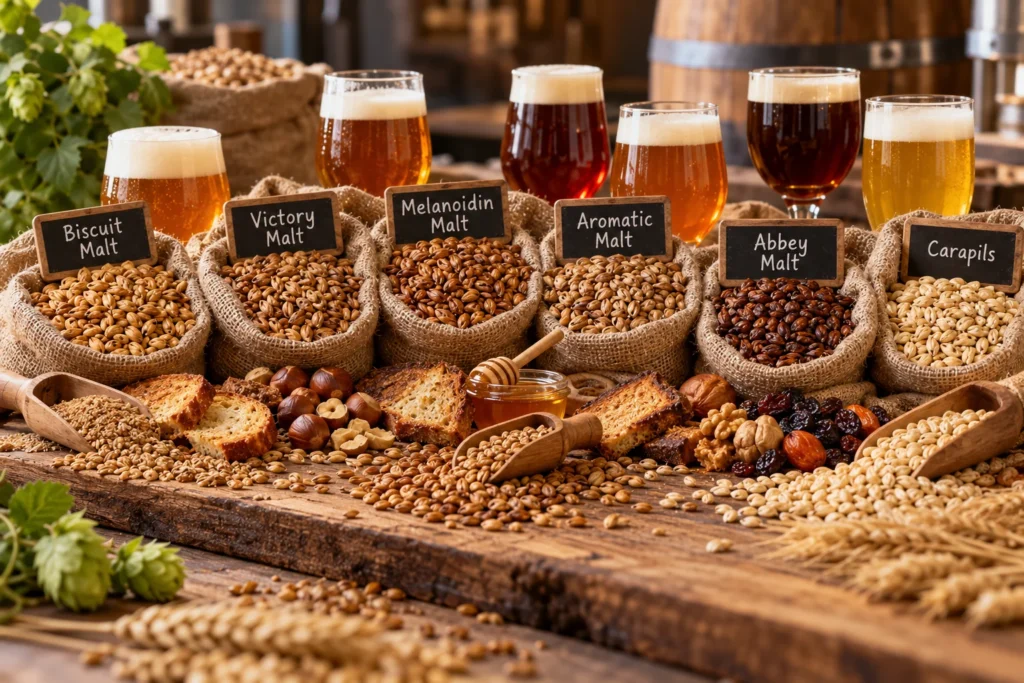
Specialty malts are some of the most useful ingredients available to homebrewers.
A relatively small amount can completely change the character of a beer.
They can add:
- biscuit;
- toast;
- bread crust;
- honey;
- nuts;
- malt richness;
- body;
- foam stability;
- color;
- aroma.
But specialty malts are also among the easiest ingredients to overuse.
Adding more does not automatically create a more complex or better beer.
In many cases, the opposite happens.
Too many specialty malts—or too much of one strongly flavored malt—can produce a beer that tastes heavy, muddled or unnecessarily sweet.
The key is understanding what each malt contributes and why it is in the recipe.
In this guide, we will look at some of the most useful specialty malts in homebrewing, including Biscuit, Victory, Melanoidin, Aromatic, Abbey and Carapils.
More importantly, we will answer the practical question:
How much specialty malt should you actually use?
What Is a Specialty Malt?
The term “specialty malt” covers malts that are generally used to modify the flavor, aroma, color, body or foam characteristics of a beer rather than forming the entire fermentable base.
A typical recipe might contain:
70–95% base malt
with the remaining percentage made up of carefully selected specialty malts, roasted malts, crystal malts or other grains.
This is not a strict formula.
Some beers contain almost no specialty malt.
Others contain substantial amounts.
But the basic idea is important:
Base malt builds the foundation. Specialty malt modifies the foundation.
Specialty Malt Is a Function, Not a Requirement
One of the most useful principles in recipe design is:
Do not add a malt unless you know why it is there.
A recipe does not become more sophisticated simply because it contains more ingredients.
A beer made from:
Pale Ale Malt + one specialty malt
can be more balanced and expressive than a recipe containing seven different malts.
Before adding any specialty malt, ask:
- What flavor do I want?
- Do I need more body?
- Do I need more malt aroma?
- Do I need more color?
- Do I want more toast?
- Do I want better foam?
- Is another ingredient already doing the same job?
If you cannot answer the question, you may not need that malt.
Specialty Malt vs Base Malt
Base malts usually provide:
- most of the fermentable extract;
- substantial enzymatic power;
- the basic malt foundation.
Examples include:
- Pilsner Malt;
- Pale Ale Malt;
- Maris Otter;
- Golden Promise;
- Vienna Malt;
- Munich Malt.
Specialty malts are usually used in smaller quantities to change particular characteristics of the beer.
Examples include:
- Biscuit Malt;
- Victory Malt;
- Melanoidin Malt;
- Aromatic Malt;
- Abbey Malt;
- Carapils.
The distinction is not always perfectly clear.
Some malts can function differently depending on the recipe.
Munich Malt, for example, may form a substantial percentage of the grain bill, while in another beer it may be used in a smaller amount to increase malt depth.
Think about function, not only the category printed on a malt chart.
Specialty Malt vs Crystal Malt
Crystal and caramel malts are technically specialty malts in the broad sense, but brewers often discuss them as their own category because they behave and taste differently.
Crystal malts commonly contribute:
- caramel;
- toffee;
- burnt sugar;
- dried fruit;
- sweetness;
- body;
- color.
The specialty malts discussed in this guide are generally more associated with:
- bread;
- biscuit;
- toast;
- malt aroma;
- honey;
- nuts;
- body and foam.
This distinction is useful when building a recipe.
If the beer needs caramel sweetness, Crystal Malt may be appropriate.
If it needs biscuit, toast or malt depth, another specialty malt may be the better tool.
Specialty Malt vs Roasted Malt
Roasted malts occupy another distinct part of the malt spectrum.
Ingredients such as:
- Chocolate Malt;
- Black Malt;
- Roasted Barley;
- Carafa
can contribute:
- chocolate;
- coffee;
- roast;
- cocoa;
- burnt toast;
- dark color.
Biscuit or Victory Malt may taste toasted, but they are nowhere near the intensity of highly roasted malts.
Understanding these categories prevents unnecessary ingredient overlap.
Specialty Malts: Quick Reference
| Malt | Main Character | Typical Usage | Common Beer Styles |
|---|---|---|---|
| Biscuit Malt | Biscuit, toast, bread crust | 2–10% | Pale Ale, Amber Ale, Brown Ale, Belgian Ale |
| Victory Malt | Toast, biscuit, nutty | 2–10% | Pale Ale, IPA, Brown Ale, Porter |
| Melanoidin Malt | Rich malt, bread crust, honey | 1–10% | Märzen, Bock, Amber Lager, malt-forward ales |
| Aromatic Malt | Intense malt, bread, honey | 2–10% | Belgian Ale, Bock, Amber Ale |
| Abbey Malt | Toast, bread, nuts, dried fruit | 2–10% | Belgian Ale, Dubbel, Brown Ale |
| Carapils / Dextrin Malt | Body, foam, subtle grain | 2–10% | Lager, Pale Ale, IPA, many light beers |
These percentages are guidelines, not laws.
The correct amount depends on:
- the specific malt;
- the maltster;
- the base malt;
- the beer style;
- original gravity;
- other specialty malts;
- the desired intensity.
Biscuit Malt
Biscuit Malt is designed to provide dry, toasted malt character.
Its flavor is often described as:
- biscuit;
- cracker;
- toasted bread;
- bread crust;
- light nuts.
Unlike Crystal Malt, Biscuit Malt generally does not contribute a strong caramel sweetness.
This makes it extremely useful when you want more malt character without making the beer taste obviously sweet.
What Does Biscuit Malt Taste Like?
Imagine the difference between fresh bread and lightly toasted bread.
Biscuit Malt moves toward the toasted side.
Depending on the amount used, it can create impressions of:
- toasted crackers;
- dry biscuits;
- bread crust;
- light nuts.
At low levels it adds background complexity.
At higher levels it can become a major part of the beer’s flavor.
How Much Biscuit Malt Should You Use?
A useful starting range is approximately:
2–5% — subtle
Adds a gentle toasted background.
5–8% — clearly noticeable
Biscuit and bread-crust character becomes obvious.
8–10% — strong
The malt becomes a major flavor component.
Above this range, the character can become dominant depending on the recipe and maltster.
For many beers, 3–6% is enough to create noticeable complexity.
Where Does Biscuit Malt Work Best?
Biscuit Malt can work particularly well in:
- Pale Ale;
- Amber Ale;
- Brown Ale;
- English Ale;
- Belgian Ale;
- Porter;
- some IPAs.
It can also be useful when the base malt is very neutral and you want to add a small amount of toasted character.
Biscuit Malt in IPA
Biscuit Malt can work in IPA, but restraint is important.
A small amount can provide structure beneath:
- citrus;
- pine;
- resin;
- floral hops.
Around 2–5% can be enough.
In a very modern fruit-forward Hazy IPA, however, strong biscuit character may compete with the soft grain and hop profile.
In that case, it may be unnecessary.
Victory Malt
Victory Malt is similar in concept to Biscuit Malt.
It is known for:
- toasted bread;
- biscuit;
- nutty character;
- dry toast.
Depending on the manufacturer, it may lean somewhat more toward toasted and nutty flavors than Biscuit Malt.
The two can often perform similar roles.
This raises an important recipe-design question:
Do you really need both?
Often, you do not.
Biscuit Malt vs Victory Malt
These two malts overlap considerably.
A simplified comparison:
Biscuit Malt
- dry biscuit;
- cracker;
- bread crust;
- toast.
Victory Malt
- toast;
- biscuit;
- slightly stronger nutty impression.
The exact difference varies by maltster.
If your recipe already contains Biscuit Malt, adding Victory Malt may not create enough additional complexity to justify another ingredient.
Sometimes choosing one of them produces a cleaner recipe.
How Much Victory Malt Should You Use?
A useful range is:
2–5% — subtle toast and nuts
5–8% — noticeable biscuit and nut character
8–10% — strong contribution
In many recipes, around:
3–6%
is plenty.
Again, taste the actual malt if possible.
Different products with similar names can behave differently.
Where Does Victory Malt Work Best?
Victory Malt can be excellent in:
- American Pale Ale;
- Amber Ale;
- Brown Ale;
- English Ale;
- IPA;
- Porter.
It works particularly well when you want a dry toasted character without adding significant caramel sweetness.
Melanoidin Malt
Melanoidin Malt is a powerful specialty malt designed to create intense malt richness.
Its character may include:
- rich malt;
- bread crust;
- toast;
- honey;
- deep bread;
- malt aroma.
It is sometimes described as producing some of the malt intensity associated with traditional decoction-mashed beers.
That comparison can be useful, but it should not be taken too literally.
Adding Melanoidin Malt is not exactly the same as performing a decoction mash.
It is simply a useful way to increase malt intensity.
What Are Melanoidins?
Melanoidins are complex compounds formed through Maillard reactions involving sugars and amino compounds.
They contribute to:
- color;
- aroma;
- malt complexity;
- bread-like flavors;
- toasted character.
Different malts contain different amounts depending on how they were produced.
Melanoidin Malt is designed to provide a concentrated form of this rich malt character.
How Much Melanoidin Malt Should You Use?
Melanoidin Malt can become intense surprisingly quickly.
A practical guide:
1–3% — subtle malt enhancement
3–5% — clearly richer malt character
5–10% — strong contribution
For many recipes:
2–5%
is already enough.
Using 10% simply because the maltster lists 10% as an acceptable maximum does not mean the beer will be better.
Maximum usage and ideal usage are not the same thing.
Where Does Melanoidin Malt Work Best?
Melanoidin Malt can work particularly well in:
- Märzen;
- Bock;
- Doppelbock;
- Amber Lager;
- Vienna Lager;
- Dunkel;
- malt-forward Amber Ale;
- certain Belgian beers.
It can also be used in small amounts to add depth to a beer made from a relatively neutral base malt.
Can Melanoidin Malt Replace Munich Malt?
Not exactly.
Munich Malt can form a substantial portion of the grain bill and provides deep bread and malt character.
Melanoidin Malt is generally more concentrated and is usually used in smaller amounts.
For example:
20% Munich Malt
and
5% Melanoidin Malt
do not create the same beer.
They may share some flavor territory, but their contribution is different.
Do not treat them as direct substitutes.
Can Melanoidin Malt Replace Decoction?
This is a common claim.
Melanoidin Malt can certainly increase the rich malt character that many brewers associate with decoction-mashed lagers.
But decoction changes the wort through an entire process involving:
- heating;
- boiling part of the mash;
- Maillard reactions;
- mash chemistry;
- repeated temperature changes.
Adding one specialty malt cannot reproduce every effect of that process.
A better way to think about it is:
Melanoidin Malt can help create rich malt intensity without requiring a decoction mash.
That is useful enough on its own.
Aromatic Malt
Aromatic Malt is another strongly flavored specialty malt.
As the name suggests, it is particularly useful for increasing malt aroma.
Common characteristics include:
- intense malt;
- fresh bread;
- bread crust;
- honey;
- light toast;
- rich cereal.
It can be surprisingly powerful.
Small quantities can noticeably change the aroma of a beer.
How Much Aromatic Malt Should You Use?
A practical range:
2–4% — subtle aromatic lift
4–7% — clearly noticeable malt aroma
7–10% — strong malt character
For many beers, 3–6% is a good working range.
As always, the actual product matters.
Some Aromatic Malts are significantly more intense than others.
Where Does Aromatic Malt Work Best?
Aromatic Malt is particularly useful in:
- Belgian Ale;
- Dubbel;
- Bock;
- Amber Ale;
- strong malt-forward ales;
- certain lagers.
It can add complexity without relying heavily on Crystal Malt.
Aromatic Malt vs Melanoidin Malt
These two can overlap.
Both can contribute:
- rich malt;
- bread;
- malt aroma;
- deeper malt complexity.
But a useful general distinction is:
Aromatic Malt → emphasizes malt aroma and rich bread character
Melanoidin Malt → emphasizes deep malt richness, bread crust and intense maltiness
This is not an absolute rule.
Products differ significantly between maltsters.
And once again, a recipe does not necessarily need both.
If they are performing almost the same job, choose the one that best fits the flavor target.
Abbey Malt
Abbey Malt is often associated with Belgian-style beers.
It can contribute a complex mixture of:
- toasted bread;
- nuts;
- malt;
- biscuit;
- light dried fruit;
- subtle caramel-like impressions.
Its exact character depends strongly on the maltster.
Compared with simple Biscuit Malt, Abbey Malt can feel more complex and sometimes slightly darker or fruitier.
How Much Abbey Malt Should You Use?
A useful starting point is:
2–4% — subtle complexity
4–7% — noticeable toasted and nutty character
7–10% — strong contribution
In many Belgian-style recipes:
3–6%
can already make a meaningful difference.
Where Does Abbey Malt Work Best?
Abbey Malt is especially suitable for:
- Belgian Dubbel;
- Belgian Amber Ale;
- Belgian Strong Ale;
- Brown Ale;
- certain darker Saison recipes;
- malt-forward specialty beers.
It can be especially useful when you want complexity that falls somewhere between toasted malt and darker caramel-like character.
Carapils / Dextrin Malt
Carapils is somewhat different from the other malts in this article.
It is generally used less for obvious flavor and more for structural effects.
Depending on the product, Carapils or Dextrin Malt may help contribute:
- body;
- mouthfeel;
- foam retention;
- foam stability;
- subtle grain character.
However, the name Carapils can refer to products made differently by different maltsters.
This matters.
Not every dextrin malt behaves exactly the same way.
Always check the manufacturer’s description and specification.
Does Carapils Really Improve Head Retention?
It can contribute to foam and body, but it should not be treated as a magical solution.
Head retention depends on many factors:
- grain composition;
- protein content;
- mash schedule;
- fermentation;
- hopping;
- carbonation;
- glass cleanliness;
- oils and fats;
- serving conditions.
If a beer has poor foam because of a process problem, simply adding more Carapils may not fix it.
Good foam comes from the entire brewing process.
How Much Carapils Should You Use?
A common practical range is:
2–5% — subtle structural contribution
5–10% — stronger body and foam contribution
Many recipes work perfectly well with:
3–5%
when Carapils is actually needed.
But it should not be added automatically to every beer.
Do You Need Carapils in Every IPA?
No.
This is a common habit in homebrew recipe design.
A brewer wants better foam, so 5% Carapils goes into every recipe.
But an IPA may already contain:
- enough protein-rich base malt;
- Wheat Malt;
- Flaked Wheat;
- Flaked Oats.
In that case, Carapils may provide little additional benefit.
Again:
Every ingredient should have a purpose.
Carapils vs Wheat Malt
Both may improve foam, but they are not identical.
Wheat Malt contributes:
- protein;
- grain flavor;
- foam;
- mouthfeel.
Carapils is generally more neutral and is often used for:
- body;
- foam;
- structural support.
If the beer can tolerate or benefit from wheat character, Wheat Malt may accomplish several goals simultaneously.
If you want to avoid adding noticeable wheat character, Carapils may be more appropriate.
Carapils vs Flaked Wheat
Flaked Wheat can contribute:
- protein;
- foam;
- haze;
- body;
- soft grain character.
Carapils generally has less impact on haze and flavor.
For a Hazy IPA, Flaked Wheat may make more sense.
For a bright Pale Lager where you want subtle body and foam support without adding haze, an appropriate dextrin malt may make more sense.
The ingredient should match the beer.
How Much Specialty Malt Should You Use?
This is the most important question in this article.
Unfortunately, there is no universal percentage.
A better approach is to think in terms of intensity.
1–3%
Usually a subtle contribution.
Useful for:
- slight malt complexity;
- small aroma adjustments;
- background character.
3–5%
Clearly noticeable in many beers.
This is often a very useful range for strongly flavored specialty malts.
5–10%
The specialty malt becomes an important part of the beer’s character.
This may be appropriate for certain recipes but should be intentional.
10–20%
At this level, the malt may become a major structural and flavor component.
Not every specialty malt is suitable for such high usage.
Always check the specific product.
Above 20%
Some malts can be used this high.
Many cannot—or at least should not be used this high without a very specific reason.
The name “specialty malt” covers many very different products.
Never apply one percentage rule to all of them.
The 5% Rule: A Useful Starting Point
For an unfamiliar specialty malt, around 5% of the grain bill can be a useful experimental starting point.
It is not a brewing law.
But it is often enough to reveal the malt’s character without allowing it to completely dominate the beer.
Suppose your total grain bill is:
5 kg
Then:
5% = 250 g
That is often enough specialty malt to create a noticeable difference.
Once you know the ingredient, you can increase or decrease it in future recipes.
Percentage Matters More Than Kilograms
When discussing specialty malt, percentages are usually more useful than fixed weights.
For example:
250 g Biscuit Malt
means something very different in:
- a 3 kg grain bill;
- a 5 kg grain bill;
- an 8 kg grain bill.
In a 5 kg grain bill:
250 g = 5%
In a 3 kg grain bill:
250 g = 8.3%
The flavor contribution can therefore be dramatically different.
Think in percentages.
Calculate Specialty Malt Percentage
The formula is simple:
Specialty Malt Weight ÷ Total Grain Weight × 100
Example:
Total grain:
5.5 kg
Biscuit Malt:
300 g = 0.3 kg
Calculation:
0.3 ÷ 5.5 × 100 = 5.45%
So Biscuit Malt represents approximately:
5.5% of the grain bill.
This makes recipes much easier to compare across different batch sizes.
One Specialty Malt vs Several Specialty Malts
Suppose a recipe contains:
- 5% Biscuit Malt;
- 5% Victory Malt;
- 5% Melanoidin Malt;
- 5% Aromatic Malt.
Individually, none of those percentages looks extreme.
Together, however:
20% of the grain bill consists of strongly flavored specialty malts.
The beer may become much more intense than expected.
This is one of the most common mistakes when designing recipes.
Do not evaluate each malt only in isolation.
Also evaluate the total specialty malt load.
Total Specialty Malt Load
A useful way to think about recipe complexity is to add up all strongly flavored specialty malts.
For example:
- Biscuit 4%;
- Melanoidin 3%;
- Crystal 5%;
- Chocolate Malt 2%.
Total:
14% specialty malt.
That does not automatically mean the recipe is wrong.
But it tells you that a significant portion of the grain bill is dedicated to flavor modification.
Ask whether every ingredient is necessary.
Sometimes reducing the recipe to:
- Biscuit 4%;
- Crystal 5%;
- Chocolate 2%
may produce a clearer beer.
Complexity does not require a long ingredient list.
Flavor Overlap
One of the most overlooked problems in recipe design is flavor overlap.
Consider:
- Biscuit Malt;
- Victory Malt;
- Aromatic Malt;
- Melanoidin Malt;
- Munich Malt.
All are different.
But all can contribute somewhere within the general family of:
- bread;
- toast;
- malt;
- biscuit;
- richness.
Using all five does not necessarily create five clearly identifiable layers.
Instead, they may blur together.
Before adding another malt, ask:
Is this adding a new flavor, or simply repeating a flavor I already have?
Building Flavor in Layers
A better approach is to assign each malt a role.
For example:
Foundation
Pale Ale Malt — 88%
Provides fermentable extract and basic malt character.
Malt depth
Munich Malt — 7%
Adds bread and malt richness.
Toast
Biscuit Malt — 3%
Adds dry toasted character.
Color and sweetness
Crystal Malt — 2%
Adds a small caramel accent.
Now every malt has a clear function.
This is usually easier to control than randomly combining specialty malts.
Example: Simple American Pale Ale Malt Bill
A clean Pale Ale might use:
92% Pale Ale Malt
5% Biscuit Malt
3% Carapils
This provides:
- clean fermentable base;
- subtle biscuit complexity;
- some structural support.
But even here, Carapils is optional.
If foam and body are already good, the beer might be even simpler:
95% Pale Ale Malt
5% Biscuit Malt
Simple recipes can be excellent.
Example: Maltier Amber Ale
A richer Amber Ale might use:
80% Pale Ale Malt
10% Munich Malt
5% Medium Crystal Malt
5% Victory Malt
Here each malt has a clear role:
Pale Ale Malt provides the base.
Munich adds rich bread.
Crystal adds caramel.
Victory adds toast and nuts.
The result can be complex without becoming chaotic.
Example: Belgian-Style Ale
A Belgian-inspired malt bill could use:
85% Pilsner Malt
7% Munich Malt
5% Aromatic Malt
3% Abbey Malt
The Pilsner base remains relatively clean.
Munich provides depth.
Aromatic increases malt aroma.
Abbey adds toasted and slightly darker complexity.
Again, every malt has a job.
Example: Malt-Forward Lager
A malt-focused lager might use:
75% Pilsner Malt
20% Munich Malt
3% Melanoidin Malt
2% Carapils
This provides:
- clean base;
- substantial bread and malt depth;
- additional rich malt intensity;
- subtle structural support.
Notice that Melanoidin Malt is kept relatively low because Munich Malt is already performing much of the malt-richness work.
Example: Specialty Malt in IPA
A modern IPA does not necessarily need many specialty malts.
For example:
95% Pale Ale Malt
5% Wheat Malt
may already provide everything required.
Or:
92% Pale Ale Malt
5% Wheat Malt
3% Biscuit Malt
could add a subtle toasted foundation.
A heavily hopped beer can become muddled if the malt bill is unnecessarily complicated.
When hops are the star, the malt should often provide support rather than competition.
Specialty Malts in Hazy IPA
Hazy IPA usually benefits from a relatively soft grain profile.
Common ingredients include:
- Pale Ale Malt;
- Pilsner Malt;
- Wheat Malt;
- Flaked Wheat;
- Flaked Oats.
Strong Biscuit, Victory or Melanoidin additions may compete with the soft, juicy character of the style.
That does not mean they can never be used.
But they should have a clear purpose.
For many Hazy IPAs, less is more.
Specialty Malts in West Coast IPA
West Coast IPA can tolerate slightly more toasted malt character.
Small amounts of:
- Biscuit Malt;
- Victory Malt;
- Munich Malt
can work well beneath:
- citrus;
- pine;
- resin;
- firm bitterness.
But excessive Crystal Malt or strongly flavored specialty malt can make the beer feel too heavy.
Modern West Coast IPA often benefits from a relatively simple malt bill.
Specialty Malts in Lager
Lager does not mean “no specialty malt.”
Depending on the style, small additions of:
- Munich;
- Vienna;
- Melanoidin;
- Carapils
can add useful character.
But clean fermentation exposes recipe mistakes.
There may be less yeast ester character or aggressive hopping to hide an overly complicated malt bill.
For many lagers, subtlety is particularly important.
Specialty Malts in Dark Beer
Porter and Stout already contain powerful ingredients such as:
- Chocolate Malt;
- Roasted Barley;
- Black Malt;
- Carafa.
Adding multiple toasted specialty malts on top can sometimes create unnecessary complexity.
However, carefully selected additions such as:
- Biscuit;
- Victory;
- Munich;
- Abbey
can add another layer beneath the roast.
The important word is:
carefully.
Does More Specialty Malt Mean More Body?
Sometimes, but not always.
Body depends on:
- mash temperature;
- grain composition;
- proteins;
- dextrins;
- yeast attenuation;
- alcohol;
- carbonation;
- original gravity.
Some specialty malts can increase perceived fullness.
But adding more Biscuit Malt does not automatically create a fuller beer.
Likewise, a high mash temperature can increase body without adding another malt.
Choose the correct tool for the problem.
Does More Specialty Malt Mean More Sweetness?
No.
Different specialty malts behave differently.
Crystal Malt can contribute significant caramel-like sweetness and fullness.
Biscuit Malt may increase malt flavor while remaining relatively dry and toasted.
Victory can contribute nuts and toast.
Melanoidin can create intense malt richness without tasting like Crystal Malt.
Do not treat all specialty malt as “sweet malt.”
Does More Specialty Malt Mean Darker Beer?
Usually, adding darker malt increases color.
But the relationship is not always intuitive.
A small amount of a very dark malt may change color more dramatically than a large amount of a moderately colored specialty malt.
If color is the primary goal, calculate it separately.
Do not add large amounts of strongly flavored malt simply because you want the beer slightly darker.
Can Specialty Malt Improve Foam?
Some can.
Carapils is commonly associated with foam and body.
Wheat-containing ingredients may also improve foam because of their protein contribution.
But foam is a system.
Good foam depends on:
- recipe;
- mash;
- fermentation;
- hops;
- carbonation;
- serving;
- clean glassware.
Specialty malt can support foam.
It cannot compensate for every process problem.
Specialty Malt and Mash pH
Specialty malts can influence mash pH.
Darker malts generally have a stronger acidifying effect than pale base malts.
However, the exact effect depends on:
- malt type;
- amount used;
- water alkalinity;
- calcium;
- magnesium;
- acid additions.
If you significantly change the grain bill, recheck your predicted and measured mash pH.
Do not assume the acid addition from a previous recipe will automatically work.
Do Specialty Malts Need to Be Mashed?
Most of the malts discussed here are normally added directly to the mash with the rest of the grain.
This includes:
- Biscuit;
- Victory;
- Melanoidin;
- Aromatic;
- Abbey;
- Carapils in most normal all-grain applications.
Exact recommendations may vary by manufacturer.
If you are unsure, check the maltster’s product information.
Do Specialty Malts Need Their Own Enzymes?
Not necessarily.
When used in small percentages alongside a strong base malt, there is normally more than enough enzymatic activity in the mash.
For example:
90% Pale Ale Malt + 10% specialty malt
generally presents no conversion problem.
The issue becomes more important when a grain bill contains very large quantities of ingredients with little or no enzymatic power.
This is why understanding the diastatic power of the overall grain bill is useful.
How Base Malt Changes Specialty Malt Perception
The same specialty malt can taste different depending on the base malt underneath it.
For example:
5% Biscuit Malt + Pilsner Malt
may create a clear toasted contrast.
But:
5% Biscuit Malt + Maris Otter
may blend into an already biscuit-rich malt foundation.
Likewise:
3% Melanoidin Malt + Pilsner Malt
may be obvious.
But:
3% Melanoidin Malt + a large percentage of Munich Malt
may be much less necessary.
Always evaluate the entire grain bill.
How Hops Change Specialty Malt Perception
A specialty malt that seems obvious in a lightly hopped beer may almost disappear in a heavily dry-hopped IPA.
This does not mean you should automatically add more.
If the hop aroma is intentionally dominant, the malt may only need to provide background support.
Trying to force every malt to remain individually identifiable can result in an unnecessarily heavy recipe.
Balance is more important than ingredient visibility.
How Yeast Changes Specialty Malt Perception
Yeast also changes the way malt is perceived.
A clean American ale yeast may allow toasted malt character to remain obvious.
A highly expressive Belgian yeast may introduce:
- fruit;
- spice;
- phenols;
- fermentation complexity.
A strongly characterful specialty malt can either complement those flavors or compete with them.
Recipe design should therefore consider:
malt + hops + yeast + water
as one system.
Taste the Malt Before Brewing
One of the easiest ways to improve recipe design is also one of the simplest:
Taste the grain.
Take a few kernels and chew them.
Compare:
- Pale Ale Malt;
- Biscuit Malt;
- Victory Malt;
- Munich Malt;
- Melanoidin Malt;
- Aromatic Malt.
You will not taste exactly what the finished beer will taste like.
But you will begin to understand the relationship between the ingredients.
You may also notice that two malts you planned to use together are surprisingly similar.
That can simplify the recipe before you even start brewing.
Keep Notes
When trying a new specialty malt, record:
- maltster;
- malt name;
- EBC or Lovibond;
- percentage used;
- base malt;
- beer style;
- mash temperature;
- final gravity;
- tasting notes.
Then write down what you would change.
For example:
Biscuit Malt 7% — too strong. Try 4% next time.
Or:
Melanoidin Malt 2% — barely noticeable. Try 3–4%.
After several batches, these notes become more valuable than generic usage charts.
Maltster Matters
Two products called “Aromatic Malt” are not guaranteed to taste identical.
Neither are two Biscuit Malts.
Maltsters use different:
- barley varieties;
- malting processes;
- kilning schedules;
- moisture targets;
- production methods.
Color specifications may also differ.
Therefore:
Use malt names as categories, but formulate recipes using the actual malt specification whenever possible.
Maximum Usage Is Not Recommended Usage
This point is extremely important.
A maltster may say:
“Usage: up to 20%.”
That does not mean:
“Use 20%.”
It means the malt can potentially be used at that level in appropriate recipes.
The ideal amount might be:
- 2%;
- 4%;
- 7%;
- 12%;
depending on the beer.
Think of maximum usage as a boundary, not a target.
Start Low With Powerful Malts
When trying a strongly flavored specialty malt for the first time, it is usually easier to start conservatively.
If 3% is slightly too subtle, you can use 5% next time.
If 10% completely dominates the beer, you may have 20 liters of beer that teaches you a very expensive lesson.
Small adjustments are easier to understand.
This is especially useful when learning:
- Melanoidin Malt;
- Aromatic Malt;
- Abbey Malt;
- strong Biscuit or Victory malts.
Avoid “Kitchen Sink” Recipes
A kitchen-sink recipe is one where the brewer adds a little of everything.
For example:
- Pale Ale Malt;
- Munich Malt;
- Vienna Malt;
- Biscuit Malt;
- Victory Malt;
- Melanoidin Malt;
- Aromatic Malt;
- Crystal Malt;
- Carapils.
Each ingredient may be good individually.
Together, they may produce a confused malt profile.
A better recipe often uses:
one foundation + one or two clearly defined character malts.
More ingredients do not automatically mean more complexity.
Sometimes they simply mean less clarity.
A Better Recipe Design Method
When building a grain bill, try this sequence.
Step 1: Choose the base
Ask:
What should the basic beer taste like?
Possible choices:
- Pilsner Malt;
- Pale Ale Malt;
- Maris Otter;
- Golden Promise;
- Vienna;
- Munich.
Step 2: Identify what is missing
Does the base need:
- toast?
- biscuit?
- malt aroma?
- caramel?
- roast?
- body?
- foam?
Step 3: Add one ingredient that solves the problem
Examples:
Need toast?
→ Biscuit Malt.
Need rich malt aroma?
→ Aromatic Malt.
Need deep malt richness?
→ Melanoidin Malt.
Need caramel?
→ Crystal Malt.
Need roast?
→ Chocolate Malt or Roasted Barley.
Need structural support?
→ Carapils, Wheat Malt or another appropriate grain depending on the beer.
Step 4: Keep the amount conservative
Start near the lower or middle part of the normal usage range.
Step 5: Brew and taste
Then adjust the next batch.
This is how recipes improve.
Practical Specialty Malt Chart
| Malt | Main Flavor | Subtle | Noticeable | Strong | Good Starting Point |
|---|---|---|---|---|---|
| Biscuit | Biscuit, toast, bread crust | 2–3% | 4–6% | 7–10% | 4–5% |
| Victory | Toast, biscuit, nuts | 2–3% | 4–6% | 7–10% | 4–5% |
| Melanoidin | Rich malt, bread crust, honey | 1–2% | 3–5% | 6–10% | 2–4% |
| Aromatic | Malt aroma, bread, honey | 2–3% | 4–6% | 7–10% | 3–5% |
| Abbey | Toast, nuts, bread, dried fruit | 2–3% | 4–6% | 7–10% | 3–5% |
| Carapils | Body, foam, subtle grain | 2–3% | 4–6% | 7–10% | 3–5% |
Again, these are practical starting ranges rather than universal rules.
Always check the specification of the actual malt you are using.
Which Specialty Malt Should You Choose?
If you want:
Dry biscuit and toast
→ Biscuit Malt
Toast with a nutty character
→ Victory Malt
Deep malt richness and bread crust
→ Melanoidin Malt
Strong malt aroma and bread
→ Aromatic Malt
Belgian-style toast, nuts and darker complexity
→ Abbey Malt
Body and foam with little flavor impact
→ Carapils / Dextrin Malt
The important part is not memorizing every malt.
It is understanding what problem each ingredient solves.
Can You Combine Specialty Malts?
Yes.
Some excellent beers use several specialty malts.
The goal is not to avoid combinations.
The goal is to avoid unnecessary combinations.
A good combination might be:
Munich Malt + small amount of Crystal Malt
because one provides bread and malt richness while the other adds caramel.
Another useful combination might be:
Biscuit Malt + Chocolate Malt
because one provides toast while the other provides cocoa and roast.
But:
Biscuit + Victory + Aromatic + Melanoidin
may contain too much flavor overlap unless there is a very specific reason for the combination.
The Best Specialty Malt Percentage
There is no single perfect percentage.
But if you want a practical rule for recipe development:
1–3% → subtle
3–5% → moderate
5–10% → prominent
10%+ → major component; use intentionally
For an unfamiliar strong specialty malt, starting around:
3–5%
is often sensible.
Then adjust according to tasting.
Final Thoughts
Specialty malts are powerful recipe-design tools.
They can turn a simple base malt into a beer with layers of:
- bread;
- toast;
- biscuit;
- nuts;
- honey;
- malt aroma;
- body;
- foam.
But the best malt bills are not necessarily the ones with the most malts.
They are the ones where every malt has a clear purpose.
Biscuit Malt can add dry toast.
Victory can add biscuit and nuts.
Melanoidin can create deep malt richness.
Aromatic can intensify malt aroma.
Abbey can add complex toasted and Belgian-style malt character.
Carapils can support body and foam when the recipe actually needs it.
The most important lesson is simple:
Do not ask, “How many specialty malts can I add?”
Ask:
“What is missing from this beer, and which malt can provide it?”
Start with the base malt.
Build the beer around a clear flavor target.
Use specialty malt deliberately.
Keep the first addition conservative.
Brew the beer.
Taste it.
Take notes.
Then adjust the next recipe.
That process will teach you more about specialty malt than any usage chart ever can.