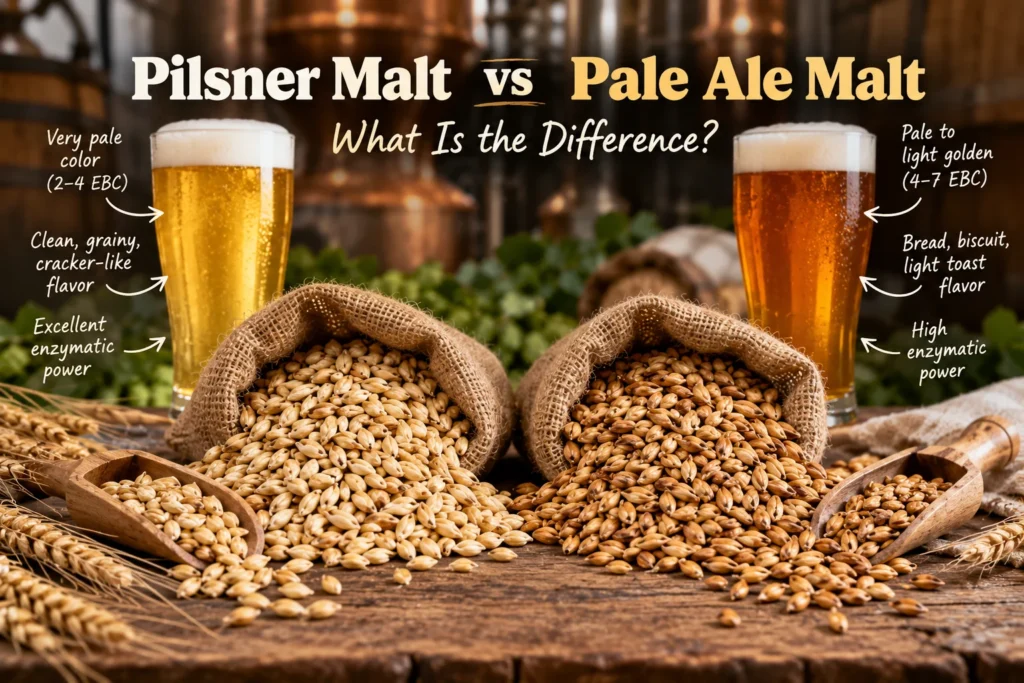
Pilsner Malt and Pale Ale Malt are two of the most widely used base malts in brewing.
At first glance, they look very similar.
Both are pale.
Both provide the majority of fermentable sugars in a beer.
Both contain enough enzymes to convert their own starches and support reasonable amounts of specialty grains.
And in many recipes, one can technically be substituted for the other.
But they are not identical.
The main difference comes from how they are kilned.
Pilsner Malt is generally kilned more gently and remains lighter in color, with a delicate grainy, cracker-like and slightly sweet malt character.
Pale Ale Malt is usually kilned a little more intensely, producing a slightly darker color and a richer malt profile with more biscuit, toast and bread-like character.
That difference may appear small on a malt specification sheet.
In the finished beer, however, it can significantly influence the overall character.
In this guide, we will compare Pilsner Malt and Pale Ale Malt in detail, including flavor, color, enzymes, fermentability, DMS, mash behavior and the beer styles where each malt works best.
What Is Pilsner Malt?
Pilsner Malt is a very pale base malt traditionally associated with European lager brewing.
It is made from malting barley and kilned at relatively low temperatures to preserve its light color and delicate flavor.
Typical Pilsner Malt contributes flavors such as:
- fresh grain;
- crackers;
- light bread;
- subtle honey;
- mild sweetness;
- delicate malt.
Its restrained character makes it an excellent foundation when the brewer wants other elements of the beer to remain clearly visible.
These may include:
- noble hops;
- yeast character;
- fermentation profile;
- water chemistry;
- subtle specialty malts.
Pilsner Malt is not limited to Pilsner.
It is used in a huge range of beers, including:
- German Pils;
- Czech Pilsner;
- Helles;
- Kölsch;
- Belgian Ale;
- Saison;
- Witbier;
- Wheat Beer;
- Belgian Strong Ale;
- some IPAs and Pale Ales.
It is one of the most versatile base malts available.
What Is Pale Ale Malt?
Pale Ale Malt is also a base malt, but it is normally kilned somewhat more strongly than Pilsner Malt.
The additional kilning develops more color and deeper malt flavors.
Depending on the maltster, Pale Ale Malt may contribute:
- bread;
- biscuit;
- light toast;
- cereal;
- nuts;
- mild malt sweetness.
It remains pale enough for light-colored beers but generally provides a more obvious malt foundation than Pilsner Malt.
Pale Ale Malt is especially common in:
- Pale Ale;
- IPA;
- English Ale;
- American Ale;
- Porter;
- Stout;
- Amber Ale;
- Brown Ale.
It is often an excellent choice when the malt should remain noticeable underneath a significant hop character.
Pilsner Malt vs Pale Ale Malt: Quick Comparison
| Characteristic | Pilsner Malt | Pale Ale Malt |
| Type | Base malt | Base malt |
| Color | Very pale | Pale to light golden |
| Malt flavor | Delicate | Richer |
| Grain character | Fresh, light, cracker-like | Bread, biscuit, light toast |
| Enzymatic power | High | High |
| Fermentable extract | High | High |
| Typical lager use | Excellent | Possible but less traditional |
| Typical Pale Ale use | Possible | Excellent |
| Typical IPA use | Excellent in some styles | Excellent |
| DMS potential | Generally higher | Generally lower |
| Specialty malt conversion | Good | Good |
| Typical percentage | Up to 100% | Up to 100% |
Both are true base malts.
The choice is therefore not about which malt is “better.”
It is about how much malt character you want in the finished beer.
The Main Difference: Kilning
The most important difference between Pilsner Malt and Pale Ale Malt is the kilning process.
After barley germinates during malting, the malt must be dried.
The temperature and duration of this drying process influence:
- color;
- aroma;
- flavor;
- enzyme activity;
- levels of certain malt compounds.
Pilsner Malt is kilned gently.
This preserves:
- very light color;
- delicate flavor;
- high enzymatic potential.
Pale Ale Malt receives somewhat more kilning.
This encourages more Maillard reactions and creates deeper malt character.
The result is still a pale malt, but with more:
- bread;
- toast;
- biscuit;
- malt depth.
You can think of the difference as moving one step further along the malt flavor spectrum.
Color Difference
Pilsner Malt is usually among the palest base malts available.
Exact values depend on the maltster, but a typical range might be approximately:
2–4 EBC
or roughly:
1–2 °L
Pale Ale Malt is usually slightly darker.
A typical range might be around:
4–7 EBC
or approximately:
2–3.5 °L
These ranges overlap between manufacturers, so always check the malt specification.
The visual difference between the grains may seem minor.
But when the malt makes up 90–100% of the grain bill, the difference becomes much more visible in the finished beer.
Pilsner Malt is ideal when you want:
- straw;
- very pale gold;
- brilliant light-golden beer.
Pale Ale Malt tends to move the beer toward:
- gold;
- deeper gold;
- light amber when combined with darker malts.
Flavor Difference
Color is easy to measure.
Flavor is where the choice becomes more interesting.
Pilsner Malt Flavor
Pilsner Malt tends to be:
- clean;
- delicate;
- grainy;
- cracker-like;
- lightly bready;
- subtly sweet.
High-quality continental Pilsner Malt can have a beautiful malt character without being heavy.
It should not be interpreted as “flavorless.”
Its flavor is simply more restrained and delicate.
Pale Ale Malt Flavor
Pale Ale Malt tends to be:
- richer;
- breadier;
- more biscuit-like;
- lightly toasted;
- more obviously malty.
The difference can be subtle in a heavily hopped beer.
In a simple beer with a restrained hop schedule, however, it can become very obvious.
Which Malt Is Sweeter?
Neither malt automatically creates a sweeter finished beer.
Perceived sweetness depends on many factors, including:
- mash temperature;
- yeast attenuation;
- original gravity;
- final gravity;
- specialty malts;
- water chemistry;
- bitterness;
- fermentation.
Pale Ale Malt may taste maltier and sometimes give the impression of more sweetness because of its richer bread and biscuit character.
But that does not necessarily mean the beer contains significantly more residual sugar.
This is an important distinction:
maltiness and sweetness are not the same thing.
Which Malt Produces More Fermentable Sugar?
Both Pilsner Malt and Pale Ale Malt have excellent extract potential.
The exact extract percentage varies between:
- maltsters;
- barley varieties;
- crop years;
- individual products.
In normal homebrewing, the difference between two specific products may matter more than the general difference between the categories.
Both can serve as the primary source of fermentable sugar in a beer.
Both can be used at:
80%, 90% or even 100% of the grain bill.
The final attenuation will usually depend much more strongly on:
- mash temperature;
- mash schedule;
- yeast strain;
- fermentation conditions
than on whether the base malt was Pilsner or Pale Ale Malt.
Both malts contain enzymes capable of converting starch into fermentable sugars.
Modern Pilsner Malt generally has excellent enzymatic power.
Modern Pale Ale Malt also usually provides more than enough enzymatic activity for normal brewing.
This means both can convert not only themselves but also reasonable quantities of adjuncts or specialty grains that contribute little or no enzymatic power.
These may include:
- Flaked Oats;
- Flaked Wheat;
- Flaked Barley;
- Crystal Malt;
- roasted malts.
The exact diastatic power varies by product.
If you are designing a recipe containing a very large percentage of unmalted grain, checking the malt specification is always a good idea.
But for a normal homebrew recipe, both are reliable base malts.
Pilsner Malt and DMS
One of the most frequently discussed differences between Pilsner Malt and Pale Ale Malt is DMS – dimethyl sulfide.
DMS can create aromas often described as:
- cooked corn;
- canned corn;
- cooked vegetables;
- sweetcorn.
In some lager styles, very low levels may be acceptable or even part of the traditional flavor background.
High levels are generally considered undesirable.
Pilsner Malt traditionally contains more of the DMS precursor SMM – S-methylmethionine because it is kilned more gently.
During wort heating, SMM can convert into DMS.
Fortunately, DMS is volatile.
A vigorous boil allows it to escape with the steam.
This is why Pilsner Malt has historically been associated with longer boils.
Do You Need a 90-Minute Boil With Pilsner Malt?
Not necessarily.
The traditional advice was often:
Pilsner Malt = 90-minute boil.
That rule is too simplistic for modern brewing.
Modern malt production has improved considerably, and many modern Pilsner Malts can be used successfully with a normal 60-minute boil.
The important factors are:
- malt quality;
- malt specification;
- boil intensity;
- evaporation;
- kettle geometry;
- rapid cooling after the boil.
A strong, uncovered 60-minute boil may be perfectly adequate for many modern Pilsner Malts.
If the maltster specifically recommends a longer boil, or if the recipe contains nearly 100% very lightly kilned Pilsner Malt and you want to be conservative, extending the boil can still make sense.
But a 90-minute boil is not an automatic requirement simply because Pilsner Malt is present.
Why You Should Not Cover the Kettle During the Boil
When DMS is produced during boiling, it needs to escape.
If the kettle is tightly covered, steam condenses and can return to the wort.
This can increase the risk of retaining volatile compounds.
During the main boil, the kettle should therefore generally remain uncovered or sufficiently open to allow steam to escape freely.
This is especially relevant when using large amounts of very pale malt.
Pale Ale Malt and DMS
Because Pale Ale Malt is kilned more strongly, it generally contains less SMM than Pilsner Malt.
Therefore, its potential for DMS formation is usually lower.
That does not mean DMS is impossible in a Pale Ale Malt wort.
Poor boiling and slow cooling can still create problems.
But in practical homebrewing, DMS receives more attention when large percentages of Pilsner Malt are used.
Pilsner Malt in Lager
This is where Pilsner Malt is at home.
For many pale lager styles, it provides exactly the character we want:
- clean;
- delicate;
- grainy;
- lightly sweet;
- crisp.
It works particularly well in:
- German Pils;
- Czech Pilsner;
- Munich Helles;
- Dortmunder Export;
- many European lagers.
In these styles, using Pale Ale Malt instead may create a beer that is slightly darker and more bread- or biscuit-forward.
That does not necessarily make the beer bad.
But it changes its character.
Pilsner Malt in Helles
Munich Helles is an excellent example of why “delicate” does not mean “boring.”
A simple Helles can use Pilsner Malt as the overwhelming majority of its grain bill.
The beer can still have a beautiful malt character.
The difference is that the malt expression is:
- soft;
- clean;
- elegant;
- lightly sweet;
- bread-like without becoming toasted.
Small additions of Munich or Vienna Malt can add depth, but they are not required to make the beer interesting.
Pilsner Malt itself can provide the foundation.
Pilsner Malt in Belgian Beer
Pilsner Malt is also extremely common in Belgian brewing.
Its restrained character provides an excellent base for:
- expressive Belgian yeast;
- spices;
- candi sugar;
- higher alcohol;
- complex fermentation aromas.
It is commonly used in styles such as:
- Belgian Blond;
- Tripel;
- Saison;
- Witbier;
- Belgian Golden Strong Ale.
Using a more intensely flavored base malt can sometimes compete with the delicate fermentation character these beers are designed to showcase.
Pilsner Malt in Saison
Pilsner Malt is one of the best base malt choices for Saison.
It creates a pale, dry-looking base and allows:
- yeast-derived pepper;
- fruit esters;
- hops;
- fermentation character
to remain prominent.
Vienna, Munich, Wheat Malt or other grains can then be added in smaller quantities to increase complexity.
But a simple Pilsner Malt-based Saison can already be excellent.
Pale Ale Malt in Pale Ale
Unsurprisingly, Pale Ale Malt is an excellent foundation for Pale Ale.
Its extra malt depth helps support hop character without dominating it.
In a classic Pale Ale, it can provide:
- bread;
- biscuit;
- subtle toast;
- malt structure.
This works especially well with hops such as:
- Cascade;
- Centennial;
- Amarillo;
- East Kent Goldings;
- Challenger.
The malt provides a platform underneath the hop character rather than disappearing completely.
Pale Ale Malt in IPA
Pale Ale Malt is one of the most common choices for IPA.
It works particularly well when you want enough malt character to support:
- high bitterness;
- large late-hop additions;
- dry hopping.
In West Coast IPA, for example, Pale Ale Malt can provide a clean but slightly richer malt foundation beneath citrus, pine and resinous hops.
The recipe does not necessarily need large amounts of Crystal Malt to create malt character.
Sometimes a good Pale Ale Malt is enough.
Can You Use Pilsner Malt in IPA?
Absolutely.
Pilsner Malt can be an excellent IPA base.
It creates a lighter malt foundation that allows hops to dominate more clearly.
This can work particularly well in:
- modern IPA;
- Hazy IPA;
- NEIPA;
- highly aromatic Pale Ale.
If you want the beer to emphasize:
- Citra;
- Mosaic;
- Nelson Sauvin;
- Nectaron;
- Amarillo;
- Galaxy
rather than bread or biscuit character, Pilsner Malt can be a very good choice.
It can also help keep the beer visually pale.
Pilsner Malt vs Pale Ale Malt in Hazy IPA
Both can work extremely well.
Choose Pilsner Malt if you want:
- a paler beer;
- a delicate malt base;
- maximum focus on hop aroma;
- a lighter grain character.
Choose Pale Ale Malt if you want:
- slightly more malt depth;
- breadier background;
- a stronger grain foundation underneath the hops.
In either case, the recipe may also contain:
- Wheat Malt;
- Flaked Wheat;
- Flaked Oats.
The base malt sets the foundation, while the wheat and oats modify protein, texture, foam and haze.
Pilsner Malt vs Pale Ale Malt in West Coast IPA
For a classic or modern West Coast IPA, Pale Ale Malt is often the natural choice.
Its slightly richer flavor stands up well to:
- firm bitterness;
- citrus hops;
- pine;
- resin;
- dry hopping.
But Pilsner Malt can produce an excellent modern West Coast IPA when the goal is an especially pale, crisp and hop-forward beer.
So the decision depends on the desired balance.
More malt structure → Pale Ale Malt
More hop focus and lighter malt character → Pilsner Malt
Pilsner Malt vs Pale Ale Malt in English Beer
Pale Ale Malt is generally the more traditional choice.
English Pale Ale Malt often has a deeper and more distinctive malt character than many generic pale base malts.
This is especially noticeable in products such as:
- Maris Otter;
- Golden Promise;
- other British Pale Ale Malts.
They can contribute rich:
- biscuit;
- bread;
- nutty;
- toasted
notes.
For:
- Bitter;
- ESB;
- English Pale Ale;
- Porter;
- English IPA,
Pale Ale Malt usually makes more stylistic sense than Pilsner Malt.
Pilsner Malt vs Pale Ale Malt in Porter and Stout
Pale Ale Malt is usually the more natural foundation.
Dark beers already contain strong specialty grains such as:
- Chocolate Malt;
- Roasted Barley;
- Black Malt;
- Carafa.
A slightly richer base malt can help provide enough malt depth underneath those intense roasted flavors.
Pilsner Malt can still work technically.
But in many Porter and Stout recipes, Pale Ale Malt provides a more natural foundation.
Can You Substitute Pilsner Malt for Pale Ale Malt?
Yes, in most recipes.
But expect some changes.
Replacing Pale Ale Malt with Pilsner Malt will generally make the beer:
- slightly paler;
- less biscuit-like;
- less toasted;
- more delicate;
- potentially more hop- or yeast-forward.
This can be beneficial if that is what you want.
For example, replacing Pale Ale Malt with Pilsner Malt in a modern IPA might make the hop character appear brighter.
But replacing Pale Ale Malt with Pilsner Malt in an English Bitter may remove some of the malt depth that defines the style.
Can You Substitute Pale Ale Malt for Pilsner Malt?
Usually, yes.
But the beer will generally become:
- slightly darker;
- breadier;
- more biscuit-like;
- maltier.
In a Saison, this may create more malt character than intended.
In a Helles, it can shift the beer away from the delicate traditional profile.
In an IPA, however, the substitution may work perfectly well.
Always think about what the base malt is supposed to contribute to the beer.
Do You Need to Adjust the Recipe When Substituting?
For a simple homebrew recipe, a direct substitution may work.
But if you want to preserve the original beer as closely as possible, consider:
- color;
- malt flavor;
- original gravity;
- extract potential;
- diastatic power.
Different maltsters also produce different extract values.
If you replace 5 kg of one malt with 5 kg of another, the OG may change slightly.
Brewing software can calculate the difference.
In many cases the adjustment will be small, but it is still worth checking.
Can You Mix Pilsner Malt and Pale Ale Malt?
Absolutely.
There is no rule saying a beer must contain only one base malt.
Combining the two can be a useful way to fine-tune malt character.
For example:
70% Pilsner Malt + 30% Pale Ale Malt
can provide a light base with slightly more bread and biscuit character.
Or:
50% Pilsner Malt + 50% Pale Ale Malt
can create a balanced base between delicate and malty.
This can be useful when you want more malt character than pure Pilsner Malt but less than a full Pale Ale Malt base.
What About Vienna and Munich Malt?
Vienna and Munich Malt continue further along the same general spectrum of kilning and malt intensity.
A simplified progression might look like:
Pilsner → Pale Ale → Vienna → Munich
As you move along this spectrum:
- color generally increases;
- malt flavor becomes stronger;
- bread and toast character increases;
- enzymatic power generally decreases.
This is not an exact scientific scale because individual malt products vary, but it is a useful way for beginners to understand the relationship.
Pilsner Malt is delicate.
Pale Ale Malt is richer.
Vienna Malt becomes more toasty and honey-like.
Munich Malt becomes deeply malty and bread-crust-like.
Pilsner Malt vs Pale Ale Malt vs Maris Otter
Maris Otter is a barley variety commonly malted as British Pale Ale Malt.
Compared with a typical continental Pilsner Malt:
Pilsner Malt
- lighter;
- cleaner;
- more delicate.
Standard Pale Ale Malt
- breadier;
- slightly richer;
- more biscuit-like.
Maris Otter
- often richer still;
- nutty;
- biscuit-like;
- traditional English malt character.
This makes Maris Otter particularly attractive for British ales and malt-forward recipes.
But it may be unnecessarily characterful when the goal is an extremely clean lager or delicate Belgian beer.
Pilsner Malt vs Pale Ale Malt vs Golden Promise
Golden Promise is another well-known base malt, strongly associated with British and Scottish brewing.
It often contributes a rich but smooth malt character.
Compared broadly:
Pilsner Malt: delicate, clean, pale.
Pale Ale Malt: bread, biscuit, malt.
Golden Promise: smooth, sweet-grain, rich malt.
The exact difference depends heavily on the maltster.
This is why comparing actual malt products is often more useful than relying only on category names.
Which Is Better for Hop-Forward Beer?
There is no universal answer.
For a very pale, aromatic, modern hop-forward beer:
Pilsner Malt can be excellent.
For a beer where you want the malt to support significant bitterness and hop intensity:
Pale Ale Malt can be excellent.
Consider the hop profile.
With very fruity hops such as:
- Citra;
- Mosaic;
- Nelson Sauvin;
- Nectaron;
- Galaxy,
a delicate Pilsner Malt base can allow the fruit character to dominate.
With classic citrus, floral, pine or resinous hops such as:
- Cascade;
- Centennial;
- Chinook;
- Simcoe,
the biscuit and bread character of Pale Ale Malt can provide an excellent foundation.
These are not strict rules.
They are tools for recipe design.
Which Is Better for Malt-Forward Beer?
Between the two, Pale Ale Malt usually provides more malt character.
If you want an even more malt-forward beer, however, you may want to consider:
- Maris Otter;
- Golden Promise;
- Vienna Malt;
- Munich Malt.
The base malt should be chosen according to the desired flavor, not simply because one malt is considered more “premium.”
Mash Temperature: Does the Base Malt Change the Rule?
Not significantly.
Mash temperature affects the balance between fermentable and less-fermentable carbohydrates regardless of whether the base is Pilsner Malt or Pale Ale Malt.
As a simplified guide:
63–64°C
- highly fermentable wort;
- drier finish;
- lighter body.
65–66°C
- balanced fermentability;
- versatile range.
67–68°C
- somewhat fuller body;
- slightly less fermentable wort.
69°C+
- increasingly full body and lower fermentability, depending on mash conditions.
The choice between Pilsner Malt and Pale Ale Malt mainly changes the malt character.
Mash temperature mainly changes the fermentability and body.
These are separate recipe-design tools.
Does Pilsner Malt Require a Different Mash?
Usually, no.
Modern Pilsner Malt is generally well modified and can be mashed using a normal single-infusion mash.
A typical homebrew mash around:
64–67°C
works perfectly well for many recipes.
Traditional step mashes and decoction schedules can still be useful for certain lager styles, but they are not automatically required simply because you are using Pilsner Malt.
Does Pale Ale Malt Require a Different Mash?
Again, no.
Modern Pale Ale Malt works very well with a standard single-infusion mash.
The mash temperature should be chosen according to the desired beer character rather than because the malt is labeled Pale Ale.
For example:
A dry West Coast IPA might use a relatively low mash temperature.
A fuller English Ale may use a slightly higher mash temperature.
The beer design determines the mash schedule.
Water Chemistry and Base Malt Choice
Water chemistry can change how the character of either malt is perceived.
A sulfate-forward water profile can emphasize:
- dryness;
- bitterness;
- crispness.
A chloride-forward profile can emphasize:
- fullness;
- roundness;
- malt softness.
This means the same Pilsner Malt can taste different in two beers brewed with different water profiles.
The same is true for Pale Ale Malt.
Base malt selection should therefore be considered together with:
- water chemistry;
- mash pH;
- hops;
- yeast;
- fermentation.
Beer flavor is the result of the complete system.
Mash pH
Both Pilsner Malt and Pale Ale Malt are pale malts and generally do not lower mash pH as strongly as darker malts.
With alkaline brewing water, acid adjustment may therefore be necessary.
A common mash pH target for many beers is approximately:
5.2–5.6 measured at room temperature.
The ideal point within that range depends on the beer and process.
Because water chemistry varies dramatically between locations, there is no universal acid addition that works for every brewer.
Measure and adjust according to your own water.
Which Malt Gives Better Head Retention?
Neither has a decisive universal advantage.
Foam depends on the complete recipe and brewing process.
If you want additional foam support, ingredients such as:
- Wheat Malt;
- Flaked Wheat;
- Flaked Barley;
- Carapils
may be useful depending on the beer.
Do not choose Pilsner Malt or Pale Ale Malt primarily on the basis of head retention.
Choose them primarily for the malt foundation you want.
Which Malt Gives Better Efficiency?
Both can provide excellent brewhouse efficiency.
Actual efficiency depends on:
- malt extract potential;
- crush;
- mash pH;
- mash temperature;
- mash duration;
- lautering;
- brewing system.
One maltster’s Pilsner Malt may have a slightly different extract potential from another maltster’s Pale Ale Malt.
Therefore, check the product specification rather than assuming one category always gives better efficiency.
Which Malt Is Better for Beginners?
Both.
There is no reason a beginner should avoid either one.
Pilsner Malt is useful for learning how a clean, delicate base allows yeast and hops to show through.
Pale Ale Malt is useful for learning how the base malt itself can contribute noticeable flavor.
In fact, one of the best homebrewing experiments is to brew the same simple recipe twice.
Use Pilsner Malt in one batch.
Use Pale Ale Malt in the other.
Keep everything else identical.
That comparison teaches more than simply reading malt descriptions.
A Simple Split-Batch Experiment
Try two small batches.
Batch A
100% Pilsner Malt
Batch B
100% Pale Ale Malt
Use the same:
- original gravity;
- mash temperature;
- water profile;
- hop variety;
- bitterness;
- yeast;
- fermentation temperature;
- carbonation.
Then compare:
- color;
- aroma;
- malt flavor;
- perceived sweetness;
- body;
- hop expression;
- finish.
The difference may not be dramatic.
That is exactly the point.
Learning to recognize subtle differences is one of the most valuable skills in recipe design.
Common Mistake: Choosing Base Malt Only by Beer Color
A pale beer does not automatically require Pilsner Malt.
And a slightly darker beer does not automatically require Pale Ale Malt.
Color is only one part of the decision.
Consider:
- flavor;
- beer style;
- hop intensity;
- yeast character;
- desired malt presence.
A modern IPA can be extremely pale and still use Pale Ale Malt.
A Belgian beer can be golden but use almost entirely Pilsner Malt.
Choose according to the complete flavor target.
Common Mistake: Adding Specialty Malt to Fix the Wrong Base Malt
Imagine you want more malt character in an IPA.
You could use a very neutral base malt and then add several specialty malts to create depth.
Sometimes that makes sense.
But sometimes the simpler solution is just to choose a more flavorful base malt.
Instead of:
Pilsner Malt + several specialty malts
you might achieve a cleaner recipe with:
Pale Ale Malt + one carefully chosen specialty malt
or even:
100% Pale Ale Malt.
Base malt is not merely a source of sugar.
It is part of the flavor design.
Common Mistake: Assuming Pilsner Malt Is Only for Lager
Pilsner Malt is extremely versatile.
It works beautifully in ales.
Examples include:
- Saison;
- Belgian Blond;
- Tripel;
- Witbier;
- Kölsch;
- Hazy IPA;
- modern IPA.
Similarly, Pale Ale Malt is not limited to Pale Ale.
It can form the base of:
- IPA;
- Porter;
- Stout;
- Brown Ale;
- Amber Ale;
- many specialty beers.
The malt name suggests its traditional use, not a strict limitation.
Practical Beer Style Guide
| Beer Style | Pilsner Malt | Pale Ale Malt |
| German Pils | Excellent | Possible |
| Czech Pilsner | Excellent | Possible |
| Helles | Excellent | Less traditional |
| Kölsch | Excellent | Possible |
| Saison | Excellent | Good |
| Witbier | Excellent | Possible |
| Hefeweizen | Excellent | Possible |
| Belgian Blond | Excellent | Good |
| Tripel | Excellent | Possible |
| American Pale Ale | Good | Excellent |
| West Coast IPA | Good–Excellent | Excellent |
| Hazy IPA / NEIPA | Excellent | Excellent |
| English Bitter | Possible | Excellent |
| English IPA | Possible | Excellent |
| Porter | Possible | Excellent |
| Stout | Possible | Excellent |
These are guidelines rather than rules.
Recipe design always allows room for experimentation.
Pilsner Malt vs Pale Ale Malt: Final Comparison
| Question | Better Choice |
| Palest possible beer | Pilsner Malt |
| Delicate malt flavor | Pilsner Malt |
| Stronger bread and biscuit character | Pale Ale Malt |
| Traditional pale lager | Pilsner Malt |
| Traditional Pale Ale | Pale Ale Malt |
| Saison | Pilsner Malt |
| Belgian beer | Usually Pilsner Malt |
| English Ale | Pale Ale Malt |
| Porter / Stout | Usually Pale Ale Malt |
| Hazy IPA | Either |
| West Coast IPA | Usually Pale Ale Malt, but either works |
| High enzymatic power | Both |
| High extract potential | Both |
| Lower DMS potential | Generally Pale Ale Malt |
| More hop-focused base | Usually Pilsner Malt |
| More malt-focused base | Usually Pale Ale Malt |
Final Thoughts
Pilsner Malt and Pale Ale Malt are both excellent base malts, and the technical differences between them may appear small.
But small differences matter when one ingredient makes up 80–100% of a beer’s grain bill.
The simplest way to think about them is:
Pilsner Malt = lighter, cleaner and more delicate.
Pale Ale Malt = slightly darker, breadier and more malt-forward.
Pilsner Malt is ideal when you want a very pale beer and a restrained malt foundation that allows hops, yeast or fermentation character to stand out.
Pale Ale Malt is ideal when you want the base malt itself to provide more bread, biscuit and light toast character.
Neither one is inherently better.
And they are not restricted to the beer styles printed in their names.
You can make IPA with Pilsner Malt.
You can make lager with Pale Ale Malt.
You can mix them.
You can use either one at 100%.
The important question is not:
“Which base malt is best?”
The better question is:
“How much malt character do I want underneath everything else in this beer?”
Once you answer that, choosing between Pilsner Malt and Pale Ale Malt becomes much easier.