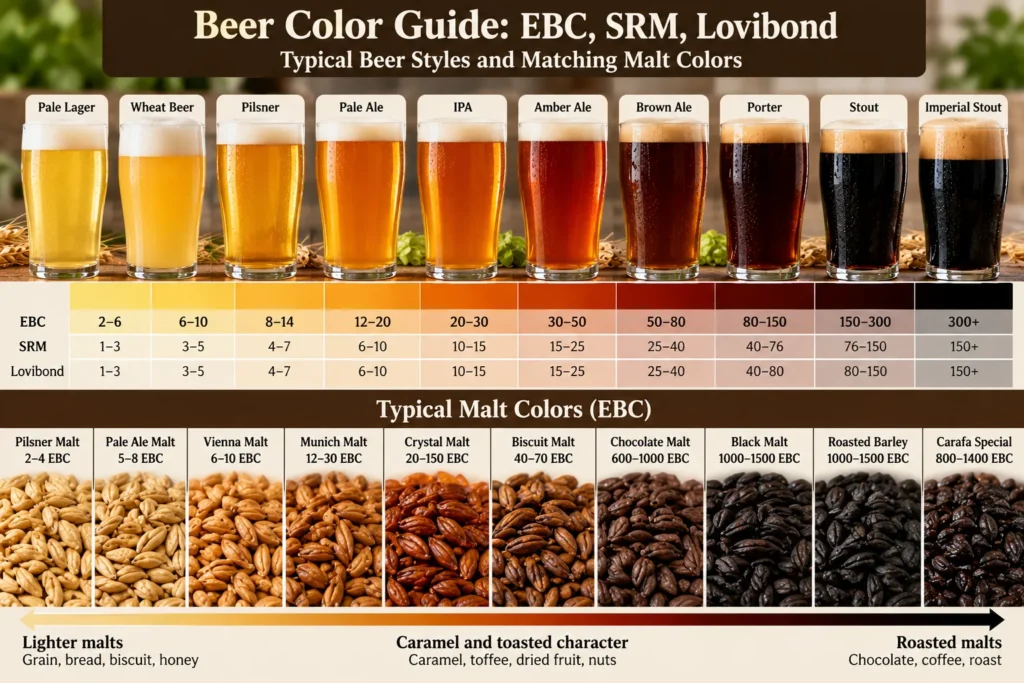
Malt determines far more than simply how much sugar is available for fermentation.
It is one of the main ingredients responsible for the:
- color;
- flavor;
- aroma;
- body;
- mouthfeel;
- foam;
- and overall malt character
of a beer.
A pale Pilsner and an almost black Imperial Stout may both be made primarily from barley malt, yet they look and taste completely different.
Much of that difference begins with how the malt was produced and how much of each malt is used in the recipe.
Brewers describe malt and beer color using several measurement systems, most commonly:
- EBC;
- SRM;
- Lovibond.
At first, numbers such as:
4 EBC
20 EBC
150 EBC
or:
1200 EBC
may seem abstract.
But once you understand what these values represent, they become extremely useful when choosing malts and designing recipes.
In this guide, we will examine how malt affects beer color, flavor, body and foam, and then explain EBC, SRM and Lovibond in practical brewing terms.
Why Does Malt Have Different Colors?
Fresh barley is relatively pale.
The wide range of malt colors develops mainly during the malting process, especially during drying, kilning, stewing and roasting.
Different combinations of:
- temperature;
- moisture;
- time;
- roasting intensity
create dramatically different malts.
A lightly kilned Pilsner Malt may remain extremely pale.
Vienna and Munich Malts receive more heat and develop deeper:
- bread;
- toast;
- honey;
- malt
character.
Crystal and Caramel Malts undergo processes that develop caramelized flavors and progressively darker colors.
Highly roasted malts can become brown or almost black.
As heat treatment increases, both color and flavor chemistry change.
This is why malt color can tell us something about a malt—but not everything.
Malt Color Is More Than Appearance
The color of malt often gives clues about its flavor.
For example, very pale malts frequently have flavors such as:
- fresh grain;
- cracker;
- light bread;
- dough;
- mild honey.
Moderately kilned malts may move toward:
- bread;
- toast;
- biscuit;
- bread crust;
- rich malt.
Darker caramelized malts can develop:
- caramel;
- toffee;
- burnt sugar;
- raisins;
- dried fruit.
Highly roasted malts may contribute:
- cocoa;
- chocolate;
- coffee;
- roast;
- burnt toast.
However, this relationship is not perfectly linear.
Two malts with similar color can taste very different.
The way the malt was produced matters just as much as the final color number.
What Is EBC?
EBC stands for:
European Brewery Convention
and EBC values are widely used in Europe to describe the color of malt and beer.
A lower EBC value indicates a lighter color.
A higher value indicates a darker color.
For example:
| Approximate EBC | General Color |
| 2–5 | Very pale |
| 5–10 | Pale gold |
| 10–20 | Gold to amber |
| 20–40 | Amber to copper |
| 40–80 | Copper to brown |
| 80–150 | Brown |
| 150–300 | Dark brown |
| 300+ | Very dark |
| 800–1500+ | Very dark roasted malt |
These ranges are intentionally broad.
The appearance of the finished beer depends on more than the EBC number of one malt.
Malt EBC vs Beer EBC
This distinction is extremely important.
When a bag of malt says:
5 EBC
that describes the color potential of the malt.
It does not mean that every beer brewed with that malt will have a finished color of exactly 5 EBC.
The final beer color depends on:
- the color of every malt in the grain bill;
- the amount of each malt;
- wort concentration;
- batch volume;
- brewhouse process;
- boil intensity and duration;
- oxidation and other processing effects.
Therefore:
malt EBC and finished beer EBC are related, but they are not the same measurement in practical recipe design.
Brewing software calculates the expected beer color from the entire grain bill.
Typical Malt Color Ranges
Approximate values can look something like this:
| Malt | Approximate EBC |
| Pilsner Malt | 2–4 |
| Pale Ale Malt | 5–8 |
| Golden Promise | 4–7 |
| Maris Otter | 5–8 |
| Vienna Malt | 6–10 |
| Munich I | 12–20 |
| Munich II | 20–30 |
| Light Crystal | 20–60 |
| Medium Crystal | 60–150 |
| Dark Crystal | 150–400+ |
| Biscuit Malt | 40–70 |
| Melanoidin Malt | 50–80 |
| Chocolate Malt | 600–1000 |
| Black Malt | 1000–1500+ |
| Roasted Barley | 1000–1500+ |
| Carafa Special | 800–1400 |
These are only approximate ranges.
Always check the specification supplied by the maltster.
A malt sold under the same general name may have a different color depending on the manufacturer.
What Is SRM?
SRM stands for:
Standard Reference Method
and is commonly used in the United States to describe beer color.
Like EBC:
- lower number = lighter beer;
- higher number = darker beer.
The scales are closely related, but the numbers are different.
A useful approximation is:
EBC ≈ SRM × 1.97
or:
SRM ≈ EBC ÷ 1.97
For practical homebrewing, many brewers simply use:
EBC ≈ 2 × SRM
This is close enough for quickly understanding a recipe.
EBC to SRM Examples
| EBC | Approximate SRM |
| 4 | 2 |
| 8 | 4 |
| 12 | 6 |
| 20 | 10 |
| 40 | 20 |
| 60 | 30 |
| 80 | 41 |
| 100 | 51 |
This makes it much easier to compare European and American recipes.
If an American recipe specifies:
10 SRM
you can think of it as approximately:
20 EBC.
What Is Lovibond?
Lovibond is another color scale that homebrewers frequently encounter, especially when reading American malt descriptions.
You may see malt names such as:
- Crystal 20L;
- Crystal 40L;
- Crystal 60L;
- Crystal 80L;
- Crystal 120L.
The “L” refers to degrees Lovibond.
Historically, the Lovibond scale was based on visual color comparison.
Today, malt specifications may still use Lovibond terminology even when laboratory methods are used to determine color.
For the homebrewer, the important point is:
Lovibond is commonly used to describe malt color, particularly Crystal and Caramel Malts.
Lovibond vs SRM
Lovibond and SRM values are numerically similar at the lighter end of the scale, which is why they are sometimes casually treated as interchangeable.
But they are not exactly the same system.
For practical homebrew recipe reading, however, a malt described as:
40L
is clearly darker than:
20L
and much lighter than:
120L.
That relationship is usually more important than memorizing laboratory definitions.
Lovibond to EBC
A commonly used approximate conversion is:
EBC ≈ Lovibond × 1.97
for many practical brewing comparisons.
However, conversions involving malt color systems are not always perfectly exact across the entire range.
For recipe design, brewing software and maltster specifications are usually more useful than manually converting every malt.
The important skill is being able to recognize the approximate color family.
Crystal 20, 40, 60 and 120 Explained
These names are common in American recipes.
As the Lovibond number increases, the malt generally becomes darker and the flavor changes.
Crystal 20
Usually relatively light.
Common character:
- light caramel;
- honey;
- mild sweetness.
Crystal 40
More obvious caramel character.
May contribute:
- caramel;
- toffee;
- richer sweetness.
Crystal 60
Deeper caramel character.
Can contribute:
- dark caramel;
- toffee;
- burnt sugar;
- deeper color.
Crystal 120
Very dark Crystal Malt.
Common characteristics may include:
- dark caramel;
- burnt sugar;
- raisins;
- dates;
- dried fruit.
This demonstrates an important principle:
Increasing malt color can change flavor quality, not just flavor intensity.
Crystal 120 is not simply “more Crystal 20.”
It is a different flavor tool.
EBC Is Not a Flavor Scale
This is one of the most important things to understand.
EBC measures color, not flavor.
A 60 EBC malt does not automatically taste twice as strong as a 30 EBC malt.
Likewise:
1000 EBC does not mean “1000 units of roasted flavor.”
The number describes color.
Flavor depends on:
- malt production;
- grain type;
- roasting;
- kilning;
- caramelization;
- quantity used;
- the rest of the recipe.
Never choose malt based on EBC alone.
Darker Malt Does Not Automatically Mean Sweeter Malt
Another common misconception is:
darker malt = sweeter malt.
This is not true.
Some dark Crystal Malts can contribute intense caramelized sweetness.
But highly roasted malts such as:
- Black Malt;
- Roasted Barley;
- dark Carafa
may contribute:
- coffee;
- cocoa;
- roast;
- bitterness;
- dryness.
They may make the beer taste less sweet, not more.
Color and sweetness are separate characteristics.
Darker Beer Does Not Automatically Mean Stronger Beer
Beer color tells you very little about alcohol strength.
A black beer may contain:
4% alcohol
while a pale beer may contain:
9% alcohol.
Color comes mainly from the grain bill.
Alcohol comes primarily from the amount of fermentable extract and the degree of fermentation.
A Dry Stout can therefore be dark but relatively low in alcohol.
A Belgian Tripel can be pale and very strong.
Never judge alcohol strength from beer color.
Darker Beer Does Not Automatically Mean More Body
This misconception is also extremely common.
A dark beer can be:
- dry;
- light-bodied;
- highly attenuated.
A pale beer can be:
- rich;
- full-bodied;
- sweet.
Body depends on factors such as:
- original gravity;
- final gravity;
- mash temperature;
- dextrins;
- proteins;
- grain composition;
- yeast attenuation;
- alcohol;
- carbonation.
Dark malt can influence body perception, but color itself does not create body.
How Malt Affects Beer Flavor
Malt flavor exists on a broad spectrum.
Very pale malts
May contribute:
- grain;
- dough;
- cracker;
- fresh bread;
- mild honey.
Moderately kilned malts
May contribute:
- bread;
- toast;
- biscuit;
- bread crust;
- rich malt.
Crystal and Caramel Malts
May contribute:
- caramel;
- toffee;
- honey;
- burnt sugar;
- dried fruit.
Specialty toasted malts
May contribute:
- biscuit;
- nuts;
- toast;
- rich bread;
- malt aroma.
Roasted malts and grains
May contribute:
- cocoa;
- chocolate;
- coffee;
- roast;
- burnt toast;
- char.
The brewer combines these different malt families to build the final flavor.
Malt Flavor Is Built in Layers
Consider a beer containing:
85% Pale Ale Malt
8% Munich Malt
5% Crystal Malt
2% Chocolate Malt
Each ingredient has a different role.
Pale Ale Malt provides the foundation.
Munich provides:
- bread;
- malt richness.
Crystal provides:
- caramel;
- sweetness;
- color.
Chocolate Malt provides:
- cocoa;
- dark color;
- light roast.
This is much more useful than simply thinking:
“I need a darker beer.”
A good malt bill is designed around flavor first and color second.
Do Not Design Beer by Color Alone
Suppose you want to make a copper-colored beer.
You could achieve that color using different combinations of malts.
But those combinations may taste completely different.
For example, color could come from:
- Munich Malt;
- Crystal Malt;
- a small amount of roasted malt;
- combinations of several malts.
The finished beer might therefore taste:
- bready;
- caramel-like;
- toasted;
- roasted
even if the color is almost identical.
Matching color does not mean matching flavor.
This is extremely important when cloning a beer.
How Malt Affects Beer Body
Beer body is the physical impression of fullness or weight when drinking the beer.
A beer may feel:
- thin;
- light;
- soft;
- medium-bodied;
- full;
- thick.
Malt influences body through several components, including:
- proteins;
- dextrins;
- beta-glucans;
- unfermentable carbohydrates.
But malt is only one part of the equation.
Mash temperature and yeast attenuation are also extremely important.
Base Malt and Body
Most base malts provide a relatively balanced fermentable foundation.
The final body depends heavily on how the wort is produced and fermented.
For example, the same Pale Ale Malt can produce:
- a dry, crisp beer
or:
- a fuller, rounder beer
depending on:
- mash temperature;
- original gravity;
- yeast;
- fermentation.
This is why changing malt is not always the correct solution when trying to change body.
Crystal Malt and Body
Crystal and Caramel Malts can increase:
- fullness;
- residual sweetness perception;
- caramel character;
- body.
However, excessive Crystal Malt can make a beer feel:
- heavy;
- sticky;
- overly sweet;
- tiring to drink.
More body is not always better.
The correct amount depends on the beer style.
Wheat and Body
Wheat Malt and Flaked Wheat can contribute:
- protein;
- foam;
- mouthfeel;
- grain character.
They can make a beer feel more substantial without necessarily making it taste sweet.
This is one reason wheat is useful in:
- Wheat Beer;
- Hazy IPA;
- Saison;
- certain Pale Ales.
Oats and Body
Flaked Oats are particularly effective at changing mouthfeel.
They can contribute:
- softness;
- smoothness;
- fullness;
- creamy texture.
This makes them popular in:
- Hazy IPA;
- NEIPA;
- Oatmeal Stout.
But excessive amounts can make wort handling more difficult and may create an overly heavy texture.
Carapils and Body
Carapils or Dextrin Malt is often used to support:
- body;
- foam;
- head retention.
However, it should not automatically be added to every recipe.
If the beer already contains ingredients such as:
- Wheat Malt;
- Flaked Wheat;
- Flaked Oats
or already has sufficient body, additional Carapils may provide little benefit.
Every malt should have a reason to be in the recipe.
Mash Temperature and Body
Malt composition and mash temperature work together.
As a general brewing principle:
lower mash temperatures tend to produce a more fermentable wort
while:
higher mash temperatures tend to produce a less fermentable, fuller wort.
For example:
63–65°C
often favors a more fermentable wort.
66–67°C
provides a useful middle ground for many beers.
68–69°C
can favor greater dextrin retention and fuller body.
These are not absolute boundaries.
Mash chemistry is more complex than one temperature number, but the relationship is extremely useful in recipe design.
Malt and Final Gravity
A beer’s final gravity affects how full or dry it tastes.
But final gravity is influenced by:
- mash temperature;
- yeast attenuation;
- wort composition;
- fermentation health;
- original gravity.
Therefore, if a beer finishes too full, adding less specialty malt may help—but the real cause could also be the mash or yeast.
Recipe design and fermentation should never be considered completely separately.
How Malt Affects Beer Foam
A good beer head is more than decoration.
Foam influences:
- appearance;
- aroma release;
- mouthfeel;
- drinking experience.
Malt contributes several foam-positive compounds, particularly proteins and polypeptides.
Certain grains can be especially useful for foam formation and retention.
Wheat and Foam
Wheat is famous for its contribution to beer foam.
Both Wheat Malt and Flaked Wheat can provide proteins that help support:
- head formation;
- head retention;
- dense foam.
This is one reason Wheat Beer often develops an impressive head.
Small amounts of wheat can also be used in other beer styles when improved foam is desirable.
Barley and Foam
Barley malt itself provides many foam-positive compounds.
Flaked Barley can be particularly useful for:
- body;
- creamy mouthfeel;
- foam stability.
This is one reason it is commonly associated with Irish-style Stout.
Carapils and Foam
Carapils is frequently marketed and used for improving:
- foam;
- foam retention;
- body.
It can help, but it is not a universal solution.
If the beer has poor foam because of:
- dirty glassware;
- fats;
- oils;
- excessive processing problems;
- inappropriate carbonation,
adding more Carapils may not solve the problem.
Foam is the result of the entire brewing process.
Hops Also Affect Foam
Although this article focuses on malt, hops also contribute compounds that can help foam stability.
A beer’s head therefore results from interactions between:
- malt proteins;
- hop compounds;
- carbonation;
- fermentation;
- serving conditions.
This is another reason why foam should not be attributed to one ingredient alone.
What Can Destroy Beer Foam?
Even a well-designed grain bill can produce poor foam if other factors interfere.
Common problems include:
- grease in the glass;
- detergent residue;
- oils;
- fatty ingredients;
- insufficient carbonation;
- inappropriate serving conditions.
If your beer has poor head retention, do not immediately change the malt bill.
First determine whether the problem actually comes from the recipe.
Malt Color and Foam Color
Malt can also affect the appearance of the foam itself.
A pale lager typically has a bright white head.
A dark Porter or Stout may develop foam that appears:
- cream;
- beige;
- tan;
- light brown.
This happens because dark malt compounds influence the visual color of the foam.
The foam therefore becomes part of the beer’s overall visual character.
Can a Small Amount of Dark Malt Change Beer Color?
Absolutely.
Very dark malts have enormous coloring power.
A small percentage of:
- Black Malt;
- Roasted Barley;
- Carafa
can significantly darken an entire batch.
For example, a brewer may use only a small amount of dark malt to adjust the color of a beer without intentionally creating a strong roasted flavor.
However, even small quantities can affect flavor.
This is why debittered or dehusked roasted malts such as certain Carafa products are sometimes used when deep color is desired with less aggressive roast character.
Color Adjustment Without Too Much Roast
Suppose your beer tastes exactly as intended but is slightly too pale.
Adding a large amount of Chocolate Malt simply to darken it may be a mistake.
You might obtain the correct color but introduce unwanted:
- chocolate;
- roast;
- bitterness.
Instead, a very small amount of an appropriate dark malt may achieve the visual adjustment with less flavor impact.
Again:
Choose malt by function, not simply by color number.
How Boiling Affects Beer Color
The grain bill is not the only factor affecting color.
Boiling can also darken wort.
During the boil:
- water evaporates;
- wort becomes more concentrated;
- Maillard reactions may continue;
- thermal reactions can increase color.
A longer or more intense boil may therefore produce darker wort than expected.
This can be especially noticeable in very pale beers.
Why Very Pale Beer Can Be Difficult to Brew
When brewing a very pale beer, such as:
- Pilsner;
- Helles;
- Kölsch-like beer;
small changes become visually noticeable.
Factors such as:
- base malt color;
- boil length;
- boil intensity;
- oxidation;
- water chemistry
can influence the final appearance.
A difference of only a few EBC may be obvious in a very pale beer.
In a black Stout, the same numerical difference may be visually irrelevant.
Why Dark Beer Color Is Difficult to Judge
At high color levels, human vision becomes less capable of distinguishing differences.
A beer at:
80 EBC
and another at:
120 EBC
may both simply look very dark in a normal glass.
Likewise, once a beer becomes nearly opaque, increasing color further may have little visible effect.
This is another reason not to chase color numbers blindly.
Glass Shape Changes Perceived Color
Beer color is also affected by how we look at it.
A beer viewed through:
- a thin tasting glass;
- a wide pint glass;
- a thick mug
can appear different.
The depth of liquid through which light travels affects perceived darkness.
Lighting also matters.
The same beer can look:
- golden;
- amber;
- copper
under different conditions.
Measured color and perceived color are therefore related but not identical.
How Beer Color Is Measured
Professional beer color measurement uses controlled laboratory methods rather than simply holding a glass up to the light.
Modern systems measure how much light is absorbed by the sample at a specified wavelength.
This provides repeatable numerical values such as SRM or EBC.
For the homebrewer, laboratory equipment is usually unnecessary.
Recipe software provides a useful prediction based on:
- malt color;
- malt quantity;
- batch volume.
The prediction is not perfect, but it is generally sufficient for recipe development.
Predicting Beer Color From a Recipe
Brewing software commonly estimates color from:
- malt weight;
- malt color;
- wort volume.
Different mathematical models may be used.
One common concept is Malt Color Units, or MCU.
A simplified form is based on:
malt weight × malt color ÷ volume
The result can then be used in equations that better approximate finished beer color.
Most homebrewers do not need to calculate this manually.
But understanding the principle is useful:
A darker malt, a larger amount of malt, or a smaller volume can all increase predicted beer color.
Why Color Calculators Are Estimates
A calculator cannot perfectly predict every brewing system.
Actual beer color can be affected by:
- malt variation;
- mash conditions;
- boil length;
- evaporation;
- wort concentration;
- kettle geometry;
- oxidation;
- fermentation;
- measurement method.
Therefore, a predicted:
20 EBC
beer may not appear exactly the same every time.
Use calculated color as a design tool, not an absolute guarantee.
EBC and Beer Style
Beer styles often have typical color ranges.
For example, very broadly:
Pale Lager
Usually very pale to gold.
Pale Ale
Usually gold to amber.
Amber Ale
Amber to copper.
Brown Ale
Copper to brown.
Porter
Brown to very dark brown.
Stout
Dark brown to black.
These descriptions are intentionally broad because style guidelines differ and recipes vary.
Color helps define visual expectations, but flavor remains more important than hitting one exact EBC number.
Should You Design a Recipe to Hit an Exact EBC?
Usually not.
Suppose your target is:
20 EBC
and your brewing software predicts:
18 EBC.
If the malt bill already provides exactly the flavor you want, changing it purely to gain two EBC may make the beer worse.
Color is important, but it should not dominate recipe design.
A better priority is:
- flavor;
- balance;
- fermentation;
- mouthfeel;
- aroma;
- appropriate appearance.
If a small color adjustment can be made without changing the flavor, excellent.
But do not sacrifice the beer for a number.
Color Is Useful for Comparing Malts
One of the most practical uses of EBC or Lovibond is comparing products.
Suppose two Munich Malts are listed as:
15 EBC
and:
25 EBC.
The darker product will probably provide a somewhat deeper color and potentially a stronger kilned character.
Likewise, a:
60 EBC Crystal Malt
and a:
300 EBC Crystal Malt
are clearly intended for different flavor roles.
The color number therefore gives useful information before you even open the bag.
But Always Read the Malt Description
Color alone is never enough.
Before choosing a malt, look at:
- EBC or Lovibond;
- flavor description;
- recommended usage;
- enzymatic power if relevant;
- grain type;
- manufacturer.
For example, two malts at approximately the same EBC may have been produced differently and therefore provide different flavors.
The manufacturer’s specification is usually more useful than the color number alone.
Color and Maltster Variation
Natural ingredients vary.
Barley from different:
- harvests;
- regions;
- varieties
can behave differently.
Maltsters also use different production processes.
Therefore, a Pilsner Malt from one producer may be:
3 EBC
while another may be:
4 EBC.
Likewise, two Chocolate Malts can differ substantially in both color and flavor.
When recreating a recipe precisely, use the actual malt specification whenever possible.
Practical Color Comparison
A useful mental map is:
2–4 EBC
Very pale malt.
Think Pilsner Malt.
5–10 EBC
Pale to lightly golden malt.
Think Pale Ale, Maris Otter, Vienna.
10–30 EBC
Increasingly rich golden, amber and malty territory.
Think Munich.
30–150 EBC
Specialty, toasted and caramel territory.
150–400 EBC
Dark Crystal and strongly colored specialty malt territory.
400–800 EBC
Dark brown and chocolate-like territory.
800–1500+ EBC
Very dark roasted malt territory.
This is not a flavor classification.
It is simply a useful visual framework.
Practical Example: Building a Pale Beer
Suppose you want a pale, crisp beer.
You might begin with:
95% Pilsner Malt
5% Wheat Malt
The beer remains pale.
The Pilsner provides the fermentable base and clean grain character.
The Wheat Malt can support:
- foam;
- mouthfeel.
There is no need to add dark specialty malt simply because the recipe seems “too simple.”
Simple can be exactly right.
Practical Example: Building an Amber Beer
Suppose you want:
- amber color;
- bread;
- light caramel;
- moderate body.
A possible grain bill might be:
80% Pale Ale Malt
12% Munich Malt
6% Medium Crystal Malt
2% Biscuit Malt
Here:
Pale Ale provides the foundation.
Munich adds bread and malt richness.
Crystal adds caramel and color.
Biscuit adds a small toasted accent.
The color is the result of the flavor design—not the only objective.
Practical Example: Building a Dark Beer
Suppose you want a Porter with:
- chocolate;
- toast;
- dark color;
- moderate roast.
A possible malt bill could include:
80% Pale Ale Malt
8% Munich Malt
5% Crystal Malt
5% Chocolate Malt
2% Black Malt
Each darker ingredient contributes something different.
The beer becomes dark because the recipe contains dark malts—but those malts were selected primarily for the flavors they provide.
Practical Example: Dark Color With Less Roast
Suppose you want a dark lager with:
- deep brown color;
- smooth malt character;
- minimal harsh roast.
You might use:
- Pilsner or Munich as the base;
- some Vienna or additional Munich for malt depth;
- a small amount of dehusked dark malt for color.
This can produce deep color without turning the beer into a Stout.
The lesson is important:
Dark color and roasted flavor can be controlled separately to some extent.
How Much Does One Dark Malt Affect the Whole Recipe?
Consider a 5 kg grain bill.
If you add:
100 g of a very dark malt
that represents only:
2% of the grain bill.
Yet if that malt is around:
1000–1500 EBC
it can have a dramatic effect on color.
This demonstrates why percentage alone does not tell the whole story.
You must consider:
percentage + malt color + flavor intensity.
Beer Color and Oxidation
Oxidation can also affect beer appearance.
Over time, oxidation may cause some beers to appear darker or duller.
This is particularly noticeable in:
- very pale beers;
- heavily hopped pale beers;
- Hazy IPA.
Oxidation can also change flavor and aroma, often long before color becomes the main concern.
Good oxygen control after fermentation therefore protects both flavor and appearance.
Beer Color and Haze
A hazy beer can appear visually different from a clear beer even when their measured color is similar.
Suspended material scatters light.
This can make a Hazy IPA appear:
- brighter;
- more opaque;
- more orange;
- more yellow
depending on lighting and the grain bill.
Therefore:
color and clarity are separate properties.
EBC does not tell you whether a beer will be clear or hazy.
Beer Color and Foam: The Complete Visual Picture
When evaluating beer appearance, think beyond one color number.
The visual character includes:
- liquid color;
- clarity or haze;
- foam color;
- foam density;
- foam retention;
- carbonation;
- glass presentation.
A 10 EBC beer can look completely different depending on whether it is:
- brilliantly clear;
- naturally hazy;
- topped with dense white foam;
- poorly carbonated.
EBC describes only one part of the picture.
Common Mistake: Choosing Malt Only by EBC
Imagine you need a 50 EBC malt.
You find:
- a Crystal Malt at approximately 50 EBC;
- a Biscuit-type malt at approximately 50 EBC;
- an Aromatic Malt in a similar range.
They may have similar color values.
But they do not taste the same.
One may contribute:
- caramel.
Another:
- toast.
Another:
- rich malt aroma.
The EBC number cannot tell you which one belongs in the recipe.
Common Mistake: Adding Dark Malt Only for Color
Sometimes a recipe calculator says:
“Target: 30 EBC. Current recipe: 24 EBC.”
The brewer adds more roasted malt.
Now the calculator says:
30 EBC.
Perfect?
Not necessarily.
The beer may now have unwanted roast flavor.
Numbers should support recipe design, not control it.
Common Mistake: Assuming More Color Means More Malt Flavor
A beer can become dramatically darker with a very small amount of highly roasted malt.
That does not necessarily make it more “malty.”
In fact, roasted flavors can dominate the softer malt character underneath.
Malty and dark are not synonyms.
A Munich-rich amber lager may taste more strongly malty than a black Dry Stout.
Common Mistake: Using Color to Predict Sweetness
A dark beer is not automatically sweet.
A pale beer is not automatically dry.
Sweetness depends much more on:
- wort composition;
- attenuation;
- residual extract;
- alcohol;
- bitterness;
- fermentation;
- specialty malt choices.
Use your palate and recipe structure—not the beer’s color—to predict sweetness.
EBC, SRM and Lovibond Quick Reference
| System | Mainly Used For | Common Region | Lower Number Means | Higher Number Means |
| EBC | Beer and malt color | Europe | Lighter | Darker |
| SRM | Beer color | United States | Lighter | Darker |
| Lovibond | Commonly malt color descriptions | United States / malt specifications | Lighter | Darker |
Useful approximation:
EBC ≈ SRM × 1.97
and approximately:
SRM ≈ EBC ÷ 1.97
For quick mental calculation:
2 EBC ≈ 1 SRM
Malt Color, Flavor, Body and Foam: Quick Reference
| Malt / Grain Type | Color Contribution | Typical Flavor Effect | Body Effect | Foam Effect |
| Pilsner Malt | Very light | Grain, cracker, light honey | Moderate | Good |
| Pale Ale Malt | Light | Bread, biscuit, malt | Moderate | Good |
| Vienna Malt | Light–medium | Bread, toast, honey | Moderate | Good |
| Munich Malt | Medium | Rich bread, toast, malt | Moderate–fuller | Good |
| Crystal Malt | Light–dark | Caramel, toffee, dried fruit | Can increase fullness | Moderate |
| Biscuit / Victory | Medium | Biscuit, toast, nuts | Small–moderate | Moderate |
| Wheat Malt | Light | Grain, wheat | Adds mouthfeel | Very good |
| Flaked Wheat | Light | Soft grain | Adds body | Very good |
| Flaked Oats | Light | Soft, creamy | Strong mouthfeel effect | Can support |
| Chocolate Malt | Very dark | Chocolate, cocoa, roast | Flavor-dependent | Limited |
| Roasted Barley | Very dark | Coffee, roast, dry bitterness | Can feel dry | Limited |
| Carafa Special | Very dark | Smooth roast, cocoa | Small | Limited |
The exact result depends on percentage and the complete recipe.
How to Choose Malt Using Color Correctly
A better method is:
Step 1: Choose the flavor
Decide whether you want:
- clean grain;
- bread;
- biscuit;
- caramel;
- nuts;
- chocolate;
- coffee;
- roast.
Step 2: Choose the appropriate malt family
For example:
Bread → Vienna or Munich.
Caramel → Crystal.
Biscuit → Biscuit or Victory.
Chocolate → Chocolate Malt.
Roast → Roasted Barley or Black Malt.
Step 3: Check the color
Now compare EBC or Lovibond values within that malt family.
Step 4: Choose the amount
Use enough to achieve the desired flavor intensity.
Step 5: Check predicted beer color
Use brewing software to see whether the overall color is appropriate.
This keeps flavor in control of the recipe, while color becomes a useful design parameter.
A Better Way to Think About Malt
Instead of thinking:
“I need a 100 EBC malt.”
think:
“I want caramel and dried-fruit character, and I also need more color.”
Instead of:
“I need something dark.”
think:
“I want dark color with minimal roast.”
Instead of:
“My beer needs more body, so I need darker malt.”
think:
“Why is the beer thin? Is it the grain bill, mash temperature, yeast attenuation or original gravity?”
These questions lead to better recipes.
Taste the Malt
Numbers are useful.
Your palate is better.
Take a few grains of:
- Pilsner;
- Pale Ale;
- Munich;
- Crystal;
- Biscuit;
- Chocolate;
- Roasted Barley
and taste them side by side.
Look at the color.
Smell them.
Chew them.
Notice how the flavor changes as the malt becomes darker.
Then notice something even more important:
malts of similar color can still taste very different.
That lesson is fundamental to recipe design.
Keep Malt Specifications
When you buy malt, save or record:
- malt name;
- maltster;
- EBC or Lovibond;
- recommended usage;
- flavor description;
- enzymatic information where relevant.
If a recipe turns out particularly well, knowing exactly which malt you used makes it much easier to reproduce.
“Munich Malt” is useful information.
“Specific maltster’s Munich I, 15 EBC” is much better.
Final Thoughts
Malt color is one of the easiest characteristics of beer to see, but one of the easiest to misunderstand.
EBC, SRM and Lovibond are useful tools because they allow brewers to describe and compare color.
But they do not tell the entire story.
EBC tells you about color. It does not tell you exactly what a malt tastes like.
A darker malt is not automatically:
- sweeter;
- stronger;
- fuller;
- more malty.
A pale beer is not automatically:
- dry;
- weak;
- thin.
Malt influences beer through a combination of:
- color;
- flavor;
- aroma;
- proteins;
- dextrins;
- fermentability;
- processing.
The best way to use color values is therefore not to chase a number.
Use them as one part of recipe design.
First decide what the beer should taste and feel like.
Choose malts that provide those characteristics.
Then use EBC, SRM or Lovibond to understand and fine-tune the resulting color.
A good brewer does not ask only:
“What color is this malt?”
The better question is:
“What will this malt contribute to the beer?”
Once you begin thinking this way, EBC stops being just a number on a bag of malt.
It becomes another practical tool for building better beer.