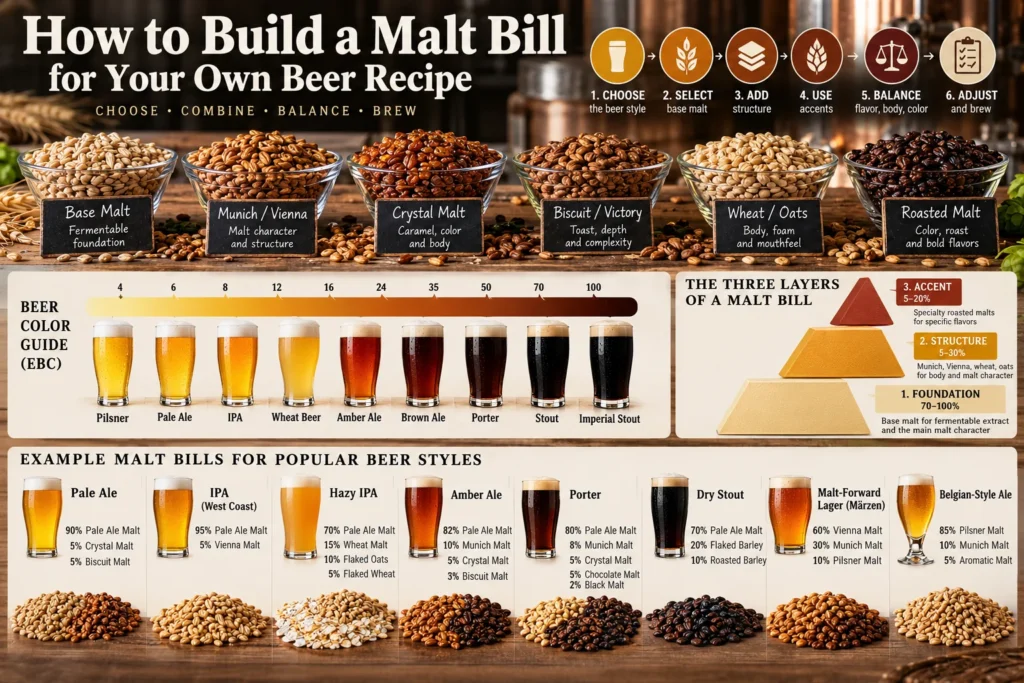
Building your own beer recipe can look complicated at first.
There are dozens of base malts, crystal malts, roasted grains, specialty malts and adjuncts available, and it is easy to assume that a complex beer requires a complex grain bill.
Usually, it does not.
Some of the best beers are built from surprisingly simple combinations of malt.
The key is not using many different malts. The key is understanding what each ingredient is supposed to contribute to the beer.
A good malt bill should have a clear structure:
- a fermentable foundation,
- enough malt character for the intended beer style,
- specialty grains only where they serve a purpose,
- and the right balance of color, flavor, body and fermentability.
This guide explains how to build that structure from the ground up.
What Is a Malt Bill?
A malt bill, also called a grain bill, is the complete combination of malts and other grains used to brew a beer.
For example:
| Ingredient | Percentage |
|---|---|
| Pale Ale Malt | 90% |
| Crystal Malt | 5% |
| Biscuit Malt | 5% |
This simple grain bill already contains three different functions.
The Pale Ale Malt provides most of the fermentable extract and enzymes.
Crystal Malt contributes caramel character, color and some body.
Biscuit Malt adds dry toasted and biscuit-like flavors.
Understanding these functions is much more useful than simply collecting malt names.
Start With the Beer You Want to Brew
Before choosing malt, decide what the finished beer should taste like.
Ask yourself:
What color should the beer be?
Very pale? Golden? Amber? Brown? Black?
How malt-forward should it be?
Clean and neutral? Bread-like? Toasty? Caramel-rich? Roasted?
How much body should it have?
Light and crisp? Medium? Soft and full?
How dry should the beer finish?
A highly fermentable beer requires a different approach from a rich, full-bodied beer.
How important are the hops?
A heavily hopped IPA often benefits from a simpler malt bill than a malt-driven Amber Ale or Bock.
This is one of the most important principles of recipe design:
Build the malt bill for the beer you want to drink, not around the ingredients you happen to own.
Step 1: Choose the Base Malt
The base malt normally forms the majority of the grain bill.
In many beers it represents approximately 70–100% of the total grain.
Common choices include:
- Pilsner Malt
- Pale Ale Malt
- Maris Otter
- Golden Promise
- Vienna Malt
- Munich Malt
The base malt provides most of the fermentable extract and usually most of the enzymatic power required during mashing.
But it also establishes the underlying malt character of the beer.
Pilsner Malt
Choose Pilsner Malt when you want a very pale, clean and delicate malt foundation.
Excellent for:
- Pilsner
- Helles
- Kölsch
- Saison
- Belgian ales
- light lagers
- some modern IPAs
Pale Ale Malt
Pale Ale Malt gives slightly more bread, biscuit and malt character while remaining versatile.
Excellent for:
- Pale Ale
- IPA
- Porter
- Stout
- Amber Ale
- many American and British ales
Maris Otter
Maris Otter generally offers a richer, more distinctly malty and biscuit-like character.
It works particularly well in:
- English Pale Ale
- Bitter
- Porter
- Stout
- English IPA
Golden Promise
Golden Promise tends to provide a soft, slightly sweet and rounded malt character.
It can work beautifully in:
- Scottish ales
- Pale Ale
- IPA
- malt-forward ales
Vienna Malt
Vienna provides more toasted bread and warm malt character than pale base malts.
It can be used as part of the grain bill or, depending on the malt and recipe, as the main base malt.
Munich Malt
Munich Malt produces a much deeper bread-crust and rich malt character.
It is especially useful in malt-forward beers such as:
- Dunkel
- Bock
- Märzen
- Amber Lager
Some Munich malts can form a large part of the grain bill, although their enzymatic strength varies by product.
Step 2: Decide Whether the Beer Actually Needs Specialty Malt
Once you have selected the base malt, stop for a moment.
Do not automatically add Crystal, Biscuit, Melanoidin, Carapils and three other malts simply because they are available.
Ask:
What is missing from the base malt?
If the answer is nothing, you may not need another malt.
A beer made from one excellent base malt can be extremely good.
Specialty malt should solve a specific recipe problem or create a specific flavor.
For example:
| Desired Character | Possible Ingredient |
|---|---|
| Caramel | Crystal Malt |
| Biscuit/toast | Biscuit or Victory |
| Deep maltiness | Munich or Melanoidin |
| Aromatic malt character | Aromatic |
| Belgian malt complexity | Abbey |
| Dark chocolate | Chocolate Malt |
| Coffee/roast | Roasted Barley |
| Black color with softer roast | Carafa Special |
| More grain protein/body | Wheat or oats |
Think in terms of function first, ingredient second.
Step 3: Build Flavor in Layers
A useful way to design a malt bill is to imagine three layers.
Layer 1 – Foundation
This is the base malt.
Usually:
70–100%
It provides the fermentable foundation and the basic malt character.
Layer 2 – Structure
These ingredients modify body, malt intensity, foam or mouthfeel.
Examples include:
- Munich Malt
- Vienna Malt
- Wheat Malt
- oats
- flaked wheat
- flaked barley
- Carapils
Depending on the beer, this layer might represent roughly:
5–30%
Sometimes considerably more.
Layer 3 – Accent
These are stronger ingredients used to create specific flavors or colors.
Examples:
- Crystal Malt
- Biscuit
- Victory
- Melanoidin
- Aromatic
- Chocolate Malt
- Roasted Barley
- Black Malt
These are often used in much smaller quantities.
This foundation–structure–accent method makes recipe design much easier.
Step 4: Use Percentages Before Kilograms
When designing a recipe, percentages are usually more useful than kilograms.
Consider this malt bill:
- Pale Ale Malt – 80%
- Vienna Malt – 10%
- Crystal Malt – 5%
- Biscuit Malt – 5%
The recipe can easily be scaled to 10, 20, 25 or 100 liters because the structure remains the same.
Once the percentages are correct, calculate the actual grain weights required to reach your target original gravity.
For example, if the total grain bill is 6 kg:
- Pale Ale Malt: 4.8 kg
- Vienna Malt: 0.6 kg
- Crystal Malt: 0.3 kg
- Biscuit Malt: 0.3 kg
This is much easier to understand and modify than designing directly in kilograms.
Step 5: Keep the Malt Bill as Simple as Possible
A common beginner mistake is assuming that more malts create more complexity.
Often they create less clarity.
Imagine a Pale Ale containing:
- Pale Ale Malt
- Vienna
- Munich
- Crystal 40
- Crystal 60
- Biscuit
- Victory
- Melanoidin
- Carapils
Every malt may be perfectly good individually.
But together they can produce a confused beer where no individual malt character is clearly identifiable.
A simpler version might contain:
- 90% Pale Ale Malt
- 5% Crystal Malt
- 5% Biscuit Malt
Now every ingredient has an obvious purpose.
Complexity should come from intentional layering, not from the number of ingredients.
How Many Malts Should a Beer Contain?
There is no correct number.
However, many excellent beers can be made with:
1–4 grain ingredients.
Some traditional beers are almost entirely one malt.
Others genuinely benefit from five or more ingredients.
The question should never be:
How many malts should I use?
Instead ask:
Does every malt in this recipe have a reason to be there?
If two ingredients perform almost the same function, consider removing one.
Building a Pale Ale Malt Bill
A Pale Ale usually benefits from a relatively simple malt foundation.
For example:
| Malt | Percentage |
|---|---|
| Pale Ale Malt | 90% |
| Crystal Malt | 5% |
| Biscuit Malt | 5% |
This creates:
- a clean fermentable base,
- mild caramel character,
- a light toasted accent.
For a more hop-focused Pale Ale, simplify even further:
| Malt | Percentage |
|---|---|
| Pale Ale Malt | 95% |
| Wheat Malt or Carapils | 5% |
The malt supports the hops instead of competing with them.
Building an IPA Malt Bill
Modern IPA often benefits from simplicity.
A clean West Coast-style foundation could be:
| Malt | Percentage |
|---|---|
| Pale Ale Malt | 95% |
| Vienna Malt | 5% |
Or simply:
100% Pale Ale Malt
A small amount of Crystal Malt can be used if some caramel character is desired, but large quantities can make the beer taste too sweet or heavy and may reduce the impression of hop brightness.
For modern hop-forward IPA, the malt bill should usually provide a platform rather than become the main attraction.
Building a Hazy IPA Malt Bill
Hazy IPA requires a somewhat different structure because body, softness and haze stability are important.
For example:
| Ingredient | Percentage |
|---|---|
| Pale Ale Malt | 70% |
| Wheat Malt | 15% |
| Flaked Oats | 10% |
| Flaked Wheat | 5% |
The Pale Ale Malt provides enzymes and fermentable extract.
Wheat contributes protein and foam stability.
Oats contribute softness and mouthfeel.
Flaked Wheat adds additional protein and structure.
Notice that the malt bill still remains relatively simple.
Building an Amber Ale Malt Bill
Amber beers usually need more malt complexity than very hop-forward pale beers.
For example:
| Malt | Percentage |
|---|---|
| Pale Ale Malt | 82% |
| Munich Malt | 10% |
| Crystal Malt | 5% |
| Biscuit Malt | 3% |
This creates several complementary layers:
Pale Ale Malt provides the foundation.
Munich provides deeper bread and malt character.
Crystal contributes caramel.
Biscuit adds a dry toasted accent.
Building a Porter Malt Bill
Dark beers require careful balance.
The goal is not simply to make the beer black.
For example:
| Malt | Percentage |
|---|---|
| Pale Ale Malt | 80% |
| Munich Malt | 8% |
| Crystal Malt | 5% |
| Chocolate Malt | 5% |
| Black Malt | 2% |
The dark malts contribute different types of roast character.
Chocolate Malt can provide cocoa, coffee and toasted flavors.
Black Malt adds deeper roast and color.
Using several dark grains without understanding their purpose can quickly produce excessive bitterness, ash or harsh roast character.
Building a Dry Stout Malt Bill
One of the best demonstrations of simple recipe design is traditional Dry Stout.
A classic structure can be approximately:
| Ingredient | Percentage |
|---|---|
| Pale Ale Malt | 70% |
| Flaked Barley | 20% |
| Roasted Barley | 10% |
Three ingredients.
Three clear functions.
Pale Ale Malt provides fermentable extract and enzymes.
Flaked Barley contributes body, protein and foam.
Roasted Barley provides the characteristic dark color, coffee and roasted flavor.
This is an excellent example of why more ingredients do not automatically produce better beer.
Building a Malt-Forward Lager
For a richer lager such as Märzen or an amber lager, the base malt itself can provide much of the complexity.
For example:
| Malt | Percentage |
|---|---|
| Vienna Malt | 60% |
| Munich Malt | 30% |
| Pilsner Malt | 10% |
Here the beer gets its character primarily from the base malts rather than from numerous specialty malts.
That creates a deep malt profile while keeping the recipe clean.
Building a Belgian-Style Malt Bill
Belgian beers are another good example of why the malt bill does not need to become complicated.
A Belgian-style ale might use:
| Malt | Percentage |
|---|---|
| Pilsner Malt | 85% |
| Munich Malt | 10% |
| Aromatic or Abbey Malt | 5% |
Much of the final complexity may then come from fermentation rather than from adding more malt.
This is important.
Not every flavor in beer needs to come from grain.
Yeast, hops, water and fermentation conditions are equally important parts of recipe design.
Color Should Be a Result, Not the Main Goal
Beer color matters, but choosing malt only to reach a particular EBC or SRM value can produce a poorly balanced beer.
Two beers with exactly the same color can taste completely different.
A dark Crystal Malt, Chocolate Malt and Carafa can all increase color, but they contribute very different flavors.
Therefore:
Choose malt primarily for flavor and function. Then check the predicted color.
If an adjustment is required, make it carefully.
Do not build the entire recipe around a color number.
Think About Fermentability
The grain bill influences original gravity, but the final body and sweetness of the beer depend on much more than the amount of grain.
Important factors include:
- malt composition,
- mash temperature,
- mash duration,
- yeast strain,
- yeast attenuation,
- fermentation health,
- original gravity.
A recipe containing a large amount of highly fermentable base malt can finish surprisingly dry.
A beer containing more crystal malt, dextrin-rich ingredients or a higher mash temperature may finish fuller.
This is why malt bill design and mash design should be considered together.
Do Not Use Crystal Malt as a Sweetness Control
Crystal and caramel malts contain compounds that contribute caramel flavors, body and varying amounts of less-fermentable material.
But adding Crystal Malt is not a precise method for setting final gravity.
If you want a fuller beer, consider the entire system:
- grain bill,
- mash temperature,
- yeast attenuation,
- original gravity,
- adjuncts,
- fermentation conditions.
A beer can taste malty without tasting sweet.
Likewise, a beer can finish at a relatively high final gravity without having a strong caramel character.
Foam Should Also Be Designed as a System
Homebrewers sometimes add Carapils, Wheat Malt or Flaked Wheat automatically because they want better head retention.
These ingredients can help, but foam stability depends on many factors:
- malt proteins,
- mash conditions,
- fermentation,
- hop compounds,
- carbonation,
- glass cleanliness,
- oils and fats,
- serving conditions.
Adding another malt is not always the solution.
If your beer already contains substantial wheat or other protein-rich grain, additional Carapils may provide little benefit.
Check the Enzymatic Strength of the Grain Bill
Base malts normally contain enough enzymes to convert their own starches during mashing.
Many specialty grains and unmalted adjuncts do not.
If a recipe contains a high percentage of adjuncts or low-enzyme malt, make sure the complete grain bill still contains sufficient diastatic power.
For ordinary recipes built mostly from modern base malt, this is rarely a problem.
It becomes more important when using large quantities of:
- flaked grains,
- unmalted grain,
- heavily kilned malt,
- certain specialty malts.
Recipe design should always consider whether the mash can actually convert the available starch.
Account for Your Brewhouse Efficiency
Two brewers using the same malt percentages may need different total grain weights.
Why?
Because brewing systems have different efficiencies.
One brewer may achieve 80% brewhouse efficiency.
Another may achieve 65%.
The malt percentages can remain identical, but the second brewer will need more total grain to reach the same original gravity.
This is why a good recipe should distinguish between:
grain composition
and
total grain quantity.
First design the composition.
Then scale it according to your target gravity, volume and brewing efficiency.
Design by Function
One of the easiest ways to improve recipe design is to assign every ingredient a job.
For example:
Base Malt
Provides fermentable extract and the main malt foundation.
Munich or Vienna
Adds bread, toast and deeper malt character.
Crystal
Adds caramel character, color and body.
Biscuit or Victory
Adds dry toast, biscuit and crust-like flavors.
Wheat
Adds protein, foam and grain character.
Oats
Adds softness and fuller mouthfeel.
Roasted Barley
Adds coffee-like roast and dark color.
Chocolate Malt
Adds cocoa, coffee and dark toast.
Carafa Special
Adds dark color and softer roast character.
Once every ingredient has a defined purpose, unnecessary ingredients become much easier to identify.
A Simple Recipe-Building Method
When creating a new malt bill, use this process.
1. Choose the beer style or flavor target
Decide what the finished beer should taste and feel like.
2. Choose one main base malt
Build the foundation first.
3. Decide whether you need a structural grain
This might be Munich, Vienna, wheat, oats or another ingredient that changes body or malt intensity.
4. Add one flavor accent if necessary
Crystal, Biscuit, Victory, Melanoidin or another specialty malt may provide the missing character.
5. Add roasted grain only if the beer needs roast or dark color
Choose the roasted malt according to the flavor you want, not simply its color.
6. Convert everything into percentages
This makes the recipe easier to understand and scale.
7. Remove anything without a clear purpose
This step often improves the recipe.
8. Calculate the total grain required
Use your target volume, target original gravity and brewhouse efficiency.
9. Check color and enzymatic power
Make sure the recipe is technically practical.
10. Consider mash temperature and yeast
The grain bill cannot be designed completely independently from fermentation.
The “Remove One Malt” Test
Before finalizing a recipe, try this simple test.
Look at every specialty malt and ask:
What happens if I remove this ingredient?
If you cannot explain what would noticeably change, the malt may not be necessary.
This is particularly useful when a recipe has six, seven or eight different malts.
Sometimes removing one or two ingredients makes the beer cleaner and more distinctive.
Change One Thing at a Time
If you are developing your own recipes, avoid changing the entire malt bill after every batch.
Suppose your Pale Ale contains:
- 90% Pale Ale Malt
- 5% Crystal
- 5% Biscuit
If the beer needs more toasted character, change the Biscuit Malt.
Do not simultaneously change:
- the base malt,
- Crystal percentage,
- Biscuit percentage,
- mash temperature,
- yeast,
- and water profile.
If you change everything, you will not know which change produced the result.
Controlled recipe development is one of the fastest ways to become a better brewer.
Taste Your Ingredients
Charts and malt descriptions are useful, but they cannot replace experience.
Taste a few kernels of your brewing malt.
Compare:
- Pilsner with Pale Ale Malt,
- Pale Ale with Vienna,
- Vienna with Munich,
- Crystal 40 with Crystal 120,
- Biscuit with Victory,
- Chocolate Malt with Roasted Barley.
The differences become much easier to understand when you can smell and taste them directly.
Keep notes.
Over time, you will build your own mental malt library.
That is more valuable than memorizing dozens of manufacturer descriptions.
Example Malt Bill Templates
These are not complete beer recipes. They are starting points for understanding grain structure.
| Beer Type | Example Malt Bill |
|---|---|
| Light Lager | 95% Pilsner + 5% Vienna |
| Pale Ale | 90% Pale Ale + 5% Crystal + 5% Biscuit |
| West Coast IPA | 95% Pale Ale + 5% Vienna |
| Hazy IPA | 70% Pale Ale + 15% Wheat + 10% Oats + 5% Flaked Wheat |
| Amber Ale | 82% Pale Ale + 10% Munich + 5% Crystal + 3% Biscuit |
| Dry Stout | 70% Pale Ale + 20% Flaked Barley + 10% Roasted Barley |
| Porter | 80% Pale Ale + 8% Munich + 5% Crystal + 5% Chocolate + 2% Black Malt |
| Malt-Forward Lager | 60% Vienna + 30% Munich + 10% Pilsner |
| Belgian-Style Ale | 85% Pilsner + 10% Munich + 5% Aromatic or Abbey |
These percentages are not rules.
They are examples of how different ingredients can be assigned specific functions.
From Malt Bill to Complete Beer Recipe
A malt bill is only one part of a beer recipe.
Once the grain structure is established, the brewer still needs to design:
- hop bitterness,
- hop flavor and aroma,
- yeast selection,
- water profile,
- mash temperature,
- fermentation temperature,
- carbonation,
- and the complete brewing process.
This is why recipe design works best when each part is understood separately before everything is combined.
The malt bill builds the foundation.
The hops shape bitterness, flavor and aroma.
The yeast transforms the wort and can contribute major flavor characteristics of its own.
Water influences mash chemistry and the perception of malt and hops.
Fermentation determines how successfully all of those ingredients become beer.
Final Thoughts
Building a good malt bill is not about finding the largest possible selection of interesting malts.
It is about giving every ingredient a reason to exist.
Start with a base malt that fits the beer.
Add structural grains only when they provide something useful.
Use specialty malts deliberately.
Use roasted grains according to the roast character you actually want.
Think in percentages before kilograms.
Consider fermentability, enzymes, color, body and foam as parts of the same system.
And when the recipe starts becoming complicated, ask whether removing an ingredient might actually make the beer better.
A simple malt bill with a clear purpose will usually produce a more focused beer than a complicated malt bill built without direction.
Once you understand that principle, you are no longer simply following recipes.
You are beginning to design your own beer.