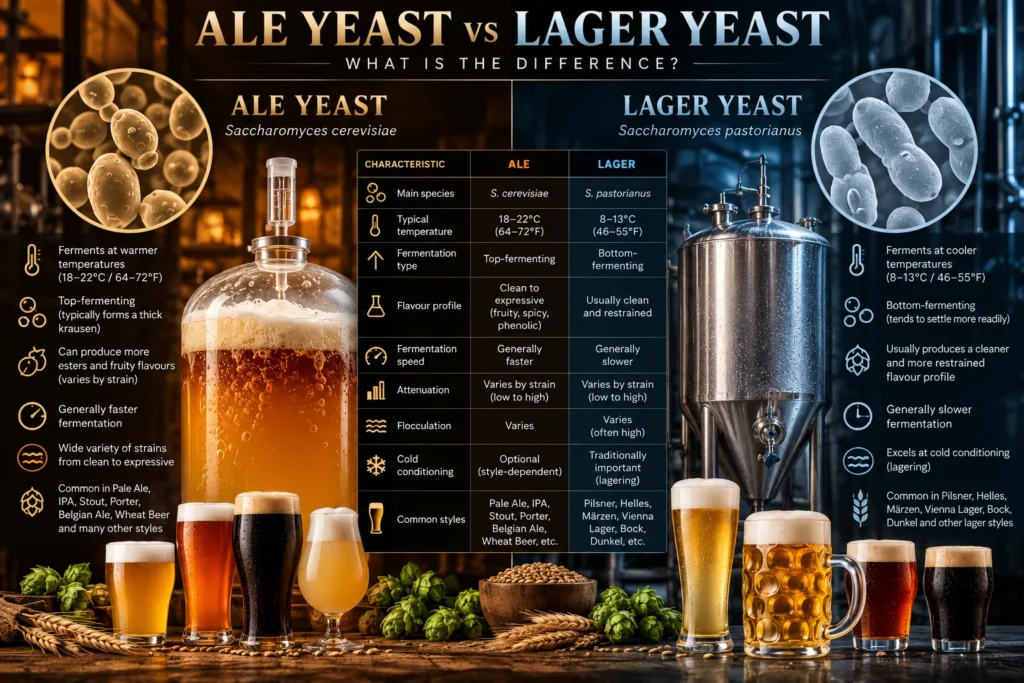
Ale and lager are the two great families of beer. Walk into almost any brewery, homebrew shop or beer bar and most of the beers you encounter can ultimately be connected to one of these two fermentation traditions.
The difference, however, is not simply that ales ferment warm and lagers ferment cold.
The yeast itself is different. Its biology is different, its preferred fermentation conditions are different, and the flavours it produces can be different. Fermentation temperature, pitching rate, maturation and the way the yeast behaves inside the fermenter all contribute to the final character of the beer.
At the same time, modern brewing has made the distinction less rigid than it once appeared. Some lager strains can ferment surprisingly cleanly at warmer temperatures, while some ale strains can perform well at relatively cool temperatures.
So what actually separates ale yeast from lager yeast?
In this second article of our beer yeast series, we will look at the differences between the two, how they behave during fermentation, what they contribute to flavour, and how to decide which one is right for your beer.
Ale Yeast and Lager Yeast Are Not the Same Organism
The first and most important difference is biological.
Most traditional ale strains belong to:
Saccharomyces cerevisiae
Traditional lager strains primarily belong to:
Saccharomyces pastorianus
Although both are brewing yeasts capable of converting wort sugars into alcohol and carbon dioxide, they are not simply the same yeast used at different temperatures.
That distinction matters.
Lager yeast is a hybrid yeast whose ancestry includes Saccharomyces cerevisiae and a cold-tolerant relative, Saccharomyces eubayanus. This helps explain why lager yeast is particularly well adapted to fermentation at lower temperatures.
Ale yeast, meanwhile, includes an enormous variety of strains that have developed distinctive characteristics through centuries of brewing.
An English ale strain, a Belgian Saison strain and a German wheat beer strain may all belong to S. cerevisiae, yet they can produce dramatically different beers.
So even the categories “ale yeast” and “lager yeast” contain substantial diversity.
The Traditional Difference: Top vs Bottom Fermentation
Ale yeast is traditionally called top-fermenting yeast, while lager yeast is described as bottom-fermenting yeast.
This terminology comes from historical observations of fermentation.
During traditional ale fermentation, brewers often observed thick yeast-rich foam accumulating near the surface of the fermenting beer. Some brewing traditions even collected yeast directly from this foam for use in the next batch.
Lager yeast became associated with yeast settling toward the bottom of the fermentation vessel.
This gave rise to the classic distinction:
Ale = top fermentation
Lager = bottom fermentation
The terms remain useful, but they should not be interpreted too literally.
During active fermentation, yeast cells do not simply remain at the top or bottom of the fermenter. CO₂ production and convection keep yeast moving throughout the liquid.
For the modern homebrewer, fermentation temperature, flavour profile, attenuation and the characteristics of the individual strain are generally more useful than imagining two completely separate layers of yeast.
Fermentation Temperature: The Most Obvious Difference
Temperature is the difference most homebrewers notice first.
Traditional ale strains generally ferment at warmer temperatures than traditional lager strains.
A typical ale fermentation might take place somewhere around:
18–22°C (64–72°F)
A traditional lager fermentation might instead occur around:
8–13°C (46–55°F)
These are broad examples, not universal rules.
Always follow the recommended range for the particular strain you are using.
Some English strains perform beautifully toward the cooler end of typical ale temperatures. Belgian and Saison strains may prefer considerably warmer conditions.
Likewise, modern lager strains can sometimes produce excellent results well above traditional lager temperatures.
The yeast packet or manufacturer’s technical information therefore matters more than a generic temperature chart.
Why Does Temperature Change the Beer?
Yeast metabolism changes with temperature.
As fermentation temperature increases, yeast generally becomes more metabolically active, but the amount and balance of fermentation by-products can also change.
These compounds include:
- esters
- higher alcohols
- sulfur compounds
- organic acids
- other flavour-active fermentation products
This is one reason many ales have a more noticeable fermentation character.
English ales may display fruity notes.
Belgian strains may produce fruit and spice.
German wheat beer strains can create banana-like esters and clove-like phenols.
Traditional lager fermentation generally aims for a cleaner profile in which fermentation-derived character is restrained and malt and hops can appear particularly precise.
But temperature alone does not determine this.
The yeast strain itself is crucial.
Fermenting an expressive Belgian ale strain at a relatively cool temperature will not magically transform it into lager yeast.
Likewise, fermenting lager yeast warmer does not turn it into ale yeast.
Ale Yeast: What Does It Usually Taste Like?
There is no single “ale yeast flavour.”
The category is far too broad.
Ale strains can range from extremely clean to intensely expressive.
A clean American ale strain may produce a neutral fermentation profile suitable for:
- American Pale Ale
- West Coast IPA
- American IPA
- Blonde Ale
- many hop-forward beers
In these beers, the purpose of the yeast is often to ferment efficiently without competing heavily with the hops.
English ale strains can produce more noticeable esters, sometimes giving impressions of:
- stone fruit
- pear
- red fruit
- subtle apple
- other fruity notes
They can also contribute to the perception of body and often show relatively strong flocculation.
Belgian strains can become much more expressive, producing combinations of:
- fruit
- pepper
- spice
- phenolic character
- complex fermentation aromas
German wheat beer strains are another extreme example.
The classic banana-like aroma associated with many Weissbiers comes largely from the ester isoamyl acetate, while clove-like character is associated with the phenolic compound 4-vinyl guaiacol.
All of these can be produced by yeasts that broadly fall within the ale family.
This demonstrates why choosing a yeast simply because the package says “ale yeast” is not enough.
Lager Yeast: What Does It Usually Taste Like?
Lager yeast is generally associated with a cleaner and more restrained fermentation profile.
That does not mean lager yeast produces no flavour.
It means the fermentation is usually managed so that yeast-derived flavours do not dominate the beer.
This allows subtle differences in malt, water chemistry and hopping to become particularly noticeable.
Consider beers such as:
- German Pils
- Czech-style pale lager
- Helles
- Vienna Lager
- Märzen
- Dunkel
- Schwarzbier
- Bock
These beers can be extremely flavourful even though their fermentation character is relatively clean.
In a good Helles, for example, delicate malt character can remain at the centre of the beer.
In a Pilsner, a clean fermentation can allow crisp bitterness and hop character to remain clearly defined.
A clean beer is not an empty beer.
In fact, producing a clean lager can expose brewing mistakes because there is often less fermentation character available to hide them.
Why Can Lager Yeast Ferment at Low Temperatures?
One of the defining characteristics of Saccharomyces pastorianus is its ability to perform effectively at temperatures that would make many ale strains sluggish.
This cold tolerance is connected to its hybrid ancestry.
For brewers, this was enormously important historically.
Fermentation and storage at low temperatures allowed the development of beers with a character very different from traditional warm-fermented ales.
The development of lager brewing was also closely connected with cold storage.
The word lager itself comes from the German concept of storing or keeping.
Fermentation is only part of the lager process.
Maturation is equally important.
What Is Lagering?
Lagering means storing and conditioning beer at low temperature after fermentation.
Traditionally, lager beer was kept cold for an extended period before serving.
During this time several things can happen:
- yeast and other particles settle
- the beer becomes clearer
- flavours become more integrated
- harsh or rough impressions may soften
- the beer develops a more refined character
Modern brewing equipment can accelerate some parts of the process, but time and cold conditioning still have value.
This is one of the major practical differences between producing many ales and producing traditional lagers.
An ale may be fermented, conditioned and ready to drink relatively quickly.
A lager often benefits from more patience.
Does Ale Yeast Ferment Faster?
Generally, warm ale fermentation proceeds faster than traditional cold lager fermentation.
Higher temperatures increase metabolic activity, so a healthy ale fermentation can often complete its main fermentation relatively quickly.
Traditional lager fermentation at lower temperatures may take longer.
However, fermentation time cannot be reduced to a simple rule such as:
Ale = 5 days
Lager = 14 days
Beer gravity, pitching rate, yeast health, strain, temperature and wort composition all matter.
A beer should never be considered finished simply because a predetermined number of days has passed.
As discussed in the first article of this series:
measure gravity rather than relying on the calendar or the airlock.
Attenuation: Is Lager Yeast More Attenuative?
Not necessarily.
Both ale and lager strains are available with low, medium and high apparent attenuation.
The final gravity of a beer depends on the combination of:
- yeast strain
- wort fermentability
- mash conditions
- original gravity
- fermentation health
- temperature
- other recipe and process variables
You therefore cannot assume that a lager will always finish drier than an ale.
A highly attenuative Saison yeast, for example, can produce an exceptionally dry beer.
An English ale strain may leave considerably more residual extract.
Some lager strains also attenuate very well.
Again, the individual strain matters more than the simple ale-versus-lager label.
Flocculation: Which One Clears Better?
There is no universal winner here either.
Some ale strains are highly flocculent and can produce brilliantly clear beer quickly.
Other ale strains remain cloudy for much longer.
Lager strains also vary.
Cold conditioning helps lager beer clarify because yeast, proteins and other suspended material gradually settle at low temperature.
This is one reason lagers often become exceptionally bright after sufficient conditioning.
But clarity should not be confused with fermentation quality.
A cloudy beer is not automatically poorly fermented, and a crystal-clear beer is not automatically well fermented.
Sulfur and Lager Fermentation
One characteristic that surprises some new lager brewers is the presence of sulfur aromas during fermentation.
Certain lager strains can produce noticeable sulfur compounds.
During active fermentation, the smell may sometimes seem alarming, especially to someone brewing a lager for the first time.
In many cases these aromas decrease considerably as fermentation and conditioning progress.
This is another reason not to judge a beer too early.
The smell coming from the fermenter on day three is not necessarily the aroma the finished beer will have several weeks later.
However, persistent unpleasant sulfur character can also indicate fermentation or process problems, so context matters.
Diacetyl and the Diacetyl Rest
Another term frequently associated with lager brewing is diacetyl.
Diacetyl can create a butter-like or butterscotch-like aroma and flavour.
Small amounts may be acceptable in certain beer styles, but excessive diacetyl is generally considered undesirable in many lagers.
During fermentation, yeast can eventually reduce diacetyl-related compounds.
For this reason, lager brewers often use a diacetyl rest.
Toward the end of fermentation, the temperature is allowed to rise, encouraging active yeast to complete fermentation and reduce unwanted fermentation by-products before the beer is chilled for lagering.
A fixed temperature and exact schedule cannot be prescribed for every yeast and every beer.
The timing should be based on fermentation progress and the behaviour of the particular strain.
Can You Make Lager With Ale Yeast?
This depends on what we mean by “lager.”
You can certainly make a clean, pale, lager-like beer using a neutral ale strain fermented cool.
Several beer styles historically occupy territory between the simple ale/lager division.
Kölsch is a famous example of a beer fermented with ale yeast but traditionally conditioned cold.
Altbier is another top-fermented German style that benefits from cool fermentation and conditioning.
These beers can be remarkably clean.
But biologically they remain ale fermentations because the yeast is an ale strain.
If you want the fermentation character of a true lager yeast, use lager yeast.
A clean ale yeast can imitate certain aspects of lager character, but it does not become S. pastorianus simply because it is fermented cold.
Can You Ferment Lager Yeast Warm?
Yes — sometimes surprisingly successfully.
This is one of the areas where modern homebrewing has changed considerably.
Some modern lager strains are capable of producing relatively clean beer at temperatures significantly higher than traditional lager fermentation temperatures.
This can be extremely useful for homebrewers who lack dedicated refrigeration.
But there is an important qualification:
not every lager strain behaves the same way when fermented warm.
Some may produce increased esters, sulfur or other fermentation character outside their preferred range.
Others are specifically selected for flexible temperature performance.
Follow the manufacturer’s recommendations and learn how the individual strain behaves rather than applying one rule to every lager yeast.
Modern Lager Yeast Has Changed Homebrewing
Historically, brewing lager at home could require substantial temperature control.
A brewer might need:
- a dedicated refrigerator
- a fermentation chamber
- an external temperature controller
- enough space for weeks of cold conditioning
Modern yeast selection has expanded the possibilities.
Some lager strains can ferment cleanly at moderately warmer temperatures. Pressure-capable fermenters have also become common among homebrewers, creating additional ways to manage lager fermentation.
This does not mean traditional cold fermentation has become obsolete.
It simply means brewers now have more options.
A traditional Pilsner fermented cold and lagered patiently remains a different approach from a fast, warm-fermented modern lager.
Both can produce excellent beer when the process suits the yeast.
Ale Yeast Under Pressure
Pressure fermentation is most commonly discussed in connection with lager brewing, but ale yeast can also be fermented under pressure.
Pressure can suppress the expression of certain fermentation compounds, including some esters.
That can be useful if the brewer wants a cleaner profile.
But it can also be undesirable.
If you deliberately choose an expressive English, Belgian or wheat beer strain because you want its fermentation character, suppressing that character with excessive pressure may defeat the purpose of choosing the yeast.
This is an important principle:
Fermentation technique should support the yeast character you want, not automatically suppress it.
Lager Yeast Under Pressure
Lager fermentation under pressure has become popular among homebrewers.
The potential advantages include:
- cleaner fermentation at somewhat warmer temperatures
- retention of more dissolved CO₂
- easier closed transfers
- reduced oxygen exposure during packaging
- partial natural carbonation
But pressure is not magic.
Too much pressure, especially if applied very early, can affect yeast growth and fermentation performance.
The appropriate pressure depends on the yeast, wort and fermentation strategy.
A spunding valve is therefore not simply a device for setting the highest pressure the fermenter can tolerate.
It is a tool for controlling another fermentation variable.
Which Yeast Should You Choose for an IPA?
For many American-style IPAs, a clean or moderately expressive ale yeast is the obvious choice.
Why?
Because the brewer usually wants the hop character to remain prominent.
A clean American strain can allow:
- citrus
- tropical fruit
- pine
- resin
- floral character
- modern hop aromas
to remain clearly identifiable.
But not every IPA needs neutral yeast.
English-style IPAs can benefit from English yeast character.
Modern hazy or New England-style IPAs are often fermented with expressive ale strains whose fruity ester profiles interact with hop-derived aromas.
So even within one broad beer family, yeast choice can dramatically change the result.
Which Yeast Should You Choose for a Pale Ale?
Again, it depends on the Pale Ale.
For a clean American Pale Ale, a neutral American ale yeast may be ideal.
For a more traditional English Pale Ale, an English strain with moderate ester production may provide a more authentic character.
If the recipe is designed around delicate malt and classic hop character, the yeast should complement rather than overwhelm them.
The name of the style gives you a starting point.
The flavour you want determines the final choice.
Which Yeast Should You Choose for a Stout?
Stout is another good example of why “ale yeast” is too broad a category.
An Irish-style stout may benefit from a yeast with restrained fruitiness and suitable attenuation.
An English stout may work beautifully with a more characterful English strain.
An Imperial Stout may require a strain with sufficient alcohol tolerance and fermentation performance to handle high-gravity wort.
The darkest malt in the recipe does not determine the yeast.
The desired balance of roast, body, attenuation and fermentation character does.
Which Yeast Should You Choose for a Lager?
If you want a traditional lager profile, start with a lager strain appropriate for the specific style.
A yeast suitable for a crisp Pilsner may not necessarily be your first choice for a rich Doppelbock.
Look at:
- recommended temperature range
- attenuation
- flocculation
- alcohol tolerance
- sulfur production
- flavour profile
- recommended beer styles
Do not choose yeast based only on whether the packet says “lager.”
The individual strain matters.
Ale vs Lager Yeast: A Practical Comparison
| Characteristic | Ale Yeast | Lager Yeast |
|---|---|---|
| Main species | S. cerevisiae | S. pastorianus |
| Traditional fermentation | Warmer | Cooler |
| Common description | Top-fermenting | Bottom-fermenting |
| Typical flavour | Clean to highly expressive | Usually clean and restrained |
| Esters | Can be low to very high | Usually lower in traditional fermentation |
| Fermentation speed | Generally faster | Traditionally slower |
| Cold conditioning | Optional/style-dependent | Traditionally important |
| Typical styles | Pale Ale, IPA, Stout, Belgian Ale, Weissbier | Pilsner, Helles, Märzen, Vienna Lager, Bock |
| Temperature flexibility | Highly strain-dependent | Increasingly flexible with modern strains |
| Pressure fermentation | Possible | Common in modern homebrewing |
This table is useful as a general guide, but there are exceptions to almost every row.
That is why understanding the individual yeast strain is more valuable than memorising rigid rules.
Is One Better Than the Other?
No.
Ale yeast is not better than lager yeast.
Lager yeast is not more advanced than ale yeast.
They are tools for producing different fermentation profiles.
A perfectly fermented Helles and a perfectly fermented English Bitter should not taste the same.
That is the point.
The brewer’s task is not to eliminate yeast character from every beer.
The task is to control fermentation so that the yeast contributes exactly what the beer needs.
The Biggest Mistake: Choosing Yeast Only by Temperature
Suppose your fermentation room is 20°C.
It would be easy to think:
“I need an ale yeast because lager yeast needs 10°C.”
That may be true for a particular traditional lager strain.
But it may be completely wrong for another modern lager strain.
Likewise, choosing an ale yeast simply because your room is warm ignores flavour, attenuation and style.
Temperature is one part of yeast selection.
A better decision considers:
- beer style
- desired flavour profile
- actual fermentation temperature
- original gravity
- attenuation
- flocculation
- alcohol tolerance
- pressure, if used
- available temperature control
- conditioning time
Choose the yeast for the beer and then create the best fermentation conditions you realistically can.
Final Thoughts
The difference between ale yeast and lager yeast begins with biology but extends through the entire fermentation process.
Ale yeast, primarily Saccharomyces cerevisiae, generally favours warmer fermentation and can produce anything from an extremely clean profile to intense fruity, spicy or phenolic character.
Lager yeast, Saccharomyces pastorianus, is adapted to cooler fermentation and is traditionally used to produce clean, refined beers followed by cold conditioning.
But modern brewing has made the boundary more flexible.
Some ale strains work beautifully at cool temperatures.
Some lager strains can produce excellent beer considerably warmer than traditional lager fermentation would suggest.
The most useful lesson is therefore not simply:
Ale = warm. Lager = cold.
It is:
Know your yeast strain, understand what character you want from it, and give it the conditions that allow it to produce that beer.
Once you understand this distinction, choosing between ale and lager yeast becomes much easier — and you also begin to understand why two beers made from similar malt and hops can taste completely different.