When choosing a brewing yeast, two terms appear again and again on yeast packets and manufacturers’ technical sheets:
Attenuation and flocculation.
They may sound technical, but both have a very practical effect on your beer.
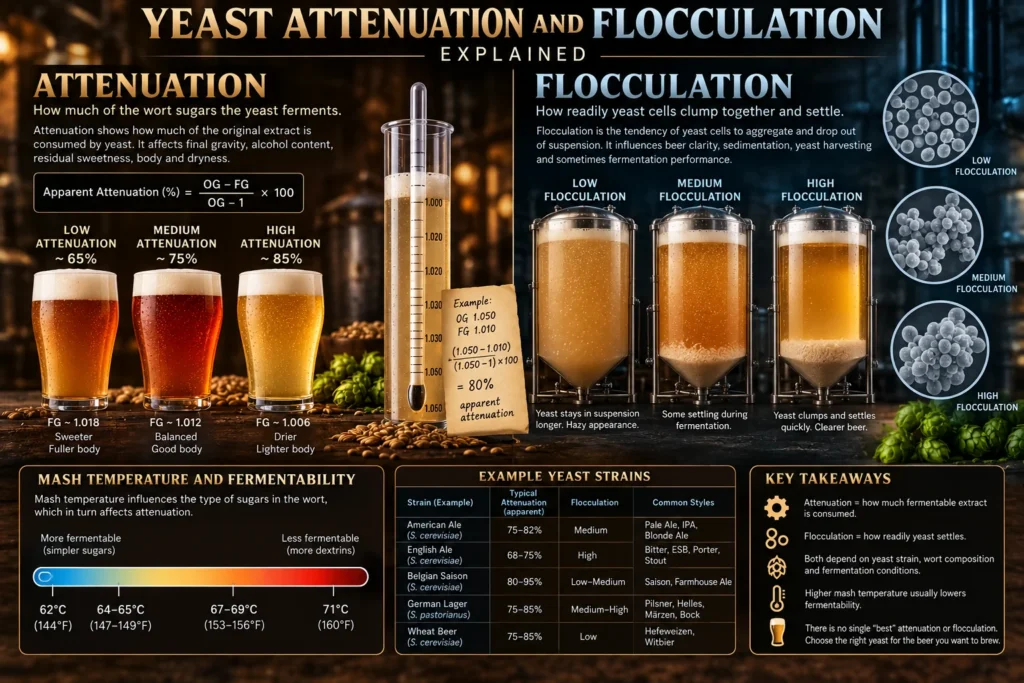
Attenuation influences how much of the fermentable extract in the wort the yeast consumes and therefore affects final gravity, alcohol content, residual sweetness, body and perceived dryness.
Flocculation describes how readily yeast cells group together and settle out of the beer. It influences clarity, sedimentation, yeast harvesting and sometimes fermentation performance.
These two characteristics are often misunderstood.
A highly attenuative yeast is not automatically a “stronger” or better yeast. A highly flocculent yeast is not automatically better because it produces clearer beer.
Different beers need different yeast behaviour.
In this third part of our beer yeast series, we will look at what attenuation and flocculation actually mean, how they affect your beer, why the numbers on a yeast packet are only estimates, and how mash temperature, wort composition and fermentation conditions interact with the yeast.
What Is Yeast Attenuation?
Attenuation describes the reduction in wort extract during fermentation as yeast consumes fermentable sugars.
Before fermentation, wort contains a mixture of sugars and other dissolved substances extracted primarily from malt.
Brewing yeast can ferment many of these sugars, but not all of them.
As fermentation progresses, the specific gravity falls.
For example:
Original Gravity (OG): 1.050
Final Gravity (FG): 1.010
The difference tells us how much extract disappeared from solution during fermentation.
In brewing, this is commonly expressed as apparent attenuation.
How Is Apparent Attenuation Calculated?
A simple formula is:
Apparent Attenuation (%) = (OG − FG) / (OG − 1) × 100
Using our example:
OG = 1.050
FG = 1.010
The gravity points are:
50 − 10 = 40
Then:
40 / 50 × 100 = 80%
So the beer has approximately:
80% apparent attenuation.
This means the measured gravity has fallen by about 80% of the original gravity points.
But there is an important word here:
apparent.
Why Is It Called Apparent Attenuation?
Alcohol is less dense than water.
As yeast converts sugars into alcohol and carbon dioxide, the alcohol produced lowers the density of the finished beer.
Because a hydrometer measures density, the final gravity makes it appear as though more extract has disappeared than actually has.
That is why the number calculated from hydrometer readings is called apparent attenuation.
There is also real attenuation, which accounts for the effect of alcohol and represents the actual reduction in extract more accurately.
For everyday homebrewing, however, apparent attenuation is the figure you will encounter most often.
When a yeast manufacturer gives an attenuation range such as:
75–80%
it is normally referring to apparent attenuation.
What Does High Attenuation Do to Beer?
A highly attenuative yeast generally consumes a greater proportion of the fermentable extract available to it.
The result is often:
- lower final gravity
- less residual sweetness
- a drier finish
- somewhat higher alcohol content
- potentially lighter perceived body
Imagine two identical worts with an OG of 1.050.
Yeast A finishes at:
1.014
Yeast B finishes at:
1.008
The second beer will generally taste drier and may feel lighter on the palate because less extract remains.
It will also contain slightly more alcohol because more fermentable sugar has been converted.
But attenuation alone does not determine body.
Proteins, dextrins, specialty malts, alcohol, carbonation and other components also influence mouthfeel.
A low FG therefore does not automatically mean a beer will feel thin.
What Does Low Attenuation Do to Beer?
A lower-attenuating yeast generally leaves more residual extract in the finished beer.
Depending on the recipe, this can contribute to:
- fuller body
- more residual sweetness
- higher final gravity
- lower alcohol compared with a more attenuative fermentation
- a rounder or richer impression
This can be desirable.
Not every beer should finish extremely dry.
An English ale, for example, may benefit from a yeast that leaves enough malt character and body to balance the beer.
The goal is not always to achieve the lowest possible FG.
The goal is to achieve the appropriate FG for the beer you are brewing.
Attenuation Does Not Tell You Everything About Yeast
Suppose a yeast manufacturer lists a strain at:
78–82% attenuation.
It is tempting to assume that every wort fermented with that strain will finish somewhere within exactly that range.
Real brewing is more complicated.
The attenuation achieved in your fermenter depends not only on the yeast strain but also on the composition of the wort.
A yeast cannot ferment sugars that it is biologically unable to metabolise.
It also cannot perform properly if fermentation conditions prevent it from completing its work.
The final gravity is therefore the result of an interaction between:
yeast + wort + fermentation conditions.
This is one of the most important concepts to understand about attenuation.
Wort Fermentability Matters
Not all wort with the same OG has the same fermentability.
Two beers can both begin at:
OG 1.050
and still finish at very different gravities even when fermented with the same yeast.
Why?
Because the composition of the extract can be different.
Wort contains several important carbohydrates, including:
- glucose
- fructose
- sucrose
- maltose
- maltotriose
- larger dextrins
Standard brewing yeast can readily ferment some of these compounds, while others are more difficult or impossible for a particular strain to metabolise.
This means that OG tells you how much dissolved extract is present, but it does not tell you exactly how much of that extract the yeast can ferment.
Mash Temperature and Attenuation
For all-grain brewers, mash temperature is one of the important tools for influencing wort fermentability.
During mashing, enzymes break starch molecules into smaller carbohydrates.
Two important enzymes are:
beta-amylase
and
alpha-amylase
They overlap in activity but favour different conditions and break down starch in different ways.
In general, a mash toward the lower part of the normal saccharification range tends to favour a more fermentable wort.
A mash toward the higher end tends to produce a somewhat less fermentable wort with more dextrinous material.
For example, broadly speaking:
64–65°C → usually more fermentable
67–69°C → usually less fermentable
This is not an absolute switch.
The relationship is gradual, and mash duration, malt characteristics, pH and other factors also matter.
But it explains something extremely important:
The same yeast can produce different attenuation in two differently mashed worts.
Does a Higher Mash Temperature Always Produce a Sweeter Beer?
Not necessarily.
A higher mash temperature can reduce fermentability and increase final gravity, but perceived sweetness depends on more than FG.
Hop bitterness, alcohol, carbonation, roasted malt, acidity and the overall flavour balance influence how sweet or dry a beer tastes.
A beer finishing at 1.014 is not automatically sweet.
Likewise, a beer finishing at 1.008 is not automatically thin or lacking body.
Numbers are useful, but sensory perception matters too.
Yeast Strain and Maltotriose
One important difference between yeast strains is their ability to utilise maltotriose.
Maltotriose is an important wort sugar composed of three glucose units.
Some brewing strains consume maltotriose efficiently.
Others consume it less efficiently.
This can create significant differences in final gravity even when two strains ferment the same wort.
A strain that consumes maltotriose effectively may attenuate further and produce a drier beer.
Another strain may leave more of it behind, resulting in a higher FG and fuller impression.
This is one reason yeast selection can influence attenuation even when the recipe and mash remain unchanged.
Highly Attenuative Does Not Mean More Alcohol Tolerant
Attenuation and alcohol tolerance are two different characteristics.
A yeast can have:
high attenuation but moderate alcohol tolerance
or:
moderate attenuation but high alcohol tolerance.
Attenuation describes how much of the available fermentable extract a yeast typically consumes.
Alcohol tolerance describes how well the yeast continues to function as ethanol concentration increases.
This distinction becomes especially important when brewing:
- Imperial Stout
- Barleywine
- Belgian Strong Ale
- Double or Triple IPA
- other high-gravity beers
For these beers, both attenuation and alcohol tolerance should be considered.
What Is Over-Attenuation?
Sometimes a beer finishes much lower than expected.
For example, you expect:
FG 1.012
but fermentation continues to:
1.004
This may simply be the normal behaviour of a highly attenuative strain in a very fermentable wort.
But unexpectedly extreme attenuation can also have other causes.
Possible explanations include:
- a very fermentable mash
- highly attenuative yeast
- diastatic yeast
- contamination by another microorganism
- inaccurate gravity measurements
The key word is unexpectedly.
A Saison yeast capable of finishing very dry is not necessarily a problem.
The same result from a yeast expected to finish relatively full may deserve investigation.
Diastatic Yeast and Very High Attenuation
Some brewing strains possess the ability to break down carbohydrates that ordinary brewing yeast cannot readily ferment.
These strains are often described as diastatic, commonly associated with Saccharomyces cerevisiae var. diastaticus.
Certain Saison strains are well-known examples.
They can produce enzymes that allow them to access more complex carbohydrates, resulting in very high attenuation.
A beer that appears to have almost finished may continue slowly fermenting.
This can create wonderfully dry Saison-style beers when intentional.
But unwanted diastatic yeast can cause serious problems in other beers.
If beer is packaged before fermentation has truly finished, continued fermentation can lead to excessive carbonation and potentially dangerous package pressure.
So when using a diastatic strain, understanding its behaviour is particularly important.
What Is Flocculation?
Flocculation is the tendency of yeast cells to aggregate into larger groups and separate from suspension.
In practical terms, it describes how readily the yeast settles out of the beer.
Yeast manufacturers commonly describe strains as having:
- low flocculation
- medium flocculation
- high flocculation
A highly flocculent strain tends to form clumps and settle relatively quickly.
A low-flocculating strain tends to remain suspended for longer.
This can have a major effect on the appearance and handling of the finished beer.
High-Flocculation Yeast
Highly flocculent strains often settle quickly once fermentation begins to slow.
Possible advantages include:
- faster clarification
- compact yeast sediment
- easier transfer of clearer beer
- potentially easier yeast harvesting
- less yeast carried into bottles or kegs
Many traditional English ale strains are known for relatively strong flocculation.
This can produce beautifully clear beer without filtration.
But high flocculation is not automatically an advantage.
If yeast settles too early, fermentation may slow before the beer reaches the expected final gravity.
That can sometimes contribute to an under-attenuated or stalled fermentation.
Low-Flocculation Yeast
Low-flocculating yeast remains suspended in the beer for longer.
This may result in:
- slower natural clarification
- more yeast remaining in suspension
- hazier beer
- longer conditioning before brilliant clarity is achieved
But remaining in suspension can also help yeast continue interacting with the wort and completing fermentation.
Low flocculation is not a defect.
In some beer styles, haze is expected or even desirable.
A German Weissbier, for example, does not need to look like a brilliantly filtered Pilsner.
Likewise, many modern hazy beers are deliberately produced with a stable cloudy appearance.
The correct level of flocculation depends on the beer.
Flocculation and Attenuation Are Different Things
These two properties are often listed next to each other, which can make them seem directly connected.
But they describe different behaviours.
Attenuation = how much fermentable extract is consumed.
Flocculation = how readily the yeast cells aggregate and settle.
A yeast can therefore be:
- highly attenuative and highly flocculent
- highly attenuative and poorly flocculent
- moderately attenuative and highly flocculent
- low attenuating and poorly flocculent
There is no universal rule that one determines the other.
However, flocculation can indirectly affect attenuation if the yeast settles before fermentation is complete.
Why Does Yeast Flocculate?
Flocculation is a complex biological process involving interactions between yeast cell surfaces.
Under appropriate conditions, cells adhere to one another and form larger aggregates.
These groups eventually become heavy enough to settle.
Several factors can influence the process, including:
- yeast genetics
- calcium availability
- fermentation stage
- temperature
- alcohol concentration
- nutrient conditions
- yeast health
This is why flocculation is not simply an on/off characteristic.
Even a yeast described as highly flocculent may behave somewhat differently under different fermentation conditions.
Calcium and Flocculation
Calcium plays several important roles in brewing, and one of them is related to yeast flocculation.
Adequate calcium levels can support normal flocculation behaviour in many brewing strains.
This does not mean that adding large amounts of calcium will automatically make every beer crystal clear.
Water chemistry should be designed for the entire brewing process and beer style, not solely to force yeast to settle.
But it is another example of how yeast performance is connected to the chemistry of the wort and beer.
Yeast does not work in isolation.
Temperature and Flocculation
Temperature can also affect how yeast settles.
At the end of fermentation, cooling the beer encourages yeast and other suspended particles to drop out.
This is one reason cold crashing is commonly used by homebrewers.
After fermentation is complete, the beer may be cooled to near refrigerator temperatures for a period before packaging.
This can accelerate clarification.
But cold crashing should normally happen after fermentation is complete.
Cooling too early can reduce yeast activity and interfere with the final stages of fermentation and cleanup.
Again, gravity readings are more reliable than simply deciding that a certain number of days has passed.
Can You Wake Up a Flocculated Yeast?
Sometimes.
If fermentation appears to have stopped too early and the yeast has settled heavily, gently resuspending some yeast may help.
This is sometimes called rousing the yeast.
The key word is gently.
The goal is not to violently shake oxygen into nearly finished beer.
A fermenter can sometimes be carefully swirled or otherwise handled in a way that brings some yeast back into suspension.
Increasing the temperature slightly toward the end of fermentation can also encourage the yeast to remain active.
But before doing anything, confirm that fermentation is actually stalled.
A stable gravity may simply mean the yeast has reached the natural finishing point of that wort.
Do Not Judge Fermentation by the Airlock
A quiet airlock does not mean fermentation has finished.
An active airlock does not necessarily mean significant fermentation is still occurring.
Gas can escape through imperfect seals, and dissolved CO₂ can continue leaving the beer after most sugar fermentation has finished.
If you want to know whether attenuation has stopped, measure gravity.
Take a reading.
Wait.
Take another reading.
If gravity remains stable and is reasonable for the recipe and yeast, fermentation is probably complete.
This is much more useful than counting bubbles.
Why Did My Beer Finish at 1.018 Instead of 1.010?
This is a common homebrewing question.
The answer is not automatically:
“Bad yeast.”
Possible causes include:
- less fermentable wort
- higher mash temperature
- yeast strain with lower attenuation
- insufficient healthy yeast
- inadequate fermentation temperature
- temperature falling during fermentation
- nutrient limitations
- high original gravity
- early flocculation
- measurement error
The correct diagnosis requires looking at the entire brewing process.
For example, if the yeast is rated at 75% attenuation and a beer started at 1.060, expecting it automatically to finish at 1.006 may be unrealistic.
On the other hand, if a normally reliable strain stops unusually high and remains sluggish, fermentation health deserves closer attention.
Hydrometer vs Refractometer During Fermentation
Gravity measurement itself can also cause confusion.
A hydrometer can be used directly on fermenting or finished beer, provided the sample is handled correctly and temperature correction is considered when necessary.
A refractometer behaves differently once alcohol is present.
Before fermentation, a refractometer is convenient for measuring wort.
After fermentation begins, alcohol affects the refractive index.
This means the raw refractometer reading cannot simply be interpreted as normal gravity.
A correction calculation is required.
Without correction, a brewer may believe the beer has stopped at a much higher gravity than it actually has.
So before diagnosing poor attenuation, make sure the measurement itself is valid.
Attenuation and Beer Style
Different beer styles benefit from different levels of attenuation.
A dry Saison may need very high attenuation.
A West Coast IPA often benefits from a relatively dry finish that keeps the beer crisp and prevents malt sweetness from obscuring hop bitterness.
A traditional English ale may intentionally retain more body.
A strong dark beer may need enough residual extract to balance alcohol and roasted malt.
A lager may need high enough attenuation to produce a clean, crisp finish without becoming watery.
There is no ideal attenuation percentage for every beer.
The correct question is:
Does this attenuation suit the beer I am trying to make?
Flocculation and Beer Style
The same principle applies to flocculation.
For a brilliantly clear English Bitter, high flocculation may be extremely useful.
For a Hefeweizen, keeping yeast in suspension may be part of the intended character.
For a Hazy IPA, appearance and yeast-hop interactions can make a low or medium-flocculating strain desirable.
For a clean lager, good sedimentation combined with cold conditioning can help create brilliant clarity.
Again:
There is no universally “best” flocculation level.
There is only the appropriate behaviour for the beer.
Reading a Yeast Manufacturer’s Specification
Imagine a yeast specification that says:
Attenuation: 75–80%
Flocculation: High
Temperature: 18–22°C
Alcohol tolerance: 10%
What does this actually tell you?
It suggests that under suitable conditions the yeast normally produces moderate-to-high apparent attenuation.
It tends to settle relatively well.
It is intended to perform within approximately the stated temperature range.
And it can generally tolerate beer up to the specified alcohol level.
But none of those numbers guarantees exactly what will happen in your fermenter.
Your recipe and process still matter.
Treat the technical sheet as a description of the yeast’s expected behaviour, not as a promise of an exact FG.
A Practical Example
Imagine two Pale Ales.
Both have:
OG 1.052
Beer A uses a yeast with approximately 72% apparent attenuation.
Beer B uses a yeast capable of approximately 82%.
If everything else were equal, Beer A might finish around:
FG 1.015
while Beer B might finish around:
FG 1.009
Beer A could feel fuller and maltier.
Beer B could feel drier and potentially allow bitterness and hop character to appear sharper.
Neither is automatically better.
They are simply different beers.
Now imagine that Beer A’s yeast is highly flocculent while Beer B’s yeast has medium-low flocculation.
Beer A might become clear much faster.
Beer B might remain hazy for longer.
Again, that does not tell us which beer is better.
It tells us how the yeast influences the finished product.
Choosing Yeast by Attenuation and Flocculation
When selecting yeast, ask what you want the finished beer to be like.
If you want:
A dry, crisp beer
look toward higher attenuation.
A fuller, rounder beer
moderate attenuation may be preferable.
Fast natural clarification
higher flocculation can help.
Yeast character or haze retained in suspension
lower flocculation may sometimes be desirable.
But do not select yeast using these two numbers alone.
Also consider:
- flavour profile
- fermentation temperature
- alcohol tolerance
- beer style
- ester production
- phenolic character
- sulfur production
- pressure fermentation compatibility
- expected fermentation speed
Yeast is a complete biological package.
Attenuation and flocculation are only two parts of its behaviour.
Do Not Chase the Lowest Final Gravity
One of the easiest mistakes for a new brewer is to think that lower FG always means better fermentation.
It does not.
If a recipe is designed to finish at 1.014 and the beer tastes balanced at 1.014, there is no prize for forcing it to 1.006.
Likewise, a beer that unexpectedly stops at 1.020 should not automatically be accepted simply because the airlock has stopped.
The target is not:
the lowest possible FG.
The target is:
the correct fermentation profile for the beer.
Attenuation, Flocculation and Consistency
Once you begin brewing the same or similar recipes repeatedly, these yeast characteristics become even more useful.
Suppose your Pale Ale normally behaves like this:
OG 1.052 → FG 1.010
You brew it several times and obtain approximately the same result.
Then one batch stops at:
1.018
That difference tells you something changed.
Maybe the mash temperature was different.
Maybe the yeast was less healthy.
Maybe fermentation temperature dropped.
Maybe the yeast flocculated prematurely.
Maybe your measurement is wrong.
Keeping brewing records makes these differences much easier to recognise.
The more familiar you become with a yeast strain, the easier it becomes to notice when it is behaving unusually.
Final Thoughts
Attenuation and flocculation are two of the most useful characteristics for understanding how a brewing yeast will behave.
Attenuation tells us how extensively the yeast is expected to ferment the available wort extract and strongly influences final gravity, dryness, alcohol and balance.
Flocculation describes the yeast’s tendency to aggregate and settle, influencing clarification, sedimentation and how long yeast remains suspended in the beer.
But neither characteristic works alone.
Attenuation depends on both the yeast and the fermentability of the wort.
Flocculation depends on yeast genetics but is also influenced by fermentation conditions.
This is why the numbers printed on a yeast packet should be treated as useful guidance rather than exact predictions.
The important lesson is:
Do not ask only how much a yeast attenuates or how quickly it settles. Ask how those characteristics fit the beer you want to brew.
Once you understand attenuation and flocculation, yeast specifications stop looking like technical marketing numbers.
They become practical tools for designing and controlling your beer.