Fermentation temperature is one of the most important variables in brewing.
You can use excellent malt, fresh hops, good water and a suitable yeast strain, yet still produce disappointing beer if fermentation temperature is poorly controlled.
Why?
Because yeast does not simply ferment at different speeds at different temperatures.
It behaves differently.
Temperature affects yeast growth, fermentation speed, attenuation and the production of many flavour and aroma compounds. The same yeast strain can produce noticeably different beer when fermented at different temperatures.
Sometimes those differences are desirable.
Sometimes they produce fruity esters, spicy complexity or traditional yeast character.
But excessive or inappropriate fermentation temperatures can also contribute to harsh alcohol character, unwanted esters, sulfur compounds, sluggish fermentation or incomplete attenuation.
In this fourth part of our beer yeast series, we will look at how fermentation temperature affects yeast, why beer temperature matters more than room temperature, what happens when fermentation is too warm or too cold, and how homebrewers can use temperature as a tool rather than simply treating it as a number on a yeast packet.
Why Does Fermentation Temperature Matter?
Yeast is a living microorganism.
Its metabolism is strongly influenced by temperature.
Within an appropriate range, increasing temperature generally increases metabolic activity and fermentation speed.
But faster fermentation does not automatically mean better fermentation.
As yeast metabolises wort sugars, it produces much more than alcohol and carbon dioxide.
Depending on the strain and fermentation conditions, yeast can produce compounds including:
- esters
- higher alcohols
- organic acids
- sulfur compounds
- phenolic compounds in certain strains
- glycerol
- many other flavour-active metabolites
Temperature can influence how much of these compounds are produced and how they are perceived in the finished beer.
This means fermentation temperature is not simply about keeping yeast alive.
It is part of flavour design.
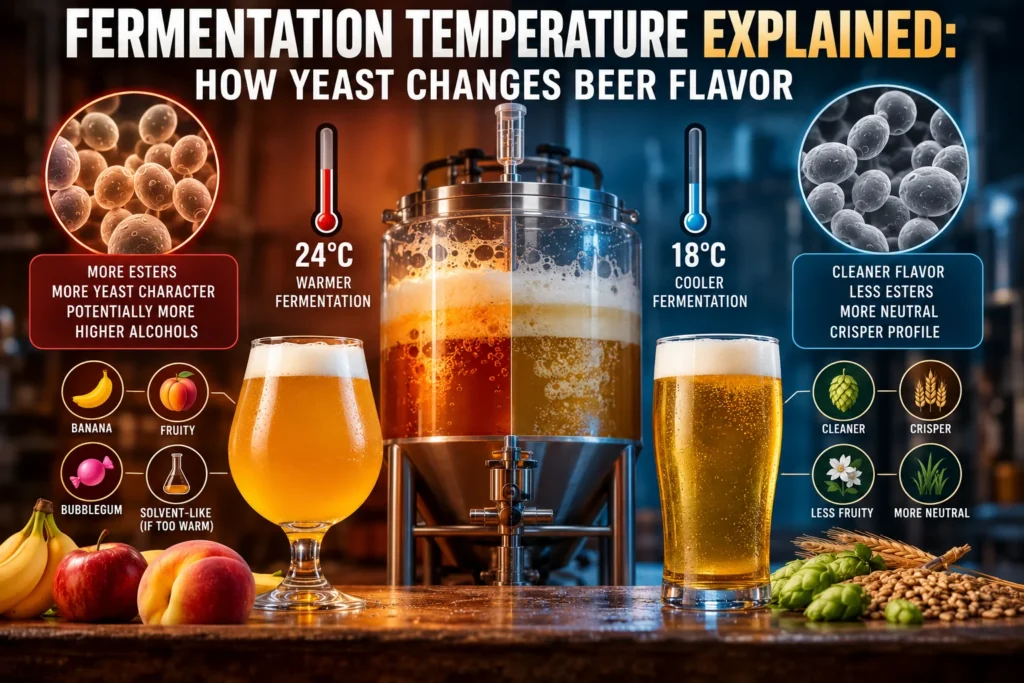
The Same Yeast Can Produce Different Beer at Different Temperatures
Imagine splitting one batch of wort into two identical fermenters.
Both receive the same amount of the same yeast.
One ferments at:
18°C
The other ferments at:
24°C
Even if both beers reach a similar final gravity, they may not taste the same.
The warmer fermentation may produce:
- more noticeable esters
- stronger fermentation-derived aroma
- potentially more higher alcohols
- a different balance between malt, hops and yeast character
The cooler fermentation may taste:
- cleaner
- more restrained
- less fruity
- more neutral
The exact result depends heavily on the yeast strain.
That last point is important.
There is no single ideal fermentation temperature for all yeast.
Yeast Temperature Range
Most commercial brewing yeast manufacturers provide a recommended fermentation temperature range.
For example, a hypothetical ale yeast might list:
18–22°C
This does not necessarily mean that the yeast instantly fails at 17°C or 23°C.
The range generally describes conditions in which the manufacturer expects the strain to perform appropriately and produce its intended character.
Within that range, temperature can still change the result.
Fermenting at 18°C may produce a different flavour profile than fermenting the same strain at 22°C.
So the recommended range should not be interpreted simply as:
“Anywhere inside this range produces exactly the same beer.”
Instead, think of it as a useful operating window.
Where you ferment within that window can become part of your recipe.
Beer Temperature vs Room Temperature
One of the most common mistakes in homebrewing is measuring the temperature of the room instead of the beer.
They are not always the same.
Fermentation is an exothermic process.
That means yeast activity produces heat.
During vigorous fermentation, the beer inside the fermenter can therefore become warmer than the surrounding air.
For example:
Room temperature:
20°C
Beer temperature during active fermentation:
22–23°C
The exact difference depends on fermentation intensity, batch size, fermenter design, cooling conditions and other factors.
The important principle is:
Control the temperature of the beer whenever possible, not simply the temperature of the room.
This becomes particularly important during the most active stage of fermentation.
Why Does Fermentation Heat Itself?
Yeast converts sugars through metabolic processes that release energy.
Some of this energy appears as heat.
During the most active phase of fermentation, millions or billions of yeast cells are metabolically active at the same time.
As a result, the temperature inside the fermenter can rise.
This can create a feedback effect:
warmer beer → faster yeast metabolism → more fermentation activity → more heat.
Without temperature control, a fermentation can therefore become significantly warmer than expected.
This is one reason a beer pitched at a sensible temperature can still develop unwanted warm-fermentation characteristics later.
The First Days of Fermentation Are Especially Important
Temperature control is important throughout fermentation, but the early active phase deserves particular attention.
During this period, yeast is:
- adapting to the wort
- reproducing
- consuming nutrients
- beginning vigorous sugar metabolism
- producing many important flavour-active compounds
If temperature rises excessively during this stage, the flavour profile of the beer can be changed before you have a chance to correct it.
Cooling the beer several days later cannot undo compounds that were already produced.
This is why experienced brewers often pay especially close attention to temperature during the first few days of fermentation.
What Happens When Ale Fermentation Is Too Warm?
Ale yeast generally works at warmer temperatures than traditional lager yeast, but that does not mean:
warmer is always better.
If an ale yeast is fermented significantly warmer than appropriate for the strain, it may produce excessive fermentation character.
Possible results include:
- excessive fruity esters
- solvent-like or harsh alcohol character
- overly strong yeast aroma
- unbalanced flavours
- rapid and aggressive fermentation
- excessive krausen
- increased risk of fermentation escaping through the airlock or blow-off system
Some of these compounds may soften during conditioning.
Others may remain noticeable in the finished beer.
The result depends on how warm the fermentation became, how long it stayed there and which yeast strain was used.
What Are Esters?
Esters are aromatic compounds produced during fermentation.
They are responsible for many familiar fruity aromas in beer.
Depending on the compound and concentration, ester character can resemble:
- banana
- pear
- apple
- stone fruit
- red fruit
- tropical fruit
- bubblegum
Esters are not automatically fermentation faults.
In many beer styles they are essential.
English ale yeast may contribute fruity esters.
Belgian yeast can produce expressive fruit character.
German wheat beer yeast may produce a characteristic banana aroma.
But in a clean American Pale Ale or a crisp lager, excessive fruity esters may be unwanted.
Temperature is one of the factors that can influence ester production.
In many strains, warmer fermentation tends to increase ester expression.
But yeast genetics remain crucial.
You cannot simply take any neutral yeast, ferment it warm and expect it to behave like a Belgian or wheat beer strain.
What Are Higher Alcohols?
During fermentation, yeast can also produce alcohols other than ethanol.
These are often called higher alcohols or fusel alcohols.
In appropriate concentrations, some higher alcohols contribute complexity and can also participate in the formation of esters.
At excessive levels, however, they may create undesirable impressions such as:
- hot alcohol
- harshness
- solvent-like character
- burning sensation
- rough alcoholic finish
High fermentation temperature can encourage increased production of certain higher alcohols, particularly when combined with other forms of yeast stress.
This is one reason simply fermenting as warm as possible to finish beer faster is rarely a good strategy.
Warm Fermentation Does Not Automatically Mean Bad Beer
This distinction is extremely important.
Some yeast strains are specifically intended to ferment warm.
Examples include many:
- Belgian ale strains
- Saison strains
- Kveik cultures
A Saison fermented at a temperature that would be considered extremely warm for a clean American ale may produce exactly the character the brewer wants.
Some Kveik cultures can ferment successfully at temperatures that would create undesirable flavours with many conventional ale strains.
So the correct question is not:
“Is 28°C too warm for yeast?”
The correct question is:
“Is 28°C appropriate for this yeast strain and this beer?”
Temperature must always be considered together with the strain and desired beer character.
What Happens When Fermentation Is Too Cold?
If yeast is fermented below an appropriate temperature for the strain, its metabolism can slow considerably.
Possible consequences include:
- long lag phase
- slow fermentation
- incomplete attenuation
- stalled fermentation
- delayed maturation
- yeast settling prematurely in some situations
The beer may appear inactive even though the yeast is still slowly working.
Cold fermentation is therefore not automatically the same as clean fermentation.
If the yeast becomes too inactive, fermentation performance can suffer.
Again, the appropriate temperature depends on the strain.
Ale Yeast and Cooler Fermentation
Many ale strains can produce relatively clean beer when fermented toward the cooler end of their recommended range.
This is particularly useful for styles where yeast should remain mostly in the background.
Examples might include:
- American Pale Ale
- West Coast IPA
- American IPA
- certain Stouts
- clean Blonde Ales
But going too cold can create problems.
If a strain performs well at 18–22°C, fermenting it at 13°C simply because “colder means cleaner” may result in slow or incomplete fermentation.
The goal is controlled fermentation, not the lowest possible temperature.
Lager Yeast and Cold Fermentation
Traditional lager fermentation is strongly associated with lower temperatures.
Many classic lager strains are fermented significantly cooler than typical ale strains.
Lower-temperature fermentation helps create the restrained yeast profile associated with styles such as:
- Pilsner
- Helles
- Märzen
- Vienna Lager
- Dunkel
- Bock
But lager yeast is not simply ale yeast that likes cold temperatures.
As discussed in the previous article on ale and lager yeast, these yeasts have biological and metabolic differences that influence how they perform.
Traditional lager fermentation also involves more than simply setting a low temperature.
Pitching rate, oxygenation, fermentation progression, maturation and cold conditioning all contribute to the finished beer.
Can Lager Yeast Ferment Warm?
Yes, some lager strains can ferment surprisingly well at warmer temperatures.
Modern brewing has demonstrated that certain lager yeasts can produce relatively clean beer outside traditional cold-fermentation schedules.
Some modern strains have even been selected or marketed specifically for faster or warmer lager fermentation.
This can be extremely useful for homebrewers who do not have powerful refrigeration systems.
But this does not mean every lager strain will produce identical results at:
10°C and 20°C.
The strain matters.
The beer style matters.
The desired flavour profile matters.
Warm lager fermentation should therefore be treated as a deliberate process choice rather than a universal shortcut.
Temperature and Fermentation Speed
Temperature strongly affects fermentation speed.
Within a yeast’s suitable operating range:
warmer → generally faster fermentation
cooler → generally slower fermentation
This can be useful.
But fermentation speed should not be the primary goal.
A beer that reaches FG in three days is not automatically better than one that takes seven days.
Likewise, slow fermentation is not automatically superior.
The objective is to give the yeast conditions that allow it to produce the desired beer reliably.
Speed is secondary.
Temperature and Attenuation
Fermentation temperature can also influence attenuation.
If fermentation becomes too cold, yeast activity may slow or stop before all available fermentable sugars have been consumed.
The result can be a higher-than-expected final gravity.
For example:
Expected FG:
1.010
Actual FG:
1.018
Before blaming the yeast strain itself, consider whether temperature dropped during fermentation.
On the other hand, warmer fermentation can accelerate sugar consumption, but that does not mean temperature alone determines final attenuation.
As discussed in the previous article, attenuation also depends on:
- yeast genetics
- wort fermentability
- mash conditions
- pitching rate
- yeast health
- nutrient availability
- original gravity
Temperature is one part of the system.
Temperature and Flocculation
Temperature can also influence yeast flocculation and sedimentation.
As fermentation finishes and beer cools, many yeast strains begin to settle more readily.
This behaviour is useful when clarifying beer.
But cooling too early can encourage yeast to become less active before fermentation and maturation are complete.
If a beer appears to have stopped above the expected FG, immediately cold crashing it is usually not the first solution.
First determine whether fermentation is actually complete.
If not, maintaining or slightly increasing an appropriate fermentation temperature may help the yeast finish its work.
Why Brewers Raise the Temperature Near the End of Fermentation
Many brewers allow fermentation temperature to rise slightly toward the end.
This can help keep yeast metabolically active as the amount of easily available sugar decreases.
For example, an ale might begin around:
18–19°C
and later be allowed to rise toward:
20–21°C
depending on the strain and recipe.
This does not mean every fermentation needs exactly this schedule.
The principle is simply that a controlled rise near the end can sometimes help yeast complete attenuation and maturation without exposing the most active early fermentation to unnecessarily high temperatures.
This approach is also used in lager fermentation.
What Is a Diacetyl Rest?
A diacetyl rest is a period, commonly used in lager brewing, during which fermentation temperature is allowed to rise near the end of fermentation.
Diacetyl can produce an aroma and flavour often compared to:
- butter
- butterscotch
- buttery popcorn
Yeast metabolism is involved both in the formation of diacetyl precursors and in the later reduction of diacetyl.
Keeping yeast active toward the end of fermentation can therefore help reduce unwanted diacetyl.
A temperature increase can accelerate this maturation process.
Although the term is strongly associated with lager brewing, diacetyl management is relevant to ale fermentation as well.
The important principle is:
do not remove healthy yeast from the beer too early.
Give it time to finish fermentation and maturation.
Temperature Stability Matters
A fermentation temperature does not need to remain perfectly unchanged every second.
But large and uncontrolled temperature swings can create problems.
Imagine an ale fermentation that moves repeatedly between:
18°C → 24°C → 19°C → 25°C
This is very different from a controlled fermentation held approximately around 19–20°C.
Rapid changes can affect yeast activity and fermentation consistency.
For homebrewers, maintaining a reasonably stable temperature is often more important than chasing a theoretically perfect number to the nearest tenth of a degree.
A controlled:
20°C
is generally more useful than a fermentation constantly fluctuating between 17°C and 24°C.
Should Fermentation Temperature Be Constant?
Not necessarily.
Controlled temperature does not mean completely static temperature.
A deliberately planned fermentation profile can be useful.
For example:
Start cooler → maintain active fermentation → allow a small rise → confirm stable FG → cold crash
can be an effective strategy for many ales.
A lager may follow a different profile:
cool fermentation → controlled rise for maturation → gradual cooling → lagering
The exact schedule depends on the yeast and beer.
The important distinction is between:
intentional temperature changes
and
uncontrolled temperature swings.
Pitching Temperature Matters Too
Fermentation temperature control begins when the yeast is pitched.
If you intend to ferment an ale at 19°C but pitch the yeast into wort at 28°C, the yeast begins its adaptation and early growth under very different conditions from those you intended.
Cooling the fermenter several hours later may not completely reverse the effects of that warm start.
A useful approach is to bring the wort reasonably close to the intended fermentation temperature before pitching.
This helps make the beginning of fermentation more predictable.
Should You Pitch Cold and Let the Beer Warm Up?
In many situations, pitching near or slightly below the intended fermentation temperature and allowing a controlled rise can work well.
For example, if an ale is intended to ferment around 19–20°C, pitching at approximately 18–19°C and allowing fermentation to rise naturally within the desired range can help control early flavour development.
However, exact practice depends on the yeast.
Some strains respond differently to cold starts.
The manufacturer’s recommendations remain a useful starting point when using an unfamiliar yeast.
How to Measure Fermentation Temperature
There are several practical ways for homebrewers to monitor beer temperature.
A temperature probe placed directly in a thermowell provides a useful measurement of the beer itself.
A sensor attached firmly to the outside of the fermenter and insulated from room air can also provide a useful approximation.
Wireless fermentation monitors can track temperature continuously and may also estimate gravity.
Whatever system you use, remember what you actually want to know:
the temperature experienced by the yeast.
A thermometer on the other side of the room tells you much less.
Simple Fermentation Temperature Control
Temperature control does not necessarily require expensive equipment.
Depending on climate and brewing conditions, useful methods include:
- choosing a naturally stable room or cellar
- water baths
- wet towels combined with evaporative cooling
- frozen bottles in an insulated container
- heating belts or heating mats
- temperature-controlled refrigerators or freezers
- dedicated fermentation chambers
A refrigerator or freezer connected to an external temperature controller is one of the most effective homebrew solutions.
It allows cooling when fermentation generates heat.
A small controlled heat source can also be used when the environment becomes too cold.
The goal is not complexity.
The goal is predictability.
Be Careful With Heating Mats
Heating mats and belts can be useful, especially in colder rooms.
But they can also heat beer surprisingly quickly.
A heater placed directly against the fermenter may create a local warm area around the sensor or vessel.
For this reason, heating should ideally be controlled by a temperature controller with a probe measuring the fermenter rather than simply leaving the heater permanently switched on.
A few degrees can make a meaningful difference to yeast behaviour.
Fermentation temperature should be controlled, not guessed.
Temperature Controllers and Probe Placement
If you use a temperature controller, probe placement matters.
If the probe measures only the air inside a fermentation refrigerator, the controller may respond to air temperature changes much faster than the beer itself.
Several litres of beer have much greater thermal mass than the surrounding air.
A useful approach is to measure the fermenter directly.
This can be done with:
- a thermowell
- a probe attached firmly to the fermenter wall and insulated from the surrounding air
The controller then responds more closely to what is happening inside the beer.
Fermentation Temperature and Pressure
Pressure fermentation adds another variable.
Fermenting under pressure can suppress the expression of some fermentation-derived compounds, particularly certain esters.
This is one reason pressure fermentation is sometimes used when fermenting lager yeast at warmer temperatures.
However, pressure does not make temperature irrelevant.
Yeast metabolism is still affected by temperature.
Excessive pressure, particularly early in fermentation, can also affect yeast growth and fermentation performance.
Pressure should therefore be treated as another fermentation tool, not as a substitute for temperature management.
Kveik and High-Temperature Fermentation
Kveik is one of the clearest examples of why yeast strain matters when discussing temperature.
Traditional Norwegian Kveik cultures are famous for their ability to ferment effectively at temperatures that would be considered extremely warm for many conventional brewing strains.
Some can produce remarkably clean beer at elevated temperatures, while others contribute distinctive citrus or fruity character.
This makes Kveik particularly useful for brewers who struggle with cooling in warm climates.
But Kveik should not create the false impression that temperature no longer matters.
Different Kveik cultures still behave differently at different temperatures.
Temperature remains a flavour-control tool.
The useful range is simply different.
Belgian Yeast and Temperature
Belgian yeast provides another excellent example.
Many Belgian strains are selected specifically because of their expressive fermentation character.
Temperature can influence the balance between:
- fruity esters
- spicy or phenolic notes
- alcohol character
- attenuation
- overall yeast expression
Some brewers intentionally begin fermentation at a moderate temperature and allow it to rise gradually.
This can encourage complete attenuation while controlling excessive flavour development during the early stage.
Again, the goal is not simply:
hot fermentation.
The goal is:
controlled yeast expression.
German Wheat Beer Yeast and Temperature
German wheat beer yeast is famous for producing flavours such as:
banana and clove.
These characteristics come from different fermentation compounds and biological pathways.
Fermentation temperature is one factor that can influence their balance, although pitching rate, wort composition and yeast strain also matter.
This is another example of temperature being used creatively.
A brewer is not always trying to eliminate yeast flavour.
Sometimes yeast flavour is one of the defining features of the beer.
Clean American Ale Yeast and Temperature
A clean American ale yeast is usually selected for the opposite reason.
The brewer often wants malt and hops to dominate while fermentation character remains relatively restrained.
For a Pale Ale or West Coast IPA, excessive warm fermentation may introduce fruity or alcoholic character that competes with the hops.
Keeping the yeast within an appropriate controlled range helps maintain the clean fermentation profile these beers often require.
This demonstrates why copying another brewer’s temperature without considering the yeast strain can be misleading.
The same temperature can be perfect for one yeast and inappropriate for another.
Can You Fix a Beer That Fermented Too Warm?
Sometimes the beer improves with conditioning.
Certain fermentation-derived flavours can soften as the beer matures.
Yeast may also continue reducing some intermediate compounds while it remains active.
But conditioning cannot magically remove every flavour produced during an excessively warm fermentation.
Prevention is far more effective.
If you notice the temperature climbing during active fermentation, bringing it gradually back under control can help prevent further unwanted flavour development.
Avoid extreme sudden temperature changes unless there is a specific reason for them.
What If Fermentation Gets Too Cold?
If fermentation becomes too cold and yeast activity slows prematurely, several steps may help.
First, measure gravity.
Do not diagnose a stalled fermentation from the airlock alone.
If gravity is still higher than expected and fermentation appears incomplete, bringing the beer gradually back into the yeast’s appropriate temperature range may restart activity.
In some cases, gently resuspending settled yeast can also help.
But again, the correct response depends on the cause.
If the wort was simply less fermentable than expected, raising the temperature will not magically allow the yeast to ferment carbohydrates it cannot metabolise.
Do Not Change Temperature Based Only on the Calendar
Recipes often contain instructions such as:
Ferment for 7 days.
But yeast does not own a calendar.
Fermentation speed changes with:
- yeast strain
- pitching rate
- temperature
- wort gravity
- oxygen availability
- nutrient availability
- pressure
- yeast health
Instead of deciding that fermentation must be finished because seven days have passed, use gravity measurements and fermentation behaviour.
A more useful sequence is:
ferment → monitor → confirm stable FG → condition → cool/package
Time is useful.
Measurement is better.
A Practical Ale Fermentation Example
Imagine a Pale Ale with:
OG: 1.052
The selected yeast has a recommended range of:
18–22°C
A reasonable fermentation strategy might look like this:
Pitch around:
18–19°C
Allow active fermentation around:
19–20°C
As fermentation slows, allow the beer to rise gradually toward:
20–21°C
Then wait until gravity becomes stable.
For example:
Day 5: 1.012
Day 7: 1.010
Day 9: 1.010
Now there is good evidence that fermentation is complete.
Only after this would you normally move toward cold crashing or packaging.
This is much more reliable than saying:
“Ale takes seven days.”
A Practical Lager Fermentation Example
Traditional lager fermentation may use a very different temperature profile.
A lager yeast might begin fermentation around:
9–12°C
depending on the strain and brewing method.
As attenuation approaches completion, the brewer may allow the temperature to rise for maturation.
After stable FG is confirmed, the beer can then be cooled and lagered.
Modern lager strains may allow substantially different schedules, including warmer fermentation.
So again, there is no universal lager temperature schedule.
Always consider the yeast strain.
What Is the Best Fermentation Temperature?
This is one of the most common questions in brewing.
Unfortunately, there is no universal answer.
The best temperature depends on:
- yeast strain
- beer style
- desired flavour profile
- original gravity
- fermentation method
- pitching rate
- pressure
- equipment
- brewer’s goals
Instead of asking:
“What is the best temperature for beer?”
ask:
“What fermentation temperature will help this yeast produce the beer I want?”
That is a much more useful brewing question.
Common Fermentation Temperature Mistakes
Several temperature-related mistakes appear repeatedly in homebrewing.
Measuring only room temperature
The fermenting beer may be warmer than the room.
Fermenting as warm as possible to save time
Fast fermentation does not automatically produce good beer.
Fermenting too cold because “cold means clean”
Yeast can become sluggish or stop prematurely.
Ignoring the yeast manufacturer’s temperature range
Different strains behave differently.
Allowing uncontrolled temperature swings
Consistency matters.
Cooling too early
Cold crashing before fermentation is complete can reduce yeast activity prematurely.
Pitching very warm and cooling later
Important flavour development begins early.
Assuming all ale or lager yeasts behave the same
They do not.
Following days instead of gravity
Fermentation is finished when the yeast has finished its work, not when the recipe calendar says so.
Fermentation Temperature Is Part of the Recipe
Homebrewers often write recipes like this:
Malt: 5 kg Pale Malt
Hops: 100 g
Yeast: one packet
Fermentation: 7 days
But fermentation deserves much more attention.
A better recipe records:
Yeast strain: specific strain
Pitch temperature: 18°C
Primary fermentation: 19°C
Late fermentation: allow rise to 21°C
FG target: approximately 1.010
Cold crash: only after stable gravity
This makes the recipe much more repeatable.
If you brew a fantastic beer and do not know how it fermented, reproducing it becomes much harder.
Temperature should therefore be recorded just like malt, hops and yeast.
Temperature Control Improves Consistency
One of the biggest benefits of temperature control is not necessarily making one beer dramatically better.
It is making your beer repeatable.
Suppose you brew the same Pale Ale three times.
Batch 1 ferments at:
19°C
Batch 2 fluctuates between:
19–25°C
Batch 3 ferments at:
22–23°C
Even with the same ingredients, the beers may taste noticeably different.
If you instead reproduce the same fermentation profile every time, you remove one major source of variation.
Consistency is one of the differences between simply producing beer and learning to control the brewing process.
Learn the Yeast, Not Just the Number
Manufacturer temperature ranges are extremely useful starting points.
But after brewing with the same strain several times, you begin to learn its personality.
Perhaps it produces the character you like at 19°C.
Perhaps at 22°C it becomes fruitier.
Perhaps it tends to flocculate early when cooled too soon.
Perhaps allowing it to rise slightly at the end consistently gives you better attenuation.
These observations are valuable.
Keep notes.
Record:
- pitching temperature
- fermentation temperature
- maximum temperature
- temperature changes
- OG
- FG
- fermentation time
- flavour results
Over several batches, you begin building your own practical knowledge of the yeast.
That information can be more useful than simply reading the temperature range printed on the packet.
Final Thoughts
Fermentation temperature is one of the most powerful tools a brewer has for controlling yeast behaviour.
Temperature influences:
- fermentation speed
- ester production
- higher alcohol production
- yeast expression
- attenuation
- flocculation
- maturation
- ultimately, the flavour and aroma of the finished beer
But there is no universally perfect fermentation temperature.
A temperature that produces a clean Pale Ale with one strain might produce an overly expressive beer with another.
A temperature considered extremely warm for lager yeast might be completely normal for Kveik.
And a temperature that produces wonderful Belgian yeast character might be inappropriate for a clean American IPA.
The important lesson is:
Fermentation temperature is not simply about keeping yeast warm or cold. It is about controlling how the yeast expresses itself in the beer.
Once you begin treating fermentation temperature as part of the recipe, rather than simply the temperature of the room where the fermenter happens to sit, you gain much greater control over your beer.
Good fermentation temperature control does not remove yeast character.
It allows you to decide how much yeast character you want.