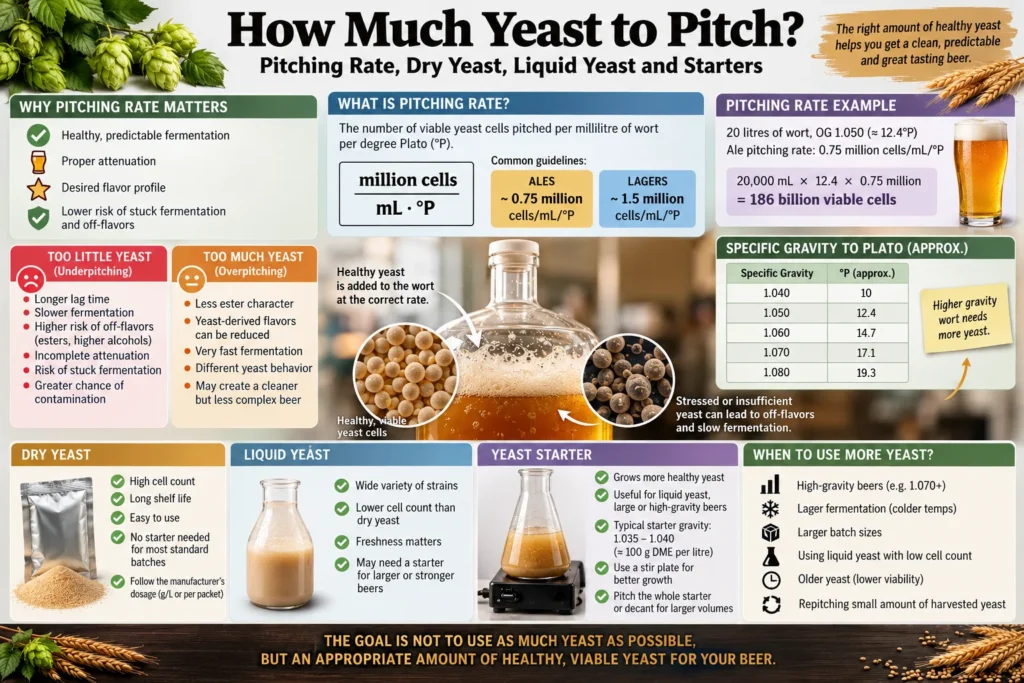
How Much Yeast to Pitch: Pitching Rate, Dry Yeast, Liquid Yeast and Starters
Yeast quantity is one of those brewing topics that seems simple at first.
Buy a packet of yeast. Open it. Add it to the wort.
For many ordinary homebrew batches, that can work perfectly well.
But as original gravity increases, batch size changes, fermentation temperature drops or yeast viability decreases, the amount of healthy yeast available at the beginning of fermentation becomes increasingly important.
This is where pitching rate comes in.
Pitching rate is not simply about adding “more yeast.” It is about providing an appropriate number of healthy, viable yeast cells for the amount and strength of wort you want to ferment.
Too little yeast can create problems.
But more yeast is not automatically better either.
In this fifth part of our beer yeast series, we will look at what pitching rate means, how much yeast a beer may need, the differences between dry and liquid yeast, when a starter makes sense, why high-gravity and lager beers often need more yeast, and why counting packets alone does not tell the whole story.
What Is Yeast Pitching Rate?
The pitching rate is the amount of yeast added to a given volume of wort.
More precisely, brewers often describe it as the number of viable yeast cells pitched per millilitre of wort per degree Plato.
A commonly used expression is:
million cells / mL / °P
This takes three things into account:
- the number of yeast cells
- the volume of wort
- the concentration of dissolved extract in the wort
This matters because a 10-litre batch of 1.040 wort does not place the same demand on yeast as 25 litres of 1.070 wort.
More wort requires more yeast.
Stronger wort generally requires more yeast.
Cold fermentation often requires more yeast.
The correct pitching rate therefore depends on the beer being brewed.
Why Does Pitching Rate Matter?
When yeast enters wort, it does not immediately begin behaving like a simple alcohol-producing machine.
It first has to adapt to its new environment.
Yeast must deal with:
- wort gravity
- osmotic pressure
- available oxygen
- nutrients
- temperature
- alcohol as fermentation progresses
- competition from other microorganisms
The population also needs to reach an appropriate level to ferment the wort efficiently.
If too few healthy cells are pitched, the yeast population may need more growth before fermentation can proceed strongly.
That can affect both fermentation performance and flavour development.
A suitable pitching rate helps create a healthy and predictable fermentation.
What Can Happen If You Underpitch?
Underpitching means adding fewer healthy yeast cells than are appropriate for the fermentation.
Possible consequences include:
- longer lag time
- slower fermentation
- increased yeast stress
- inconsistent attenuation
- higher final gravity
- stalled fermentation
- increased ester production in some strains
- increased higher alcohol production under some conditions
- greater batch-to-batch variation
- increased opportunity for unwanted microorganisms to establish themselves before fermentation becomes dominant
Not every slightly underpitched beer will fail.
Yeast can reproduce.
That ability is one reason brewing works even when the initial cell count is not perfect.
But relying on excessive yeast growth to compensate for a very low pitch is not the same as beginning fermentation with an appropriate population.
Does Underpitching Always Produce More Esters?
This is often presented as a simple rule:
less yeast = more esters
Reality is more complicated.
Pitching rate can influence ester production, but ester formation is also affected by:
- yeast strain
- fermentation temperature
- wort composition
- oxygen availability
- pressure
- yeast health
- growth conditions
With some strains and beer styles, controlled underpitching may increase desirable fermentation character.
Traditional or expressive beer styles may even use fermentation practices that would not be ideal for a very clean American ale.
But deliberately manipulating pitching rate for flavour is different from accidentally pitching unhealthy or insufficient yeast.
For most brewers, reliable fermentation should come first.
Once the behaviour of a particular yeast is understood, pitching rate can become another tool for fine-tuning character.
Can You Pitch Too Much Yeast?
Yes.
This is called overpitching.
Homebrewers are usually more likely to seriously underpitch than to slightly overpitch, but extremely large yeast pitches are not automatically beneficial.
If a very large population is added, less yeast growth may occur.
This can alter fermentation behaviour and the production of flavour-active compounds.
Potential effects may include:
- reduced ester character
- reduced yeast-derived complexity
- extremely rapid fermentation
- different maturation behaviour
- changes in the expected character of expressive yeast strains
In many clean beer styles, moderate overpitching may not create an obvious problem.
But the idea that:
“If one packet is good, five packets must be better”
is not a useful brewing principle.
The goal is an appropriate pitch, not the largest possible pitch.
Traditional Pitching Rate Guidelines
A frequently cited traditional guideline for ale fermentation is approximately:
0.75 million cells per mL per °P
For lager fermentation, a commonly cited value is approximately:
1.5 million cells per mL per °P
In other words, the traditional lager pitching rate is often roughly twice the ale rate.
These numbers are useful reference points, but they should not be treated as universal laws.
Modern yeast manufacturers may recommend different rates for specific strains.
Dry yeast products can also be specified in grams per litre rather than calculated cell counts.
Modern warm-fermenting lager strains may have different requirements from traditional cold-fermented lager strains.
Very strong beers may need different strategies again.
So pitching-rate formulas are best used as tools for understanding scale and yeast demand, not as rigid commandments.
What Is Degree Plato?
Pitching-rate calculations often use degrees Plato (°P) rather than specific gravity.
Degrees Plato represent the approximate percentage of dissolved extract in wort by mass.
For practical homebrewing purposes, specific gravity can be converted approximately to Plato.
Some useful rough examples are:
| Specific Gravity | Approx. °P |
|---|---|
| 1.040 | 10°P |
| 1.050 | 12.4°P |
| 1.060 | 14.7°P |
| 1.070 | 17.1°P |
| 1.080 | 19.3°P |
Brewing software and calculators can perform the conversion more accurately.
For understanding pitching rate, these approximations are usually enough.
A Simple Pitching Rate Example
Imagine brewing:
20 litres of wort
with an original gravity of:
1.050
That is approximately:
12.4°P
Using a traditional ale pitching rate of:
0.75 million cells / mL / °P
we calculate:
20 litres = 20,000 mL
So:
20,000 × 12.4 × 0.75 million
= approximately:
186 billion viable cells
This gives us an idea of the yeast population required according to that pitching-rate model.
It does not mean you need to count 186 billion cells yourself.
The practical question becomes:
Does the yeast product I am using provide approximately the amount of healthy yeast needed for this fermentation?
Why Packet Count Can Be Misleading
It is tempting to think:
one packet = one batch
But packets are not all equivalent.
Different yeast products can contain:
- different amounts of yeast
- different cell concentrations
- different package weights
- different viability levels
- different recommended pitching rates
An 11 g dry yeast packet cannot automatically be considered equivalent to every other 11 g packet.
Likewise, one package of liquid yeast cannot automatically be assumed to contain the same number of viable cells as another package.
Always check the manufacturer’s recommendations for the specific product.
Dry Yeast and Pitching Rate
Modern dry brewing yeast is extremely convenient.
It usually contains a large population of yeast in a stable form and can often be pitched directly into ordinary-strength wort.
Advantages of dry yeast include:
- good shelf stability
- convenient storage
- high cell density
- relatively predictable performance
- easy pitching
- no starter required in many normal-strength beers
This is one reason dry yeast has become so popular among homebrewers.
A single correctly sized packet may be entirely sufficient for many ordinary ale batches.
But that does not mean one packet is always enough.
Batch volume and original gravity still matter.
How Many Cells Are in a Packet of Dry Yeast?
There is no single correct answer for every manufacturer and every product.
Cell count depends on:
- yeast strain
- package weight
- production process
- manufacturer specification
- storage conditions
- age
Some manufacturers therefore avoid giving homebrewers a simple fixed cell count and instead provide a recommended dosage such as:
grams of yeast per hectolitre
or:
grams per litre
This can actually be more practical.
If the manufacturer recommends a specific dosage range, using that recommendation is often better than assuming a generic cell count from an internet calculator.
One Packet or Two?
Consider a typical 20–25 litre ale of moderate gravity.
One fresh packet of modern dry ale yeast may often be sufficient if that packet is designed for that volume and gravity.
Now change the beer to:
25 litres at OG 1.075
The fermentation challenge is significantly greater.
A second packet may make sense.
Likewise, a cold-fermented lager may benefit from a larger pitch than a warm-fermented ale of similar gravity.
This is why the answer to:
“How many packets of yeast do I need?”
cannot be given without knowing at least:
- batch size
- original gravity
- yeast product
- fermentation temperature
- beer type
Should Dry Yeast Be Rehydrated?
This is another area where brewing advice has changed over time.
Traditionally, many dry yeast manufacturers recommended rehydrating yeast in sterile or boiled-and-cooled water before pitching.
The idea was to allow dried cells to rehydrate under controlled conditions before encountering concentrated wort.
Modern dry yeast products, however, are often specifically designed for direct pitching.
Some manufacturers explicitly recommend sprinkling the yeast directly into the wort.
Others still provide rehydration procedures.
The best approach is therefore simple:
Follow the current instructions for the specific yeast you are using.
Do not automatically apply instructions written for one dry yeast product to every other dry yeast.
Should You Make a Starter With Dry Yeast?
Usually, no.
A starter is generally unnecessary for modern dry brewing yeast and may even defeat some of the advantages of the drying process.
Dry yeast is produced with cellular reserves intended to help it begin fermentation effectively.
If you need substantially more dry yeast, it is usually simpler and more predictable to pitch an additional packet.
So instead of making a starter from one dry yeast packet for a high-gravity beer, buying and pitching the appropriate amount of dry yeast is normally the better approach.
There can be unusual exceptions, but for normal homebrewing:
dry yeast → use the appropriate quantity of yeast
rather than automatically:
dry yeast → make a starter
Liquid Yeast and Pitching Rate
Liquid yeast offers homebrewers access to an enormous variety of strains.
This includes many:
- traditional British strains
- Belgian strains
- lager strains
- German wheat strains
- regional brewery cultures
- specialty fermentation strains
But liquid yeast presents a different pitching-rate challenge.
The number of viable cells available in the package may be lower than the amount required for a particular batch.
Viability also changes with age and storage conditions.
This is where yeast starters become particularly useful.
Freshness Matters More With Liquid Yeast
Living yeast cells gradually lose viability during storage.
The exact rate depends on:
- packaging technology
- yeast strain
- storage temperature
- production method
- package age
This means an older liquid yeast package may contain fewer viable cells than a fresh one.
A package may still ferment beer successfully, but the effective pitching rate may be lower than expected.
For this reason, production date or best-before information can be particularly useful when working with liquid yeast.
Modern packaging has improved considerably, so old rules about liquid yeast viability should not automatically be applied to every current product.
Again, manufacturer information is the best starting point.
What Is a Yeast Starter?
A yeast starter is a small volume of low-to-moderate gravity wort prepared before brew day to grow and activate yeast.
Instead of pitching the original liquid yeast package directly into the main batch, the brewer adds it to the starter.
The yeast then has an opportunity to:
- become metabolically active
- reproduce
- increase cell population
- demonstrate viability before brew day
After sufficient growth, the starter yeast is pitched into the main wort.
The main purpose of a starter is not to “wake up” yeast for the sake of activity.
Its most important role is often to increase the amount of healthy yeast available for pitching.
When Is a Yeast Starter Useful?
A starter may be useful when:
- using liquid yeast with insufficient cells for the batch
- brewing a large batch
- brewing high-gravity beer
- using an older liquid yeast culture
- repitching a small amount of harvested yeast
- preparing yeast for a demanding fermentation
- propagating a culture from a small source
A starter is not automatically necessary for every liquid yeast package.
Some modern liquid products contain enough yeast to directly inoculate standard batches.
Always compare the manufacturer’s intended batch size and gravity range with the beer you plan to brew.
Starter Wort Gravity
Starter wort should provide yeast with nutrients and fermentable sugars without creating unnecessary stress.
A commonly used starter gravity is around:
1.035–1.040
The goal is yeast growth, not making strong beer.
A very high-gravity starter can expose the yeast to greater osmotic and alcohol stress.
For normal propagation, moderate-strength starter wort is usually preferred.
Dry malt extract is commonly used because it makes starter preparation simple and predictable.
How Much DME for a Starter?
A useful practical approximation is:
100 g of dry malt extract per litre of water
This produces wort around the typical starter-gravity range, depending on exact extract composition and final volume.
For example:
1 litre starter → approximately 100 g DME
1.5 litre starter → approximately 150 g DME
2 litre starter → approximately 200 g DME
The starter wort should be boiled for sanitation, cooled to a suitable temperature and handled with good sanitary practices before yeast is added.
Does a Bigger Starter Always Grow More Yeast?
Generally, a larger starter provides more resources for growth, but yeast propagation is not determined by volume alone.
Growth also depends on:
- starting cell count
- starter gravity
- oxygen availability
- agitation
- yeast strain
- temperature
- nutrient availability
- initial yeast health
This is why starter calculators often ask for both the starting cell count and the desired final cell count.
A 2-litre starter is not automatically the correct starter for every beer.
Stir Plates and Yeast Starters
A stir plate continuously or intermittently agitates a yeast starter using a magnetic stir bar.
This keeps yeast in suspension and improves gas exchange.
The result can be greater yeast growth compared with a completely static starter.
This means a smaller continuously stirred starter may sometimes produce a similar cell population to a larger unstirred starter.
A stir plate is useful, but it is not essential.
Homebrewers can also periodically shake or swirl a starter manually.
The important goal is to create conditions that support healthy yeast growth.
Oxygen and Yeast Starters
Oxygen plays a different role at the beginning of fermentation than it does after fermentation.
During early growth, yeast uses oxygen in important cellular processes, including the production of compounds needed for healthy cell membranes.
This is one reason starter agitation can improve yeast growth.
But after beer fermentation is underway, oxygen becomes something brewers generally try to avoid because of oxidation.
So remember:
oxygen can be useful during yeast propagation and at the beginning of fermentation
but:
oxygen exposure later in the brewing process can damage beer quality.
Context matters.
Should You Pitch the Whole Starter?
There are two common approaches.
A relatively small starter can often be pitched completely into the wort.
For larger starters, some brewers prefer to allow the yeast to settle, chill the starter, pour off most of the spent starter beer and pitch mainly the yeast slurry.
This is called decanting the starter.
Why?
Because several litres of oxidised, lightly hopped or unhopped starter beer may alter the flavour of the main batch.
This matters more for delicate beers and large starter volumes.
High-Gravity Beer Needs More Yeast
As original gravity increases, fermentation becomes more demanding.
High-gravity wort contains more dissolved sugars and creates greater osmotic stress at the beginning of fermentation.
As fermentation progresses, yeast must also tolerate increasing alcohol concentration.
For stronger beers, good yeast management becomes increasingly important.
This may involve:
- larger pitching rates
- multiple dry yeast packets
- larger or stepped starters
- healthy harvested yeast
- appropriate oxygenation
- good nutrient availability
- careful temperature control
A yeast strategy that works perfectly for a 1.045 Pale Ale may not be appropriate for a 1.090 Imperial Stout.
What Is a Step Starter?
Sometimes the required yeast population is too large to produce efficiently in one small starter.
In that case, yeast can be propagated in stages.
For example:
small starter → larger starter → final pitching population
This is known as a step starter or stepped propagation.
It is particularly useful when starting with:
- a very small yeast population
- an older culture
- yeast from a bottle
- a slant or laboratory culture
- a small harvested sample
- yeast for a very large or high-gravity batch
Each stage increases the population before transferring the yeast into a larger volume of fresh starter wort.
Lager Beer Often Requires More Yeast
Traditional lager fermentation usually uses a larger pitching rate than ale fermentation.
Why?
One major reason is temperature.
At lower fermentation temperatures, yeast metabolism and reproduction are slower.
A larger initial yeast population helps establish strong fermentation without requiring excessive growth under cold conditions.
This is why a traditional lager pitch may be approximately twice the conventional ale pitching rate.
For homebrewers, this can mean:
- using multiple packets of dry lager yeast
- making a larger liquid yeast starter
- building a stepped starter
- pitching a healthy harvested lager slurry
Again, modern strains can differ significantly.
Some lager yeasts are designed to work at warmer temperatures or with different pitching recommendations.
Follow the strain rather than blindly following the category.
Warm-Fermented Lager Yeast May Change the Calculation
If lager yeast is fermented warmer, its pitching requirements may differ from a traditional 9–12°C fermentation.
This is particularly relevant with modern lager strains designed for warm fermentation.
But it would be a mistake to assume:
warm lager fermentation = ale pitching rate
for every strain.
Manufacturer recommendations should remain the primary reference.
Temperature, gravity, strain and fermentation method should all be considered together.
Pitching Rate and Fermentation Temperature Work Together
Pitching rate should never be considered completely separately from temperature.
Imagine two identical batches.
Batch A receives a healthy pitch and ferments at a controlled temperature.
Batch B receives too little yeast and ferments too warm.
Batch B now combines two major sources of fermentation stress.
The result may be much less predictable.
Good fermentation management means looking at the entire system:
healthy yeast + suitable pitching rate + appropriate temperature + suitable wort + good sanitation
rather than expecting one variable to compensate for everything else.
Pitching Rate and Pressure Fermentation
Pressure adds another factor.
During pressure fermentation, especially if significant pressure is applied very early, yeast growth and metabolism may be affected.
This makes healthy pitching particularly important.
A fermentation that begins with insufficient yeast and immediately experiences significant pressure may behave differently from one allowed to establish itself first.
Some brewers therefore begin fermentation at low or minimal pressure and allow pressure to build later.
The ideal strategy depends on:
- yeast strain
- beer style
- temperature
- pressure level
- desired flavour profile
Pressure fermentation does not remove the need for proper yeast management.
Harvested Yeast and Repitching
Yeast harvested from a previous fermentation can contain an enormous number of cells.
This makes repitching attractive.
But slurry volume alone does not tell you exactly how much healthy yeast is present.
Harvested slurry can contain:
- living yeast
- dead yeast
- trub
- hop particles
- proteins
- beer
- other solids
Its concentration can vary dramatically.
A jar containing 200 mL of thick slurry is not necessarily equivalent to another 200 mL sample.
Age and storage conditions also affect viability.
This makes repitching less precise than simply measuring slurry volume.
Is Fresh Yeast Slurry Better Than a New Packet?
Not automatically.
Freshly harvested yeast can be extremely healthy and active.
It can also provide a very large cell population at almost no cost.
But its quality depends on how it was harvested and stored.
Consider:
- the health of the previous fermentation
- alcohol strength of the previous beer
- sanitation
- storage temperature
- storage duration
- hop and trub contamination
- number of previous generations
- signs of contamination or unusual fermentation
Yeast from a healthy moderate-strength beer is generally a better candidate for repitching than yeast recovered from an extremely strong or problematic fermentation.
How Long Can Harvested Yeast Be Stored?
There is no single safe number that applies to every situation.
Viability decreases during storage, and contamination risk depends heavily on handling.
Freshly harvested yeast used relatively soon is easier to evaluate than slurry stored for a long period.
As storage time increases, it becomes increasingly useful to consider:
- viability
- smell and appearance
- storage conditions
- starter propagation
- whether the economic saving is worth the risk to an entire batch
For homebrewers, yeast is often inexpensive compared with the value of a complete batch of beer.
Saving a small amount of money is not always worth risking 20–25 litres of wort.
Does More Yeast Make Fermentation Faster?
Often, an appropriately larger pitch can shorten lag time and help fermentation establish itself quickly.
But this should not be confused with:
maximum yeast = minimum fermentation time
Fermentation speed also depends on:
- temperature
- gravity
- yeast strain
- wort fermentability
- oxygen
- nutrients
- pressure
- yeast health
The goal is not to create the fastest possible fermentation.
The goal is to create a healthy fermentation that produces the desired beer.
How Do You Know If You Pitched Enough Yeast?
You cannot reliably determine the exact pitching rate simply by watching the airlock.
But fermentation performance provides useful clues.
A healthy fermentation often shows:
- appropriate fermentation onset
- predictable gravity reduction
- reasonable attenuation
- expected yeast character
- stable final gravity
- no obvious signs of stress or contamination
However, a fast start does not prove that the pitching rate was perfect.
Likewise, a slow start does not automatically prove underpitching.
Temperature, yeast strain and other variables must also be considered.
Good brewing records help identify patterns over several batches.
Do You Need a Yeast Pitching Calculator?
Not always.
For ordinary-strength beer using a fresh dry yeast packet according to the manufacturer’s recommended dosage, a detailed calculator may be unnecessary.
But pitching calculators become useful when working with:
- liquid yeast
- starters
- large batches
- high-gravity beer
- traditional cold-fermented lager
- harvested yeast
- stepped propagation
A calculator can estimate the required yeast population and help determine starter size.
But remember:
a calculator produces an estimate.
The real biological condition of the yeast cannot always be reduced to one exact number.
A Practical Dry Yeast Example
Imagine brewing:
25 litres of Pale Ale
OG:
1.050
Fermentation temperature:
19°C
with a modern dry ale yeast whose manufacturer recommends one 11 g packet for approximately this volume and gravity.
In this situation, one fresh packet may be entirely appropriate.
There is little reason to make a starter simply because yeast calculators exist.
Now change the recipe:
25 litres
OG:
1.080
The yeast requirement increases substantially.
Using two packets may now be a much more sensible strategy, depending on the specific manufacturer’s dosage recommendation.
The beer changed.
So the yeast strategy should change too.
A Practical Liquid Yeast Example
Imagine the same:
25 litres
OG:
1.050
but now you want to use a liquid English ale strain.
The package contains a limited population of viable cells.
If the manufacturer specifies that one fresh package is sufficient for this batch, direct pitching may be appropriate.
If not, a starter can increase the population before brew day.
Now imagine brewing:
25 litres at 1.075
with the same liquid culture.
A larger starter, multiple packages or stepped propagation may be required.
Again, the answer depends on the actual product.
A Practical Lager Example
Suppose you brew:
25 litres of lager
OG:
1.050
and intend to ferment at:
10°C
This fermentation may require significantly more yeast than a 25-litre ale of the same gravity fermented at 19°C.
Depending on the yeast product, the practical solution may be:
- multiple dry yeast packets
- a large liquid yeast starter
- a stepped starter
- healthy harvested yeast
This is one of the situations where simply thinking:
“One packet for one fermenter”
can easily lead to underpitching.
Common Pitching Rate Mistakes
Several mistakes appear repeatedly in homebrewing.
Assuming one packet always equals one batch
Batch size, gravity, yeast type and temperature matter.
Making starters from dry yeast automatically
Modern dry yeast usually does not need a starter.
Ignoring liquid yeast age
Viability can change during storage.
Using high-gravity wort with the same yeast quantity as ordinary beer
Stronger wort creates greater fermentation demands.
Underpitching cold lager fermentation
Traditional lager fermentation often needs a larger yeast population.
Assuming more yeast is always better
Overpitching can alter fermentation character.
Measuring harvested yeast only by slurry volume
Slurry concentration and viability vary.
Ignoring yeast health
A large quantity of unhealthy yeast is not equivalent to a healthy pitch.
Trying to compensate for poor temperature control with more yeast
Pitching rate and temperature are different variables.
Trusting a calculator more than the yeast manufacturer
Calculators are estimates. Product-specific information matters.
Pitch Healthy Yeast, Not Just Enough Yeast
Cell count is only part of the story.
Imagine two pitches that both contain:
200 billion cells
In one case, the cells are fresh, healthy and ready to ferment.
In the other, a significant portion is damaged or metabolically weak.
The numbers may appear similar on paper, but fermentation performance can be very different.
This is why pitching rate should really be thought of as:
an appropriate population of healthy, viable yeast
rather than simply:
a large number of cells.
Yeast Management Is Part of Recipe Design
When designing a beer, brewers often focus on:
- malt percentages
- hop varieties
- bitterness
- water chemistry
- mash temperature
Yeast may simply appear as:
1 packet
But that description can be incomplete.
A better recipe might include:
Yeast: specific strain
Pitch: 1 or 2 packets / calculated starter
Pitch temperature: 18°C
Fermentation: 19°C
Late fermentation: allow rise to 21°C
Expected attenuation: strain-dependent
Target FG: approximately 1.010
This makes fermentation much more repeatable.
Yeast quantity is not separate from recipe design.
It is part of it.
Should Beginners Worry About Exact Cell Counts?
Not excessively.
Pitching rate is important, but homebrewing should not become an exercise in pretending biological systems are perfectly precise.
For a beginner brewing ordinary-strength ale with a fresh, reputable dry yeast:
following the manufacturer’s recommended dosage and fermentation temperature is usually an excellent starting point.
There is no need to become obsessed with whether the pitch contains exactly 183 billion or 191 billion viable cells.
Precision becomes more useful when brewing:
- stronger beers
- cold lagers
- large batches
- expensive wort
- difficult fermentations
- liquid yeast cultures
- reused yeast
Learn the principle first.
Use more detailed calculations when they actually improve the process.
A Simple Decision Guide
For many homebrewers, yeast pitching can be approached like this:
Normal-strength ale + fresh dry yeast
→ Follow manufacturer dosage. Usually simple.
High-gravity ale + dry yeast
→ Consider additional packets according to dosage recommendations.
Traditional cold lager + dry yeast
→ Expect a larger pitch than for a comparable ale.
Fresh liquid yeast + ordinary beer
→ Check whether the package contains enough yeast for the intended volume and gravity.
Liquid yeast + large or strong beer
→ Starter or additional packages may be appropriate.
Old liquid yeast
→ Consider viability and starter propagation.
Harvested yeast
→ Consider slurry concentration, age, health and previous fermentation conditions.
This is much more useful than automatically applying the same yeast quantity to every recipe.
Final Thoughts
Pitching rate is not about adding as much yeast as possible.
It is about starting fermentation with an appropriate population of healthy, viable yeast.
Too little yeast can contribute to slow, stressed or inconsistent fermentation.
Excessively large pitches can also alter yeast behaviour and reduce the fermentation character expected from certain strains.
Dry yeast has made pitching much easier for homebrewers because modern products often contain large, stable populations and can be pitched directly into normal-strength wort.
Liquid yeast offers enormous strain diversity, but starters can become important when the available cell population is insufficient.
High-gravity beer, traditional cold-fermented lager and large batches increase yeast demand and deserve more careful planning.
And reused yeast introduces another question entirely: not just how much slurry you have, but how much healthy yeast that slurry actually contains.
The most useful principle is:
Do not ask only, “How many packets of yeast should I use?” Ask, “How much healthy yeast does this particular fermentation need?”
Once you begin thinking that way, pitching rate stops being a mysterious brewing formula and becomes another practical tool for making fermentation more predictable, repeatable and successful.