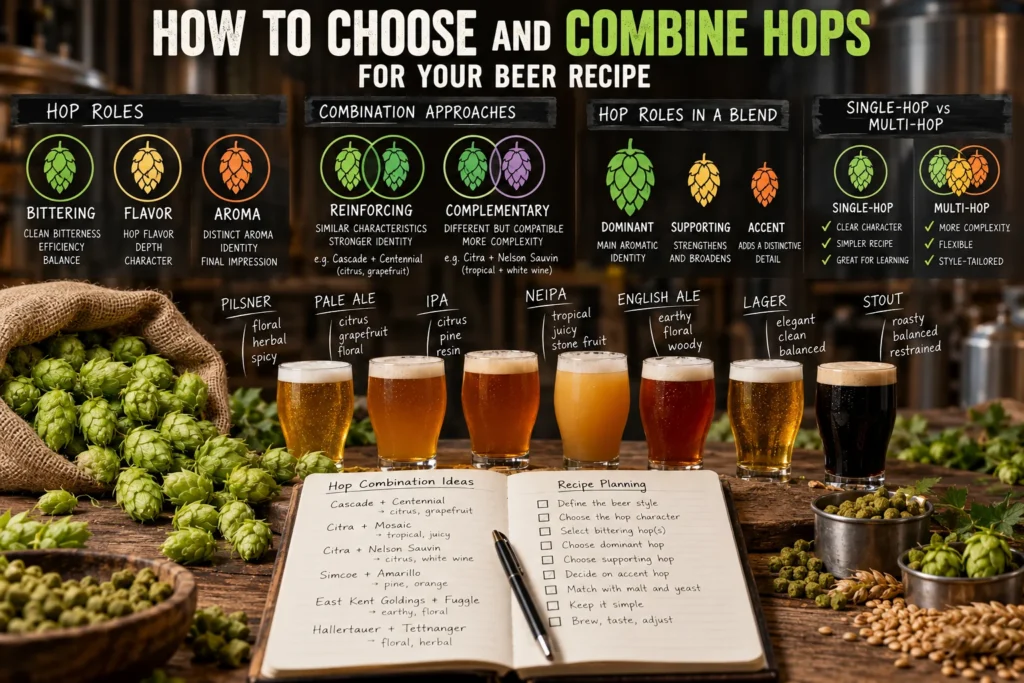
Choosing hops for a beer recipe is not simply a matter of finding the varieties with the most exciting aroma descriptions.
A hop may smell incredible on its own and still be completely wrong for the beer you are trying to brew.
Another hop may appear less spectacular on paper but fit perfectly with the malt, yeast and overall character of the recipe.
The same is true when combining hops.
Using three, four or five varieties does not automatically create a more complex or better beer.
Sometimes two carefully selected hops create a clearer and more memorable character than a complicated blend of six varieties.
And sometimes the best choice is simply one hop.
The practical question is therefore not:
“Which hops are the best?”
It is:
“Which hops will help create the beer I want to drink?”
This article brings together the practical side of hop selection and recipe design.
We will look at:
- choosing hops according to the beer style
- selecting bittering and aroma hops
- deciding between single-hop and multi-hop recipes
- combining two or three varieties
- assigning dominant, supporting and accent roles
- matching hops with malt and yeast
- building hop combinations for Pale Ale, IPA, NEIPA, Lager, Stout and English Ale
- recognizing when a hop bill has become unnecessarily complicated
The goal is not to use more hops.
The goal is to use hops with purpose.
START WITH THE FINISHED BEER
Before choosing a hop variety, imagine the finished beer.
Ask yourself:
What should the beer smell like?
What should the bitterness feel like?
Should the hop character be subtle or dominant?
Should it be citrusy, tropical, piney, floral, spicy, herbal, earthy or wine-like?
Should the malt remain clearly noticeable?
Should the yeast contribute significant character?
Should the beer feel traditional or modern?
These questions are more useful than starting with a list of hops you happen to have available.
A recipe should begin with an idea of the finished beer.
Then the ingredients are chosen to create that idea.
THINK ABOUT THE ROLE OF THE HOPS
Hops can perform different jobs in a recipe.
A hop may be used primarily for:
BITTERNESS
FLAVOR
AROMA
or a combination of these.
Some varieties are especially convenient for efficient bittering.
Others are chosen mainly because of their distinctive aroma.
Many modern varieties can perform both roles.
The important thing is not whether a hop is officially described as a “bittering hop” or an “aroma hop.”
The important question is:
What job do you want this hop to perform in this particular recipe?
CHOOSING A BITTERING HOP
When the primary purpose of an addition is bitterness, aroma may be less important than:
- clean bitterness
- predictable performance
- appropriate intensity
- efficiency
This is why relatively high-alpha hops are often used for bittering.
Less hop material may be required to reach the desired bitterness.
Common examples include varieties such as:
Magnum
Warrior
Columbus / CTZ
Chinook
and other higher-alpha varieties.
But there is no rule saying that the bittering hop must be different from the aroma hops.
A single variety can be used throughout the recipe if that makes sense.
For example, a Cascade Pale Ale can use Cascade for bittering, late additions and aroma.
However, if your goal is simply clean bitterness, using a neutral and efficient bittering hop such as Magnum can leave your more aromatic hops available for later additions.
This can be especially practical when expensive or limited aroma hops are being used.
DOES THE BITTERING HOP MATTER?
Yes, but not always as much as the late-hop character.
Long-boiled additions lose much of their volatile aroma.
Therefore, the distinctive aromatic identity of a hop is usually less obvious when it is used only for bittering.
This is why replacing an expensive aroma variety with a clean bittering hop can sometimes make very little sensory difference in the finished beer.
But bittering hops are not completely interchangeable.
Different varieties and processes can still influence the character and quality of bitterness.
The practical lesson is simple:
Do not waste a rare aroma hop in a role where its special character cannot meaningfully contribute to the beer unless there is a specific reason to do so.
CHOOSING AROMA HOPS
Aroma hops should be selected according to the character you want in the finished beer.
Think in sensory families.
For example:
CITRUS
Cascade
Centennial
Citra
Amarillo
Motueka
PINE AND RESIN
Chinook
Simcoe
Centennial
Columbus / CTZ
TROPICAL FRUIT
Citra
Galaxy
Nectaron
Mosaic
STONE FRUIT
Nectaron
Amarillo
Mosaic
WHITE WINE / GRAPE / GOOSEBERRY
Nelson Sauvin
FLORAL / HERBAL / SPICY
Hallertauer Mittelfrüh
Saaz
Tettnanger
Spalt
EARTHY / WOODY / TRADITIONAL ENGLISH
East Kent Goldings
Fuggle
These categories are not absolute.
A single hop can show several different characteristics depending on harvest, recipe and process.
But thinking in aroma families is extremely useful when designing a recipe.
DO NOT CHOOSE HOPS ONLY FROM THEIR DESCRIPTION
Modern hop descriptions can sound like fruit cocktails:
mango
passion fruit
lime
peach
pineapple
white wine
blueberry
gooseberry
orange
grapefruit.
It is tempting to select hops simply because the description sounds impressive.
But a beer recipe needs coherence.
A hop that contributes passion fruit and pineapple may be excellent in a modern IPA.
It may be completely unnecessary in a traditional English Bitter.
Likewise, a delicate herbal and spicy hop may be perfect in a German lager but disappear underneath an enormous dry-hop charge in a Hazy IPA.
The best hop is not the hop with the longest aroma description.
It is the hop whose character fits the beer.
START WITH THE BEER STYLE
Beer style provides a useful first direction.
It does not mean that every recipe must follow historical tradition exactly.
But style gives you a framework.
For example:
GERMAN PILS
Useful direction:
floral, herbal, spicy, elegant
Possible hops:
Hallertauer Mittelfrüh, Tettnanger, Spalt
CZECH-STYLE PILSNER
Useful direction:
spicy, herbal, earthy, floral
Possible hop:
Saaz
ENGLISH BITTER / ESB
Useful direction:
earthy, floral, herbal, woody, gently fruity
Possible hops:
East Kent Goldings, Fuggle
AMERICAN PALE ALE
Useful direction:
citrus, grapefruit, floral, light pine
Possible hops:
Cascade, Centennial, Amarillo, Citra
WEST COAST IPA
Useful direction:
citrus, grapefruit, pine, resin, modern fruit
Possible hops:
Centennial, Chinook, Simcoe, Citra, Amarillo, Columbus / CTZ
HAZY IPA / NEIPA
Useful direction:
tropical fruit, citrus, stone fruit, passion fruit
Possible hops:
Citra, Mosaic, Galaxy, Nectaron, Nelson Sauvin
SAISON
Useful direction:
spicy, herbal, floral, citrus
Possible hops:
Saaz, Hallertauer-type varieties, Motueka
ENGLISH PORTER OR STOUT
Useful direction:
restrained earthy, herbal or traditional hop character
Possible hops:
East Kent Goldings, Fuggle
These are directions, not laws.
Modern brewers can intentionally break traditional combinations.
But it is easier to break a rule intelligently when you understand what the traditional direction was trying to achieve.
SINGLE-HOP BEER
A single-hop beer uses one hop variety throughout the recipe or for the major aroma additions.
This approach has several advantages.
It allows you to understand the character of a variety clearly.
It can create a focused hop profile.
It simplifies recipe design.
And it makes the beer easier to reproduce.
Examples might include:
Cascade Pale Ale
Citra IPA
Nelson Sauvin Pale Ale
Saaz Pilsner
East Kent Goldings Bitter.
Single-hop brewing is one of the best ways to learn hops.
If you always use five varieties together, it becomes difficult to understand what each one actually contributes.
WHEN A SINGLE HOP IS ENOUGH
A single hop can work particularly well when the variety already has a broad and complex aroma profile.
Citra, Mosaic, Nelson Sauvin and Nectaron, for example, can each produce highly expressive beers without needing several additional varieties.
Classic varieties can also stand alone beautifully.
Cascade can define an American Pale Ale.
Saaz can define the hop character of a Czech-style lager.
East Kent Goldings can provide everything an English Bitter needs.
Complexity does not always require multiple ingredients.
WHY COMBINE HOPS?
Hop combinations can be useful for two main reasons.
The first is:
REINFORCEMENT.
Two hops can emphasize similar characteristics.
For example:
Cascade + Centennial
Both can contribute classic American citrus and grapefruit character.
Together they can create a broader version of the same general direction.
The second is:
COMPLEMENTATION.
Two hops can contribute different but compatible characteristics.
For example:
Citra + Nelson Sauvin
Citra can contribute citrus and tropical fruit.
Nelson can add white wine, grape and gooseberry character.
The combination can create something neither hop produces alone.
Both approaches are valid.
REINFORCING HOP COMBINATIONS
Reinforcing combinations use hops with overlapping characteristics.
Examples:
Cascade + Centennial
→ grapefruit, citrus, floral
Citra + Galaxy
→ tropical fruit, citrus, passion fruit
Citra + Nectaron
→ tropical fruit, citrus, stone fruit
Centennial + Chinook
→ citrus, grapefruit, pine, resin
These combinations can create a strong, focused identity.
The advantage is clarity.
The hops are moving in roughly the same sensory direction.
COMPLEMENTARY HOP COMBINATIONS
Complementary combinations use hops that bring different but compatible elements.
Examples:
Citra + Nelson Sauvin
→ citrus/tropical + white wine/gooseberry
Simcoe + Amarillo
→ pine/resin + orange/floral
Mosaic + Centennial
→ complex fruit/berry + citrus/grapefruit
Nelson Sauvin + Nectaron
→ white wine/gooseberry + peach/passion fruit
The goal is not to create as many different flavors as possible.
The goal is to create contrast without losing coherence.
TWO HOPS CAN BE ENOUGH
A two-hop combination is one of the easiest ways to create complexity while keeping the recipe understandable.
You can think of it as:
MAIN CHARACTER + SUPPORTING CHARACTER.
For example:
Citra + Centennial
Citra may provide the dominant tropical/citrus character.
Centennial supports it with grapefruit, citrus and a little resinous structure.
Or:
Nelson Sauvin + Citra
Nelson can be the distinctive white-wine character.
Citra can provide a familiar citrus and tropical foundation.
Two well-chosen hops can produce enormous complexity.
THREE-HOP COMBINATIONS
Three hops provide even more possibilities, but they should have defined roles.
A useful way to think about a three-hop blend is:
DOMINANT HOP
SUPPORTING HOP
ACCENT HOP.
THE DOMINANT HOP
The dominant hop defines the main aromatic identity of the beer.
It should be the character you want people to notice first.
Examples:
Citra in a citrus/tropical IPA
Nelson Sauvin in a wine-like Pale Ale
Cascade in a classic American Pale Ale
East Kent Goldings in an English Bitter
Hallertauer Mittelfrüh in a traditional German lager.
The dominant hop does not necessarily need to represent the majority of every addition.
But its character should be clearly recognizable.
THE SUPPORTING HOP
The supporting hop strengthens or broadens the dominant character.
For example:
Dominant: Citra
Supporting: Centennial
Citra provides tropical citrus.
Centennial adds grapefruit, floral notes and light resin.
Or:
Dominant: Cascade
Supporting: Amarillo
Cascade provides classic grapefruit.
Amarillo adds orange and floral character.
The supporting hop should help build the beer rather than fight for attention.
THE ACCENT HOP
The accent hop is used to add a smaller distinctive detail.
Think of it almost like seasoning.
For example:
Dominant: Citra
Supporting: Centennial
Accent: Chinook
Citra provides fruit.
Centennial provides citrus structure.
Chinook adds a smaller pine and resin edge.
Another example:
Dominant: Citra
Supporting: Mosaic
Accent: Nelson Sauvin
Citra provides citrus/tropical character.
Mosaic broadens the fruit complexity.
Nelson contributes a distinctive wine-like accent.
An accent hop can be extremely effective at a smaller proportion.
It does not need to dominate the blend.
A SIMPLE RATIO FOR THREE-HOP BLENDS
There is no universal correct ratio.
But when designing a blend for the first time, a useful conceptual starting point might be:
50% DOMINANT
30% SUPPORTING
20% ACCENT.
For example:
Citra 50 g
Centennial 30 g
Chinook 20 g.
This does not mean every three-hop recipe should use 50/30/20.
It is simply an easy way to force yourself to decide which hop is doing what.
You could also use:
60 / 30 / 10
40 / 40 / 20
or equal proportions.
The important thing is that the blend has a reason behind it.
EQUAL RATIOS CAN ALSO WORK
Sometimes the goal is not to create a dominant hop.
You may want two varieties to contribute equally.
For example:
Citra 50%
Mosaic 50%.
This is one of the simplest ways to build a modern IPA combination.
Equal ratios work particularly well when both hops are strong and complementary.
But equal ratios should be a conscious decision, not simply the default because the mathematics are easy.
DO NOT ASSUME EVERY HOP MUST BE USED AT EVERY STAGE
A recipe containing three hop varieties does not mean all three must be used in every addition.
One hop may provide bitterness.
Two may be used late.
Three may appear in the final aroma blend.
For example:
Bittering:
Magnum
Late additions:
Centennial + Citra
Aroma / dry hop:
Citra + Centennial + Chinook.
This gives each hop a role.
Another recipe might deliberately use the same blend throughout.
Both approaches can work.
The important thing is intentional design.
BITTERING HOP AND AROMA HOPS CAN BE DIFFERENT
One of the most practical recipe structures is:
NEUTRAL BITTERING HOP + CHARACTERFUL AROMA HOPS.
For example:
Magnum for bitterness
Citra + Centennial + Cascade for aroma.
The Magnum does not need to become part of the beer’s aromatic identity.
Its job is simply to provide efficient, clean bitterness.
This allows the aroma varieties to be used where their character matters more.
This approach is especially useful in Pale Ale and IPA.
BUT ONE HOP CAN DO EVERYTHING
There is nothing wrong with using the same variety for bittering, late additions and aroma.
This can create a coherent single-hop beer.
For example:
Cascade at the beginning of the boil
Cascade late in the boil
Cascade at flameout
Cascade as dry hop.
The beer then becomes a clear expression of Cascade.
This is particularly useful when learning a hop variety.
DESIGNING AN AMERICAN PALE ALE
American Pale Ale is an excellent style for learning hop combinations.
The beer should usually remain drinkable and balanced while clearly expressing American hop character.
A useful direction might be:
citrus + grapefruit + floral + light pine.
A classic combination:
Cascade + Centennial.
A slightly more modern combination:
Cascade + Amarillo.
A more fruit-forward version:
Citra + Cascade.
A three-hop version:
Citra — dominant
Centennial — supporting
Cascade — accent.
Another option:
Cascade — dominant
Amarillo — supporting
Centennial — accent.
The malt and yeast should still have room to participate.
A Pale Ale does not need to become a small NEIPA.
DESIGNING A WEST COAST IPA
West Coast IPA usually benefits from a clearer and sharper hop identity.
Typical directions include:
citrus
grapefruit
pine
resin
dank character
with modern fruit sometimes layered over the classic profile.
Possible combinations:
Centennial + Chinook
Simcoe + Centennial
Citra + Centennial + Chinook
Simcoe + Amarillo + Centennial
Citra + Simcoe + Columbus / CTZ.
For example:
Dominant: Citra
Supporting: Centennial
Accent: Chinook
This can produce:
tropical/citrus fruit
supported by grapefruit
with a pine/resin edge.
The result remains recognizably West Coast while still using a modern hop.
DESIGNING A MODERN IPA
A modern IPA may emphasize fruit more heavily than a classic West Coast version.
Useful combinations include:
Citra + Mosaic
Citra + Amarillo
Citra + Galaxy
Citra + Nelson Sauvin
Citra + Nectaron
Mosaic + Nelson Sauvin.
Three-hop examples:
Citra + Mosaic + Nelson Sauvin
Citra + Galaxy + Nectaron
Citra + Amarillo + Mosaic.
The challenge is not finding enough fruit character.
Modern hop varieties can provide enormous intensity.
The challenge is keeping the blend recognizable rather than turning it into an undefined wall of fruit.
DESIGNING A HAZY IPA / NEIPA
Hazy IPA often uses hops with strong:
tropical
citrus
stone fruit
passion fruit
and sometimes white-wine characteristics.
Examples:
Citra + Mosaic
Citra + Galaxy
Citra + Nectaron
Citra + Nelson Sauvin
Mosaic + Nectaron.
Three-hop combinations might include:
Citra — dominant
Mosaic — supporting
Nelson Sauvin — accent
or:
Citra — dominant
Nectaron — supporting
Galaxy — accent.
Another approach is to build around Nelson:
Nelson Sauvin — dominant
Citra — supporting
Nectaron — accent.
The malt, yeast and water profile of a Hazy IPA already contribute softness and fruit perception.
The hop blend should work with them rather than simply piling fruit on top of fruit.
DESIGNING A LAGER
Lager does not automatically mean “almost no hops.”
Hop character can be extremely important in lager.
But the desired expression is often more restrained and elegant.
For a German-style lager:
Hallertauer Mittelfrüh
Tettnanger
Spalt
can provide:
floral
herbal
spicy
delicate earthy character.
A single hop may be enough.
For example:
Hallertauer Mittelfrüh alone can produce a beautifully coherent hop profile.
A combination such as:
Hallertauer Mittelfrüh + Tettnanger
can add subtle complexity without overwhelming the beer.
For a Czech-style Pilsner:
Saaz may be all that is needed.
Do not make a lager hop bill complicated simply because you have many varieties available.
Delicacy is part of the design.
DESIGNING A MODERN HOPPY LAGER
A modern hoppy lager allows more freedom.
A clean lager fermentation can provide a neutral background for expressive hops.
Possible combinations:
Motueka + Nelson Sauvin
Citra + Motueka
Nelson Sauvin + Citra
Cascade + Centennial.
But the balance is important.
If the hop profile becomes enormous, the beer may drink more like an IPA fermented with lager yeast than a traditionally balanced lager.
That may be exactly what you want.
The important thing is to make that choice intentionally.
DESIGNING AN ENGLISH ALE
English hop character usually works differently from modern American IPA character.
Typical directions include:
earthy
floral
herbal
woody
spicy
gently fruity.
East Kent Goldings can work beautifully alone.
Fuggle can also work alone.
A classic combination:
East Kent Goldings + Fuggle.
You do not need five varieties.
The malt and English yeast may already provide significant complexity.
The hops should support the beer rather than erase that character.
DESIGNING A STOUT OR PORTER
Dark beer does not automatically require complicated hopping.
Roasted malt, chocolate malt, caramel character and fermentation profile may already dominate the beer.
The hop’s job may simply be:
balance the sweetness
provide bitterness
add a restrained herbal or earthy background.
Possible choices:
Magnum for clean bitterness
East Kent Goldings for traditional character
Fuggle for earthy/woody character
Challenger or similar English-style varieties where appropriate.
An American Stout can intentionally use more assertive American hops such as:
Cascade
Centennial
Chinook.
But again, ask what the beer needs.
If the roasted malt is supposed to be the star, a massive tropical hop blend may create conflict rather than complexity.
MATCH HOPS WITH THE MALT BILL
Hops do not exist in isolation.
The same hop blend can taste completely different depending on the malt bill.
A light Pale malt base leaves enormous room for hop expression.
Caramel and Crystal malts can interact with citrus, resin and fruit.
Roasted malt can support earthy, piney or citrus hop character but may compete with delicate tropical aromas.
Traditional English malt can work beautifully with earthy and floral English hops.
German Pilsner malt can provide an elegant base for Noble-type hops.
When choosing hops, ask:
What will the malt contribute?
Will the hops reinforce it?
Contrast it?
Or completely cover it?
MATCH HOPS WITH THE YEAST
Yeast can dramatically change how hop character is perceived.
A clean American ale yeast allows hops to appear direct and clear.
An English yeast may contribute fruit that blends with citrus or stone-fruit hops.
A Belgian yeast may add esters and phenols that interact with spicy, citrus or herbal hops.
A German wheat yeast can contribute banana and clove, meaning an enormous tropical hop blend may create sensory competition.
A clean lager yeast provides a very different background from an expressive ale yeast.
Therefore, do not design the hop bill independently from the fermentation character.
The finished beer is the combination of all these elements.
THINK ABOUT THE WATER PROFILE
Water can change the way hop character is perceived.
A sulfate-forward water profile can make bitterness feel:
drier
sharper
more defined.
A chloride-forward profile can emphasize:
fullness
softness
roundness.
This is one reason the same Citra and Mosaic combination can feel very different in a West Coast IPA and a Hazy IPA.
The hops may be similar.
The beer around them is not.
WHEN DOES A HOP BLEND BECOME TOO COMPLICATED?
There is no exact number.
But complexity becomes a problem when you can no longer explain why each variety is present.
Imagine a recipe containing:
Citra
Mosaic
Galaxy
Nelson Sauvin
Nectaron
Amarillo
Simcoe.
Could that make a delicious beer?
Absolutely.
But ask yourself:
What is Citra doing?
What is Mosaic doing?
Why is Galaxy needed?
What does Nelson add?
Can you actually perceive Nectaron?
What is Amarillo contributing?
Does Simcoe improve the blend or simply add another name?
If you cannot answer those questions, the recipe may be more complicated than necessary.
THE FOURTH OR FIFTH HOP OFTEN CONTRIBUTES LESS THAN YOU EXPECT
When several highly aromatic hops are combined, individual identities begin to overlap.
The first hop may establish the main character.
The second adds complexity.
The third adds an accent.
The fourth, fifth and sixth may become increasingly difficult to identify.
This does not mean that four-hop or five-hop blends are wrong.
Professional brewers use complex blends successfully.
But every additional variety should earn its place in the recipe.
A USEFUL RULE: REMOVE ONE HOP
When designing a complicated hop bill, try this exercise:
Remove one variety.
Then ask:
Does the recipe lose something important?
If the answer is no, that hop probably was not necessary.
This simple method can make recipes cleaner, cheaper and easier to reproduce.
TWO OR THREE HOPS ARE OFTEN THE SWEET SPOT
For many homebrew recipes, two or three aroma varieties provide an excellent balance between:
complexity
clarity
cost
and repeatability.
One hop can be very focused.
Two can create interaction.
Three can create layers.
Beyond that, complexity can continue increasing, but clarity often begins decreasing.
This is not a law.
It is a useful recipe-design principle.
DO NOT DESIGN THE RECIPE FROM LEFTOVER HOPS ALONE
Homebrewers often have many partially used bags of hops.
It is tempting to build a recipe by saying:
“I have 25 g of Chinook, 35 g of Amarillo, 40 g of Cascade, 20 g of Citra and 15 g of Nelson left. I’ll use everything.”
Sometimes this produces a good beer.
But it is not really recipe design.
First decide what beer you want.
Then decide which of those hops belong in it.
The rest can wait for another recipe.
FRESHNESS MAY MATTER MORE THAN THE PERFECT VARIETY
A theoretically perfect hop that has been badly stored may be worse than a slightly different but fresh variety.
Hop aroma is sensitive to:
oxygen
heat
time
and poor storage.
When choosing between several hops, consider not only the variety but also:
harvest quality
storage conditions
packaging
freshness.
A fresh, well-stored hop is one of the foundations of good hop character.
HARVEST VARIATION IS REAL
The same named hop does not taste exactly identical every year.
Agricultural products vary.
Climate, growing location, harvest timing and processing can influence aroma.
This is why experienced brewers smell and evaluate hops rather than relying only on the name printed on the packet.
If a particular bag of Mosaic smells strongly of berry and tropical fruit, design around what is actually in front of you.
Do not force it to match a description from a website.
SUBSTITUTING HOPS
Sometimes the hop you want is unavailable.
Do not substitute only according to alpha-acid percentage.
For an aroma addition, consider:
aroma family
intensity
role in the blend
and beer style.
If the missing hop provides grapefruit and floral character, choose a replacement that moves in a similar direction.
If it provides white-wine character, replacing it with a strongly resinous hop may completely change the recipe.
Substitution should preserve the purpose of the hop, not merely a number on the package.
A PRACTICAL WAY TO BUILD A HOP BILL
When creating a recipe from scratch, use this sequence.
STEP 1 — DEFINE THE BEER
Example:
American Pale Ale.
STEP 2 — DEFINE THE HOP CHARACTER
Example:
citrus, grapefruit, light floral character.
STEP 3 — CHOOSE THE BITTERING STRATEGY
Example:
Magnum for clean bitterness.
STEP 4 — CHOOSE THE DOMINANT AROMA HOP
Example:
Cascade.
STEP 5 — CHOOSE A SUPPORTING HOP
Example:
Centennial.
STEP 6 — DECIDE WHETHER AN ACCENT HOP IS ACTUALLY NEEDED
Example:
Amarillo for orange/floral character.
STEP 7 — REMOVE ANYTHING THAT DOES NOT HAVE A CLEAR JOB
If the beer already has the character you want, stop adding varieties.
This produces a recipe with intention rather than a collection of ingredients.
EXAMPLE: CLASSIC AMERICAN PALE ALE
Goal:
drinkable, citrusy, grapefruit-forward, lightly floral.
Bittering:
Magnum
Dominant:
Cascade
Supporting:
Centennial.
Possible accent:
Amarillo.
The result can remain recognizable, balanced and easy to drink.
There is no need to add Galaxy and Nelson Sauvin simply because they are excellent hops.
They would move the beer in another direction.
EXAMPLE: WEST COAST IPA
Goal:
firm bitterness, citrus, grapefruit, pine and resin with some modern fruit.
Bittering:
Magnum or Columbus / CTZ
Dominant:
Citra
Supporting:
Centennial
Accent:
Chinook.
Alternative:
Dominant: Simcoe
Supporting: Centennial
Accent: Amarillo.
Both combinations can create a clear West Coast identity while emphasizing different aspects of it.
EXAMPLE: HAZY IPA
Goal:
soft, highly aromatic, tropical and juicy.
Dominant:
Citra
Supporting:
Mosaic
Accent:
Nectaron.
Alternative:
Dominant: Citra
Supporting: Nelson Sauvin
Accent: Galaxy.
The important thing is not simply maximizing the number of tropical varieties.
The hops should create a recognizable aromatic direction.
EXAMPLE: GERMAN-STYLE LAGER
Goal:
clean fermentation, elegant malt, floral/herbal/spicy hop character.
Bittering and aroma:
Hallertauer Mittelfrüh.
Or:
Dominant: Hallertauer Mittelfrüh
Supporting: Tettnanger.
Nothing else may be necessary.
Restraint is part of the recipe.
EXAMPLE: ENGLISH BITTER
Goal:
malt-driven, gently fruity fermentation, traditional earthy/floral hop character.
Dominant:
East Kent Goldings
Supporting:
Fuggle.
Or simply:
East Kent Goldings alone.
The yeast and malt already provide complexity.
The hops do not need to compete with them.
EXAMPLE: STOUT
Goal:
roasted malt first, balanced bitterness, restrained hop character.
Bittering:
Magnum.
Optional character hop:
East Kent Goldings.
For an American interpretation:
Centennial or Cascade can provide a more noticeable citrus character.
The choice depends on whether you want:
traditional roasted balance
or
an intentionally American hop presence.
BUILD YOUR OWN HOP PAIRING LIBRARY
Over time, keep records of combinations you enjoy.
For example:
Cascade + Centennial
→ classic American citrus/grapefruit
Citra + Mosaic
→ modern tropical/citrus complexity
Citra + Amarillo
→ citrus/orange/fruit
Citra + Centennial
→ modern fruit + classic citrus structure
Centennial + Chinook
→ grapefruit/pine/resin
Simcoe + Amarillo
→ pine/resin + orange/floral
Citra + Nelson Sauvin
→ tropical/citrus + white wine/gooseberry
Nelson Sauvin + Nectaron
→ wine-like character + peach/passion fruit
Hallertauer Mittelfrüh + Tettnanger
→ floral/herbal/spicy lager character
East Kent Goldings + Fuggle
→ traditional English floral/earthy/woody character.
Your own brewing notes will eventually become more useful than any generic pairing chart.
LEARN FROM SINGLE-HOP BEERS
If you are unsure what a hop contributes, brew with it alone.
A simple Pale Ale is an excellent testing ground.
Keep the malt bill and yeast relatively neutral.
Use one hop.
Then record:
aroma
flavor
bitterness impression
fruit character
herbal character
resin
pine
floral character
and how the profile changes as the beer ages.
Once you understand the individual varieties, combining them becomes much easier.
COMPARE THE SAME RECIPE WITH DIFFERENT HOPS
Another powerful experiment is to keep the recipe identical and change only the hops.
For example:
Batch 1 — Cascade
Batch 2 — Citra
Batch 3 — Nelson Sauvin.
The malt, yeast, water and fermentation remain the same.
This teaches you more about hop character than changing the entire recipe every time.
DO NOT COPY A HOP COMBINATION WITHOUT UNDERSTANDING IT
If a famous IPA uses three particular varieties, that does not mean those hops will automatically work in your recipe.
The commercial beer may use:
different malt
different yeast
different water
different hop products
different equipment
different extraction
different oxygen control
and a completely different hopping rate.
Use successful recipes as inspiration.
But understand the purpose of the combination before copying it.
THE BEST HOP COMBINATION DEPENDS ON THE ENTIRE BEER
There is no universally best combination.
Citra + Mosaic may be fantastic in one IPA and completely wrong in an English Bitter.
Saaz may be perfect in a Czech-style lager and disappear inside a heavily dry-hopped NEIPA.
East Kent Goldings may be beautiful in an English Pale Ale but not provide the aggressive fruit profile expected from a modern Hazy IPA.
Hop selection only makes sense in context.
A PRACTICAL HOP-SELECTION CHECKLIST
Before finalizing your hop bill, ask:
- What beer style am I brewing?
- What should the finished beer smell like?
- How important should bitterness be?
- Should hop aroma be subtle, moderate or dominant?
- What is my main aroma direction?
- Which hop best represents that direction?
- Do I need a supporting hop?
- Do I really need an accent hop?
- Does every variety have a clear purpose?
- Are the hops reinforcing each other or creating useful contrast?
- Will the hop character work with the malt bill?
- Will it work with the yeast character?
- Does the water profile support the intended perception?
- Am I using an expensive aroma hop where its aroma will actually matter?
- Could the recipe be just as good with fewer varieties?
- Are the hops fresh and properly stored?
- Can I reproduce this combination in a future batch?
- What will I learn from brewing this recipe?
If you can answer these questions, your hop bill probably has a clear direction.
HOPS ARE PART OF RECIPE DESIGN
A beer recipe is not:
Malt recipe
plus
Hop recipe
plus
Yeast.
It is one system.
Malt affects body, sweetness, color and flavor.
Hops affect bitterness, flavor and aroma.
Yeast changes fermentation character, attenuation and the perception of hop-derived compounds.
Water changes how bitterness, dryness, softness and fullness are perceived.
Fermentation and cold-side handling determine how much of the planned character survives into the glass.
A better way to think about recipe design is:
BEER CONCEPT
↓
MALT + HOPS + YEAST + WATER
↓
BREWING PROCESS
↓
FERMENTATION
↓
PACKAGING
↓
FINISHED BEER
The hops must make sense inside that entire system.
SIMPLE RECIPES ARE EASIER TO IMPROVE
If a beer contains six hop varieties and the aroma is not what you wanted, it can be difficult to identify the problem.
Which hop should you increase?
Which should you reduce?
Which one created the unwanted character?
Was one variety unnecessary?
With a simpler recipe, improvement becomes easier.
For example:
Cascade 60%
Centennial 40%.
If you want more grapefruit and structure next time, increase Centennial.
If you want more classic Cascade character, increase Cascade.
The recipe teaches you something.
That is one of the greatest advantages of simplicity.
COMPLEXITY SHOULD COME FROM INTERACTION, NOT JUST QUANTITY
A complex beer does not require a long ingredient list.
Complexity can come from the interaction between:
one malt base
one expressive yeast
two carefully chosen hops
and the correct fermentation process.
Likewise, a beer containing eight malts and six hops can still taste confused rather than complex.
Complexity and complication are not the same thing.
BUILD A SMALL PERSONAL HOP LIBRARY
You do not need twenty hop varieties to brew many different beers.
A practical small collection might contain:
ONE CLEAN BITTERING HOP
For example:
Magnum.
ONE CLASSIC AMERICAN CITRUS HOP
For example:
Cascade or Centennial.
ONE MODERN FRUIT-FORWARD HOP
For example:
Citra or Mosaic.
ONE PINE / RESIN HOP
For example:
Chinook or Simcoe.
ONE EUROPEAN LAGER HOP
For example:
Hallertauer Mittelfrüh or Saaz.
ONE ENGLISH HOP
For example:
East Kent Goldings.
ONE DISTINCTIVE NEW WORLD HOP
For example:
Nelson Sauvin or Nectaron.
With a small collection like this, you can build an enormous range of beers while still learning what each variety actually does.
YOUR OWN EXPERIENCE MATTERS
Hop charts, manufacturer descriptions and brewing articles are useful starting points.
But your own sensory experience matters enormously.
If you discover that you love:
Citra + Centennial + Cascade
then record the ratio.
If Nelson Sauvin dominates your blend too strongly, reduce it next time.
If 10% Chinook gives exactly the pine accent you want, remember it.
If a three-hop blend tastes better to you than the five-hop version, simplify the recipe.
Good recipe design develops through repetition.
KEEP BREWING NOTES
For every hop-forward beer, record:
Hop varieties
Harvest year if known
Alpha acid percentage
Bittering hop
Late-hop varieties
Whirlpool varieties
Dry-hop varieties
Total amounts
Ratios between varieties
Beer volume
Yeast strain
Fermentation temperature
Water profile
Packaging method
Aroma when fresh
Aroma after several weeks
Bitterness perception
Which hop seemed dominant
Which hop disappeared
What you would change next time.
These notes gradually create your own practical hop database.
DO NOT SEARCH FOR THE PERFECT HOP COMBINATION
There is no perfect combination.
There are only combinations that are more or less appropriate for a particular beer.
The same brewer may choose:
Hallertauer Mittelfrüh for a Helles
Saaz for a Czech-style Pilsner
East Kent Goldings for an English Bitter
Cascade + Centennial for an American Pale Ale
Citra + Centennial + Chinook for a West Coast IPA
Citra + Mosaic + Nectaron for a Hazy IPA.
None of these combinations is universally better than the others.
Each one has a different job.
FINAL THOUGHTS
Choosing and combining hops is one of the most creative parts of beer recipe design.
But creativity works best when it has direction.
Start with the beer you want to create.
Decide what role the hops should play.
Choose a bittering strategy.
Choose the main aroma direction.
Then select the smallest number of varieties needed to build that character.
One hop may be enough.
Two hops can create interaction.
Three hops can create a dominant, supporting and accent structure.
Four or five may work when each has a genuine purpose.
But never add another hop simply because the recipe looks more impressive with another name in it.
Think about the malt.
Think about the yeast.
Think about the water.
Think about the fermentation process.
And above all, think about what you want to taste and smell when the finished beer reaches the glass.
The best hop bill is not the one with the rarest varieties.
It is not the one with the most varieties.
It is not the one with the most grams of hops.
It is the one in which every hop has a reason to be there.
“Do not ask which hop combination is the best. Ask which hops belong in the beer you want to brew.”