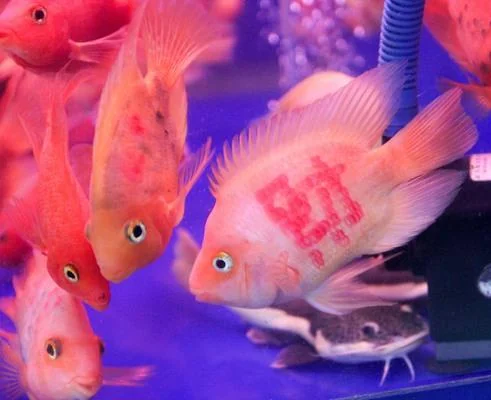
More recently, even fish – particularly the so-called parrot cichlids – have become recipients, if we can call them that, of “tattooing” services. These small aquatic animals became the subjects of a bizarre trend that emerged in China during the mid-2000s, where artificially decorated specimens were sold for considerably higher prices than ordinary aquarium fish.
The phenomenon is not quite as new as it may initially seem. Reports of tattooed fish being commercially sold in China date back to around 2005, and by 2007 such specimens could already be found in an aquarium shop in Suzhou, Jiangsu Province.
Parrot cichlids were decorated with flowers and various designs that sellers claimed were applied using a special laser rather than the chemical colouring techniques traditionally used on ornamental fish.
A few years later, in 2009, the phenomenon attracted international media attention.
At the Qingshiqiao pet market in Chengdu, China, so-called “fortune fish” or “lucky fish” were offered for sale, decorated with flowers, rainbow-like patterns and Chinese characters supposedly wishing their owners good fortune, prosperity, longevity or happiness.
The fish most frequently used were tropical parrot cichlids. These are hybrid cichlids bred primarily for the ornamental aquarium trade and are easily recognised by their rounded bodies and characteristic orange or reddish colouration.
Tattoos with flowers and Chinese characters
The designs placed on the bodies of these fish varied considerably.
Some specimens featured flowers or ornamental patterns, while others carried Chinese characters representing wishes such as:
- good luck;
- happiness;
- long life;
- prosperity;
- or phrases similar to “May your business prosper.”
In China, where symbols connected with luck, prosperity and wealth have an important place in popular culture, these fish were marketed not merely as aquarium pets but almost as living good-luck charms.
In some cases, sets of four fish were sold together, with each fish carrying a different character. Together they could represent wishes for luck, prosperity, longevity and happiness.
Tattooed fish were more expensive
The trend naturally had a strong commercial aspect.
According to a 2009 report, an ordinary parrot cichlid could cost approximately 10 yuan, while a tattooed specimen was sold for at least 25 yuan.
A set of four fish carrying symbols representing “luck,” “prosperity,” “long life” and “happiness” could cost around 120 yuan.
In other words, adding a decorative design could double or even triple the commercial value of the fish.
It is therefore easy to understand why the technique rapidly became interesting to ornamental fish dealers.
How were the fish “tattooed”?
Chinese sellers claimed that the designs were applied using a low-intensity laser, together with pigments used to create the desired pattern.
Some contemporary reports even claimed that the procedure caused no pain, did not harm the fish and produced a permanent design.
However, these statements primarily came from dealers and people involved in selling the decorated animals.
There was little serious scientific evidence demonstrating that the procedure was genuinely painless or completely harmless.
Furthermore, the term “tattooed fish” can refer to several very different procedures.
Over the years, various methods have been used in the ornamental fish trade, including:
- injecting dye using needles;
- placing pigment beneath the skin;
- chemically dyeing fish through coloured baths;
- temporarily removing or damaging the protective mucus layer before applying colour;
- procedures advertised as laser tattooing.
Within aquarium literature, fish modified using these methods are often described as painted fish, dyed fish or tattooed fish.
Is laser tattooing really painless?
This is one of the most controversial parts of the story.
Dealers claimed that laser-based tattooing was safer than older dye-injection techniques and caused little or no significant injury to the fish.
Experts, however, were far less convinced.
In 2009, fisheries expert Zhang Zhicheng warned that laser tattooing could harm the fish because the procedure affected the protective surface of its skin and could disturb its physiological balance.
For a fish, the skin and the mucus layer covering it are not simply an external surface.
This layer forms one of the animal’s most important natural barriers against bacteria, parasites and other pathogens present in the water.
Any procedure that damages or removes this protective surface can potentially increase the risk of:
- infections;
- stress;
- skin damage;
- reduced resistance to disease;
- recovery problems following the procedure.
For this reason, claims that fish tattooing is completely “painless” should be treated with considerable caution.
Artificially colouring fish is much older
Although tattooed fish carrying Chinese characters became particularly well known between approximately 2005 and 2009, the idea of artificially colouring ornamental fish is much older.
Artificial colouring of certain aquarium species had already been practised in parts of Asia during the final decades of the twentieth century.
One of the best-known examples was the glassfish, whose partially transparent body made injected fluorescent dyes especially visible.
Similar techniques were later used on other ornamental species.
Aquarium publications and scientific discussions repeatedly criticised these procedures because repeated injections, chemical baths or damage to the protective mucus layer can cause significant stress and health problems.
Parrot cichlids nevertheless became some of the most recognisable representatives of the tattooed-fish phenomenon.
One reason is their large, rounded and relatively uniform body shape, which provides a highly visible surface for decorative designs.
From flowers to “I Love You”
As the method became more popular, the range of designs also expanded.
Alongside Chinese characters and flowers, tattooed fish appeared carrying:
- hearts;
- numbers;
- stars and other symbols;
- flags;
- short messages;
- and even the words “I Love You.”
In certain markets, these fish were sold as decorative gifts for special occasions, including Valentine’s Day.
To a customer, such an animal could appear unusual, exotic or perhaps entertaining.
For the fish itself, however, the decoration represented a physical intervention carried out entirely for aesthetic and commercial purposes.
The trend did not completely disappear
Although tattooed fish received most of their international media attention between 2007 and 2009, the practice did not disappear entirely.
Artificially patterned parrot cichlids continued to appear years later at Asian aquarium exhibitions and within the ornamental fish trade.
In 2019, for example, parrot cichlids carrying artificial decorative designs were documented at a professional aquarium trade exhibition in China.
The exact method used is not necessarily the same in every case.
Some sellers describe laser-based procedures, while other artificially coloured specimens may have been created by injecting dyes or using different colouring techniques.
For that reason, the commercial term “tattoo” should not be confused with the technique used to create a professional tattoo on human skin.
A tattoo without consent
From an artistic point of view, the image of a fish carrying a perfectly visible Chinese character or floral design on its side is undeniably unusual.
Ethically, however, the situation is very different.
Human tattooing is a personal decision.
A person chooses:
- what design they want;
- where the tattoo will be placed;
- who will perform it;
- and whether they accept the discomfort and risks associated with the procedure.
An animal obviously has no such choice.
Its body is altered solely to make it visually unusual, commercially more attractive and potentially more valuable.
For this reason, tattooed and artificially coloured fish have attracted criticism from aquarists and animal-welfare advocates since the practice first became widely known.
What was presented almost two decades ago as a technological curiosity and a new aquarium trend also raises a much larger ethical question:
how far should we go in altering an animal’s body simply to make it appear more interesting or commercially valuable?