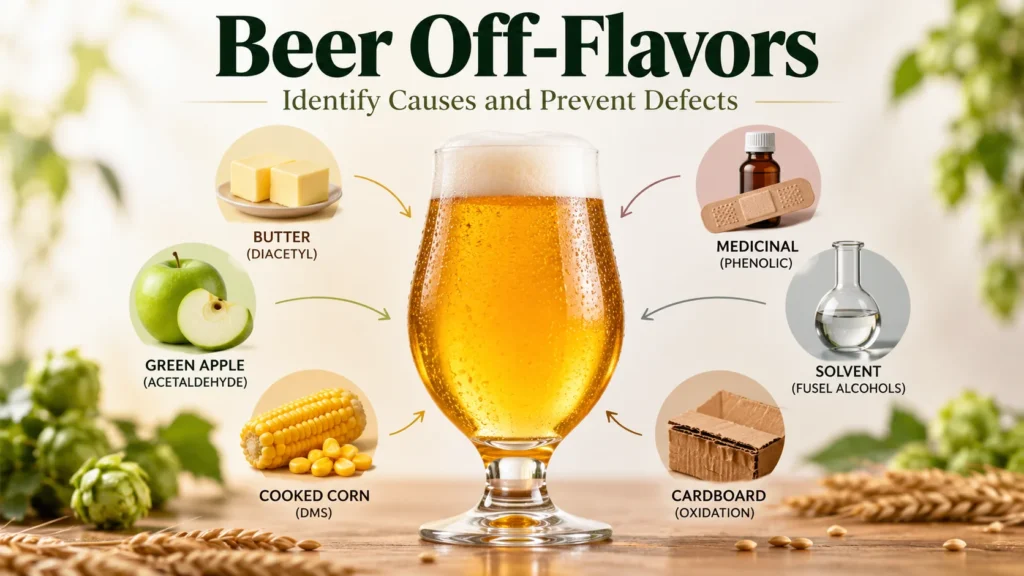
Beer off-flavors are among the most useful diagnostic tools available to a homebrewer.
A buttery aroma may point toward incomplete diacetyl reduction. Fresh green apple can indicate elevated acetaldehyde. Cooked corn may suggest dimethyl sulfide, while medicinal phenolics can indicate chlorine-related compounds, wild yeast contamination, or other process problems.
The important skill is not simply memorizing a list of beer defects.
It is learning to connect:
sensory character → probable cause → stage of the brewing process → corrective action
Many off-flavors originate during fermentation, but problems can also be introduced during:
- wort production;
- chilling;
- yeast handling;
- dry hopping;
- transfers;
- packaging;
- storage.
Some compounds that are undesirable in one beer style may be acceptable or even characteristic in another. Clove-like 4-vinyl guaiacol, for example, is an important part of traditional Weissbier character but would normally be considered inappropriate in a clean American Lager.
For that reason, this guide treats off-flavors as sensory characteristics that must always be interpreted in the context of beer style, concentration and brewing process.
1. What Is a Beer Off-Flavor?
An off-flavor is an aroma, flavor or mouthfeel characteristic that is inappropriate for the intended beer.
It can result from:
- incomplete fermentation;
- yeast stress;
- excessive fermentation temperature;
- poor oxygen management;
- microbial contamination;
- wort production problems;
- unsuitable brewing water;
- excessive heat;
- poor ingredient handling;
- packaging oxygen;
- light exposure;
- excessive aging.
The presence of a detectable compound does not automatically mean that the beer is defective.
Many flavor-active compounds naturally occur during brewing.
The real question is:
Is the compound present at an appropriate level for the intended beer style?
2. Quick Beer Off-Flavor Diagnostic Table
The following table gives a practical overview before we examine each fault in detail.
3. Diacetyl: Butter, Butterscotch and Slick Mouthfeel
Diacetyl is one of the best-known fermentation-related beer off-flavors.
Typical sensory character
Diacetyl may be perceived as:
- butter;
- melted butter;
- butterscotch;
- movie-theater popcorn;
- toffee-like aroma;
- an oily or slick sensation on the palate.
Sensitivity differs greatly between drinkers.
Some people detect very small amounts, while others have considerable difficulty perceiving diacetyl at all.
How diacetyl forms
During fermentation, yeast produces α-acetolactate as part of amino-acid metabolism.
α-Acetolactate can leave the yeast cell and undergo oxidative decarboxylation outside the cell, producing diacetyl.
This is important because the transformation can continue even after the initial phase of fermentation.
Healthy yeast can subsequently take diacetyl back up and reduce it to compounds with much higher sensory thresholds.
This is the basis of normal diacetyl reduction during beer maturation.
Why diacetyl remains in finished beer
Common causes include:
- cooling the beer too early;
- removing beer from the yeast prematurely;
- insufficient healthy yeast;
- poor yeast condition;
- interrupted fermentation;
- inadequate maturation time;
- certain bacterial contaminations;
- renewed fermentation after dry hopping.
Hop creep deserves special attention.
Dry hops can introduce enzymes capable of breaking down residual carbohydrates into more fermentable sugars.
If fermentation restarts, additional α-acetolactate may be formed, which can result in diacetyl reappearing after dry hopping.
Diacetyl rest
A diacetyl rest is particularly common during lager fermentation.
Near the end of fermentation, the beer is allowed to warm so that metabolically active yeast can complete diacetyl reduction before cold conditioning.
The appropriate temperature depends on:
- yeast strain;
- fermentation temperature;
- beer gravity;
- fermentation progress.
A common lager practice is to raise the beer into roughly the mid-to-upper teens Celsius near the end of fermentation rather than crash-cooling immediately. BJCP likewise describes a traditional lager diacetyl rest around 15–18°C.
Can diacetyl be acceptable?
Yes, at low concentrations in certain traditional styles.
Small amounts may be acceptable in some:
- Czech lagers;
- British ales;
- Irish Red Ale.
It should not, however, dominate the beer.
Diacetyl Troubleshooting
4. Acetaldehyde: Green Apple and Young Beer Character
Acetaldehyde is an intermediate compound in alcoholic fermentation.
Yeast converts fermentable sugars through several metabolic steps, eventually producing ethanol.
Acetaldehyde occurs immediately before ethanol in this pathway.
Typical sensory character
Elevated acetaldehyde is frequently described as:
- freshly cut green apple;
- green apple skin;
- cut grass;
- green leaves;
- raw pumpkin;
- occasionally latex paint.
The classic homebrewing description is simply:
“green apple.”
Why acetaldehyde remains in beer
The most common reason is that the beer is still immature.
Possible causes include:
- fermentation stopped prematurely;
- unhealthy yeast;
- insufficient yeast;
- premature cold crashing;
- removing beer from yeast too soon;
- poor fermentation conditions;
- certain microbial contamination;
- oxidation-related reactions during storage.
BJCP similarly describes elevated acetaldehyde as particularly associated with young beer and premature removal from the yeast.
Prevention
The best prevention is healthy, complete fermentation.
Use:
- sufficient healthy yeast;
- appropriate wort oxygenation before fermentation;
- suitable fermentation temperature;
- adequate yeast nutrition;
- enough maturation time.
Do not package beer solely because airlock activity has stopped.
Gravity stability and fermentation completeness are much more meaningful indicators.
Can acetaldehyde disappear?
If the problem is simply immature beer and healthy yeast remains present, additional maturation can reduce it.
If the character results from contamination or serious oxidation, additional conditioning may not solve the problem.
5. DMS: Cooked Corn and Cooked Vegetables
Dimethyl sulfide, abbreviated DMS, is a sulfur-containing volatile compound.
Typical sensory character
DMS can resemble:
- cooked corn;
- canned corn;
- cooked cabbage;
- celery;
- cooked vegetables;
- sometimes onion-like vegetable aromas.
At low levels, DMS can be acceptable in some pale lager styles.
At excessive levels it becomes distracting.
Where does DMS come from?
An important precursor is S-methylmethionine (SMM), which originates in malt.
Heat can convert SMM into DMS.
Lightly kilned malts, particularly Pilsner-type malts, tend to contain more SMM than more heavily kilned base malts.
DMS is volatile.
During a vigorous open boil, much of it can escape with the steam.
Problems are more likely when:
- wort heating is insufficient;
- the boil is weak;
- evaporation is restricted;
- wort remains hot for a long period after boiling;
- cooling is unusually slow;
- microbial contamination contributes sulfur compounds.
BJCP likewise identifies SMM conversion, wort boiling and slow wort cooling as important factors in excessive DMS.
Should the kettle be covered during the boil?
During normal wort boiling, steam should be allowed to escape freely.
A tightly covered kettle can reduce the removal of volatile compounds.
However, it is overly simplistic to blame all DMS problems on a kettle lid.
Malt composition, wort production, evaporation and cooling profile all matter.
Do all Pilsner malt beers need a 90-minute boil?
No.
This is an old rule that should not be applied automatically to every modern malt and brewing system.
Modern malt specifications, evaporation rate, wort composition and equipment vary.
The better principle is:
use an effective boil and process appropriate to the malt and system rather than blindly assigning one universal boil duration.
DMS Risk Factors
6. Phenolic Off-Flavors
Phenolic aromas are a good example of why beer flavor must always be interpreted in context.
Some yeast-derived phenols are desirable.
Others are serious defects.
Desirable yeast phenols
Certain brewing yeast strains possess the POF+ — phenolic off-flavor positive — phenotype.
Despite the name, these strains intentionally produce phenolic character appropriate to particular styles.
The best-known example is 4-vinyl guaiacol (4-VG).
It contributes aromas resembling:
- clove;
- spice;
- subtle smoke.
This character is expected in traditional German wheat beer and occurs in several Belgian beer styles. BJCP identifies 4-vinyl guaiacol as the signature clove-like phenol of Weissbier and notes yeast strain and fermentation conditions as important factors.
When phenols become a defect
Unwanted phenolic character may resemble:
- medicinal products;
- adhesive bandages;
- plastic;
- electrical tape;
- antiseptic;
- harsh smoke.
Potential causes include:
- wild yeast contamination;
- bacterial contamination;
- chlorine or chloramine in brewing water;
- sanitizer-related chlorine contamination;
- process problems involving grain husks.
Chlorophenols
When phenolic compounds interact with chlorine, extremely flavor-active chlorophenols can form.
These may produce powerful medicinal or plastic-like aromas.
This is one reason chlorine and chloramine should be managed before brewing.
Campden treatment, appropriate filtration or another validated dechlorination method can be used depending on the water supply.
Do not confuse intentional phenols with contamination
A clove character in a Weissbier is not automatically a defect.
The same aroma in a clean American Blonde Ale probably is.
Beer style matters.
7. Fusel Alcohols and Hot Alcohol Character
Fermentation produces ethanol, but it also produces smaller quantities of higher alcohols, commonly called fusel alcohols.
At appropriate concentrations, some fermentation-derived alcohol compounds can contribute complexity.
At excessive levels they produce harshness.
Typical sensory character
Excessive higher alcohols may be perceived as:
- hot;
- warming;
- burning;
- spicy;
- harsh;
- alcoholic.
The sensation can extend beyond aroma and flavor into mouthfeel.
Common causes
Factors that can increase higher alcohol production include:
- excessively high fermentation temperature;
- insufficient yeast pitch;
- unhealthy yeast;
- inadequate wort oxygenation before fermentation;
- nutrient deficiencies;
- high-gravity wort;
- severe fermentation stress.
BJCP likewise associates excessive higher alcohol character with high fermentation temperature, high gravity and stressed yeast conditions.
Prevention
Control:
- pitch rate;
- yeast health;
- fermentation temperature;
- wort composition;
- oxygenation before fermentation;
- nutrients where appropriate.
Do not assume that a beer will automatically improve if fermentation is simply made as cold as possible.
The correct temperature depends on the yeast strain and beer style.
8. Solvent-Like Flavors
A solvent-like beer may smell or taste like:
- nail polish remover;
- paint thinner;
- glue;
- harsh chemical solvent.
This character may involve several compounds and should not automatically be attributed to a single chemical.
One important candidate is ethyl acetate.
At low concentration, ethyl acetate can contribute pleasant fruity character.
At sufficiently high concentration, the character can become distinctly solvent-like.
ASBC sensory material lists acetaldehyde, ethyl acetate, higher alcohols and 4-vinyl guaiacol among important fermentation-derived flavor-active compounds, illustrating how concentration changes whether a fermentation compound is pleasant, neutral or defective.
Causes can include
- high fermentation temperature;
- stressed yeast;
- inappropriate yeast growth;
- excessive ester production;
- very high-gravity fermentation;
- contamination.
A harsh solvent note should therefore be diagnosed together with the fermentation history.
9. Oxidation: The Most Common Packaging Defect
Oxidation is particularly important in modern hop-forward beer.
Once active fermentation is substantially complete, oxygen becomes increasingly undesirable.
Classic oxidation character
Oxidized beer may show:
- cardboard;
- wet paper;
- stale bread;
- dull malt;
- sherry-like notes;
- muted hop aroma;
- darker color;
- loss of fresh fruit character;
- sweet or heavy aged character.
The classic paper/cardboard marker is strongly associated with (E)-2-nonenal, which has an exceptionally low sensory threshold. BJCP gives a value of about 0.1 ppb for this compound.
Oxidation is not limited to one compound, however.
Aging changes many beer components simultaneously.
The final sensory expression depends strongly on beer style.
Oxidation in IPA and NEIPA
Hop-forward beers are especially sensitive because their fresh aroma profile is a major part of their identity.
Oxygen exposure can lead to:
- rapid fading of hop aroma;
- loss of bright tropical or citrus character;
- darker beer color;
- dull or sweet flavor;
- stale hop character.
Common oxygen entry points
- opening the fermenter unnecessarily;
- splashing during transfer;
- open siphoning;
- poorly purged kegs;
- oxygen-rich bottle headspace;
- leaking keg seals;
- dry hopping with excessive oxygen exposure;
- repeated sampling;
- oxygen-permeable packaging.
Prevention
After fermentation:
move beer quietly, minimize splashing and reduce exposure to air.
For kegging:
- purge receiving vessels with CO₂;
- use closed transfers when practical;
- purge headspace;
- verify keg seals.
For bottling:
- avoid splashing;
- use correct fill levels;
- cap promptly;
- store packaged beer cool.
BJCP similarly emphasizes avoiding post-fermentation oxygen exposure, minimizing splashing and storing beer cool.
10. Lightstruck Beer: Skunky Aroma
Lightstruck flavor is technically different from oxidation but is another common storage defect.
Beer exposed to ultraviolet and certain visible wavelengths can undergo photochemical reactions involving hop-derived compounds.
The resulting sulfur compounds produce the familiar:
skunky aroma
High-risk packaging
- clear glass;
- green glass.
Brown glass provides much better protection.
Cans provide essentially complete light protection.
Prevention
Keep hopped beer away from strong sunlight and intense light exposure.
This fault can form surprisingly quickly.
11. Astringency Is Not the Same as Bitterness
Astringency and bitterness are frequently confused.
Bitterness
Bitterness is primarily a taste sensation.
Astringency
Astringency is primarily a mouthfeel sensation.
It may feel:
- drying;
- puckering;
- rough;
- tea-like;
- mouth-coating.
Potential brewing causes include:
- excessive tannin extraction;
- oversparging;
- inappropriate sparge pH;
- excessive extraction from grain husks;
- very high hop-polyphenol load;
- excessive fruit skins or spices.
A beer may therefore taste both bitter and astringent, making the overall bitterness seem much harsher than the measured IBU would suggest.
12. Sulfur Aromas
Not every sulfur aroma is DMS.
Sulfur compounds can produce many different sensory impressions:
- rotten egg;
- struck match;
- cabbage;
- onion;
- sulfurous gas.
Hydrogen sulfide, for example, is commonly described as rotten egg.
Some yeast strains naturally produce significant sulfur character during fermentation, particularly some lager strains.
Much of this may dissipate during:
- active fermentation;
- conditioning;
- lagering.
Persistent sulfur may indicate:
- yeast stress;
- nutrient imbalance;
- fermentation problems;
- microbial contamination.
Do not diagnose every sulfur smell as DMS.
13. Esters: Fruit Character or Fermentation Defect?
Esters are another group where style context matters.
They can produce aromas resembling:
- banana;
- pear;
- apple;
- strawberry;
- stone fruit;
- tropical fruit.
Some ester character is essential in styles such as:
- Belgian ales;
- Hefeweizen;
- many English ales.
The same level may be inappropriate in:
- American Lager;
- German Pils;
- Kölsch;
- very clean American ales.
Excessive ester production can be encouraged by
- warm fermentation;
- certain yeast strains;
- wort composition;
- yeast stress;
- pitching rate;
- oxygen availability.
The goal is therefore not:
“eliminate esters.”
The goal is:
produce an ester profile appropriate to the beer style.
14. Infection and Microbial Off-Flavors
Not every unusual beer flavor is caused by yeast metabolism.
Unwanted microorganisms can create:
- sourness;
- phenolics;
- excessive diacetyl;
- ropey texture;
- unusual attenuation;
- overcarbonation;
- medicinal character;
- acetic character.
Possible contaminants include:
- wild Saccharomyces;
- Brettanomyces;
- Lactobacillus;
- Pediococcus;
- Acetobacter;
- other environmental microbes.
These organisms are not inherently undesirable.
They are intentionally used in many sour and mixed-fermentation beer styles.
They become a problem when they appear unintentionally.
Warning signs of contamination
- gravity continues falling unexpectedly;
- bottles become increasingly overcarbonated;
- flavor changes rapidly after packaging;
- unexpected sourness develops;
- unusual pellicle or surface growth appears;
- recurring identical defects affect several batches.
Good sanitation is therefore not simply about making equipment look clean.
Cleaning removes soil. Sanitizing reduces microorganisms on an already clean surface.
Both steps matter.
15. Can an Off-Flavor Be Fixed After Fermentation?
Sometimes.
It depends on the fault.
A common homebrewing mistake is to try to repair a process defect with another ingredient.
For example:
- adding more hops to hide oxidation;
- adding sweetness to cover harsh fusel alcohol;
- adding flavoring to mask contamination.
Sometimes the better lesson is to identify exactly where the process failed and prevent it in the next batch.
16. At What Stage Did the Off-Flavor Probably Originate?
This is one of the most useful ways to diagnose brewing problems.
17. A Systematic Method for Troubleshooting Beer Off-Flavors
When something tastes wrong, avoid changing five things at once.
Use a systematic approach.
Step 1: Describe the flavor without diagnosing it
Instead of:
“I think the beer is oxidized.”
write:
“The beer has a wet-cardboard aroma and the hop aroma has faded.”
Sensory description should come before diagnosis.
Step 2: Determine when it appeared
Ask:
- Was it present before packaging?
- Did it appear after dry hopping?
- Did it develop only after several weeks in the bottle?
- Was the fermenting beer clean but the kegged beer defective?
This dramatically narrows the possibilities.
Step 3: Review the process log
Check:
- yeast strain;
- pitch rate;
- fermentation temperature;
- OG and FG;
- fermentation duration;
- dry-hop schedule;
- cold-crash timing;
- transfer method;
- packaging procedure;
- storage temperature.
Step 4: Consider style appropriateness
A flavor is not automatically a fault simply because you detect it.
Ask whether the character is expected in that style.
Step 5: Change one variable
If possible, change only one major parameter in the next batch.
This makes the result interpretable.
18. Build an Off-Flavor Log
Good homebrewers keep recipe records.
Very good homebrewers also keep sensory records.
Over several batches, this record becomes extremely valuable.
You begin to learn the behavior of:
- your yeast;
- your fermenter;
- your temperature control;
- your packaging process;
- your brewing system.
19. Prevention Is Better Than Correction
Most serious beer defects are easier to prevent than to repair.
The most important general practices are surprisingly simple.
Use healthy yeast
Correct yeast management reduces the risk of:
- diacetyl;
- acetaldehyde;
- fusel alcohols;
- stalled fermentation;
- unexpected attenuation.
Control fermentation temperature
Do not choose a fermentation temperature simply because it is possible.
Choose it because it suits:
- the yeast strain;
- beer style;
- desired ester profile;
- desired fermentation speed.
Give fermentation enough time
Airlock activity is not a reliable definition of completed fermentation.
Use gravity stability and sensory evaluation.
Maintain excellent sanitation
Especially on the cold side.
Everything touching cooled wort or beer should be properly cleaned and sanitized.
Control oxygen after fermentation
This becomes increasingly important for:
- Pale Ale;
- IPA;
- NEIPA;
- highly aromatic beer.
Cool and store packaged beer properly
Heat accelerates many undesirable aging reactions.
Cold storage generally helps preserve beer freshness.
20. Final Beer Off-Flavor Troubleshooting Matrix
21. Conclusion: Learn to Diagnose the Process, Not Just the Flavor
Learning beer off-flavors is one of the fastest ways to become a better homebrewer.
The objective is not merely to recognize:
butter = diacetyl
or:
green apple = acetaldehyde.
The real value comes from understanding why the compound is present.
Diacetyl may indicate incomplete maturation.
Acetaldehyde may indicate young beer or stressed fermentation.
DMS may lead us back to malt selection, boiling or wort cooling.
Phenolic character may be perfectly appropriate for one yeast strain but evidence of contamination in another beer.
Hot alcohol and solvent character can reveal fermentation stress.
Oxidation points us toward cold-side oxygen management and packaging.
Once sensory evaluation is connected to process knowledge, an off-flavor is no longer simply a disappointing defect.
It becomes diagnostic information.
That is one of the most useful skills in serious homebrewing:
taste the beer, identify the symptom, investigate the process and correct the cause rather than merely trying to hide the result.