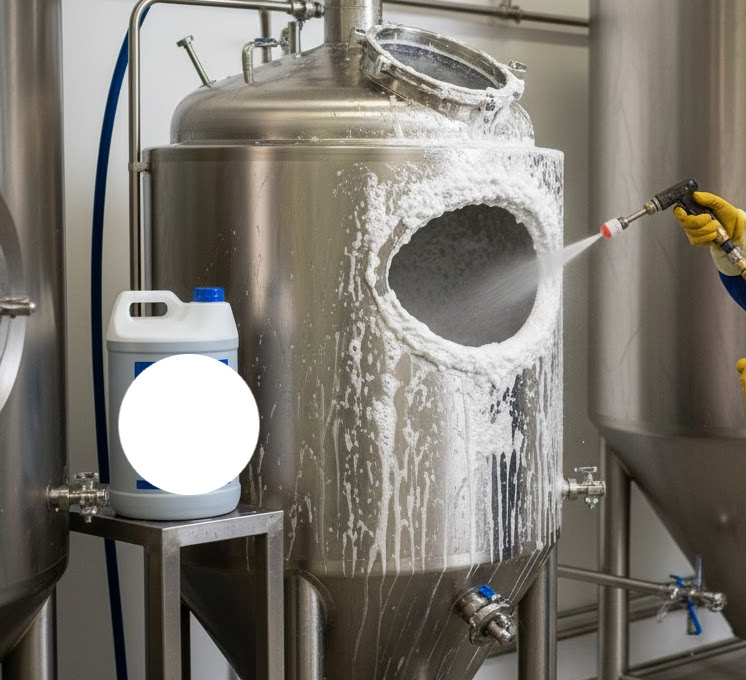
Why is hygiene essential?
In homebrewing, the most common cause of failure is not a bad recipe — it is poor hygiene. Sanitization may be the most tedious part of brewing, yet it is also the most crucial rule.
The source of contamination:
After the wort is boiled and begins to cool, the risk of infection increases dramatically. Every tool that comes into contact with the cooled wort can harbor invisible microorganisms — wild yeasts and bacteria — that may spoil the flavor of the beer.
The consequences:
Contamination can result in unpleasant off-flavors, such as sourness or vinegar-like notes, rendering the beer undrinkable. Both visible and invisible residues — proteins, hop resins, or mineral deposits — must be removed.
Sanitization:
This step destroys any microorganisms remaining on already cleaned surfaces and equipment.
Strict rule:
Only thoroughly cleaned vessels can be effectively sanitized.
The World of Cleaning and Sanitizing Agents
Instead of regular household detergents, it is highly recommended to use professional brewing-grade products, as plastic containers easily absorb odors and residues.
Oxi-based cleaners (e.g. Chemipro Oxi, Oxi, PBW):
These are alkaline solutions based on sodium percarbonate. They remove organic residues such as proteins and sugars.
If you use ordinary dish soap, choose an unscented type and rinse thoroughly afterward.
Sanitizers:
Acid-based agents (e.g. Star San, Chemipro San, Iodophor, Alcohol) are phosphoric acid–based, foaming sanitizers that effectively eliminate microorganisms.
Some sanitizers, such as Star San, are no-rinse — which is a huge time-saver.
Correct Sanitizing Procedure
Every tool that comes into contact with the cooled wort must be sanitized.
Steps of Sanitization:
Cleaning: Remove all visible dirt and residue.
Rinsing: Rinse thoroughly — leftover cleaning agents may reduce the sanitizer’s effectiveness.
Sanitizing:
Foaming sanitizers (e.g. Star San): Dilute according to the manufacturer’s instructions (usually 10–25 ml per 10 liters of water).
Allow the sanitizer to act for a few minutes — this contact time is generally sufficient.
Do not rinse off if the product allows it.
Acid-based sanitizers like Star San leave behind a very thin protective film that does not affect flavor but provides long-term protection against wild yeast and bacteria.
Special Equipment Care
After alkaline cleaning, fill the vessel with a sanitizing solution or spray it with Star San.
Always wear gloves when handling chemicals. For plastic containers, use fragrance-free products.
KEG – CIP (Cleaning in Place):
Use a specialized cleaning solution, then flush with an acid-based sanitizer.
Even the hidden crevices of KEG seals can be sanitized effectively — stronger sanitizers like Iodophor are ideal for this purpose.
Small Parts (Tap, Valve, Hose):
Keep a spray bottle filled with Star San solution — it will be your best friend during brewing.
While chilling the wort, continuously spray all parts that come into contact with it.
A quick mist is often enough for effective sanitization.
ChemSan – The European No-Rinse Sanitizer
Alongside Star San, Chemipro San (ChemSan) is one of the most popular acid-based, no-rinse sanitizers among homebrewers in Europe. It is a highly effective, foaming, phosphoric acid–based sanitizer that kills a broad spectrum of microorganisms on contact.
How to use ChemSan correctly:
Dilute approximately 15–25 ml of ChemSan per 10 liters of cold or warm water (check label for exact ratio).
Mix gently until a light foam forms.
Apply the solution by spraying, soaking, or filling the vessel or equipment.
Allow at least 1–2 minutes of contact time before use.
Do not rinse — the remaining foam is harmless and will not affect the taste or quality of the beer.
ChemSan leaves a thin, invisible protective layer that helps prevent contamination until use. Because it requires no rinsing, it is exceptionally convenient for sanitizing fermenters, siphons, tubing, and all small brewing components.
When handled properly, ChemSan ensures a perfectly clean and safe environment for your beer — protecting your work, your flavors, and your brewing passion.
Preparing and Sanitizing Bottles
Let’s begin with the bottles:
I heat about 10 liters of water to 80 °C, then pour it into a 20-liter washing basin. I add one dishwasher capsule, the same type used in dishwashers, which works perfectly for cleaning bottles.
Next, I submerge five 0.5-liter bottles at a time (that’s about as many as I can handle per batch) and let them soak for one or two minutes.
If a bottle is particularly dirty or moldy, I scrub it thoroughly with a bottle brush, then rinse it two or three times to remove all detergent residues.
Once the bottles are clean, I prepare another batch of hot water and add Chemipro Oxi (a cleaning agent), about 25–40 grams, and soak the bottles in it for two to three minutes — or as many as I can fit into the basin or bucket — making sure they fill completely with water.
Afterward, I shake out the water but do not rinse them again; I simply let them dry as they are.
In the past, when I was using Chemipro Oxi, I didn’t sanitize the bottles afterward if they were already clean — I believed that Oxi also disinfected. However, it doesn’t disinfect; it only cleans.
Fortunately, I’ve never had any issues.
So, after washing the bottles and rinsing them two or three times to remove the soda residue, I lined them up on the table and poured about 150 ml of prepared ChemSan solution (10 ml ChemSan + 5 liters of distilled water) into the first bottle.
I shook it well, then poured the solution through a funnel into the next bottle, shaking that one too, and continued this way until all the bottles were done.
For some reason, I don’t like the excess foam that remains inside, so I poured about 100 ml of distilled water into one of the bottles, then transferred it successively from one to the next — this method nicely rinsed away the foam.
After that, I placed the bottles upside down to dry on a bottle drying rack. I bought a good-quality one that holds around 80 bottles, and I consider it one of my best investments — it has made the entire process much easier.
Cleaning the Keg and Fermenter
I wash the keg or fermenter (the fermentation vessel) with regular washing soda (not dishwasher tablets), using a soft sponge.
Once clean, I rinse it thoroughly, then pour in 1–2 liters of ChemSan solution (sanitizer).
I seal it and shake or rotate the container for about two minutes, ensuring the sanitizer contacts all interior surfaces.
Then I pour the solution out into a washing basin, where I also place smaller items that need sanitizing.
Both the fermenter and the keg should be sanitized before each use.
If you’re not planning to use them for a while, simply wash them thoroughly — you can sanitize them too, but it’s best to sanitize again before the next use.
When cleaning the keg, I expel the cleaning solution using CO₂ pressure, which helps clean the liquid line as well.
I attach the tap, release the liquid, then flush it through again with clean water — and finally with sanitizer.
I like everything to be spotless — I believe that’s one of the reasons my beer has never been infected, even during times when I wasn’t extremely careful.
As I mentioned earlier, use sanitizers — that’s the safest way!