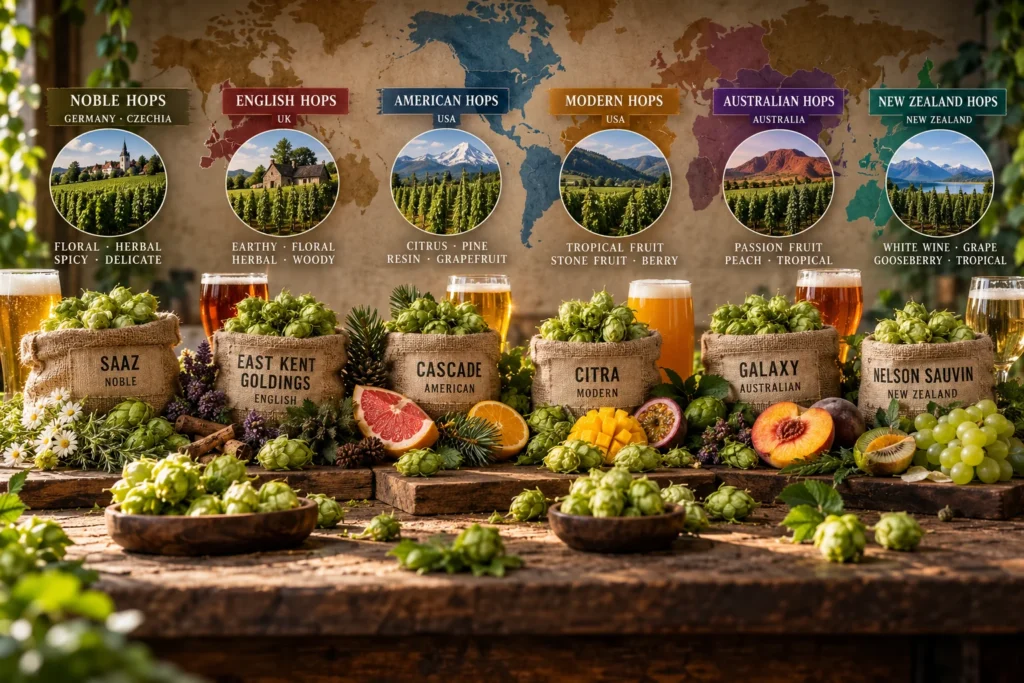
Choosing a hop variety is about much more than looking at the alpha acid percentage printed on the package.
Two hop varieties can have similar alpha acid levels and produce completely different beers. One may smell of flowers, herbs and delicate spices, while another can deliver grapefruit, pine and resin. A third may produce intense mango, passion fruit, peach or white-wine-like aromas.
This is why learning hop varieties is easier when we stop thinking about them as a long alphabetical list and start thinking about them in families of origin and sensory character.
Traditional European Noble hops occupy a very different aromatic world from classic English varieties. The American hop revolution introduced grapefruit, citrus, pine and resin. Modern American breeding pushed further toward tropical fruit and intensely aromatic varieties, while Australia and New Zealand developed some of the most distinctive fruit- and wine-like hops available to brewers today.
In this guide, we will explore the major hop families and the flavors and aromas commonly associated with them.
We will also look at well-known varieties including:
Saaz, Hallertauer Mittelfrüh, Tettnang, East Kent Goldings, Fuggle, Cascade, Centennial, Chinook, Amarillo, Citra, Mosaic, Galaxy, Nelson Sauvin and Nectaron.
The objective is not to memorize dozens of hop names.
The objective is to understand what kind of hop character you want in your beer — and which families and varieties can help you create it.
Why Hop Variety Matters
Hop varieties are not interchangeable.
If a recipe calls for Saaz and you replace it with Citra, you have not simply changed one ingredient for another with a similar function.
You may have changed the entire aromatic identity of the beer.
Saaz is traditionally associated with delicate spicy, herbal and floral character.
Citra is famous for powerful citrus and tropical fruit.
Both are hops.
But they belong in very different sensory worlds.
This becomes especially important when hops are used where their aromatic character can remain prominent.
The right question is therefore not simply:
“Which hop can I use?”
It is:
“What character do I want this hop to create?”
Understanding Hops by Aroma Family
Before looking at geographic families, it helps to understand the vocabulary used to describe hops.
Common hop descriptors include:
- citrus
- grapefruit
- lemon
- lime
- orange
- pine
- resin
- floral
- herbal
- spicy
- earthy
- woody
- tropical fruit
- passion fruit
- mango
- pineapple
- stone fruit
- peach
- apricot
- berry
- blackcurrant
- grape
- gooseberry
- white wine
- melon
Some hops fit neatly into one or two categories.
Others are much more complex.
A variety may be citrus-forward but also show pine and floral notes. Another may combine tropical fruit with stone fruit and berries.
The exact perception also depends on the crop, freshness, brewing process, other hops, yeast, malt and water.
Hop descriptors should therefore be treated as sensory directions rather than guaranteed flavors.
A hop described as “mango” does not literally contain mango juice.
It contains aromatic compounds that can remind us of mango.
Geography Is Useful — But It Is Not Everything
Grouping hops by country or region is extremely useful because hop-growing traditions and breeding programs developed recognizable characteristics.
But geography should not become a rigid rule.
Not every American hop tastes of grapefruit.
Not every English hop is earthy.
Not every New Zealand hop tastes like white wine.
Modern breeding programs deliberately cross genetic material from different sources, and modern varieties can have extremely complex ancestry.
So when we talk about:
Noble hops
English hops
American hops
Australian hops
New Zealand hops
we are describing useful brewing traditions and sensory families — not absolute flavor laws.
Noble Hops
The term Noble hops traditionally refers to a small group of classic continental European aroma hops valued for their refined character.
The four varieties most commonly included are:
- Hallertauer Mittelfrüh
- Tettnanger
- Spalt
- Saaz
These hops are closely associated with traditional European lagers and other classic beer styles.
Their character is usually much more restrained than that of modern American or Southern Hemisphere varieties.
Instead of explosive mango or grapefruit, expect descriptors such as:
floral, herbal, spicy, delicate, earthy and gently woody.
Their strength is often elegance rather than intensity.
Hallertauer Mittelfrüh
Hallertauer Mittelfrüh is one of Germany’s classic aroma hops.
Its character is commonly described as:
floral, herbal, spicy and gently citrus-like.
It is elegant rather than aggressive.
Mittelfrüh works particularly well when the hop character should support the beer without dominating it.
Typical applications include:
- German Pils
- Helles
- Kölsch
- Weissbier
- Bock
- traditional German lagers
In a malt-forward lager, Mittelfrüh can provide enough aromatic complexity to keep the beer interesting while allowing the malt to remain central.
It represents an important lesson about traditional hops:
intensity is not the same thing as quality.
A delicate hop can be exactly what a delicate beer needs.
Saaz
Saaz is one of the world’s most historically important hop varieties and is strongly associated with Czech brewing.
Its classic profile is often described as:
spicy, herbal, floral and earthy.
Saaz is particularly famous for its role in Czech-style Pilsner.
Rather than producing the bold citrus and tropical fruit associated with many modern varieties, Saaz provides a refined, distinctive spicy-herbal character.
Typical uses include:
- Czech Pilsner
- Bohemian-style lagers
- Belgian ales
- Saison
- traditional European beers
Saaz demonstrates why hop character cannot be judged simply by intensity.
Its aroma may be less explosive than Citra or Galaxy, but in the right beer it is unmistakable.
Tettnanger
Tettnanger, associated with the Tettnang growing region in Germany, belongs to the traditional Noble-hop world.
Typical descriptors include:
floral, herbal, spicy and gently earthy.
It can be used in:
- German lagers
- Pilsner
- Helles
- Kölsch
- wheat beer
- traditional European ales
Tettnanger can provide a refined background hop character without overpowering delicate malt or yeast profiles.
Spalt
Spalt is another classic German hop associated with traditional lager brewing.
Its character is generally:
spicy, herbal, floral and delicate.
Like the other Noble varieties, it is not primarily about massive aroma intensity.
It is about balance, refinement and traditional European hop expression.
Noble Does Not Mean “Better”
The word Noble can be misleading.
It does not mean these hops are automatically higher quality than other hops.
It refers to a traditional group of European varieties with particular historical and sensory characteristics.
Citra is not inferior because it is not a Noble hop.
Nelson Sauvin is not inferior.
Cascade is not inferior.
They simply serve different purposes.
A Noble hop may be perfect for a German Pils and completely wrong for the tropical character you want in a modern IPA.
The beer determines the correct hop.
English Hops
Traditional English hop character occupies another distinct part of the hop spectrum.
Common descriptors include:
earthy, floral, herbal, woody, spicy and gently fruity.
English hops often integrate beautifully with British malt and expressive English ale yeast.
Rather than sitting on top of the beer as an enormous fruit aroma, they often become part of a more integrated malt–yeast–hop profile.
Two of the most important names to know are:
East Kent Goldings and Fuggle.
East Kent Goldings
East Kent Goldings, usually abbreviated EKG, is one of the classic English aroma hops.
Its character is often described as:
floral, earthy, herbal, spicy and gently honey-like.
Depending on the beer and crop, subtle citrus or sweet aromatic notes may also appear.
EKG is particularly well suited to:
- English Bitter
- ESB
- English Pale Ale
- English IPA
- Porter
- traditional English ales
It pairs beautifully with British pale malts such as Maris Otter and with the fruity character of many English yeast strains.
This creates an important concept in recipe design:
ingredients can reinforce a regional beer identity.
English malt + English yeast + English hops can create a coherent character that would be very different if the same recipe used Citra and a neutral American yeast.
Fuggle
Fuggle is another famous English hop.
Its profile is often described as:
earthy, woody, herbal and gently floral.
It can sometimes show mild fruit or mint-like impressions depending on the crop and brewing context.
Typical styles include:
- Bitter
- Mild
- Brown Ale
- Porter
- Stout
- English Pale Ale
Fuggle is rarely chosen because a brewer wants an explosive tropical aroma.
Its value is in the traditional, earthy-herbal complexity it can bring to malt-focused English beers.
English Hops and Balance
English beer provides an excellent example of why hop intensity should always be considered in context.
A traditional Bitter may have obvious hop character, but the hops are usually integrated with:
malt, fermentation esters and bitterness.
If we replaced East Kent Goldings with a huge Citra dry hop, the beer might still taste good.
But it would no longer express the same traditional identity.
There is nothing wrong with modern interpretations.
The important point is understanding what the substitution changes.
The American Hop Revolution
American hops changed the aromatic vocabulary of beer.
While traditional European hops were often associated with floral, herbal and spicy characteristics, American varieties introduced much stronger expressions of:
grapefruit, citrus, pine and resin.
This character became central to the development of American Pale Ale and American IPA.
One variety in particular became a symbol of this transformation:
Cascade.
Cascade
Cascade is one of the most influential hops in modern craft brewing.
Its classic profile includes:
grapefruit, citrus, floral and lightly spicy notes.
It can also show subtle pine characteristics.
Cascade became strongly associated with American Pale Ale and the early American craft beer movement.
Typical uses include:
- American Pale Ale
- American IPA
- Amber Ale
- American-style Porter
- many classic craft beer recipes
Cascade is still an excellent teaching hop because its character is recognizable without being as overwhelmingly intense as some newer varieties.
A simple Cascade Pale Ale remains one of the best ways to understand classic American hop character.
The Classic American “C” Hops
American craft brewing developed a group of varieties often informally referred to as the “C hops.”
Important examples include:
- Cascade
- Centennial
- Chinook
- Columbus
- sometimes other C-named varieties depending on the discussion
They helped define the classic American Pale Ale and West Coast IPA character.
The broad sensory family includes:
citrus, grapefruit, pine, resin, floral character and spice.
But each variety has its own identity.
Centennial
Centennial is sometimes described informally as “Super Cascade”, although that description is an oversimplification.
It often displays:
lemon, grapefruit, citrus, floral and resinous notes.
Centennial works extremely well in:
- American Pale Ale
- IPA
- West Coast IPA
- Double IPA
- American Amber Ale
It can provide a bridge between classic citrus and more assertive resinous hop character.
Cascade and Centennial together form one of the classic American hop combinations.
Chinook
Chinook usually moves farther toward the bold side of classic American hopping.
Common descriptors include:
pine, resin, spice and grapefruit.
Depending on usage and crop, it can become quite assertive.
Chinook is particularly well suited to:
- American IPA
- West Coast IPA
- American Pale Ale
- stronger hop-forward ales
Used carefully, it provides a beautiful pine-resin backbone.
Used heavily in the wrong beer, it can become rough or overpowering.
This makes Chinook a good example of why hop character and hopping rate must work together.
Columbus / CTZ
Columbus is commonly associated with the group known as CTZ — Columbus, Tomahawk and Zeus.
These hops are closely related and often treated similarly in brewing.
Their character can include:
resin, dankness, spice, citrus and pungent herbal notes.
CTZ became an important part of many assertive American IPA and Double IPA recipes.
It is particularly useful when the brewer wants a more aggressive, resinous or “dank” American hop profile.
Amarillo
Amarillo helped expand American hop character beyond the original grapefruit-pine spectrum.
It is commonly associated with:
orange, citrus, floral character and stone fruit.
Some brewers perceive peach, apricot or tropical notes as well.
Amarillo is particularly versatile in:
- Pale Ale
- IPA
- Hazy IPA
- American Wheat
- hop-forward Blonde Ale
It combines extremely well with other American varieties.
Citra + Amarillo, for example, can produce a broad citrus and fruit profile.
Amarillo + Centennial can create a more classic citrus-forward American character.
Modern American Hops
The next major stage in American hop development brought increasingly intense fruit character.
Instead of primarily:
grapefruit + pine + resin
many newer varieties moved toward:
mango + passion fruit + peach + berries + tropical citrus.
Two of the most important modern American hops are:
Citra and Mosaic.
Citra
Citra has become one of the defining hop varieties of modern craft beer.
As the name suggests, citrus is an important part of its character, but its profile is much broader.
Common descriptors include:
lime, grapefruit, orange, tropical fruit, passion fruit and mango.
Depending on the crop and brewing context, other fruit characteristics may also appear.
Citra is widely used in:
- American Pale Ale
- IPA
- West Coast IPA
- Hazy IPA / NEIPA
- Double IPA
- modern hop-forward ales
Its intensity makes it extremely effective, but it can also dominate a hop blend if used without restraint.
Citra works well both as a leading hop and as part of a combination.
Mosaic
Mosaic is famous for its complex aromatic profile.
Descriptors commonly associated with it include:
blueberry, berry, tropical fruit, mango, citrus, stone fruit, pine and earthy notes.
The exact expression can vary considerably.
This complexity is part of the reason for its name: its aroma can seem like a mosaic of different fruit and hop characteristics.
Mosaic is widely used in:
- IPA
- Hazy IPA
- Pale Ale
- Double IPA
- modern hop-forward beer
Citra + Mosaic has become one of the most recognizable combinations in modern IPA brewing.
Citra often brings bright citrus and tropical fruit, while Mosaic can add deeper fruit, berry and complex aromatic layers.
Simcoe
Simcoe occupies an interesting position between classic and modern American hop character.
It can show:
pine, resin, citrus, passion fruit and berry-like character.
This makes it useful in both classic West Coast IPA and more modern hop combinations.
Simcoe can be assertive but also remarkably complex.
Classic combinations such as:
Simcoe + Centennial + Amarillo
became strongly associated with American IPA and Double IPA.
Modern American Hops Are Not All “Juicy”
It is easy to think of modern American hops as one large tropical-fruit category.
That is a mistake.
Some are strongly citrus-forward.
Some are tropical.
Some emphasize berries.
Some retain substantial pine or resin.
Others can be herbal, dank or even coconut-like.
This is why simply choosing a hop because it is “modern” does not guarantee the flavor you want.
Read its sensory profile and, more importantly, learn how it behaves in your own beer.
Australian Hops
Australia has produced several highly distinctive modern hop varieties.
They are often associated with intense fruit character.
Depending on the variety, descriptors may include:
passion fruit, peach, citrus, pineapple and other tropical fruit.
One of the most famous Australian hops is:
Galaxy.
Galaxy
Galaxy became internationally famous for its powerful fruit character.
Common descriptors include:
passion fruit, peach, citrus and tropical fruit.
Its aroma can be extremely intense.
Galaxy is widely used in:
- IPA
- Hazy IPA
- Pale Ale
- Australian-style hop-forward beers
It can work beautifully as a dominant hop, but its intensity means it should be used deliberately.
Some batches or applications can also show more assertive or vegetal characteristics, demonstrating again that a hop’s catalogue description is not the entire story.
Galaxy can pair effectively with varieties such as Citra, Mosaic and other tropical-fruit-forward hops.
New Zealand Hops
New Zealand has become one of the most exciting hop-growing regions in modern brewing.
Its varieties can display extremely distinctive profiles, including:
tropical fruit, citrus, stone fruit, white wine, grape, gooseberry and berries.
New Zealand hops often have a character that is immediately different from classic American citrus-pine varieties.
Two important examples are:
Nelson Sauvin and Nectaron.
Nelson Sauvin
Nelson Sauvin is one of the most recognizable New Zealand hops.
Its name references Sauvignon Blanc because its aroma can remind brewers of white wine.
Common descriptors include:
white wine, gooseberry, grape, tropical fruit and citrus.
It can be extraordinarily distinctive.
Nelson Sauvin works well in:
- Pale Ale
- IPA
- Hazy IPA
- modern lager
- Saison
- experimental hop-forward beer
Because its character is so recognizable, it can dominate a blend.
Used well, however, it can add an elegant wine-like dimension that few other hops reproduce.
Nectaron
Nectaron is a modern New Zealand hop known for an intense fruit profile.
Typical descriptors include:
passion fruit, peach, pineapple, citrus and tropical fruit.
It works particularly well in modern hop-forward beers such as:
- IPA
- Hazy IPA
- Pale Ale
- Double IPA
Nectaron represents the modern New Zealand direction very well: highly aromatic, fruit-forward and distinctive.
It can work as a leading hop or alongside varieties such as Citra, Mosaic or Nelson Sauvin.
Motueka
Motueka is another important New Zealand variety.
It is often associated with:
lime, lemon, citrus, tropical fruit and subtle herbal/spicy character.
This gives it interesting versatility.
It can work in modern Pale Ale and IPA, but also in lager, Saison and other styles where a fresh citrus character is desirable without overwhelming the beer.
Riwaka
Riwaka is known for an especially intense aromatic profile.
It is frequently associated with:
grapefruit, passion fruit, citrus and tropical fruit.
Its powerful character and limited availability have made it highly sought after among brewers.
It demonstrates how far modern hop breeding has moved from the delicate aroma of traditional European Noble varieties.
Old World vs New World Hops
A useful — though simplified — way to understand the broad difference is:
| Hop Family | Common Character |
|---|---|
| Noble European | Floral, herbal, spicy, delicate |
| English | Earthy, floral, herbal, woody, gently fruity |
| Classic American | Grapefruit, citrus, pine, resin |
| Modern American | Citrus, tropical fruit, stone fruit, berry |
| Australian | Tropical fruit, passion fruit, peach, citrus |
| New Zealand | Tropical fruit, citrus, white wine, grape, gooseberry, stone fruit |
This table is a map, not a law.
Individual varieties can cross several categories.
But when you first begin learning hops, these broad families make the enormous number of available varieties much easier to understand.
Hop Flavor Families
Another useful method is to forget geography temporarily and group hops by the character you want.
Citrus
Common descriptors:
grapefruit, lemon, lime, orange, tangerine.
Examples may include:
Cascade, Centennial, Citra, Amarillo, Motueka.
Pine and Resin
For classic West Coast character, look toward varieties associated with:
pine, resin, pungency and sometimes dank character.
Examples include:
Chinook, Columbus/CTZ, Simcoe.
These hops can create the sharp, dry, resinous impression strongly associated with classic American IPA.
Floral and Herbal
For more delicate traditional character:
Hallertauer Mittelfrüh, Saaz, Tettnanger, East Kent Goldings
can provide floral, herbal and spicy complexity.
These characteristics are particularly useful when you do not want fruit to dominate the beer.
Spicy
Spicy hop character is particularly important in many European styles.
Examples include:
Saaz, Hallertauer Mittelfrüh, Tettnanger and Spalt.
This type of hop character can complement lager yeast, Saison yeast and certain Belgian fermentation profiles beautifully.
Tropical Fruit
For:
mango, passion fruit, pineapple and other tropical characteristics
brewers frequently look toward hops such as:
Citra, Galaxy, Nectaron and Mosaic.
This family is particularly important in modern IPA and Hazy IPA.
Stone Fruit
Peach and apricot-like character can appear in several modern varieties.
Examples include:
Amarillo, Mosaic, Galaxy and Nectaron.
Stone-fruit hops can work particularly well with fruity yeast strains.
The combination can make it difficult to distinguish where fermentation character ends and hop character begins — which can be exactly what the brewer wants.
White Wine, Grape and Gooseberry
This is one of the most distinctive modern hop families.
Nelson Sauvin is the classic example.
Its wine-like, grape and gooseberry character can give beer a completely different aromatic direction from traditional American IPA hops.
These hops can be especially interesting in:
- modern Pale Ale
- IPA
- Saison
- modern lager
- experimental beer
Berry Character
Certain modern hops can produce berry-like impressions.
Mosaic is one of the best-known examples, often associated with blueberry or mixed berry character alongside tropical fruit, citrus and pine.
Berry character can be very dependent on the crop and brewing context.
Earthy and Woody Character
Traditional English varieties such as:
Fuggle and East Kent Goldings
can provide earthy, woody and herbal complexity.
These descriptors sometimes sound less exciting on paper than “mango” or “passion fruit.”
But in an English Brown Ale, Bitter or Porter, they can be exactly the character the beer needs.
Context matters more than fashionable aroma descriptions.
Choosing Hops for Beer Style
Instead of asking which hop is “best,” begin with the beer.
German Pils
Consider:
Hallertauer Mittelfrüh, Tettnanger, Spalt
for refined floral, herbal and spicy character.
Czech Pilsner
Saaz is the classic direction.
English Bitter or ESB
Consider:
East Kent Goldings, Fuggle
for traditional English character.
American Pale Ale
Classic choices include:
Cascade, Centennial, Amarillo
while modern interpretations can include Citra, Mosaic and others.
West Coast IPA
Consider combinations involving:
Centennial, Chinook, Simcoe, Columbus/CTZ, Cascade, Citra, Amarillo.
The desired direction is often citrus, pine, resin and a clean, assertive hop profile.
Hazy IPA / NEIPA
Fruit-forward varieties are common:
Citra, Mosaic, Galaxy, Nectaron, Nelson Sauvin
and many other modern hops.
Saison
Traditional European varieties such as Saaz can work beautifully, but modern interpretations may also use varieties such as Nelson Sauvin or Motueka.
English Brown Ale
East Kent Goldings or Fuggle can support malt and English yeast without dominating them.
Vienna Lager
Traditional German or European varieties such as:
Tettnanger, Hallertauer Mittelfrüh or Spalt
are natural choices when malt should remain central.
Should You Always Use Hops From the Style’s Country?
No.
Traditional ingredients are extremely useful when you want traditional character.
But brewing is not a museum.
You can make:
an American-hopped lager
a Nelson Sauvin Saison
a Citra wheat beer
an English malt-based IPA with modern American hops.
These beers can be excellent.
The important distinction is between:
traditional style expression
and
modern interpretation.
If you know what the traditional ingredient contributes, you can make deliberate substitutions instead of accidental ones.
Hop Substitution
Sometimes the hop you want is unavailable.
The obvious solution is to find a substitute.
But good substitution is not simply:
“Find another hop with the same alpha acid percentage.”
For aroma-oriented use, consider:
- dominant aroma family
- secondary aroma notes
- intensity
- traditional vs modern character
- the role of the hop in the recipe
For example, replacing Centennial with Cascade may preserve a broadly classic American citrus direction, although the result will not be identical.
Replacing Saaz with Citra would change the beer far more dramatically.
A substitute does not have to be chemically identical.
It needs to make sense for the role the original hop was performing.
Hop Pairing
Some hops work especially well together because they reinforce or complement one another.
Examples include:
Cascade + Centennial
Classic American citrus, grapefruit and floral character.
Citra + Mosaic
Powerful modern citrus, tropical fruit, berry and complex fruit character.
Citra + Amarillo
Bright citrus, orange and tropical fruit.
Simcoe + Centennial + Amarillo
Classic American IPA territory with pine, citrus, resin and fruit.
Citra + Galaxy
Intense tropical fruit and citrus.
Nelson Sauvin + Citra
White wine, gooseberry and tropical citrus.
Nelson Sauvin + Nectaron
Wine-like character combined with peach, pineapple and tropical fruit.
But these are not mandatory formulas.
Hop pairing is recipe design.
The goal is not to collect famous combinations.
The goal is to understand what each variety contributes.
Complementary vs Reinforcing Hop Combinations
There are two useful ways to build a hop blend.
Reinforcing
Choose varieties with similar characteristics.
For example:
Citra + Amarillo
can reinforce citrus and fruit character.
Complementary
Choose varieties that add different dimensions.
For example:
Centennial + Chinook
can combine citrus with stronger pine and resin.
Neither method is inherently better.
It depends on whether you want a focused aroma or a broader, more layered profile.
Do Not Use Too Many Hop Varieties Without a Reason
Modern brewing offers hundreds of hop varieties.
That does not mean every IPA needs six of them.
If you combine too many varieties, individual character can disappear into a generic “hoppy” aroma.
Sometimes:
one hop teaches you more.
Two hops can create a clear combination.
Three can create complexity while remaining understandable.
Beyond that, every additional variety should have a purpose.
Ask:
What does this hop add that the others do not?
If you cannot answer that question, you may not need it.
Single-Hop Beers Are Excellent Learning Tools
One of the fastest ways to learn hop varieties is to brew single-hop beers.
For example:
Cascade Pale Ale
Citra Pale Ale
Centennial Pale Ale
Nelson Sauvin Pale Ale
Keep the malt, yeast and general recipe structure similar.
Change the hop.
Now you can compare the differences much more easily.
You will begin to recognize:
Cascade grapefruit
Citra tropical citrus
Nelson wine-like fruit
Centennial lemon/grapefruit
without relying entirely on supplier descriptions.
This knowledge becomes extremely useful when you later design hop combinations.
The Same Variety Can Change Between Harvests
Hops are agricultural products.
The aroma of a variety is not perfectly identical every year.
Weather, growing region, harvest timing, processing and storage can all influence character.
One year’s crop may appear more citrus-forward.
Another may seem more herbal or resinous.
Professional brewers sometimes select specific hop lots because the differences between lots can be significant.
Homebrewers usually have less control over lot selection, but there is still an important lesson:
the name on the package describes the variety, not an absolutely identical aroma every time.
Smell your hops.
Take notes.
Learn the product you actually have.
Freshness Still Matters
A famous hop variety does not guarantee great aroma if it has been stored badly.
Fresh, properly stored Cascade may be more useful than an old, oxidized package of an expensive modern hop.
Hop aroma is particularly sensitive to:
oxygen, heat, time and poor packaging.
Store hops cold and well sealed.
For longer storage, freezing and vacuum sealing are extremely useful.
Ingredient quality matters as much as variety selection.
Hop Variety and Yeast Character
Hop selection should not happen in isolation from yeast.
A clean American ale yeast can leave plenty of space for Citra, Centennial or Cascade to dominate.
A fruity English yeast may blend beautifully with traditional English hops.
A German wheat yeast producing banana and clove can interact very differently with hops than a neutral yeast.
A Saison strain can complement spicy European hops or create interesting combinations with modern fruit-forward varieties.
A Hazy IPA yeast with strong fruity ester production can amplify the impression of tropical hops.
This means hop selection is partly about deciding whether you want the yeast to:
stay out of the way
support the hops
or
interact with them.
Hop Variety and Malt Character
The malt bill also changes how hops are perceived.
A light Pale Ale base provides a relatively neutral platform for hop aroma.
Caramel-rich malt can make certain citrus or resinous hops feel heavier.
Roasted malt can interact with bitterness and obscure delicate hop aroma.
A soft, pale Hazy IPA grist can support intense fruit-forward hops.
A Vienna Lager malt bill may benefit more from restrained traditional hopping than from explosive tropical fruit.
Again, the best hop is not the hop with the most impressive catalogue description.
It is the hop that fits the beer.
Build Your Own Hop Vocabulary
When tasting your beer, avoid writing only:
“hoppy.”
Try to describe what you actually perceive.
Is it:
grapefruit?
lemon?
orange peel?
pine needles?
resin?
fresh herbs?
pepper?
flowers?
mango?
peach?
white grapes?
gooseberries?
The more specific your vocabulary becomes, the easier it becomes to design recipes intentionally.
Eventually you will stop thinking:
“I need an IPA hop.”
and begin thinking:
“I want grapefruit and pine with a smaller layer of orange and floral character.”
Now you can choose varieties with a clear purpose.
A Practical Hop Family Reference
| Desired Character | Useful Varieties to Explore |
|---|---|
| Delicate floral / herbal / spicy | Saaz, Hallertauer Mittelfrüh, Tettnanger, Spalt |
| English earthy / floral / herbal | East Kent Goldings, Fuggle |
| Classic grapefruit / citrus | Cascade, Centennial |
| Pine / resin | Chinook, Simcoe, Columbus/CTZ |
| Orange / citrus | Amarillo |
| Tropical citrus | Citra |
| Complex fruit / berry | Mosaic |
| Passion fruit / tropical | Galaxy |
| White wine / gooseberry | Nelson Sauvin |
| Peach / pineapple / tropical | Nectaron |
| Lime / fresh citrus | Motueka |
This should be used as a starting point, not as an absolute rule.
Individual harvests and brewing conditions can change what you perceive.
If You Are New to Hops, Start With a Small Library
You do not need twenty varieties in your freezer to brew excellent beer.
A small, carefully chosen selection can cover an enormous range.
For example:
Hallertauer Mittelfrüh or Saaz
Traditional European character.
East Kent Goldings
Traditional English character.
Cascade
Classic American citrus.
Centennial or Chinook
Classic American IPA character.
Citra
Modern citrus and tropical fruit.
Mosaic
Complex modern fruit.
Nelson Sauvin or Nectaron
Distinctive New Zealand character.
With a small collection like this, you can already explore a huge part of the hop spectrum.
As your experience grows, add varieties because they offer something you actually want — not simply because they are fashionable.
Choosing a Hop: A Simple Checklist
When selecting a hop for a beer recipe, ask:
- What beer style am I brewing?
- Do I want traditional or modern character?
- What is the dominant aroma I want?
- Do I want citrus, pine, floral, spicy, tropical, stone fruit or wine-like character?
- Should the hop dominate or support the beer?
- What malt character will it interact with?
- What yeast character will it interact with?
- Am I using one hop or building a blend?
- If building a blend, what role does each variety have?
- Is the hop fresh and properly stored?
- What does the actual hop smell like?
- Have I brewed with it before?
These questions are more useful than simply asking:
“What is the best hop?”
There is no universally best hop.
There is only the hop that best fits the beer you want to create.
Final Thoughts
The enormous number of hop varieties available today can seem overwhelming.
But you do not need to memorize hundreds of names.
Start with the major families.
Noble hops teach you delicate floral, herbal and spicy European character.
English hops introduce earthy, woody, floral and traditional British character.
Classic American hops bring grapefruit, citrus, pine and resin.
Modern American hops expand the spectrum toward tropical fruit, berries and stone fruit.
Australian hops can provide intense tropical and passion-fruit character.
New Zealand hops add some of the most distinctive modern profiles, including tropical fruit, stone fruit, citrus, white wine, grape and gooseberry.
Then learn individual varieties inside those families.
Taste Cascade next to Citra.
Compare Saaz with Centennial.
Compare East Kent Goldings with Mosaic.
Try Nelson Sauvin beside Nectaron.
The differences become much easier to understand when you experience them in beer rather than simply reading descriptions.
Most importantly, do not choose hops because a variety is fashionable or because another brewer says it is the best.
Ask what your beer needs.
Do not choose a hop because it has the most impressive aroma description. Choose the hop whose character belongs in the beer you want to brew.
That is how hop selection becomes part of recipe design rather than simply ingredient shopping.