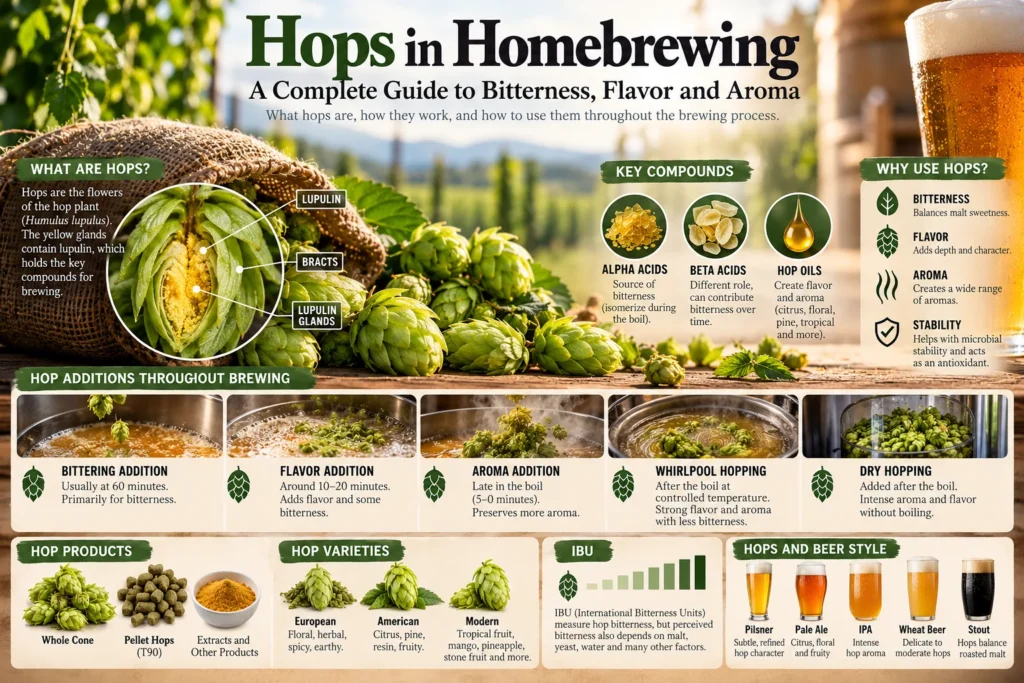
Hops are one of the defining ingredients of beer.
They can provide firm bitterness, delicate floral notes, fresh citrus, tropical fruit, pine, herbs, spice, resin, stone fruit and many other aromas. In some beer styles, hops remain quietly in the background. In others, they become the dominant character of the entire beer.
But hops do much more than simply make beer bitter.
The same hop variety can produce very different results depending on when it is added, how much is used, how long it remains in contact with the wort or beer, and how it is processed during brewing.
A hop addition at the beginning of a 60-minute boil serves a very different purpose from the same hop added during whirlpool or dry hopping.
Understanding this relationship is one of the foundations of recipe design.
In this guide, we will look at what hops are, why brewers use them, how alpha acids create bitterness, what hop oils contribute to flavor and aroma, the difference between bittering, flavor and aroma additions, and how modern brewing uses hops throughout the brewing and fermentation process.
This is the foundation article for our hop series.
Later articles will explore IBU calculations, hop varieties, whirlpool hopping and dry hopping in much greater detail.
What Are Hops?
Hops are the flowers of the hop plant, Humulus lupulus.
The plant is a climbing perennial belonging to the Cannabaceae family. In brewing, the female flowers — commonly called hop cones — are used because they contain the resins and essential oils that are important for beer.
Inside the hop cone are small yellow glands containing lupulin.
Lupulin contains many of the compounds brewers are interested in, including:
- alpha acids
- beta acids
- essential oils
- polyphenols
- other aromatic and bitter compounds
If you break open a hop cone, the yellow powder-like material inside is lupulin.
This is where much of the brewing value of the hop is concentrated.
Why Are Hops Used in Beer?
Historically, brewers discovered that hops provided several useful properties.
Today, we primarily think about four major contributions:
Bitterness
Hop-derived bitterness balances the sweetness of malt.
Flavor
Hops can contribute citrus, floral, herbal, spicy, fruity, resinous, woody and many other flavors.
Aroma
Late additions and dry hopping can create intense hop aromas without necessarily producing large amounts of bitterness.
Stability
Hop compounds also have antimicrobial and antioxidant properties that historically contributed to beer stability.
For the modern brewer, however, the most obvious relationship is the balance between malt sweetness and hop bitterness.
Without bitterness, many beers would taste excessively sweet.
Without malt character, strong bitterness could feel thin and aggressive.
Great beer often depends on finding the right balance between them.
The Anatomy of a Hop Cone
A hop cone consists of overlapping leafy structures called bracts and bracteoles surrounding the central stem.
Near their bases are the lupulin glands.
These glands contain the resins and oils responsible for much of the hop’s brewing character.
When hops are harvested, dried and processed correctly, brewers try to preserve these compounds as effectively as possible.
This is particularly important for aromatic hop varieties because many of their desirable compounds are volatile.
Heat, oxygen, time and poor storage can all change hop character.
This is why hop freshness and storage conditions matter so much.
What Are Alpha Acids?
Alpha acids are among the most important compounds in hops because they are the primary source of hop bitterness in beer.
The main alpha acids include:
- humulone
- cohumulone
- adhumulone
Fresh alpha acids themselves are not highly soluble in wort.
During boiling, heat causes them to undergo a chemical transformation known as isomerization.
They become iso-alpha acids, which are much more soluble and contribute the familiar bitterness of beer.
This explains why boil time matters.
A hop added early in the boil has more time for alpha acids to isomerize.
A hop added very late has much less time.
Therefore, early additions are generally associated with bitterness, while later additions preserve more flavor and aroma.
What Does Alpha Acid Percentage Mean?
Hop packages usually display an alpha acid percentage, often written as AA%.
For example:
Cascade – 5.5% AA
Centennial – 10% AA
Citra – 13% AA
Magnum – 14% AA
These values can vary significantly between harvests.
The alpha acid percentage indicates approximately how much of the hop’s weight consists of alpha acids.
A hop containing 14% alpha acids has considerably more bittering potential per gram than one containing 5%.
This is why high-alpha varieties such as Magnum are often efficient bittering hops.
You can use a relatively small quantity to create substantial bitterness.
But alpha acid percentage does not tell you how the hop will smell or taste.
Two varieties with identical alpha acid percentages can have completely different aromatic profiles.
Alpha acid percentage is therefore only one part of understanding a hop.
What Are Beta Acids?
Hops also contain beta acids, primarily lupulone, colupulone and adlupulone.
Beta acids behave differently from alpha acids.
They do not isomerize during boiling in the same way and are not responsible for most of the immediate bitterness produced during normal wort boiling.
However, beta acids can oxidize over time, producing compounds that contribute bitterness.
Their role in brewing is therefore different and generally less important for everyday recipe calculations than alpha acids.
For most homebrewers designing a standard recipe, alpha acids are the primary focus when calculating hop bitterness.
Beta acids are still part of hop chemistry, but they should not be treated simply as a second version of alpha acids.
What Are Hop Oils?
If alpha acids are primarily associated with bitterness, hop oils are strongly associated with aroma and flavor.
Hop essential oils make up only a small percentage of the hop cone, but their sensory impact can be enormous.
Important hop oil components include:
- myrcene
- humulene
- caryophyllene
- farnesene
There are also many other compounds, and modern hop aroma research extends far beyond these four traditional categories.
Hop aroma is chemically complex.
The final character does not depend simply on the quantity of one oil.
Interactions between numerous volatile compounds, fermentation, yeast metabolism, oxidation and brewing process all influence what we eventually perceive in the glass.
Myrcene
Myrcene is often one of the most abundant essential oils in hops.
It can be associated with characteristics described as:
resinous, herbal, green, citrus-like or fruity, depending on the hop variety and context.
Many modern American hop varieties contain relatively high levels of myrcene.
Because myrcene is highly volatile, long boiling drives much of it away.
This is one reason why hops intended for strong aroma are generally added later in the process.
Humulene
Humulene is traditionally associated with more herbal, woody and spicy hop character.
It is particularly important in the traditional aroma profiles of many European hop varieties.
Classic noble-type hops are often discussed in relation to humulene-rich aromatic profiles.
Again, however, individual hop character cannot be predicted from a single oil number alone.
Caryophyllene
Caryophyllene can contribute spicy, woody and herbal characteristics.
It occurs in many plants beyond hops and is one component of the complex aromatic mixture found in hop oils.
Its contribution depends on concentration and interaction with many other compounds.
Farnesene
Farnesene is present at notable levels in certain traditional hop varieties and can contribute delicate floral, herbal and green characteristics.
Some classic European varieties are particularly associated with it.
But just like the other oils, it should be considered part of the overall aromatic profile rather than a standalone flavor predictor.
Modern Hop Aroma Is More Complicated Than Four Oils
For many years, hop descriptions focused heavily on myrcene, humulene, caryophyllene and farnesene.
These remain useful reference points, but modern brewing has shown that hop aroma is considerably more complicated.
Other compounds can contribute aromas reminiscent of:
- grapefruit
- lime
- orange
- lemon
- passion fruit
- mango
- pineapple
- peach
- apricot
- blackcurrant
- gooseberry
- white wine
- coconut
- berries
Thiols, esters and other trace compounds can have enormous sensory impact even at very low concentrations.
Yeast can also transform certain hop-derived compounds during fermentation, changing the aroma that reaches the finished beer.
This interaction is one reason why the same hops can smell different in different beers.
Bitterness, Flavor and Aroma Are Not Completely Separate
Traditional brewing terminology often divides hop additions into:
Bittering hops
Flavor hops
Aroma hops
This is useful for learning, but reality is more complicated.
A 60-minute addition mainly contributes bitterness, but it may still influence flavor.
A 10-minute addition contributes flavor and aroma, but it also contributes bitterness.
A whirlpool addition can produce strong aroma and flavor while also contributing some bitterness, especially at higher temperatures.
Dry hopping is primarily used for aroma and flavor, but it can also change the perception of bitterness and the overall chemistry of the beer.
So it is better to think of hop contribution as a continuum rather than four completely isolated categories.
What Is a Bittering Addition?
A bittering addition is usually made relatively early in the boil.
For example:
60 minutes before the end of the boil
or sometimes:
45–90 minutes, depending on the recipe and brewing process.
The purpose is primarily to convert alpha acids into bitter iso-alpha acids.
Because the hops remain in hot wort for a long time, many volatile aroma compounds are lost.
This means you do not necessarily need your most expensive aromatic hops for bittering.
For example, a brewer may use Magnum at 60 minutes for clean bitterness and save Citra, Cascade or Nelson Sauvin for later additions where their aromatic character can be better preserved.
This can be both efficient and economical.
Does the Bittering Hop Variety Matter?
Yes — but usually less than with late additions.
When hops are boiled for a long time, much of their distinctive volatile aroma disappears.
However, bitterness quality is not necessarily identical between all hop varieties.
Hop chemistry, alpha-acid composition, cohumulone levels, polyphenols, hopping rate and wort conditions can influence the sensory result.
Still, in practical homebrewing, bittering additions are generally selected more for:
alpha acid percentage, bitterness quality, consistency and efficiency
than for delicate aroma.
This is why clean, high-alpha hops are so popular for bittering.
What Is a Flavor Addition?
Traditionally, hops added somewhere around the final 10–20 minutes of the boil are described as flavor additions.
At this point, the hops still receive enough heat to contribute bitterness, but more aromatic compounds survive compared with a 60-minute addition.
The result can provide a stronger hop flavor in the finished beer.
For example:
Centennial – 10 minutes
might contribute citrus and floral character while still adding measurable bitterness.
The exact result depends on temperature, time, hop variety, wort gravity and brewing system.
The traditional concept of a separate “flavor addition” is useful, although modern hop-forward brewing often relies more heavily on very late-boil and whirlpool additions.
What Is an Aroma Addition?
Aroma additions are usually made very late in the boil.
Examples include:
5 minutes
2 minutes
flameout / 0 minutes
The shorter exposure to boiling temperatures preserves more volatile hop compounds.
These additions therefore emphasize aroma much more than early bittering additions.
However, they can still contribute bitterness.
A hop added at flameout does not instantly become cold.
The wort may remain near boiling temperature for several minutes.
During this time, alpha-acid isomerization can continue.
This becomes particularly important when large quantities of hops are used.
What Does “Flameout” Mean?
Flameout simply means the heat source has been switched off at the end of the boil.
A recipe might say:
Citra – 30 g at flameout
This means the hops are added when boiling ends.
But flameout does not define an exact temperature.
One brewing system may cool from 100°C to 80°C very quickly.
Another may remain above 90°C for a considerable period.
Therefore, two brewers using the same flameout addition may obtain different bitterness and aroma.
This is one reason why modern recipes increasingly specify whirlpool temperature and contact time instead of simply saying “0 minutes.”
We will examine whirlpool hopping in detail later in this series.
What Is Whirlpool Hopping?
Whirlpool hopping involves adding hops after the boil and allowing them to remain in hot wort for a controlled period before or during cooling.
For example:
80°C for 20 minutes
Whirlpool additions are extremely important in modern hop-forward beers.
They can contribute substantial hop flavor and aroma while usually producing less bitterness than a comparable boiling addition.
Temperature matters enormously.
A whirlpool at 95°C behaves differently from one at 80°C or 70°C.
For now, the important point is:
Whirlpool hopping occupies the space between hot-side bittering and cold-side dry hopping.
A later article in this series will cover whirlpool temperature, time and hop utilization in detail.
What Is Dry Hopping?
Dry hopping means adding hops to the beer after the boil, usually during or after fermentation.
Because the hops are not boiled, many volatile aromatic compounds can be retained.
Dry hopping is one of the most important techniques used in modern IPA, Pale Ale and other hop-forward styles.
It can produce intense aromas of:
citrus, tropical fruit, pine, resin, stone fruit, berries, flowers, herbs and many other characters.
But more dry hops do not automatically produce better beer.
Contact time, temperature, hop variety, oxygen exposure, yeast activity and hopping rate all matter.
Very large dry-hop additions can also introduce vegetal character, polyphenols, hop burn and beer loss.
Dry hopping deserves its own detailed discussion, so we will cover it separately later in the series.
Bittering, Flavor, Aroma, Whirlpool and Dry Hop: The Basic Difference
A simple way to understand the brewing process is:
| Addition | Typical Purpose | Heat Exposure |
|---|---|---|
| Early boil | Primarily bitterness | High / long |
| Mid-late boil | Bitterness + flavor | High / moderate |
| Late boil | Flavor + aroma + some bitterness | High / short |
| Flameout / Whirlpool | Flavor + aroma + some bitterness | Moderate to high |
| Dry hop | Primarily aroma + flavor | No boiling |
This is deliberately simplified.
The boundaries overlap.
But it provides a useful framework for understanding recipe design.
What Are Dual-Purpose Hops?
Some hop varieties have traditionally been described as either:
bittering hops
or
aroma hops.
Other varieties are called dual-purpose hops because they can perform both roles effectively.
For example, a hop may have enough alpha acid to provide efficient bitterness while also having an attractive aroma profile.
Modern hop breeding has produced many varieties with both high alpha-acid levels and powerful aroma.
This means the old division between bittering and aroma varieties is less rigid than it once was.
You can bitter with an aroma hop.
You can use a high-alpha hop late in the boil.
The real question is whether doing so makes sense for the beer and your ingredient budget.
Hop Form: Whole Cone, Pellet and Other Products
Hops are available in several forms.
For most homebrewers, the two traditional forms are:
whole-cone hops
and
pellet hops.
Modern brewing also uses concentrated hop products, lupulin-enriched pellets, extracts and other advanced hop preparations.
Whole-Cone Hops
Whole-cone hops are dried hop flowers that remain relatively close to their natural form.
They can provide excellent beer.
Some brewers enjoy their traditional character and handling.
However, whole hops take up more storage space and absorb more wort or beer.
They can also be less convenient in some brewing systems.
Because they contain more plant material by volume, large additions can result in substantial liquid losses.
Pellet Hops
Pellet hops are produced by milling dried hops and compressing them into pellets.
T90 pellets are among the most common products used by homebrewers.
Pellets are compact, easy to store and widely available.
When added to wort or beer, they break apart and disperse.
They generally offer efficient utilization and are extremely convenient for modern brewing.
For these reasons, pellet hops have become the standard choice for many homebrewers and commercial breweries.
Are Pellet Hops Better Than Whole Hops?
Not automatically.
Both can produce excellent beer.
Pellets are usually more practical because they are compact, easy to store, readily available and efficient.
Whole hops may suit certain equipment or brewing preferences.
The important considerations are:
freshness, storage, hop quality and how the product fits your brewing process.
A fresh, properly stored hop is far more valuable than choosing one format simply because someone claims it is inherently superior.
What Is Hop Freshness?
Hop quality changes with time.
Oxygen, heat and light can degrade hop compounds.
This is especially important for aroma hops.
Old or badly stored hops can lose bright, fresh aroma and develop dull, cheesy or otherwise unpleasant characteristics.
This is why hops should generally be stored:
cold, sealed and protected from oxygen and light.
Once a package has been opened, removing as much air as practical before resealing helps preserve quality.
Vacuum sealing is particularly useful for homebrewers who buy hops in larger packages and use them over several batches.
Freezer storage is commonly used for long-term hop storage.
Why Harvest Year Matters
Hops are agricultural products.
Their chemistry changes from harvest to harvest.
The same variety can have different:
- alpha acid percentages
- oil content
- aromatic intensity
- sensory character
from one crop year to another.
This is why recipes should not assume that every package of a named hop has exactly the same alpha-acid content.
If an old recipe says:
20 g Centennial at 60 minutes – 10% AA
but your Centennial is 8.5% AA, the resulting bitterness will be lower if everything else remains unchanged.
Conversely, a 12% AA crop could produce more bitterness.
Always check the alpha-acid percentage printed on the actual package when bitterness matters.
What Is IBU?
IBU stands for International Bitterness Units.
It is a standardized measurement related to the concentration of bitter compounds in beer, particularly iso-alpha acids.
In simplified recipe design, brewers use IBU calculations to estimate the bitterness produced by hop additions.
For example:
20 IBU might represent relatively gentle bitterness.
40 IBU may feel moderately bitter depending on the beer.
70 IBU can be strongly bitter.
But IBU is not the same as perceived bitterness.
A 40 IBU beer with substantial residual sweetness can taste less bitter than a dry 35 IBU beer.
Water chemistry, alcohol, malt character, final gravity, hop compounds and other factors influence perception.
Therefore:
IBU is a useful brewing number, but it does not completely describe how bitter a beer will taste.
We will examine IBU and hop utilization in detail in the next article.
Why Boil Time Changes Hop Utilization
The longer alpha acids remain in hot wort, the greater the opportunity for isomerization — up to practical limits.
This is why a 60-minute hop addition generally contributes more bitterness than the same amount added for 10 minutes.
However, utilization does not increase indefinitely in a perfectly linear way.
Many factors influence it, including:
- boil time
- wort gravity
- hop form
- equipment
- kettle geometry
- hopping rate
- temperature
This is why brewing software uses mathematical models to estimate IBU.
Common models include Tinseth and Rager.
The exact calculated number may differ between models.
For practical homebrewing, consistency in the method you use is often more valuable than treating an estimated IBU as an absolutely precise laboratory measurement.
More Hops Does Not Always Mean More Bitterness
This is especially important in modern beer.
A heavily dry-hopped Hazy IPA may contain several hundred grams of hops while having relatively moderate calculated bitterness.
A traditional Bitter might contain much less hop material overall but derive a substantial proportion of its bitterness from early-boil additions.
The quantity of hops alone therefore tells us very little.
We need to know:
which hops, how much alpha acid they contain, when they were added, at what temperature, and for how long.
More Hops Does Not Always Mean More Aroma Either
This may seem surprising.
If 100 grams of dry hops smell great, why not use 300 grams?
Because hop aroma does not necessarily increase proportionally forever.
At high hopping rates, extraction can reach diminishing returns.
At the same time, additional plant material can increase:
- polyphenols
- vegetal character
- astringency
- hop burn
- beer loss
Very large additions can therefore become inefficient or even reduce drinkability.
Modern hop-forward brewing is not simply about using the maximum possible amount of hops.
It is about extracting the right character efficiently.
Hop Character Depends on the Beer Around It
The same hop combination can behave differently in different beers.
Citra and Mosaic in a dry West Coast IPA may appear sharp, bright and intensely citrus-tropical.
The same hops in a soft Hazy IPA with higher chloride, different yeast and a fuller body may seem rounder and juicier.
Cascade in an American Pale Ale may show grapefruit, floral and citrus character.
In another recipe, the malt, yeast and water profile may change how those same aromas are perceived.
Hops do not exist in isolation.
They interact with:
malt, yeast, water chemistry, alcohol, bitterness, body and fermentation.
This is why copying only the hop schedule from another recipe does not guarantee the same result.
Classic and Modern Hop Character
Hop breeding has changed dramatically.
Traditional European varieties are often associated with profiles such as:
floral, herbal, spicy, earthy and delicate.
Classic American varieties introduced stronger:
citrus, grapefruit, pine and resin character.
Modern varieties have expanded the range even further:
mango, passion fruit, pineapple, peach, apricot, lime, white wine, gooseberry, berries and other intense fruit characters.
None of these groups is inherently better.
The correct choice depends on the beer.
A German Pils does not necessarily benefit from the same hop profile as a modern NEIPA.
A West Coast IPA and an English Bitter require very different approaches.
Understanding hop varieties will therefore be another important part of this series.
Should You Use One Hop or Several?
Both approaches can work.
A single-hop beer uses one hop variety for most or all additions.
This is an excellent way to learn a hop.
For example, a Cascade single-hop Pale Ale can teach you how Cascade behaves as bittering, late-boil and dry-hop additions.
A multi-hop beer allows different varieties to complement one another.
For example:
Citra + Centennial + Cascade
can combine tropical citrus, grapefruit, floral and classic American hop character.
But more varieties do not automatically create a better beer.
Using five or six hops without a clear reason can create an unfocused aroma.
Sometimes two well-chosen varieties produce a clearer and more memorable result than six.
Think About Hop Roles When Designing a Recipe
Instead of simply creating a list of hop additions, ask what each addition is supposed to accomplish.
For example:
Magnum – 60 minutes
Purpose: clean bitterness.
Centennial – 10 minutes
Purpose: citrus/floral flavor plus some bitterness.
Cascade – 5 minutes
Purpose: late hop flavor and aroma.
Citra + Cascade – whirlpool
Purpose: strong citrus and fruity aroma.
Citra + Centennial – dry hop
Purpose: fresh hop aroma.
Now every addition has a reason.
This is much more useful than adding hops at 60, 30, 15, 10, 5 and 0 minutes simply because an old recipe template used those times.
Do You Need a 30-Minute Hop Addition?
Not necessarily.
Traditional recipes often contain multiple additions throughout the boil.
Modern recipes are frequently simpler.
For example, a modern Pale Ale might use:
one clean bittering addition
followed by
late-boil hops
then
whirlpool
and possibly
dry hopping.
This can create a very clear division between bitterness and aroma.
That does not mean intermediate additions are wrong.
They simply need a purpose.
Every hop addition should answer the question:
What do I want this addition to contribute?
Hops and Oxygen
Oxygen is especially important when dealing with heavily hopped beer.
Hop aroma is vulnerable to oxidation.
Fresh citrus and tropical aromas can fade, while the beer may develop duller, sweeter or stale characteristics.
This is particularly important after fermentation.
Dry hopping, transferring and packaging can all introduce oxygen if handled carelessly.
Modern hop-forward beers therefore benefit greatly from oxygen-conscious practices such as:
- minimizing splashing
- limiting unnecessary fermenter opening
- closed transfers where possible
- purging kegs with CO₂
- careful packaging
Excellent hops cannot compensate for heavily oxidized beer.
Protecting hop aroma after fermentation is just as important as creating it.
Hops and Yeast
Hops and yeast interact in several interesting ways.
During fermentation, yeast can transform certain hop-derived compounds.
This phenomenon is often discussed under the term biotransformation.
The result can alter the aroma profile of the finished beer.
This is one reason some brewers add dry hops during active fermentation.
However, the subject is more complicated than simply saying:
“Dry hop during fermentation for more tropical flavor.”
Timing, yeast strain, hop variety, temperature and fermentation activity all influence the result.
Adding hops during active fermentation can also mean that some volatile compounds are lost with escaping CO₂.
So, as with most hop techniques, there is no single timing that is automatically best for every beer.
Hops and Beer Style
Different styles require very different hopping strategies.
German Pils
Usually elegant bitterness with refined spicy, floral or herbal hop character.
Czech-Style Pilsner
Traditional hop character can be prominent, with soft but noticeable bitterness and classic spicy/herbal aroma.
English Bitter
Balanced bitterness with earthy, floral, herbal or gently fruity English hop character.
American Pale Ale
Usually clearer citrus, floral, pine or fruity American hop character.
West Coast IPA
Firm bitterness, dry finish and intense citrus, pine, resin or modern fruit aroma.
Hazy IPA / NEIPA
Often softer bitterness with very large late and dry-hop additions emphasizing juicy fruit aroma.
Stout
Hop aroma is often restrained, with bitterness used mainly to balance roasted malt and residual sweetness.
Saison
Hop character can range from subtle to moderately expressive, often complementing the dry, spicy fermentation profile.
There is no universal “correct” hopping schedule.
The hopping strategy should support the beer.
Common Hop Mistakes
Several mistakes appear frequently in homebrewing.
Choosing Hops Only by Alpha Acid Percentage
AA% tells you about bittering potential, not the complete flavor and aroma profile.
Ignoring the Alpha Acid Percentage of the Actual Package
Different harvests can have different AA%.
Use the number on your hops when calculating bitterness.
Using Expensive Aroma Hops Only for Long Boil Bittering
It can work, but much of their special aromatic character may be lost.
A clean high-alpha bittering hop may be more efficient.
Assuming Flameout Means Zero Bitterness
Hot wort can continue isomerizing alpha acids after the heat is switched off.
Assuming Dry Hopping Adds No Perceived Bitterness
Dry hopping can alter bitterness perception and introduce other compounds that affect the sensory profile.
Using More Hops Without a Clear Purpose
More is not automatically better.
Ignoring Oxygen
Hop-forward beers are particularly sensitive to oxidation.
Using Old or Poorly Stored Hops
Freshness matters enormously for aroma.
Copying a Hop Schedule Without Understanding It
Know why every addition is there.
A Simple Pale Ale Example
Imagine a 25-litre American Pale Ale.
We want:
moderate bitterness
clear citrus character
fresh hop aroma
A simple hop strategy might look like:
Magnum – 60 minutes
Provides most of the clean bitterness.
Cascade – 10 minutes
Adds citrus/floral flavor and some bitterness.
Cascade + Centennial – flameout or whirlpool
Builds stronger citrus and aromatic character.
Cascade + Centennial – dry hop
Adds fresh aroma after fermentation.
This schedule is easy to understand because each addition has a specific job.
If the beer needs more bitterness, we can adjust the bittering hop addition.
If it needs more aroma, we can adjust the late or dry-hop additions.
This is much easier to control than randomly increasing every hop addition.
A Simple Lager Example
Now consider a Vienna Lager.
The objective is completely different.
We want malt character to remain central.
A simple schedule might use a traditional European hop variety:
60-minute addition for bitterness
and
a small late addition for delicate aroma.
There may be no dry hop at all.
That does not mean the beer is “less hoppy” in a negative sense.
It means the hops are performing the role required by the style.
Good hop design is not measured by how many grams of hops are used.
It is measured by whether the hops improve the beer.
A Simple Modern IPA Example
For a modern IPA, the structure may look very different:
Clean bittering addition
Small or moderate late-boil addition
Large whirlpool addition
Large dry-hop addition
This moves much of the hop material away from long boiling and toward techniques designed to preserve aroma.
The result can produce intense hop character without requiring extreme kettle bitterness.
This approach has become central to many modern hop-forward beers.
Learn Your Hops by Brewing With Them
Hop descriptions are useful.
But nothing replaces brewing experience.
A supplier may describe a hop as:
citrus, tropical, passion fruit, pine
but your perception may be different.
The hop may also behave differently depending on whether you use it at 60 minutes, 10 minutes, whirlpool or dry hop.
One of the best ways to learn a hop variety is to brew a simple Pale Ale with it.
Keep the malt bill simple.
Use a familiar yeast.
Then allow the hop to become the main variable.
This helps you understand what the variety actually contributes in your brewery.
Keep Hop Notes
Just as with yeast, good brewing notes are extremely valuable.
Record:
Hop variety
Harvest year
Alpha acid percentage
Amount
Whirlpool temperature
Whirlpool duration
Dry-hop amount
Dry-hop timing
Dry-hop contact time
Aroma before brewing
Aroma and flavor in finished beer
Perceived bitterness
Storage conditions
Over time, this becomes your personal hop database.
You may discover that one hop works beautifully for you in whirlpool but you dislike it as a dry hop.
You may find that two varieties create a combination you want to use again.
Or you may discover that reducing the quantity actually improves the beer.
These observations are more valuable than simply collecting hop descriptions from catalogues.
Hops Are Part of the Recipe, Not a Separate Layer
It is tempting to design a beer in separate pieces:
malts first
then
hops
then
yeast
then
water.
But good recipes work as systems.
A highly attenuative yeast can make bitterness seem sharper.
A higher final gravity can soften perceived bitterness.
A sulfate-forward water profile can emphasize hop bitterness and dryness.
A chloride-forward profile can create a softer impression.
A fruity yeast can complement certain modern hops.
A strongly roasted malt bill can require enough bitterness to prevent the beer from becoming cloying.
Everything interacts.
The question is not simply:
“How many hops should I use?”
The better question is:
“What role should hops play in this particular beer?”
Final Thoughts
Hops are among the most exciting ingredients available to brewers because a relatively small amount can dramatically change a beer.
But understanding hops begins with separating several different concepts.
Alpha acids are primarily important for bitterness.
Hop oils and other aromatic compounds contribute much of the flavor and aroma we associate with different varieties.
Boil time and temperature influence how these compounds behave.
Early additions are primarily used for bitterness.
Late additions preserve more flavor and aroma.
Whirlpool hopping allows brewers to extract substantial hop character at lower temperatures than boiling.
Dry hopping creates fresh hop aroma without boiling the hops.
But these categories overlap.
A hop addition does not contribute only one thing.
Bitterness, flavor and aroma exist on a continuum, and the final result depends on the entire brewing process.
The most useful habit when designing a hop schedule is therefore simple:
Do not add hops simply because a recipe says “60, 15, 5 and 0 minutes.” Give every hop addition a purpose.
Know which addition creates your bitterness.
Know which addition builds flavor.
Know which addition creates aroma.
And most importantly, understand how those contributions fit the beer you actually want to brew.
That is the foundation of good hop recipe design.