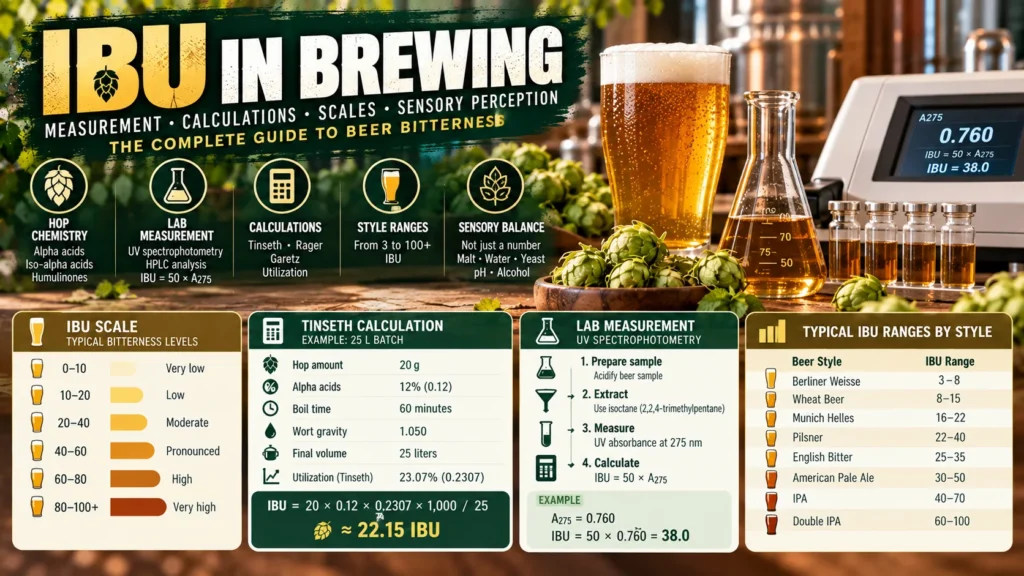
IBU in brewing is one of the most widely used measurements for describing beer bitterness, yet it is also one of the most frequently misunderstood. International Bitterness Units provide an analytical framework for evaluating bitter compounds in beer, but they do not directly measure how bitter a beer will taste. Understanding the distinction between calculated IBU, laboratory-measured IBU, and perceived bitterness is essential for designing balanced recipes, interpreting brewing software, and controlling bitterness from the brewhouse to the finished glass.
A beer calculated at 60 IBU may taste smoother than another beer calculated at 35 IBU. Two beers with the same laboratory-measured bitterness can exhibit noticeably different bitterness intensity, quality, and persistence. Even the same hop variety can produce different results depending on wort gravity, boiling conditions, whirlpool temperature, fermentation, dry hopping, and packaging.
The explanation lies in chemistry, process engineering, analytical measurement, and human sensory perception.
IBU is not simply a number assigned to hops. It is the result of a complex series of chemical reactions and physical processes that begin when hops enter the wort and continue through fermentation, maturation, and storage.
This technical guide examines the science of beer bitterness in detail, including:
- The chemical compounds responsible for bitterness.
- The International Bitterness Unit scale and its limitations.
- Laboratory measurement using UV spectrophotometry.
- Advanced analytical methods for individual bitter compounds.
- Tinseth, Rager, and Garetz bitterness calculations.
- Alpha-acid utilization during wort boiling.
- Whirlpool and hop-stand bitterness.
- Dry hopping, humulinones, and hop creep.
- The effects of malt, residual extract, pH, minerals, and alcohol.
- BU:GU ratios and bitterness balance.
- Practical calculations for 25-liter brewing batches.
- Troubleshooting unexpected bitterness.
- Sensory evaluation and process repeatability.
The objective is not merely to calculate IBU, but to understand what the number represents, how it is obtained, why it changes, and how to use it intelligently when designing beer recipes.
1. What Is IBU?
IBU stands for International Bitterness Units.
It is a standardized analytical expression of beer bitterness based on the ultraviolet absorbance of specific substances extracted from beer under defined laboratory conditions.
Historically, IBU was developed primarily to quantify the contribution of hop-derived bitter compounds, especially iso-alpha acids.
Iso-alpha acids are formed when alpha acids from hops undergo isomerization during wort boiling.
In conventional brewing practice, an IBU value is often discussed as though it were equivalent to the concentration of iso-alpha acids in milligrams per liter.
This approximation is useful in some circumstances, but it is not a complete chemical definition of the standard IBU measurement.
One IBU is not universally equivalent to exactly 1 mg/L of iso-alpha acids in every finished beer.
The conventional spectrophotometric method responds to a mixture of extractable ultraviolet-absorbing compounds, including substances other than iso-alpha acids.
This distinction becomes particularly important in heavily dry-hopped beers, aged beers, and products containing substantial concentrations of oxidized hop compounds.
Three different meanings of bitterness
A calculated value is a prediction. A laboratory value is a measurement. Perceived bitterness is a sensory response.
A technically sound brewing process treats these as related but separate quantities.
2. Is IBU a Scale From 0 to 100?
No.
The IBU scale does not have a fixed upper limit of 100.
A beer may contain 5, 20, 50, 80, 100, or more IBU.
However, increasingly high calculated values do not necessarily represent proportionally greater measured bitterness or sensory intensity.
At very high hopping rates, alpha-acid solubility, isomerization kinetics, adsorption, precipitation, fermentation losses, and analytical limitations become important.
A brewing calculator may predict 150 IBU, but this does not establish that the finished beer contains 150 IBU when tested in a laboratory.
Similarly, a beer measuring 90 IBU is not necessarily perceived as 50% more bitter than a beer measuring 60 IBU.
A practical interpretation of the IBU scale
The following categories are an editorial guide for comparing typical beer bitterness levels. They are not official sensory classifications or universal perception thresholds.
📊 Understanding the IBU Scale
Illustrative ranges for interpreting bitterness numbers, not standardized sensory categories.
3. Typical IBU Ranges by Beer Style
Beer style provides useful context for interpreting bitterness.
A 25 IBU beer may be relatively bitter for a delicate wheat beer but comparatively mild for an American Pale Ale.
The following ranges are representative style targets. They should be interpreted as practical guidelines rather than universal specifications for every beer bearing the style name.
| Beer style | Typical IBU range | General bitterness character |
|---|---|---|
| 🍋 Berliner Weisse | 3–8 | Very low |
| 🌾 Weissbier | 8–15 | Low |
| 🍺 Munich Helles | 16–22 | Gentle, balanced |
| 🌼 Kölsch | 18–30 | Low to moderate |
| 🍞 Vienna Lager | 18–30 | Balanced |
| 🌿 Czech Premium Pale Lager | 30–45 | Firm but integrated |
| 🌿 German Pils | 22–40 | Noticeable, clean |
| 🍂 English Bitter | 25–35 | Balanced to moderately bitter |
| 🍯 English Extra Special Bitter | 30–50 | Moderate to firm |
| ☕ Irish Stout | 25–45 | Roast-supported bitterness |
| 🍊 American Pale Ale | 30–50 | Moderate to pronounced |
| 🌲 American IPA | 40–70 | Pronounced |
| 🥭 Hazy IPA | Variable, often 20–50 | Often softer in perception |
| 🔥 Double IPA | 60–100 | High, balanced against stronger beer |
Hazy IPA deserves special attention. Conventional IBU calculations can be less representative of its finished sensory profile because whirlpool hopping, dry hopping, humulinones, polyphenols, and fermentation interactions may contribute substantially.
These values also illustrate why comparing IBU without considering style can be misleading.
A well-balanced stout and a well-balanced pilsner may have similar IBU values but entirely different bitterness characteristics.
4. The Chemistry Behind Beer Bitterness
The principal hop-derived bitter compounds originate from resins contained in the lupulin glands of hop cones.
These resins include alpha acids and beta acids, along with compounds formed through chemical transformation and oxidation.
Alpha acids
The major alpha acids include:
- Humulone.
- Cohumulone.
- Adhumulone.
Other alpha-acid homologues occur in smaller quantities.
Alpha acids are relatively poorly soluble in wort compared with their isomerized products.
During wort boiling, alpha acids undergo isomerization, producing iso-alpha acids.
The resulting iso-alpha acids are more soluble and are responsible for much of the characteristic bitterness of conventionally hopped beer.
Iso-alpha acids
Iso-alpha acids exist as different molecular isomers, including cis and trans forms.
Their formation, distribution, stability, and degradation depend on brewing conditions.
Iso-alpha acids contribute not only to bitterness but also to certain foam properties.
However, their final concentration is influenced by losses throughout brewing and fermentation.
Beta acids
The principal beta acids include:
- Lupulone.
- Colupulone.
- Adlupulone.
Beta acids are relatively insoluble in beer and contribute little directly to conventional bitterness in their unoxidized form.
Their oxidation products can contribute bitterness.
Therefore, the beta-acid content of a hop is not directly interchangeable with its alpha-acid content in a conventional IBU calculation.
Humulinones
Humulinones are oxidation products of alpha acids.
They are particularly relevant to modern dry-hopped beers because they can be extracted into beer without the high-temperature isomerization required for conventional iso-alpha-acid formation.
Humulinones are bitter, but their bitterness quality and intensity differ from those of iso-alpha acids.
Consequently, a heavily dry-hopped beer may gain analytically detectable bitter compounds even when the dry hopping occurs at fermentation temperature.
Polyphenols
Hop polyphenols can influence:
- Astringency.
- Mouthfeel.
- Haze formation.
- Bitterness quality.
- Sensory persistence.
Astringency is not identical to bitterness.
Bitterness is a taste sensation, while astringency is primarily a drying or puckering mouthfeel sensation.
They can occur together, making a beer seem harsher than its measured IBU would suggest.
5. How Alpha Acids Become Bitter Iso-Alpha Acids
During wort boiling, heat promotes the structural rearrangement of alpha acids into iso-alpha acids.
The rate of isomerization depends on temperature, pH, and the chemical environment.
At typical atmospheric boiling temperatures, isomerization is sufficiently rapid to make kettle hopping an effective method of producing bitterness.
However, the total amount of alpha acid added to the kettle does not all become iso-alpha acid in the finished beer.
Several processes compete:
- Isomerization.
- Thermal degradation.
- Adsorption onto hot break and other solids.
- Retention in hop material.
- Losses in trub.
- Adsorption onto yeast during fermentation.
- Precipitation and removal during clarification.
- Further changes during storage.
For this reason, bitterness calculations use a utilization factor rather than assuming complete conversion.
What does hop utilization mean?
In homebrewing calculations, utilization is an empirical fraction describing how effectively a hop addition contributes to the predicted IBU.
For example, a model utilization of 25% means the calculation treats 25% of the nominal alpha-acid mass as contributing to the estimated bitterness concentration.
It does not mean that exactly 25% of the alpha-acid molecules were chemically converted and retained as pure iso-alpha acids.
That distinction matters because utilization models incorporate empirical brewing behavior rather than measuring individual reaction yields.
6. How IBU Is Measured in a Brewing Laboratory
The traditional laboratory method for determining beer bitterness is based on solvent extraction followed by ultraviolet spectrophotometry.
It is fundamentally different from the mathematical models used by recipe calculators.
Instead of predicting bitterness from the brewing ingredients, the laboratory analyzes a sample of the actual beer.
6.1 The spectrophotometric principle
The conventional procedure involves acidifying a prepared beer sample and extracting bitter substances into an organic solvent, typically isooctane (2,2,4-trimethylpentane).
The extracted phase is then analyzed using a UV spectrophotometer at a wavelength of 275 nanometers.
Under the defined conditions of the standard method, the absorbance is converted into bitterness units using:
IBU = 50 × A275
Where:
- IBU = measured bitterness units.
- A275 = absorbance of the prepared organic extract at 275 nm, relative to the specified blank.
- 50 = the conversion factor for the standardized procedure.
The formula is valid for the specified analytical procedure, including its sample preparation and extraction conditions. It is not a universal conversion for arbitrary UV measurements.
6.2 Example of a laboratory calculation
Suppose the instrument reports an absorbance of 0.760 at 275 nm for a properly prepared sample.
IBU = 50 × 0.760 = 38.0 IBU
If the absorbance is 1.120:
IBU = 50 × 1.120 = 56.0 IBU
If the absorbance is 1.600:
IBU = 50 × 1.600 = 80.0 IBU
These are mathematical examples of the standardized relationship, not actual laboratory results.
6.3 Laboratory absorbance conversion table
6.4 What equipment is required?
A laboratory performing conventional IBU testing generally requires:
| Equipment | Function |
|---|---|
| 🔬 UV spectrophotometer | Measures absorbance at 275 nm |
| 🧊 UV-compatible cuvettes | Hold the sample during measurement |
| ⚗️ Extraction vessels | Allow controlled solvent extraction |
| 🧪 Analytical-grade reagents | Provide defined extraction conditions |
| ⚖️ Calibrated pipettes | Ensure accurate sample and reagent volumes |
| 🌀 Mixing equipment | Provides reproducible contact between phases |
| 📋 Quality-control materials | Check method performance and repeatability |
The spectrophotometer must be capable of measuring ultraviolet light at 275 nm.
An ordinary visible-light colorimeter is not necessarily suitable.
6.5 Why sample preparation matters
The analytical result can be affected by:
- Incorrect sample volume.
- Incomplete extraction.
- Poor separation of the aqueous and organic phases.
- Contamination.
- Solvent impurities.
- Inappropriate cuvettes.
- Instrument baseline errors.
- Deviations from the standardized procedure.
Suspended material, haze, and sample handling can also complicate the analysis.
The analytical procedure must therefore be followed consistently.
Safety note: Isooctane is a highly flammable organic solvent. Laboratory extraction requires appropriate ventilation, chemical-resistant equipment, safe waste handling, and trained personnel. It should not be improvised in a domestic kitchen or brewing area.
7. What Does the Laboratory Actually Measure?
A conventional spectrophotometric IBU result is an operationally defined measurement.
This means the value is defined by what the analytical procedure extracts and detects.
Iso-alpha acids are major contributors, but the UV method is not perfectly selective for them.
Other compounds that absorb ultraviolet light under the analytical conditions can contribute to the result.
This is one reason why a spectrophotometric IBU measurement should not be interpreted as an exact determination of the concentration of one specific molecule.
Why this matters for heavily hopped beers
Modern IPAs may contain substantial quantities of:
- Iso-alpha acids.
- Humulinones.
- Hop-derived polyphenols.
- Other oxidized hop compounds.
- Compounds extracted during dry hopping.
The analytical measurement can reflect a mixture of these contributions.
Two beers with the same measured IBU may therefore contain different distributions of bitter compounds.
Their perceived bitterness can differ accordingly.
8. Advanced Bitterness Analysis: HPLC
High-performance liquid chromatography, or HPLC, provides a more selective approach to beer bitterness analysis.
Instead of measuring the combined ultraviolet absorbance of an extracted mixture, a validated chromatographic method can separate and quantify individual chemical compounds or compound groups.
Depending on the method and detector, these may include:
- Specific iso-alpha-acid isomers.
- Alpha acids.
- Humulinones.
- Other hop-derived bitter substances.
Spectrophotometry versus HPLC
HPLC is particularly valuable when investigating why two beers have similar IBU measurements but different sensory bitterness.
However, even a detailed chemical analysis does not completely predict human sensory perception.
9. Can Homebrewers Measure IBU at Home?
A hydrometer cannot measure IBU.
A refractometer cannot measure IBU.
A pH meter cannot measure IBU.
A conductivity meter cannot measure IBU.
These instruments measure different physical or chemical properties.
A brewing refractometer estimates refractive index, commonly expressed through Brix or a gravity-related scale.
It does not determine the concentration of hop bitter compounds.
Practical options for homebrewers
Option 1: Calculate bitterness using brewing software.
This is the most accessible method and is sufficient for routine recipe development when its limitations are understood.
Option 2: Use a validated laboratory service.
A finished beer sample can be analyzed to obtain a measured IBU value.
Option 3: Use sensory comparison.
Controlled tasting can help compare bitterness intensity and quality, but cannot establish an exact IBU value.
Option 4: Perform laboratory analysis with appropriate equipment.
This is technically possible for a sufficiently equipped and trained operator, but is not a simple home test.
What about inexpensive IBU meters?
Any instrument marketed for bitterness measurement should be evaluated according to its analytical principle, calibration, repeatability, and validation.
A digital display alone does not establish that the device measures standardized IBU.
If the instrument uses optical or indirect estimation methods, its result must be validated against an accepted laboratory method.
10. Calculating IBU: The Basic Engineering Equation
For a conventional kettle hop addition, a common calculation is:
IBU = hop mass (g) × alpha-acid fraction × utilization × 1,000 / beer volume (L)
Where:
- Hop mass is expressed in grams.
- Alpha-acid fraction is the percentage divided by 100.
- Utilization is a dimensionless fraction.
- Volume is expressed in liters.
For example, 12% alpha acids must be entered as 0.12.
A utilization of 25% must be entered as 0.25.
Example: 25 L of beer
Assume:
- Hop mass: 20 g.
- Alpha acids: 12%.
- Utilization: 25%.
- Final calculation volume: 25 L.
Calculation:
IBU = 20 × 0.12 × 0.25 × 1,000 / 25 = 24.0 IBU
The result is 24 estimated IBU.
The utilization value is an assumption in this example.
It must not be interpreted as a universal utilization for every 60-minute hop addition.
11. Why Different Brewing Calculators Produce Different IBU Values
Brewing software may use different empirical models.
Three commonly discussed approaches are:
- Tinseth.
- Rager.
- Garetz.
They were developed using different assumptions and empirical relationships.
Consequently, the same recipe may produce different estimated IBU values depending on the selected model.
These differences do not necessarily mean one calculator is defective.
They reflect different models of hop utilization.
12. The Tinseth Model
The Tinseth model is widely used in homebrewing software.
It estimates utilization as a function of wort gravity and boiling time.
The conventional equation is:
U = 1.65 × 0.000125^(G − 1) × (1 − exp(−0.04 × t)) / 4.15
Where:
- U = utilization fraction.
- G = wort specific gravity used by the model.
- t = boiling time in minutes.
- exp = exponential function.
The equation contains two main components.
Gravity factor
Gravity factor = 1.65 × 0.000125^(G − 1)
Higher wort gravity reduces the predicted utilization.
Time factor
Time factor = (1 − exp(−0.04 × t)) / 4.15
Longer boiling increases predicted utilization, but the increase becomes progressively smaller.
Complete example
Assume:
- Wort gravity: 1.050.
- Boiling time: 60 minutes.
- Hop mass: 20 g.
- Alpha acids: 12%.
- Beer volume: 25 L.
Gravity factor:
1.65 × 0.000125^(1.050 − 1) ≈ 1.0529
Time factor:
(1 − exp(−0.04 × 60)) / 4.15 ≈ 0.2191
Utilization:
U ≈ 1.0529 × 0.2191 ≈ 0.2307
IBU:
IBU ≈ 20 × 0.12 × 0.2307 × 1,000 / 25 ≈ 22.15 IBU
The estimated contribution of this addition is approximately 22.2 IBU.
The calculation assumes that the selected gravity is representative of the wort conditions required by the model and that the chosen volume basis is applied consistently.
13. Tinseth Utilization at Different Boiling Times
For a wort gravity of 1.050, the conventional Tinseth equation produces approximately the following utilization values.
| Boiling time | Estimated utilization |
|---|---|
| 5 minutes | 4.60% |
| 10 minutes | 8.36% |
| 15 minutes | 11.44% |
| 20 minutes | 13.96% |
| 30 minutes | 17.74% |
| 45 minutes | 21.17% |
| 60 minutes | 23.07% |
| 90 minutes | 24.60% |
These values are model predictions, not experimentally measured utilization for a particular brewing system.
They illustrate an important principle: the additional utilization gained from extending the boil becomes progressively smaller.
A 90-minute addition does not produce 50% more bitterness than an otherwise identical 60-minute addition.
A practical implication
Extending a 60-minute hop addition to 90 minutes may increase predicted utilization modestly, but it also changes the thermal history of the wort.
The decision should account for the full brewing process rather than bitterness alone.
14. Visualizing the Effect of Boiling Time
The Tinseth model predicts a nonlinear increase in utilization.
The following graphic uses a constant wort gravity of 1.050 and the utilization values calculated in the previous section.
15. The Rager Model
The Rager model is another established empirical approach to predicting bitterness.
It uses a time-dependent utilization equation and applies a gravity correction for higher-gravity wort.
A commonly implemented version expresses utilization as a percentage:
U% = 18.11 + 13.86 × tanh((t − 31.32) / 18.27)
Where t is boiling time in minutes and tanh is the hyperbolic tangent function.
For wort gravity above 1.050, a common Rager gravity adjustment is:
GA = (G − 1.050) / 0.2
For gravity at or below 1.050, GA is taken as zero.
The estimated bitterness is then calculated as:
IBU = hop mass (g) × alpha-acid fraction × (U% / 100) × 1,000 / [volume (L) × (1 + GA)]
Example: Rager calculation
Use the same assumptions as the Tinseth example:
- 20 g hops.
- 12% alpha acids.
- 60 minutes.
- Wort gravity 1.050.
- Volume 25 L.
At 60 minutes:
U% = 18.11 + 13.86 × tanh((60 − 31.32) / 18.27)
U% ≈ 31.97%
At gravity 1.050, GA = 0.
IBU ≈ 20 × 0.12 × 0.3197 × 1,000 / 25
Estimated Rager bitterness ≈ 30.69 IBU.
The same hop addition was estimated at approximately 22.15 IBU using Tinseth.
That is a substantial difference, even though the ingredients and brewing parameters are unchanged.
The difference originates from the empirical models.
What should a brewer do?
Choose one calculation model, understand its assumptions, and use it consistently.
Changing the model between recipes can make comparisons misleading.
If laboratory measurements become available, they can be used to evaluate how well the selected model predicts the results of the specific brewing system.
16. The Garetz Model
The Garetz approach is another historical method for estimating hop bitterness.
It incorporates adjustments intended to account for factors such as wort gravity, hopping rate, and boiling conditions.
Its calculations are more involved than the basic Tinseth model.
An important complication is that different software implementations and published adaptations may handle the corrections differently.
For this reason, a Garetz estimate should be compared only when the exact implementation and input assumptions are known.
Comparing bitterness models
| Characteristic | Tinseth | Rager | Garetz |
|---|---|---|---|
| 🧮 Calculation complexity | Moderate | Moderate | Higher |
| ♨️ Boiling-time relationship | Exponential | Hyperbolic tangent | Empirical adjustments |
| 🌾 Gravity adjustment | Continuous factor | Higher-gravity correction | Multiple corrections |
| 🍺 Common application | Homebrew recipe design | Homebrew recipe design | Alternative empirical estimation |
| ⚠️ Main limitation | Equipment-dependent prediction error | Different utilization assumptions | Implementation differences |
No single model can be assumed to predict every brewing system accurately.
The most useful model is often the one that provides consistent estimates that can be compared with the brewer’s actual results.
17. Calculating Multiple Hop Additions
Most beers use more than one hop addition.
For conventional kettle hopping, the total estimated bitterness is calculated by adding the contributions of individual additions:
Total estimated IBU = IBU₁ + IBU₂ + IBU₃ + …
Each addition must be calculated using its own mass, alpha-acid percentage, boiling time, and relevant utilization assumptions.
Example: A 25 L American Pale Ale
Assume a constant calculation gravity of 1.050 and a final calculation volume of 25 L.
| Addition | Hop | Alpha acids | Time | Mass |
|---|---|---|---|---|
| 1 | Magnum | 12% | 60 min | 15 g |
| 2 | Centennial | 10% | 15 min | 20 g |
| 3 | Cascade | 6% | 5 min | 30 g |
Using the Tinseth model, the approximate utilization factors are:
- 60 minutes: 0.2307.
- 15 minutes: 0.1144.
- 5 minutes: 0.0460.
Calculations:
Magnum = 15 × 0.12 × 0.2307 × 1,000 / 25 ≈ 16.61 IBU
Centennial = 20 × 0.10 × 0.1144 × 1,000 / 25 ≈ 9.15 IBU
Cascade = 30 × 0.06 × 0.0460 × 1,000 / 25 ≈ 3.31 IBU
Total estimated IBU ≈ 16.61 + 9.15 + 3.31 = 29.07 IBU
This example does not include additional bitterness from post-boil hot contact or dry hopping.
It also assumes the stated gravity is suitable for all three calculations.
18. Calculating the Hop Mass Needed for a Target IBU
The basic IBU equation can be rearranged to calculate the required hop mass.
Hop mass (g) = target IBU × volume (L) / [alpha-acid fraction × utilization × 1,000]
Example: Target 30 IBU
Assume:
- Target contribution: 30 IBU.
- Volume: 25 L.
- Hop alpha acids: 12%.
- Utilization: 0.2307.
Calculation:
Hop mass = 30 × 25 / (0.12 × 0.2307 × 1,000)
Hop mass ≈ 27.09 g
Therefore, approximately 27.1 g of 12% alpha-acid hops would be required to provide 30 predicted IBU under the stated assumptions.
This equation is useful when replacing one bittering hop with another.
However, it should not be used to assume that different hop varieties produce identical sensory bitterness.
19. Why Alpha-Acid Percentage Matters
Two batches of the same hop variety may contain different alpha-acid percentages.
Suppose a recipe originally uses:
20 g of Magnum at 12% alpha acids.
A new batch of Magnum contains 10% alpha acids.
To maintain the same nominal alpha-acid input:
New mass = original mass × original AA% / new AA%
New mass = 20 × 12 / 10 = 24 g
Under equal utilization assumptions, 24 g at 10% alpha acids provide the same nominal alpha-acid input as 20 g at 12%.
This is an appropriate first-order adjustment for a conventional bittering addition.
For late hopping and dry hopping, matching alpha-acid mass does not guarantee matching aroma or sensory bitterness.
20. The Effect of Wort Gravity on Utilization
Wort gravity influences the utilization predicted by conventional bitterness models.
In the Tinseth equation, higher gravity reduces the calculated utilization.
Consider a 60-minute addition of 20 g hops at 12% alpha acids into 25 L of beer.
| Wort gravity | Tinseth utilization | Estimated IBU |
|---|---|---|
| 1.030 | 27.62% | 26.52 |
| 1.040 | 25.24% | 24.23 |
| 1.050 | 23.07% | 22.15 |
| 1.060 | 21.09% | 20.25 |
| 1.070 | 19.28% | 18.51 |
| 1.080 | 17.62% | 16.92 |
These are calculated values from the Tinseth model.
They are not universal laboratory measurements of hop utilization.
What about partial-volume boiling?
When brewing concentrated wort and diluting afterward, the gravity during boiling can be higher than the gravity of the finished beer.
The higher boiling gravity may reduce predicted utilization.
Dilution also reduces the concentration of bitter compounds in the final volume.
Both effects must be considered.
Using the final diluted gravity as though it were the actual boiling gravity can produce inaccurate predictions.
21. Boil Volume, Evaporation, and IBU
The volume used in bitterness calculations must be defined consistently.
During boiling, water evaporates and wort volume decreases.
This changes the concentration of dissolved substances.
Suppose the calculated bitter-compound contribution is held constant, but the final volume differs.
A batch expected to finish at 25 L instead finishes at 23 L.
If the predicted bitterness was 40 IBU at 25 L, a simple concentration adjustment would give:
40 × 25 / 23 ≈ 43.48 IBU
This is a mathematical concentration estimate, assuming the same retained bitter-compound mass.
In real brewing, a changed boil can also affect utilization, thermal exposure, trub losses, and other variables.
Therefore, the concentration adjustment alone is not a complete brewing model.
Practical recommendation
Record the actual post-boil volume, original gravity, and volume transferred to the fermenter.
For repeatable recipes, use a consistent definition of volume in the selected bitterness calculation model.
22. Hop Pellets Versus Whole-Cone Hops
Hop form can influence extraction and handling losses.
Pellet hops are mechanically processed and generally provide efficient contact with wort.
Whole-cone hops have a different physical structure and may behave differently in the kettle.
Some brewing calculations apply a pellet utilization adjustment.
However, a universal pellet correction factor is not reliable for every system.
The actual difference depends on:
- Hop processing.
- Pellet type.
- Wort circulation.
- Boil intensity.
- Hop containment.
- Trub separation.
- Contact time.
A hop spider, mesh bag, or other containment device may alter extraction depending on its dimensions, loading, and wort flow.
For a recirculating brewing system, good wort movement around the hops is important.
Overloading a small hop spider can reduce effective contact and make bitterness predictions less reliable.
23. Whirlpool Hopping and Hop Stands
Whirlpool hopping occurs after the main boil, while the wort is still hot.
It is commonly used to increase hop flavor and aroma while controlling bitterness.
However, hot wort can continue to isomerize alpha acids after the heating element is switched off.
The rate depends strongly on temperature.
General temperature considerations
At temperatures close to boiling, isomerization remains significant.
As temperature decreases, the reaction becomes slower.
At approximately 80°C, isomerization can still occur, particularly during extended contact.
At lower temperatures, the balance increasingly shifts toward extraction with less thermal isomerization.
There is no single universal temperature at which alpha-acid isomerization abruptly stops.
Whirlpool temperature guide
24. Why a Zero-Minute Hop Addition Is Not Always Zero IBU
A zero-minute addition means the hops are added at flameout or when active boiling stops.
It does not necessarily mean the hops contribute zero bitterness.
If the wort remains near boiling temperature for 20 minutes, alpha-acid isomerization may continue.
If the wort is rapidly cooled, the contribution may be much smaller.
Therefore, a zero-minute addition must be interpreted together with the cooling profile.
Two different scenarios
Scenario A: Rapid chilling
Hops are added at flameout and the wort is cooled quickly.
Thermal exposure is relatively short.
Scenario B: Extended hot stand
Hops are added at flameout and the wort remains hot for 25 minutes.
The same hop mass may contribute substantially more bitterness.
A recipe that lists only “0 minutes” does not fully describe either process.
25. Why Whirlpool IBU Calculations Are Difficult
Traditional Tinseth and Rager equations were developed primarily for conventional boiling conditions.
Applying them directly to a hop stand at 80°C requires additional assumptions.
Some brewing programs use temperature-dependent utilization corrections.
Others approximate the hop stand as an equivalent boiling time.
These methods can be useful for consistency, but they are approximations.
A universal formula that accurately predicts every whirlpool system is not available.
A better practical approach
Record:
- Temperature when hops are added.
- Actual temperature profile.
- Contact duration.
- Hop mass and alpha-acid percentage.
- Wort volume.
- Whether hops remain in contact during chilling.
- Final measured IBU, when available.
This information allows the brewer to evaluate repeatability and refine future estimates.
26. Dry Hopping and Bitterness
Dry hopping is commonly associated with aroma rather than conventional kettle bitterness.
However, dry hopping can change the bitterness chemistry of beer.
It can introduce humulinones and polyphenols, while also changing the concentration of iso-alpha acids through adsorption and other interactions.
Consequently, dry hopping does not always increase measured IBU.
Depending on the beer and hopping conditions, measured bitterness may increase, decrease, or remain relatively similar.
Why measured IBU can decrease after dry hopping
Hop material can adsorb certain bitter compounds.
The addition and removal of hop solids may alter the concentration of iso-alpha acids in the beer.
At the same time, new compounds may be extracted.
The net analytical result depends on the balance of these effects.
Why perceived bitterness can increase
Even when conventional measured IBU changes only modestly, dry hopping can introduce astringency and additional bitter compounds.
A beer may therefore feel harsher or more persistent in bitterness without a proportionate increase in the laboratory IBU result.
27. Humulinones and Modern IPA Bitterness
Humulinones are particularly important in dry-hopped beers.
They form through oxidation of hop alpha acids and can be extracted at relatively low temperatures.
Their bitterness differs from conventional iso-alpha-acid bitterness.
They are generally described as less bitter per unit concentration than iso-alpha acids, although the precise sensory relationship depends on experimental conditions and the beer matrix.
For this reason, a simple assumption that every milligram of humulinones contributes one additional IBU is not analytically justified.
Practical consequence
A Hazy IPA can have:
- Moderate conventional measured IBU.
- High hop aroma.
- Significant humulinone content.
- Noticeable polyphenol-derived astringency.
- A soft or harsh bitterness depending on the overall formulation.
The total sensory experience cannot be predicted from one number alone.
28. Dry-Hop Quantity and Bitterness Quality
Increasing dry-hop dosage does not produce a simple linear increase in aroma quality or bitterness.
At higher rates, additional extraction may become less efficient.
Greater hop mass can also increase:
- Beer losses.
- Hop particulate load.
- Polyphenol extraction.
- Astringency risk.
- Oxygen exposure during handling.
- Potential for hop creep.
The ideal dry-hop rate depends on hop variety, hop product, temperature, contact duration, beer composition, and the desired sensory profile.
A higher dosage is not automatically a better dosage.
29. Hop Creep and Its Indirect Effect on Bitterness
Hop creep occurs when enzymes introduced with hops break down certain residual carbohydrates into more fermentable sugars.
If viable yeast remains present, additional fermentation may occur.
Potential consequences include:
- Lower final gravity.
- Additional alcohol production.
- Carbon dioxide production.
- Changes in carbonation.
- Changes in perceived dryness.
- Diacetyl formation or reappearance during renewed fermentation.
Hop creep does not directly mean that the beer has gained a particular number of IBU.
However, a reduction in residual extract can change the balance of the beer and make bitterness seem more prominent.
This is an important distinction between analytical bitterness and sensory balance.
30. Perceived Bitterness: Why IBU Is Not the Whole Story
Human bitterness perception is influenced by more than the concentration of iso-alpha acids.
The overall beer matrix changes how bitter compounds are perceived.
Important factors include:
- Residual extract and sweetness.
- Malt flavor.
- Final gravity and attenuation.
- Beer pH.
- Sulfate and chloride concentrations.
- Carbonation.
- Alcohol.
- Polyphenols.
- Roast-derived compounds.
- Serving temperature.
- Individual sensory sensitivity.
Two beers with identical measured IBU can therefore taste noticeably different.
Bitterness intensity versus bitterness quality
Bitterness has several sensory dimensions.
Intensity: How strong is the bitter taste?
Onset: How quickly does bitterness become apparent?
Duration: How long does the bitterness remain?
Quality: Does it seem smooth, firm, sharp, coarse, or harsh?
Aftertaste: What remains after swallowing?
A well-designed IPA may have substantial bitterness but a clean, controlled finish.
A poorly balanced beer may have fewer IBU but an unpleasant, lingering bitterness.
31. The Influence of Final Gravity
Final gravity is an important component of beer balance, but it is not a direct measure of sweetness.
A beer finishing at 1.008 may taste drier than one finishing at 1.018, provided the rest of the formulation is comparable.
However, final gravity includes contributions from substances that are not necessarily sweet.
Dextrins, proteins, minerals, and other dissolved compounds can affect density without contributing equivalent sweetness.
Therefore, final gravity should be interpreted together with attenuation, malt composition, alcohol, and sensory evaluation.
Example: Two 45 IBU beers
Beer A:
- Original gravity: 1.052.
- Final gravity: 1.008.
- IBU: 45.
Beer B:
- Original gravity: 1.068.
- Final gravity: 1.018.
- IBU: 45.
Beer A may present a drier, more bitterness-forward balance.
Beer B may have greater body and malt support.
These are likely sensory tendencies, not guaranteed outcomes.
32. The BU:GU Ratio
The Bitterness Units to Gravity Units ratio, abbreviated BU:GU, is a practical method for comparing the bitterness target with the original gravity of a beer.
It is especially useful during recipe design.
Formula
BU:GU = IBU / gravity points
Gravity points are calculated from original gravity:
Gravity points = (OG − 1) × 1,000
For an OG of 1.050:
Gravity points = (1.050 − 1) × 1,000 = 50
If the beer contains 40 IBU:
BU:GU = 40 / 50 = 0.80
Example comparisons
| Original gravity | IBU | BU:GU |
|---|---|---|
| 1.040 | 15 | 0.375 |
| 1.045 | 25 | 0.556 |
| 1.050 | 30 | 0.600 |
| 1.050 | 40 | 0.800 |
| 1.060 | 45 | 0.750 |
| 1.060 | 60 | 1.000 |
| 1.075 | 75 | 1.000 |
BU:GU is a dimensionless ratio.
It is not a laboratory measurement and does not account directly for final gravity, attenuation, pH, roast character, or bitterness quality.
A visual BU:GU reference
33. The Limitations of BU:GU
BU:GU compares bitterness with original gravity, not with actual residual sweetness.
Consider two beers:
Beer A: OG 1.060, FG 1.006, IBU 45.
Beer B: OG 1.060, FG 1.020, IBU 45.
Both have:
BU:GU = 45 / 60 = 0.75
Yet their sensory balance may be quite different.
Beer A is likely to present a drier finish, while Beer B may provide more body and residual extract.
The ratio cannot distinguish between them.
It is therefore most useful as a starting point for recipe design, not as a final prediction of drinking experience.
34. Sulfate, Chloride, and Bitterness Perception
Water chemistry influences how beer bitterness is perceived.
Sulfate is often associated with a drier, more assertive bitterness presentation.
Chloride can support fullness and roundness.
However, neither ion directly determines the IBU value.
A beer containing 45 measured IBU remains analytically at 45 IBU regardless of whether the water profile makes the bitterness seem softer or more pronounced, assuming no other chemical changes occur.
Why absolute concentrations matter
Consider two water profiles:
Profile A:
- Sulfate: 100 mg/L.
- Chloride: 50 mg/L.
Profile B:
- Sulfate: 200 mg/L.
- Chloride: 100 mg/L.
Both have a sulfate-to-chloride ratio of 2:1.
Yet their absolute mineral concentrations differ substantially.
The ratio alone does not describe the complete sensory effect.
Water chemistry should therefore be designed using actual ion concentrations, not merely a target ratio.
35. Beer pH and Bitterness
pH affects the chemistry and perception of bitterness.
Wort pH can influence hop compound solubility, isomerization, and extraction.
Beer pH can influence the sensory expression of bitterness and other flavor characteristics.
Higher beer pH may be associated with a coarser or more lingering bitterness under some conditions.
However, pH effects depend on the entire beer matrix and should not be treated as a simple universal relationship.
Practical implication
If a beer tastes unusually harsh, investigate both the measured bitterness and the beer’s pH.
Changing the hop schedule without considering pH may fail to address the underlying cause.
Similarly, increasing mineral concentrations to make bitterness more pronounced can produce unwanted sensory effects if the beer is already poorly balanced.
36. Roasted Malts and Bitterness
Dark malts contribute flavor compounds that can be perceived as bitter or astringent.
Coffee-like, burnt, cocoa-like, and roasted flavors can interact with hop bitterness.
This is particularly important in stout and porter.
A stout with 40 IBU and substantial roasted malt character may taste very different from a pale lager with the same IBU.
The analytical IBU measurement does not fully describe roast-derived bitterness.
Therefore, designing a stout by matching an IPA’s IBU value does not guarantee comparable bitterness intensity or quality.
37. Alcohol and Carbonation
Alcohol can affect the sensory balance of beer through warmth, body, and interactions with flavor perception.
Carbonation contributes acidity-related sensations and carbonic bite.
Higher carbonation can make a beer feel sharper or more refreshing, depending on the style.
These effects can change the overall impression of bitterness without requiring a corresponding change in measured IBU.
For example, a highly carbonated, dry beer may seem sharper than a fuller-bodied beer with softer carbonation.
38. Serving Temperature and Sensory Evaluation
Serving temperature affects the release of aroma compounds and the perception of flavor.
A very cold beer may suppress some aromatic and flavor characteristics.
As the beer warms, additional malt, hop, and fermentation-derived flavors may become apparent.
For meaningful bitterness comparisons, beers should be evaluated at comparable temperatures.
Other important controls include:
- Similar carbonation.
- Comparable glassware.
- Consistent sample volume.
- Similar serving conditions.
- Neutral tasting environment.
- Blind sample identification when possible.
Without these controls, sensory differences may be attributed incorrectly to IBU.
39. Sensory Thresholds Are Not Fixed IBU Boundaries
There is no universal IBU number at which every person begins to perceive bitterness.
Human sensitivity varies.
Bitterness detection and recognition depend on the compound, concentration, beer matrix, individual physiology, and tasting conditions.
The sensory threshold of an isolated bitter compound in water is not necessarily the same as its threshold in beer.
Likewise, the detection threshold is not equivalent to a pleasantness threshold.
A beer can be analytically bitter without being unpleasant.
It can also be unpleasantly harsh at a relatively modest IBU value.
40. Can a Beer Really Have More Than 100 IBU?
Yes, values above 100 IBU can be reported.
However, extremely high bitterness values require careful interpretation.
The conventional spectrophotometric method can respond to several classes of extracted compounds.
At high hopping rates, the relationship between hop additions, measured IBU, and perceived bitterness becomes increasingly complex.
A recipe calculator predicting 150 IBU does not establish that the finished beer contains 150 measured IBU.
Physical and analytical limitations
Several processes limit the efficiency of adding ever-larger hop quantities:
- Limited solubility.
- Diminishing utilization.
- Adsorption onto solids.
- Trub losses.
- Yeast adsorption.
- Compound degradation.
- Changes in the composition of extracted bitter substances.
There is no universally valid hard ceiling of exactly 100 IBU.
The correct conclusion is that very high calculated bitterness should not be interpreted as a directly verified laboratory result.
41. Why More Hops Do Not Always Mean More IBU
Consider adding another 100 g of hops to an already heavily hopped beer.
The effect depends on when the hops are added.
At the beginning of boiling, the additional alpha acids may increase bitterness significantly.
During a hot whirlpool, the contribution depends on temperature and time.
During dry hopping, the contribution may involve humulinones, polyphenols, adsorption, and other processes.
Therefore, hop mass alone cannot predict IBU.
A 200 g dry-hop addition is not equivalent to a 200 g bittering addition.
42. Why Two Beers With 50 IBU Can Taste Different
Consider two hypothetical beers.
Beer A — West Coast IPA
50 IBU
OG 1.060
FG 1.008
Dry finish, firm bitterness, prominent citrus and pine
Beer B — Hazy IPA
50 IBU
OG 1.070
FG 1.016
Fuller body, tropical aroma, potentially softer bitterness
Illustrative formulations, not measured samples. Equal IBU does not establish equal perceived bitterness.
The analytical bitterness values are identical.
Yet the beers differ in residual extract, fermentation profile, hop composition, aroma, and potentially water chemistry.
Their sensory bitterness may therefore be quite different.
This is one of the strongest arguments against treating IBU as a complete description of beer balance.
43. Why a 35 IBU Beer Can Taste Harsher Than a 60 IBU Beer
A beer with relatively low measured bitterness may still exhibit:
- Excessive astringency.
- Harsh roast character.
- Unbalanced mineral concentrations.
- Elevated pH.
- Unpleasant oxidized hop flavors.
- Very low residual sweetness.
- Strong lingering bitter compounds.
A beer with higher IBU may have better-integrated bitterness supported by malt, alcohol, body, and hop aroma.
The lower-IBU beer can therefore be less pleasant.
Bitterness quality matters as much as bitterness quantity.
44. Troubleshooting Unexpected Bitterness
When a beer is more bitter than expected, investigate the brewing process systematically.
45. What to Record for Repeatable IBU Calculations
For every brew, record the parameters that influence bitterness.
| Parameter | Recommended record |
|---|---|
| 🌿 Hop variety | Exact variety and product form |
| 📦 Hop lot | Harvest year and lot when available |
| ⚖️ Alpha acids | Percentage printed on the actual package |
| 🧮 Calculation model | Tinseth, Rager, or another named model |
| 🌾 Wort gravity | Gravity used for utilization calculations |
| ♨️ Boil time | Actual duration of each addition |
| 💧 Wort volume | Defined volume basis and measured volumes |
| 🌡️ Whirlpool | Temperature profile and contact time |
| ❄️ Dry hopping | Mass, timing, temperature, and duration |
| 🧫 Fermentation | Yeast, attenuation, and final gravity |
| 🧪 pH | Mash, wort, and beer pH when measured |
| 🍺 Sensory result | Intensity, quality, and persistence |
| 🔬 Laboratory IBU | Measured result, if available |
The more consistently these parameters are recorded, the easier it becomes to improve bitterness predictions.
46. Calibrating a Brewing System Against Measured IBU
A useful long-term strategy is to compare calculated bitterness with laboratory measurements.
Suppose three beers are brewed using the same equipment and the same calculation model.
| Batch | Calculated IBU | Laboratory IBU | Difference |
|---|---|---|---|
| Pale Ale | 35 | 31 | −4 |
| IPA | 55 | 48 | −7 |
| Bitter | 28 | 26 | −2 |
These are illustrative values, not experimental findings.
The results suggest that the selected calculation method may be overpredicting bitterness for these batches.
However, three samples are not enough to establish a universal correction factor.
The differences may be related to hop additions, fermentation losses, measurement uncertainty, and recipe-specific conditions.
Relative prediction error
A useful comparison is:
Relative error (%) = (measured IBU − predicted IBU) / predicted IBU × 100
For the illustrative IPA:
Relative error = (48 − 55) / 55 × 100 ≈ −12.73%
The measured result is approximately 12.7% below the predicted value.
With enough representative batches, the brewer can investigate whether the errors are systematic.
It is preferable to develop separate observations for conventional kettle hopping and heavily whirlpool- or dry-hopped beers.
47. Measurement Uncertainty and Repeatability
Laboratory results are not infinitely precise.
Every analytical method has measurement uncertainty.
Potential sources include sample preparation, instrument performance, extraction efficiency, and operator technique.
A result reported as 40 IBU should not automatically be interpreted as exactly 40.000 IBU.
The appropriate number of significant digits depends on the method’s demonstrated precision.
Repeatability versus accuracy
Repeatability describes how closely repeated measurements agree under similar conditions.
Accuracy describes how close a result is to an accepted reference value.
A method may be repeatable but biased.
For example, repeated results of 45, 45, and 46 IBU may show good repeatability.
However, these results do not establish accuracy without suitable quality controls or reference measurements.
48. Practical Sensory Bitterness Evaluation
Sensory evaluation is valuable even when laboratory measurement is unavailable.
The objective should be to describe bitterness systematically rather than assign an invented IBU number.
A useful 0–5 sensory intensity scale
This is an internal tasting scale, not an official IBU conversion.
| Score | Sensory description |
|---|---|
| 0 | No noticeable bitterness |
| 1 | Very low bitterness |
| 2 | Low but recognizable bitterness |
| 3 | Moderate bitterness |
| 4 | Strong bitterness |
| 5 | Very strong bitterness |
In addition to intensity, record bitterness quality.
For example:
Intensity: 4/5.
Onset: Rapid.
Quality: Firm, clean.
Persistence: Moderate.
Astringency: Low.
Overall balance: Good.
This description is more informative than saying only that the beer is “very bitter.”
49. Sensory Bitterness Evaluation Sheet
50. Frequently Asked Questions About IBU
Does 1 IBU equal 1 mg/L of iso-alpha acids?
Not exactly in every beer. It is a useful historical approximation, but the conventional spectrophotometric IBU method measures an operationally defined response that can include other extracted compounds.
Is 100 IBU the maximum possible bitterness?
No. There is no fixed 100 IBU upper limit. However, very high values require careful analytical and sensory interpretation.
Can a refractometer measure IBU?
No. A refractometer measures refractive index and cannot directly determine hop bitterness.
Does boiling hops longer always increase IBU?
The predicted contribution generally increases with boiling time under conventional conditions, but utilization shows diminishing returns and depends on other variables.
Does dry hopping increase IBU?
It can increase or decrease the measured value, depending on extraction, adsorption, and the initial composition of the beer.
Does more hop aroma mean more bitterness?
No. Aroma intensity and analytical bitterness are different properties.
Can two beers have identical IBU and different bitterness?
Yes. The composition of bitter compounds and the beer matrix influence sensory perception.
Does sulfate increase laboratory IBU?
Sulfate does not directly add hop-derived bitter compounds. It may change bitterness perception, but this should not be confused with increasing the analytical IBU value.
Is BU:GU the same as IBU?
No. IBU is a bitterness measurement or estimate, while BU:GU is a calculated ratio comparing bitterness with original gravity points.
Which IBU formula is the most accurate?
There is no universally most accurate formula for every brewing system. Tinseth and Rager are empirical models that may perform differently depending on equipment and process.
Can a 40 IBU beer be harsher than a 70 IBU beer?
Yes. Astringency, pH, residual extract, minerals, roast compounds, and bitterness quality can make the lower-IBU beer seem harsher.
Should I calculate IBU from the pre-boil or post-boil volume?
Use the volume convention required by the selected model and software. The concentration basis must be consistent with the final calculation, and wort gravity during boiling must be represented appropriately.
Is IBU important for Hazy IPA?
Yes, but it is less capable of describing the complete sensory experience in beers with extensive whirlpool hopping and dry hopping.
Can measured IBU change during storage?
Yes. Bitter compounds can undergo chemical changes during storage, and the analytical and sensory bitterness profiles may evolve.
Is a higher IBU always better for IPA?
No. The target should be appropriate for the style, original gravity, final gravity, aroma profile, and desired bitterness quality.
51. Engineering Summary: What IBU Can and Cannot Tell You
52. Final Conclusions
IBU is one of the most valuable numerical tools in brewing, but its meaning depends on how the value was obtained.
A calculated IBU value is a prediction based on a mathematical model.
A measured IBU value is the result of a defined analytical procedure.
Perceived bitterness is the sensory response to bitter compounds within the complete beer.
These three concepts must not be confused.
For conventional kettle hopping, mathematical models such as Tinseth and Rager provide practical methods for estimating bitterness. Their predictions depend on alpha-acid concentration, hop mass, wort gravity, boiling time, volume, and model assumptions.
For modern heavily hopped beers, the situation becomes more complex.
Whirlpool additions can continue to produce iso-alpha acids after the main boil. Dry hopping can introduce humulinones and polyphenols while also affecting existing iso-alpha acids. Fermentation and clarification can remove bitter compounds, and changes in final gravity, pH, mineral composition, and carbonation can modify sensory balance.
A laboratory IBU result provides useful information, but it does not completely describe the chemical composition or drinking experience of the beer.
The best approach combines several methods:
Use calculated IBU to design the recipe.
Use laboratory measurement when analytical verification is required.
Use sensory evaluation to determine whether the bitterness is appropriate for the beer.
Use detailed brewing records to improve consistency.
For a homebrewer, the most important objective is not achieving the highest possible IBU.
It is producing a beer in which bitterness has the intended intensity, character, balance, and persistence.
A carefully designed 35 IBU Pale Ale can be more successful than an excessively bitter IPA with an impressive calculated number.
Similarly, a well-made 70 IBU IPA can be smooth, balanced, and highly drinkable when the bitterness is supported by the rest of the beer.
IBU measures an important aspect of beer bitterness. Good brewing determines what that bitterness becomes in the glass.