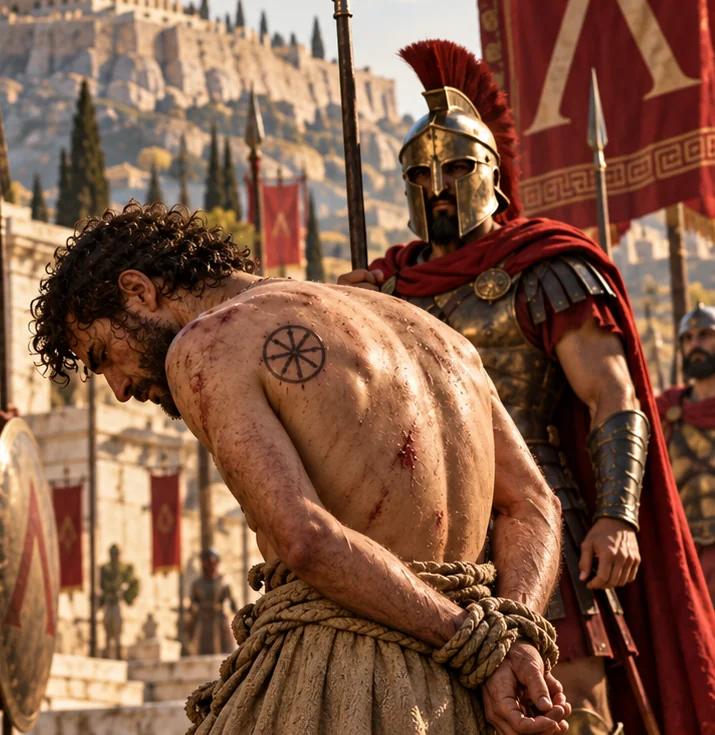
So far, we have explored civilizations in which tattoos could signify nobility, belonging, social rank, protection or closeness to the divine. Ancient Greece and Rome reveal a very different side of tattoo history. In the Greco-Roman world, permanent marks placed on the skin were often associated not with beauty but with punishment, slavery, captivity and disgrace. From this world comes one of the words we still use today to describe a social mark that is difficult to erase: stigma.
Tattoos, Greeks and “barbarians”
In the ancient Greek world, tattooing was strongly associated with peoples whom the Greeks regarded as foreigners or “barbarians”.
The Thracians are among the best-known examples. Greek art sometimes depicts Thracians, particularly Thracian women, with geometric and figurative markings on their arms, legs and other parts of the body.
The Persians also used permanent body marking.
Herodotus records that after the Battle of Thermopylae in 480 BC, the Persian king Xerxes ordered certain Thebans who had fallen into his hands to be marked with royal signs.
Within the Persian world, such markings could represent domination and the submission of the marked individual.
The Greeks themselves eventually adopted tattooing or permanent body marking as a method of punishment and identification.
Here we find one of the fundamental differences between Greco-Roman stigma and many tribal tattoo traditions:
in many cases, the person carrying the stigma did not choose it.
It was imposed.
From ornament to punishment
In Greek society, tattooing acquired strongly negative associations when it began to be used for slaves, prisoners and criminals.
The purpose was simple.
A permanent mark made a person easy to identify.
An escaped slave could change clothes, flee to another city or attempt to pass as a free person.
A visible mark on the forehead or hands was much harder to conceal.
Tattooing therefore became a method of control.
It was not merely a physical punishment but a social one: the individual permanently carried evidence of status or wrongdoing on the body.
The Romans adopted and further developed this use of body marking.
Tattooing slaves and criminals in the Roman world
Greek and Roman sources contain numerous references to slaves and condemned individuals carrying stigmata.
These marks could consist of letters, abbreviations or other inscriptions indicating the person’s status or punishment.
Ancient literature even includes references to runaway slaves carrying inscriptions on their faces that were difficult to hide.
Petronius’ famous Satyricon, for example, includes a scene in which characters attempt to disguise themselves as runaway slaves by imitating such facial inscriptions.
Modern accounts often repeat a formula equivalent to:
“Stop me, I am a runaway.”
Textual markings placed on runaway slaves are well documented, but an important distinction must be made: there is no direct evidence that this exact phrase was a universal standard used throughout the Roman Empire.
“Tax paid” – a more complicated story than it seems
One of the best-known stories about Roman slave tattooing claims that slaves transported into the province of Asia were tattooed with a mark meaning “tax paid”.
The story originates in an important legal inscription discovered at Ephesus known as the Customs Law of Asia or Lex Portorii Asiae.
Published in AD 62, the inscription records customs regulations for the Roman province of Asia.
One passage refers to the application of a mark or fiscal seal to slaves for whom customs duties had been paid.
Over time, some scholars interpreted this as referring to a tattoo or permanent bodily mark.
Others have suggested that it may instead have been a seal attached to a collar or another identification device.
For this reason, the image of a Roman slave literally carrying the words “Tax paid” tattooed on the forehead is a possible interpretation, but it should not be presented as an absolutely established fact.
Plato and body marking as punishment
Numerous Greek and Latin authors mention permanent body marking in the context of punishment.
A particularly clear example appears in Plato.
In the Laws, the philosopher discusses the punishment of temple robbery.
If the offender was a slave or foreigner, Plato proposed that the person’s misfortune or guilt should be inscribed on the forehead and hands, after which the offender should be whipped and expelled.
It is one of the clearest examples demonstrating the association between permanent marking of the skin and social punishment in the Greek world.
Caligula and stigma as humiliation
Tattooing and branding were not necessarily reserved for slaves.
The Roman historian Suetonius reports that Emperor Caligula ordered even men of high social standing to be disfigured with marks before being sent to the mines, road works or other forms of punishment.
For a free man or member of the upper classes, such punishment carried an additional meaning.
The stigma symbolically reduced him to the status of those deprived of freedom and honour.
Orpheus and the tattooed Thracian women
The connection between tattooing and the Thracian world appears dramatically in Greek art.
Numerous Greek vases dating from the fifth century BC depict the death of the legendary musician Orpheus.
According to myth, after the loss of his wife Eurydice, Orpheus was eventually killed by Thracian women.
On the vases, they are shown attacking him with various weapons: spears, knives, axes, stones and other objects.
But there is an extraordinary detail.
Many of the Thracian women are shown with tattoos.
Lines, dots, zigzags, spirals, stylised animals and other geometric motifs appear on their arms and sometimes their legs.
A vase attributed to the painter Hermonax, dating to approximately 470–450 BC, depicts tattooed Thracian women attacking Orpheus.
These images are among the most important visual sources for Thracian tattooing.
Several ancient traditions attempt to explain the tattoos worn by Thracian women. In some versions, they are associated with punishment; in others, with status, beauty or even the story of Orpheus himself.
The claim that the women specifically tattooed themselves to commemorate the killing of Orpheus and to warn unfaithful husbands of their fate, however, should be treated as a later interpretation rather than a proven historical fact.
Roman military tattoos – what do we really know?
One of the most fascinating questions concerns the marking of Roman soldiers.
Over time, the idea became widespread that Roman legionaries carried tattoos of the imperial eagle or the emblem of their legion.
There is indeed an important source that describes the marking of recruits.
The Roman military writer Vegetius, who probably wrote in the late fourth or early fifth century AD, states that a new recruit should not immediately receive the official mark applied by puncturing.
He first had to be tested.
Only after proving himself physically and personally suitable for military life could he receive the mark.
This description is extremely important in the history of military tattooing.
Vegetius, however, does not clearly describe what the mark looked like.
It may have been:
- a unit symbol;
- an imperial mark;
- an abbreviation;
- an administrative mark;
- or another official symbol.
It has sometimes been suggested that the mark could have been the Roman eagle or the emblem of the legion, but the evidence is insufficient to state this with certainty.
Did Hadrian’s soldiers have tattoos?
A popular claim holds that legionaries and auxiliaries serving at Hadrian’s Wall carried military tattoos.
The idea was popularised in part by British Roman archaeology specialist Lindsay Allason-Jones.
The difficulty lies in the chronology.
Hadrian ruled from AD 117 to 138, while Vegetius wrote more than two centuries later.
Vegetius’ text demonstrates the existence of some form of military marking in the later Roman army, but it does not automatically prove that exactly the same practice was used on every soldier stationed at Hadrian’s Wall in the second century.
It is an interesting hypothesis, but it should be presented as a hypothesis rather than an established fact.
Aëtius and one of the earliest technical descriptions of tattooing
One of the most fascinating sources for ancient tattooing techniques comes from the sixth century.
The Byzantine physician Aëtius of Amida preserved in his extensive medical compilation a detailed description of how a stigma was created.
He explains that such markings could be found on the face and other parts of the body and specifically mentions marks seen on the hands of soldiers.
His pigment recipe included several ingredients:
- burned or prepared plant material;
- corroded bronze;
- plant galls;
- vitriol;
- vinegar;
- water;
- leek juice.
Older translations provide various proportions for these ingredients.
It is more accurate to preserve the historical proportions rather than automatically converting ancient units into modern grams, because the exact value of historical units could vary according to period and region.
How was the tattoo made?
Aëtius’ description is surprisingly similar in basic principle to traditional hand tattooing.
First, the area was prepared.
The design was drawn on the skin.
The skin was then repeatedly punctured with needles until bleeding occurred.
Pigment was then rubbed into the freshly punctured surface.
In other words, the basic principle was:
repeated puncturing + introducing pigment into the skin.
This is also the fundamental concept underlying modern tattooing.
The enormous difference lies in depth control, equipment, pigments, hygiene and infection prevention.
An ancient procedure of this kind would be considered extremely risky in a professional modern tattoo studio.
BOX: What does “stigma” mean?
The word stigma comes from Greek.
The verb stizein meant roughly “to prick”, “to mark” or “to make a mark by puncturing”.
The resulting mark was a stigma.
Ancient texts do not always distinguish perfectly between tattooing, branding and, in some cases, markings produced through burning.
For this reason, historians must examine the context to determine which technique was probably used.
In Greco-Roman society, the stigma placed on a slave or criminal was more than a physical mark.
It represented social degradation.
From this comes the modern meaning of stigma: a characteristic or mark associated with shame, dishonour or exclusion.
Tattoo removal in Antiquity
If tattoos could serve as marks of slavery or crime, it is understandable that some people wanted to remove them.
Greek and Roman physicians described various procedures for eliminating stigmata.
Aëtius preserved several such recipes.
One method used substances similar to lime or gypsum together with sodium carbonate.
Another contained pepper, rue and honey.
The procedure was far more brutal than modern removal techniques.
The area could be treated with nitre or another caustic substance, followed by resin and several days of bandaging.
The tattoo could then be punctured again with a needle until it bled, after which salt was applied to the wounds.
Prepared substances were later applied and the area bandaged again.
Aëtius claimed that marks could be removed in approximately twenty days without significant scarring.
From the perspective of modern medicine, this claim should be treated with considerable caution.
The procedure effectively created a new controlled injury in the skin, with obvious risks of infection, chemical burns and scarring.
Other ancient removal methods
Aëtius was not the only author to describe such procedures.
Greco-Roman sources preserve different formulas intended either to remove pigment or to destroy the skin in which the pigment had been placed.
Some contained plants, minerals, natural acids and other caustic substances.
There are even accounts of mixtures that seem bizarre today, including preparations made with animal excrement and vinegar.
From a modern tattooing perspective, these techniques resemble a combination of abrasion, chemical cauterisation and traumatic removal of the skin.
Almost two thousand years would pass before the development of modern laser systems capable of selectively breaking down tattoo pigment.
Theophilos and the two monks “written on the face”
A dramatic episode in the later history of bodily stigma occurred in the Byzantine Empire.
During the iconoclastic conflicts, the Byzantine emperor Theophilos, who ruled from 829 to 842, persecuted the brothers and monks Theodore and Theophanes.
They defended the veneration of religious icons.
In 836, after refusing to abandon their position, twelve iambic verses were inscribed on their foreheads and faces.
Because of this punishment, the two became known as the Graptoi, meaning approximately “the written ones” or “the inscribed ones”.
The verses were not simply obscene lines, as some popular accounts suggest.
Their purpose was public humiliation and to present the two men as heretics and criminals.
It is a remarkable continuation of the ancient concept of stigma: the body became a surface on which authority could publicly write a person’s supposed guilt.
Constantine and the protection of the face
An important change took place during the reign of Constantine the Great.
Around AD 315–316, Constantine issued legislation concerning condemned people sent to the mines or gladiatorial punishment.
The law did not completely prohibit bodily marking.
It did, however, forbid placing the mark on the face.
The punishment could instead be marked on the hands or lower legs.
The reasoning behind the law is extraordinary: the human face, formed in the image of heavenly beauty, should not be defiled.
This change is also important in the development of Christian attitudes toward the human body.
Constantine, however, did not make Christianity the official religion of the Roman Empire in 325.
The Edict of Milan in 313 granted Christianity legal freedom of worship.
Nicene Christianity became the official religion of the Roman Empire only in 380, under Emperor Theodosius I through the Edict of Thessalonica.
Did the Church ban tattooing in 787?
This is one of the most frequently repeated stories in popular tattoo history.
It is often stated that:
“Pope Hadrian I banned tattooing in 787.”
The problem is that the statement, in this form, is incorrect.
The Second Council of Nicaea took place in 787, with the approval of Pope Hadrian I.
The council dealt primarily with the iconoclastic controversy and the legitimacy of venerating religious images.
There is no canon from this council establishing a universal prohibition on tattooing.
A papal mission and ecclesiastical council held in Northumbria in England around 786–787, however, discussed body marking in a much more nuanced way.
The surviving texts distinguished between marks made for pagan reasons and those endured or received “for God”.
In other words, Christian religious body marking was not necessarily treated in exactly the same way as markings associated with practices regarded as pagan.
This distinction is extremely important.
Tattooing did not disappear from the Christian world
For this reason, the claim that tattooing became completely unknown in Christian Europe until the nineteenth century is also incorrect.
The practice became much less common in certain European regions, but it did not disappear.
Christian pilgrims travelling to the Holy Land continued at various times to wear or receive permanent religious marks.
Crosses, the name of Christ, Jerusalem symbols and other pilgrimage marks were tattooed for centuries.
The tradition of Christian pilgrimage tattooing in Jerusalem survived into the modern era.
From imposed stigma to chosen tattoo
Perhaps the greatest difference between Greco-Roman tattooing and the way tattoos are understood today is the question of choice.
In a modern tattoo studio, a tattoo is normally chosen by the person who will wear it.
In Ancient Greece and Rome, many of the marks that we would today describe as tattoos served the opposite purpose.
They said:
this person is a slave.
this person ran away.
this person was condemned.
this person belongs to an institution.
The body became a permanent document.
Authority could write a person’s legal or social identity directly onto the skin.
It is precisely this use that explains why the Greco-Roman world contributed so strongly to the association between tattooing and the concept of stigma.
It is one of the darkest, yet also one of the most fascinating chapters in tattoo history.
From tattooed Thracian women depicted on Greek pottery to marked slaves, prisoners of war, Roman soldiers and condemned people, permanent marks on the skin told stories of power, belonging, shame and identity.
And the word that once described a mark pricked into the skin of a slave or condemned person has survived to the present day.
Stigma.