Siberut Island is a secluded jungle paradise located about 60 miles west of Padang, Indonesia. Although part of the Mentawai Islands—known to the world as the “last frontier of surfing”—Siberut remains extremely difficult to reach, especially if one wishes to visit the Mentawai people: a tribe covered in tattoos who are the very soul of the island.
To get there, you must endure a 10-hour journey on a swaying ferry, which is sure to exhaust anyone who cannot handle sea travel. The sea is so restless at night that by morning, the ferry reeks like a Roman vomitorium after a long night. Then, just when you think the hardest part is over, another six-hour challenge awaits: a dugout canoe, carved from a single tree trunk, waiting for you at the port. If it rains—which happens almost daily here—the journey in the narrow canoe becomes pure misery. But if the sun shines, you will literally bake in the heat like a piece of sago (the edible palm heart)! However, if you want to witness some of the world’s most beautiful tattoos and see how these people adorn themselves, the effort is well worth it. You will never forget it!
SAREREKET: The Local People
The Mentawai are an ancient tribe that has lived on Siberut Island for thousands of years. Although Christian missionaries and Muslims converted many Mentawai living in the southern parts near Pagai and Sipora in the 19th century, there remain areas where the ancient culture has stayed intact. And that is a significant achievement.
Following Indonesia’s independence in 1950, the new government launched an aggressive campaign to modernize the Mentawai people. Traditional cultural practices—such as tattooing, tooth filing, and wearing simple loincloths—were banned, as they were considered “pagan” or “savage.” Furthermore, every individual was required to join one of the official religions, whether Christianity or Islam.
Around the 1990s, the oppression of Mentawai traditions took a more brutal turn, as people were forced to move into new, government-established villages. The Mentawai religion (shamanism) was outlawed, and police confiscated the shamans’ (sikerei) goods, herbs, and sacred objects. Unfortunately, the very shamans who succeeded in preserving the rainforests and holding the community together were stripped of their basic human rights and placed outside the law.
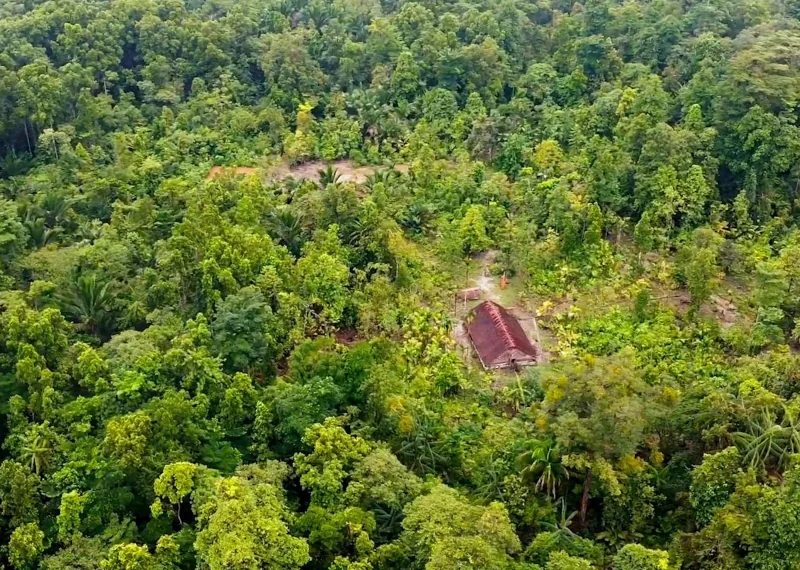
Fortunately, some Mentawai clans living deep in the island’s interior managed to escape this crisis and government “development.” One such group is the Sarereket, or the “local people,” who made the brave decision to leave their ancestral village of Ugai—a place where mosques, Catholic missions, and a modern port were being built—and move deeper into the jungle in hopes of saving their ancient culture.
WELCOME TO THE JUNGLE
The Mentawai jungle has always been a place where everything—plants, rocks, animals, and people—is surrounded by spirits (Kina). These spirits live in everything and everywhere: on the ground, in the sky, under the water, in the treetops, and inside the bamboo. They can speak and act just like humans. Some spirits help protect humanity, but there are also malevolent spirits who punish people with illness or misfortune.
When malaria infects the jungle, there is no doubt that human life is constantly threatened by disease. This is why the population has always remained at this level. The Mentawai try to explain the aggressive onset of illness as a lack of harmony between man and nature. To maintain this harmony, religious commands and codes must be followed at all times, every day, because violating them can have serious consequences.
Because of this, the Mentawai developed a complex system of taboos that regulates every action. For example, they live in total harmony with nature and only take what they need. Fruit is only eaten when it is in season and during specific ceremonies. For the rest of the year, they eat sago-based foods, various greens, and rice.
But taboos extend beyond breakfast, lunch, and dinner. In the founding of a marriage among the “humanitarian” Mentawai people, sex is taboo. If you wish to be “occupied,” you and your partner must leave the jungle and use a “love hut” hidden from the world. Before hunting, men do not wash their hair; otherwise, their arrows will not strike any game, or they will fall ill. When preparing poison for their arrows, men must not sleep or bathe that night. If they do, the hunted monkeys will die too high in the trees, or the poison will be diluted and ineffective. During the hunt, they must not beat their dogs, or the dogs will catch nothing.
The playful animals living in the jungle are believed to be the pets of the ancestors. A successful hunt is seen as a favor from the ancestors. The skulls of monkeys or other animals are hung in the village as a way of giving thanks to the spirits.
SIKEREI: The Guardian of the Forest
As mentioned, the core of the Mentawai faith is the importance of coexistence. Health is the overall picture of harmony and balance, something sacred and beautiful to the Mentawai. But if the balance is upset, the only way to restore it is to appease the spirits.
With the help of medicinal herbs, evil spirits are calmed; through magic and spoken sacrifices, they are fully appeased. In these cases, the shaman, or sikerei, is the mediator, as he is the only one capable of communicating with these spirits.
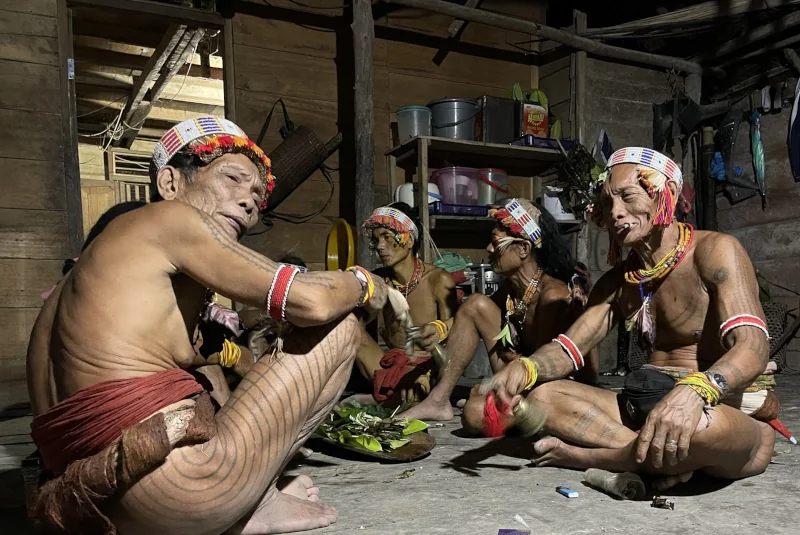
Aman Lao Lao is a sikerei, literally: “one who has magic power.” But he is not just a doctor. He is a leader, priest, pharmacist, psychologist, dancer, family man, and community man all in one. Furthermore, Mentawai society is egalitarian, yet shamans are regarded as the leaders of their people. The tribe has both spiritual and external world connections. Sometimes they travel to distant cities to meet government representatives to fight for their rights.
Since the Mentawai belief system is animistic and restricted by many taboos, it is the responsibility of Aman Lao Lao, the shaman, to maintain the balance between the worlds of humans, nature, and spirits. For Aman Lao Lao and other Mentawai shamans, nature is both religion and survival; they must know the forest inside and out to maintain harmony.
Illness can be treated with herbs, but on a spiritual level, the shaman’s intervention decides the patient’s fate. It is the sikerei who enters a trance and performs the magic that saves the soul.
Like many other ancient cultures, the Mentawai believe that all illness is nothing more than soul loss (ketsat). If the soul leaves the sick body, the result is death. Soul loss is usually caused by the spirits of illness and ghosts (sanitu). If a taboo is broken, many ceremonies are held to calm and persuade the spirits.
One of the most important shamanic rituals for broken taboos is the pasaksak. Once it begins, all work must stop, except for cooking and the rituals. Although the Mentawai have many pasaksak ceremonies—for cutting a tree, building a canoe or hut, marriage, funerals, hunting expeditions, initiation, foreign visitors, and tattooing healing rituals—every one of them is performed to appease the spirits of the jungle.
At the same time, another way for the Mentawai to preserve their soul is by decorating their bodies. Whether man or woman, if they do not respect their body, if they do not decorate it with beads, flowers, and especially sharpened teeth and tattoos, then the body ceases to be attractive to the soul. In this case, the soul may decide to leave its human host and move freely. If the soul does not return home, it may decide to return to the ancestral world, at which point the person must die.
Shamans like Aman Lao Lao, Aman Toshi, and Berit are all experts in self-beautification. Almost every day, they wear flowers in their hair, beads around their necks and wrists, and use face paint to highlight their features or rub their bodies with turmeric, which is “scented by the earth.”
The “Father” of Mentawai Tattoos
Providing for the soul is a fundamental principle of Mentawai life. And as a tool for permanent body decoration, tattooing is always at hand. Just like good food, music, and dance, it has religious significance that serves the benefit of the community members.
Traditionally, tattooing took place after a religious ceremony (Put Lepa). This was meant to drive out the evil influence of blood shed in the village or the Longhouse (UMA). As the name suggests, these are very long houses with many doors, and several people live in each room. The porch of the uma was built so that not a single drop of blood would fall to the ground. If it did, Paget Sabbau or Teteu (“Grandfather”) would soon appear, and a massive earthquake would occur. To better understand, according to myth, Paget Sabbau was the first Mentawai shaman who taught his people everything they know today, including tattooing. But the people became envious of his power and decided to kill him.
When they were building the first UMA, they sent Teteu down to dig in the center of the structure. When he was down there, the people lowered the building and trapped him underground. To avenge this, Teteu knocked down the uma with an earthquake. To redeem this sin, the Mentawai people began to offer sacrifices to the Great Father. Traditionally, these were performed in an uma under construction. Although these sacrifices are no longer performed in that way today, it is still considered a taboo for even a drop of blood to fall on the ground. Thus, if a chicken or pig is sacrificed, they are killed with an arrow or by wringing their necks. Paget Sabbau is so respected today that his name is a taboo, except in very serious conversations. Aman Lao Lao refuses to speak of him because his power was extremely great. The only time Teteu’s name is mentioned is when a new uma is built. Since Teteu loved dancing, they dance in his honor.
The Spirit of Mentawai Shaman Tattoos
Since the soul loves a beautiful and fully tattooed body, the Mentawai believe this allows them to take their physical essence with them into the afterlife. They believe that their tattoos (titi) allow their followers to recognize them after death. Most importantly, many types of tattoos are created specifically to protect people from the evil spirits lurking in the jungle.
The artist who applies the tattoos is called the Sipan, or “the man who makes the needle.” Tattoos are given at special moments in life. Traditionally, when a girl or boy reaches the age of seven, they receive their first tattoo on their back (though nowadays this often starts in adolescence). This is followed by the thighs and legs (usually before marriage), and then by complicated neck and chest tattoos. The final stage begins when an individual reaches 40, with tattoos applied to the forearms and calves.
Naturally, Mentawai clans have their own unique tattoos based on the stages of tattooing. Lao Bai Bai, Aman Lao Lao’s wife, who comes from another region, said her hands were tattooed first (in one day). Then she waited a year, after which her chest and back were tattooed (also in one day).
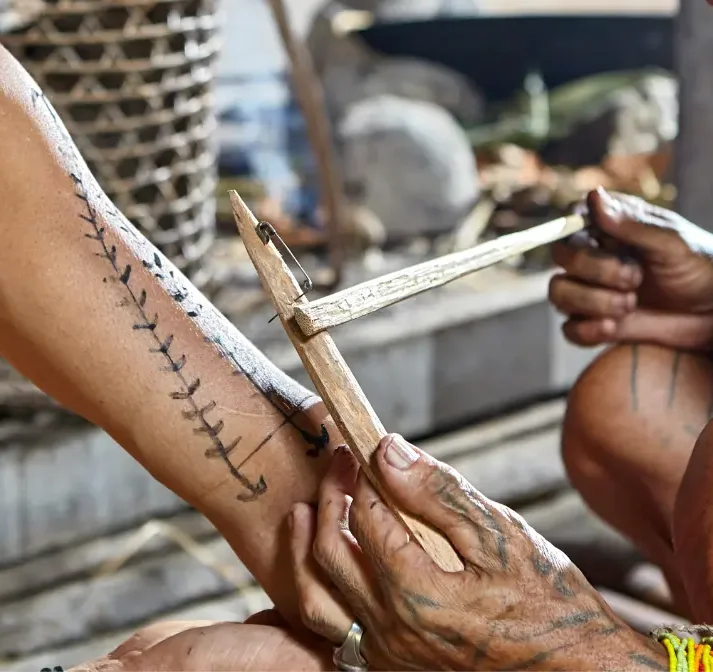
Traditionally, Mentawai tattooists sometimes use sharp pieces of bark as a tool on the skin. Others take a thorn pricked into a bamboo stick and tap it into the skin with a wooden mallet. While some indigenous groups use orange needles or lemon thorns, in Siberut, the tradition remains unique.
Among the Mentawai tribe, anyone can be a tattoo artist, but only those who are truly talented get work. Aman Beret, who tattooed me, learned from his father, who was a very respected artist. Unfortunately, there are few tattoo artists working in Siberut today, and Aman Beret’s own body is not fully covered in tattoos simply because there is no one left who could tattoo him perfectly.
Furthermore, tattooists like Aman Beret can no longer find apprentices with the necessary patience and talent. Of course, many can no longer afford tattoos either. The price for a lifetime of tattoos is high: a medium-sized pig, a Durian tree, four sago palms, a coconut palm, and a basket of chickens. But if you want to be a “true” woman, man, or shaman, tattoos are essential. This reflects the Mentawai ideology.
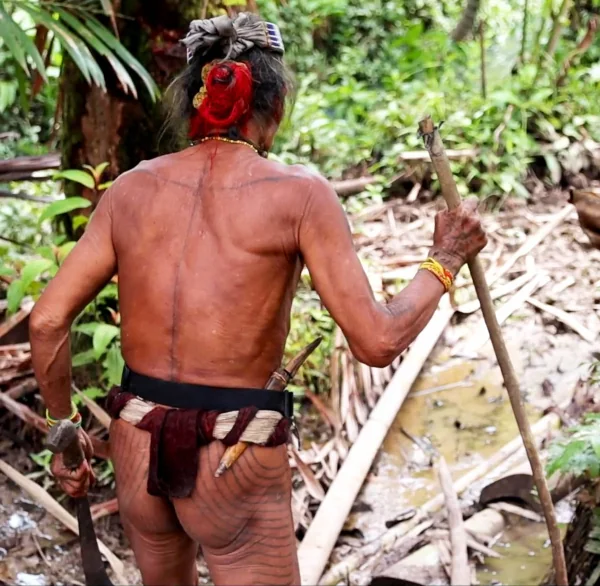
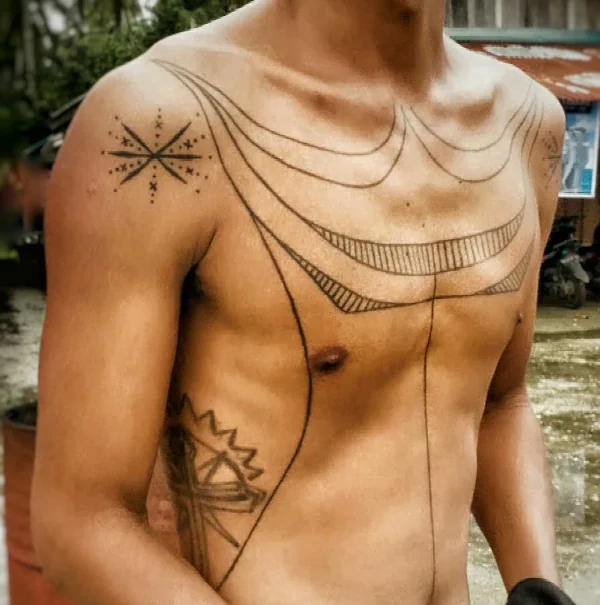
Tattoos distinguish regional identities. I was amazed that the natives I lived with could tell which community a person belonged to just by the style of their tattoos. In the past, great hunters were easily distinguished by the marks on their bodies and the tattoos on their shoulders. Even today, in parts of Siberut, intricate tattoos represent the “Tree of Life” or the sago palm on the body. Long jagged lines run along the arms, representing the prickly leaves of the tree; tattoos on the ankles or arms represent the roots, and curved lines on the chest represent the sago flower. Some elder Mentawai say the Tree of Life must be tattooed on every shaman because death cannot penetrate it. Of course, the sago palm is the people’s staple food and also what their livestock eats.
The residents of Butui told me that their tattoos do not necessarily represent the Tree of Life to them. For example, the spiked tattoo shapes on their arms represent the thorny leaves of the rattan palm. The small marks on the thighs and legs (resembling chicken feet) represent dog paws. This is a form of magic meant to help the person run as fast as a dog.
The complicated tattoos on the chest (dudukat) and the beads on the elbows (ngalou) bring the tattoos close to the soul. Rosettes tattooed on men’s shoulders (sepippurat) and similar bold patterns on women’s shoulders and backs symbolize that evil should slide off the body like raindrops off a flower. Naturally, no evil spirit should be able to find a person wearing such tattoos, as they form a kind of protective shield around the body.
An Uncertain Future
Deep in the forest, the sound of an illegal chainsaw can be heard constantly. What will remain of Siberut’s once-dense forests is unknown. Annual deforestation, which spreads like a plague, threatens not only biodiversity but also religious shamanism and the Mentawai tattooing rituals.
Aman Lao Lao always says: “Mentawai culture, including the practice of tattooing, depends on the existence and meaning of the dense forest. The destruction of the forest destroys these things, but my people can prevent this.” Ipai Aman, another elderly resident, said: “I am very worried about the loss of the forest and the tattooing traditions. All of this leads to the complete loss of our culture—from the uma buildings to sago agriculture.”
Despite being socially treated as second-class citizens on the island, the shamans of Butui rarely have the opportunity to speak out and voice their concerns. However, they are the voice of their people, and their voice cannot be silenced, as they will continue to fight for their rights. Ultimately, shamanism and the practice of tattooing have formed the foundation of Mentawai culture for millennia, and the Mentawai shaman remains their guardian.