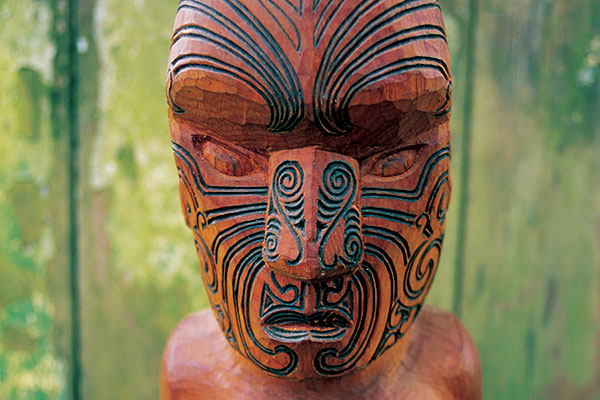
The word “tattoo” originates from the Tahitian word “tatau”. Captain James Cook used the word “tattow” when he witnessed a tattooing for the first time in his life in Tahiti in 1796.
According to Māori mythology, tattooing began thanks to a love story. The story is about the love between a young man named Mataora (Face of Vitality) and a young princess from the Underworld, Niwareka. One day, Mataora beat Niwareka, who left him and returned to her father’s kingdom, Uetonga. Mataora, heartbroken and plagued by guilt, set out to search for the princess. After many hardships and passing numerous trials, Mataora arrived in Uetonga, but the long journey had taken its toll; his face was dusty and filthy. Niwareka’s family mocked and humiliated the young man because of his distressed appearance. The humiliated Mataora begged for forgiveness, and Niwareka forgave him. Niwareka’s father offered to teach Mataora the art of tattooing. At the same time, Mataora learned the art of Taniko – weaving in multiple colours. After this, Mataora and Niwareka returned to the world of humans, bringing the arts of Moko and Taniko with them.
Ta Moko – Moko, the Process – the Product
According to archaeological sources, tattooing originated in New Zealand and spread toward the Eastern Polynesian culture. Bone chisels used for tattooing have been found at archaeologically distinct points in time in New Zealand, but also in some early Eastern Polynesian sites. Although the Māori practiced the art of tattooing, there is no evidence that non-Māori peoples did the same.
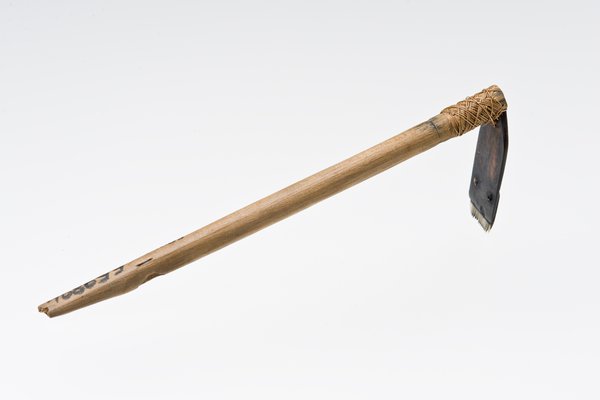
In early New Zealand, a large number of chisels were found, which confirms that initially, they preferred straight templates with more precise patterns.
The head was considered the most sacred part of the body, and because tattooing led to bleeding, it could only be performed by the most knowledgeable craftsmen or “tohunga-ta-oko”. These individuals occupied a high place on the social ladder. Every high-ranking person in the Māori tribe wore tattoos, and someone without any tattoos was simply considered to be without status or social rank.
Tattooing began in adolescence, accompanied by many customs and rituals. In addition to making a warrior more attractive in the eyes of women, tattooing had two other practical meanings: marking the entry into a stage of life and recording an important event in a person’s life.
There were certainly many taboos during the tattooing period: until the facial tattoos were completed, sexual relations and solid foods were forbidden. Instead, liquid foods were fed into the mouth using a wooden funnel, lest the infectious food touch the inflamed skin. This was also the only way for the tattooed person to receive nourishment until the wounds healed.
A full facial tattoo took a very long time, and a good artist carefully studied the bone structure of the face before beginning the execution of the artwork.
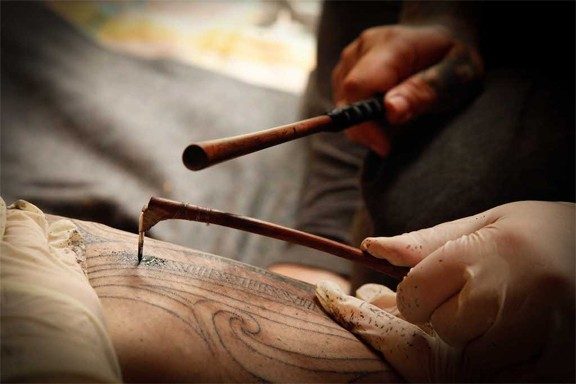
The tattooing tool was a bone instrument that had either a serrated or a straight edge. In the first phase of tattooing, deep incisions were made in the skin, then a chisel was dipped in sooty black pigment – e.g., burnt gum or burnt caterpillars – and tapped onto the skin.
It was a long and painful procedure, and often, Karaka tree leaves were placed on the deep cuts to speed up healing. Wars were frequent, and the warriors had little time for recovery. During the tattooing process, flute music and sung poetry were performed to ease the pain.
Although tattoos were primarily done on the face, warriors in North Auckland used double spiralled twists on their loins, which often descended to knee height.
Women were not tattooed to the same extent as men. The lines above the lips were usually tattooed dark, and the nostrils were very finely incised. The chin moko was always the most popular tattoo, the use of which lasted until the 1970s.
Moko Templates and Symbols
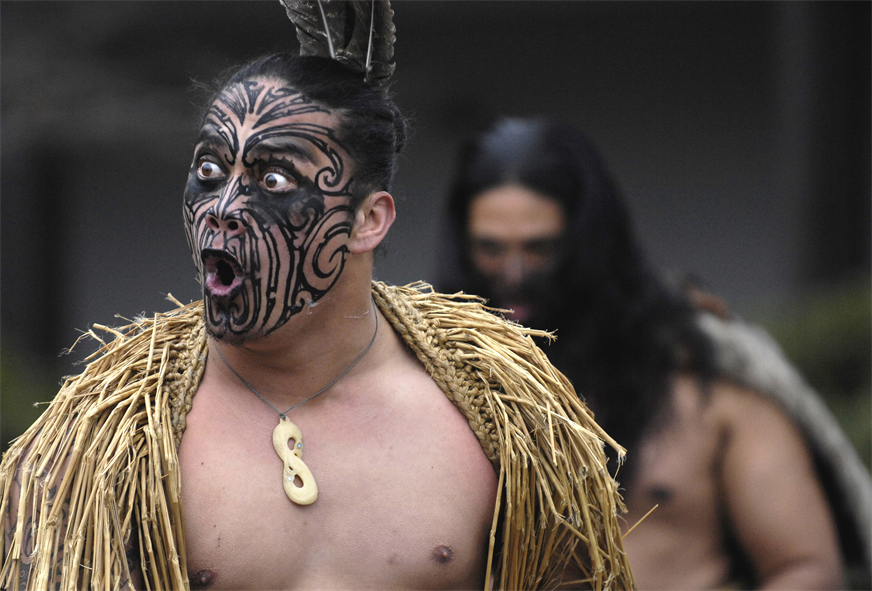
The Moko is like an identification card or a passport. For men, the Moko indicated rank, fighting prowess, or masculinity. The carrier’s power position and authority were immediately recognized in this Moko. Naturally, combined with other external signs, an individual Moko defined the carrier’s “identity.” For example, a chief’s Moko, also wearing a dog skin cloak, could be identified as a leader responsible for warriors.
These signs undoubtedly served the function of an “identity card.” It would have been a great insult if the person was not recognized as the true chief, and this could lead to “utu” (revenge).
The Moko facial tattoo is generally divided into eight parts:
| Māori Term | Area | Meaning |
| Ngakaipikirau | Center of the forehead | Rank and occupation |
| Ngunga | Around the eyebrows | Position on the social ladder |
| Uirere (rangul hapu) | Around the eyes and nose | Occupation |
| Uma | Temple | First or second marriage |
| Raurau | Area below the nose | A type of personal signature |
| Taiohou | Cheekbone | Occupation |
| Wairua (mana) | Tip of the chin | Inner position/spiritual power |
| Taitoto | Jawline | Social status (tattooed at birth) |
These markings have been applied to both sides of the face since ancient times. The left side (generally, but not obligatory, tribal affiliation) denotes the father’s side, while the right side indicates the maternal roots. Ancestry (whakapapa) is crucial information before the Moko is created. If one branch of the family was not considered high-ranking, the corresponding part of the face might not receive a Moko design. Similarly, the absence of a Moko tattoo in the center of the forehead showed that the wearer had no inherited social rank or status.
Māori tattooing is one of the world’s most distinctive tattoo arts, a sacred practice for the Māori people of New Zealand, which was likely introduced from the Eastern Polynesian islands.
The TA MOKO Tattoo
Traditional Māori tattoos are known as “TA MOKO” and consist of highly raised spiral designs covering the face and, in some cases, the buttocks and legs. In fact, the term “TA MOKO” refers to the tattooing process, while the finished artwork, the tattoo itself, is called “Moko”. However, as we shall see, the act of tattooing and the tattoo itself are two distinct branches according to Māori tradition.
The history of the Māori population is rather obscure, as is the history of Māori tattooing, but we have a mythical story:
According to legend, Ta Moko originated in the Underworld. When Mataora, a young warrior, fell in love with Niwareka, the princess of the Underworld, she agreed to come to our world and marry him. Because he treated her badly, they separated, and Niwareka returned to her father’s kingdom. Feeling guilty, Mataora descended into the depths to win back his love. He succeeded, and Niwareka’s father taught him the art of Māori tattooing. Mataora brought Ta Moko (and other skills) back to this world, and humans accepted them.
Māori tattooing is a very complex process. Knives and chisels, smooth or serrated, are used, and the ink is applied through incisions. It is perhaps unnecessary to say that it is a very painful process, but Māori tattooing is more than just mere ornamentation. The tattoos were proof of courage, strength, and power. Both men and women were tattooed, but women to a lesser extent. The tattooing procedure was a ritual accompanied by music and deep sleep, where sleep was practically a necessity because the face swelled severely due to the wounds inflicted by the tattooing.
The tattoo itself is extremely expressive, a complex pattern of intricate curves and spirals. Its creation begins in adolescence and records important events that occurred throughout life. It was an essential part of the culture. Indeed, those who did not wear a tattoo were considered outcasts, worthless, and outside of society.
Today, the traditional Māori tattoo, or “TA MOKO”, is almost entirely extinct, but tattoos of Māori origin are seeing a revival. Although Māori culture is currently experiencing a revitalization, it went through a period of decline after European colonization, when traditions like tattooing lost much of their original significance.
Modern Māori Tattooing
Tattoos derived from Māori origins have changed. Nowadays, many value those designs that have grown in popularity. Modern Māori tattoos are usually located on the body rather than the face and utilize modern tattooing methods.
Māori Population
The Māori are present today in New Zealand, where they arrived in the 13th century from Eastern Polynesia, which is why their language is related to the language of the people of Tahiti and the Cook Islands.
Some Māori oral traditions credit the discovery of New Zealand to Kupe, who arrived on these shores after setting off from the land known as Hawaiki. After exploring the islands and naming them AOTEAROA (Land of the Long White Cloud), he returned to his homeland to announce his discovery and prepare for a larger expedition. Scientific research suggests multiple waves of migration, but Māori tribes claim recognition of the fact that they are the descendants of the passengers of the seven canoes that first landed on the shores of New Zealand.
Social Organization
The main group in Māori society was the “iwi” (tribe), which was usually composed of several “hapu” (sub-tribes). Members of the tribe bear the prefix “ngati” or “ngai” in their name, meaning “descendant of someone” or “person of someone.” For example, Ngati Pikiao is a hapu (sub-tribe) that lives near Lake Rotorua. Together with other hapu in the Rotorua/Taupo area, they form the Te Arawa iwi (tribe), which traces its name to the canoe their ancestors arrived in Aotearoa on.
In pre-European Māori society, the hapu was more important than the iwi. The hapu fought against each other but sometimes united to confront an iwi. A hapu had several hundred members and consisted of a few “whanau” (extended families). A whanau of twenty to thirty members occupied one or more dwellings, often a large house inside the village. As they lived in a warrior society, the Māori built fortified villages, or “pa”, which they inhabited during conflicts. These villages were strategically placed, usually on hilltops, terraced, and surrounded by several concentric palisades laced with spears, attempting to deter the enemy. “Whakapapa” (genealogy) was very important in Māori tribal organization. During ceremonies, speakers recited lengthy family trees to prove their credibility.
Power belonged to the “Rangatira” (noble families). The eldest son of the family was the “ariki”, the hereditary chief, who passed on the power to his eldest son in the same way. Below the Rangatira were the “tutua” (common families) and at the bottom the “taurekareka” (slaves), who were captured in battle or born into slavery.
Another important class was represented by the “tohunga” (priests), who conducted religious and magical ceremonies, but also possessed knowledge of agriculture, carving, genealogy, and tattooing. With the arrival of the “pakeha” (Europeans), many tribes dispersed due to fighting, land confiscation, and the work of missionaries. To counteract the pakeha, the tribes attempted to unite in the 19th century, leading to the strengthening of the iwi over the hapu.
After World War II, the iwi became an important factor as the government established trust boards within their framework, which could represent Māori interests and, not least, claim compensation for non-compliance with the terms of the Waitangi Treaty.
Marae – a sacred meeting place where the Māori language and culture are promoted.
The urbanization that began in the middle of the 20th century undermined Māori identity; many lost contact with their tribes, which is why almost one-fifth of the Māori population does not know which iwi they belong to, and an even larger proportion does not know their hapu. Nevertheless, an increasing number of Māori are trying to rediscover their tribal roots through the marae – ancient meeting places.
Religion
Traditional Māori religion was based on the worship of ancestors and nature. Living beings and the forces of nature had “mauri” (life force). They were also the dwelling places of gods and demigods who demanded respect and peace, which was offered to them in ceremonies supervised by the priests.
Two important elements of Māori belief were mana and tapu. Mana – spiritual power or respect – could be acquired through valorous deeds, wisdom, eloquent speeches, inheritance, or… by consuming the enemy, thereby acquiring their mana. Great tribal chiefs had great mana.
Tapu (sacred or taboo, as Captain Cook translated it) encompassed a certain number of activities, such as certain fishing and hunting rules, and prohibitions related to the dead or sacred places. The punishment for non-compliance was death, which was either carried out by the tribe or the offender was afflicted by disease or plague.
Prophet Te Kooti
The Māori population was subjected to an extensive campaign of proselytization by missionaries in the 19th century, which shattered Māori society but not their traditional religion. As a result, two important Māori Christian sects were formed. The Ratana movement, founded in the early 19th century by a “medicine man,” remains an important political factor today with many members. Ringatu (Raised Hand), a less important movement also founded in the 19th century. Its founder was the guerrilla leader and prophet Te Kooti, who claimed 16,000 followers and influenced other movements, such as the Ngati Dread, a Rastafari Māori sect.
Mythology
Māori society preserved the myths of its Polynesian origins but adapted them to the new environment. The demigod Maui is a popular figure in Polynesian belief, and the Māori often tell stories of his deeds. Māori oral tradition preserves much about their origin and migrations, and tribal legends are recounted from memory.
Myths about the gods and nature formed the foundations of their religion. Although these vary from tribe to tribe, they tell the same creation story, from non-existence to the union of the Earth Mother (Papatuanuku) with the Sky Father (Ranginui). Rangi and Papa had many sons, the Māori gods, who lived in such a close parental embrace that not even light could penetrate. The gods, tired of the darkness, decided to separate their parents. They tried one after another, unsuccessfully, until finally, Tanemahuta, the god of the forest, succeeded with the strength of the kauri trees and separated the sky from the earth.
Light flooded the world and gave life to many creatures, and then Tane fashioned a woman from clay, and thus the human race was born.
Māori Art
Among the rich Māori music traditions, the best known is the Haka. The Haka is a warrior dance whose purpose was to intimidate the enemy. It is most often performed by the national rugby team (the All Blacks) to intimidate opponents. It is a terrifying performance, featuring rhythmic movements, brutal, rough striking of the body, angry glances, punctuated by sudden noises, followed by a hoarse chorus, whose aim is to cause horror and terror. Tourists can see the Haka dance performed by the Māori, where women also present the Poi dance, a graceful choreography that begins with swinging a ball made of poi (a type of flax fibre) on a rope.
The Māori were uniquely talented master carvers in the Pacific region. The construction of houses or canoes was a privileged task, using green stone before the appearance of steel tools, which arrived with the Europeans. The basic design of a Māori sculpture was human figures, mainly ancestors. Spirals are important elements, while the manaia is a well-known, interesting Māori Māori motif, depicted either as a bird or a snake with a human head. Sculpture also includes ornaments made of bone and green stone, as well as various staffs. The best-known ornament is the tiki – an artistic creation made of green stone, depicting a distorted human figure with its head turned to the side.
Traditional Māori Costume
The colder weather in New Zealand required warmer clothing, and Māori women are considered the best weavers in the Pacific region. The flax, which was abundant, was spun into yarn, from which cloaks, jackets, skirts, baskets, and other items were made. The most beautiful were the cloaks and capes decorated with feathers imported from abroad, which are rare today.
The Māori Language
Only 4% of the population speaks the Māori language, but this number is continually growing. The language is official and is also taught in schools. Kohanga reo (language nest) encourages children in some regions to immerse themselves in learning the language.
Some Words and Phrases in Māori
Māori words and phrases are becoming increasingly known in mass media and everyday language alike. Just like the words presented below, some geographical terms, such as awa (river), puke (hill), roto (lake), wai (water), and whanga (harbour), are useful for understanding the names of some places.
- kia ora: hello, but also means thank you
- haere mai: Welcome!
- haere ra: Goodbye!
- tena koa: please
- ae: yes
- kaore: no
- marae: tribal meeting place
- pa: fortified village
- Aotearoa: New Zealand (The Land of the Long White Cloud)
- tangata whenua: name for the inhabitants of the country
Māori words are increasingly used in everyday English, especially in mass media, where television shows often greet with kia ora (Hello/Welcome). At the same time, great emphasis is placed on the correct pronunciation of the words, even if they sound funny.