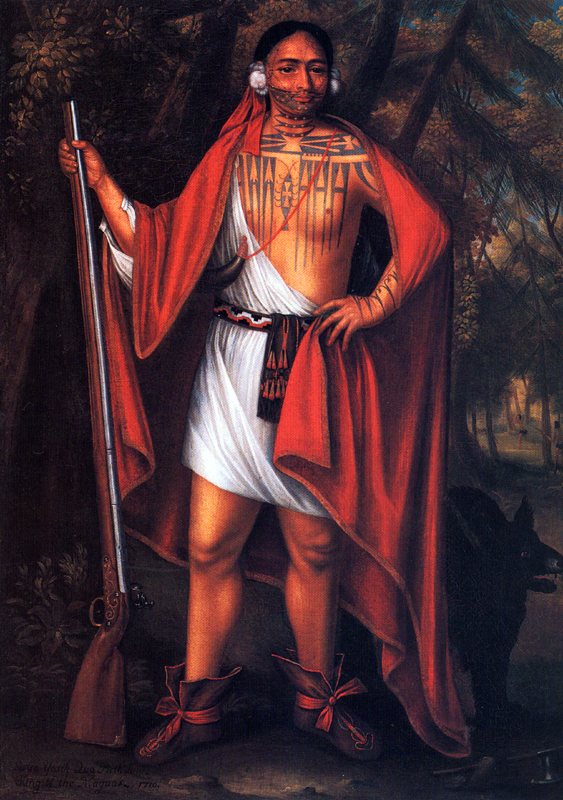
When the American writer, Lewis Henry Morgan, published his work on Iroquois culture in 1851, the tradition of tattooing had already faded among the people he described as so vibrant and colourful. Missionaries, much like the cessation of tribal warfare, compelled the native peoples to adapt to European culture and fashion, which favored fewer and non-permanent decorations on the body. This led to the decline of tattooing traditions.
The tattooing motifs worn by Iroquois warriors during the wars with King Philip (1675-1676) formed a unified line, connecting the hairline with scars sustained in battle. A Manitou tattoo was often painted near the mouth, and a bird near the sternum. On the back of the figure, several headless figures could be seen, representing the number of enemies killed.
Although the tradition of tattooing was once widespread in the northeastern regions, surprisingly little historical evidence remains that provides data on the use, form, and significance of this indelible art. In fact, the only substantial proof of this long-faded art comes from documents preserved from the early 18th century and a few surviving portraits of tattooed group leaders.
Given the scarcity of documentation concerning tattoos in this region—due to scarce, unfinished, and not sufficiently thorough research—I will attempt to clarify some facts related to this tradition in this article. My goal is to reveal what lies hidden behind these symbols by observing the warrior groups and photographs of tattoos, where the warriors’ markings are clearly visible.
👣 In the Footsteps of the Warriors
Up until the 18th century, the surviving Iroquois nations—the Mohawk, Oneida, Onondaga, Cayuga, Seneca, and Tuscarora—regarded themselves as the United Nations, reminding themselves that their safety and strength lay in strict tribal laws. Other groups, such as the Mohicans, neighbors to the Mohawks, soon formed an alliance in 1640, even if their relationship was sometimes fraught with tension.
The Iroquois tribal nations were closely linked to others through marriage, and whenever the war cry sounded, they summoned all related tribes to their aid. Generally speaking, warfare was not about acquiring natural resources or conquering new territories; it was more of an endless cycle that demanded many bloody sacrifices and violent deaths.
As soon as an Iroquois warrior achieved the rank of man, he was gifted a new name, which he received from a list maintained by a chief. Around the same time, the young man was encouraged to wander alone in the wilderness until he found his own Manitou, who would protect him in battles for the rest of his life. Sometimes a man’s Manitou was the Sun or another celestial body. However, if the Manitou was an animal, its skin or feathers would be worn by the Indian during battles and journeys, as it was believed they carried the animal’s spirit.
An elaborately decorated Onondanga war club, which belonged to a great war chief and dates back to 1760. Four small circles indicate that he was wounded by a gunshot four times. On one side of the weapon, 13 armed figures can be seen. The other side details the campaigns he participated in, regardless of whether he was injured during them or not.
A warrior’s Manitou was often painted on his skin or face. When the young warrior dreamt, it was considered a divine sign or a warning from his assistant, who was connected to the master: the God of War (Areskoui) and the Creator (Master of Life), who were identified with the Sun. These messages had to be taken seriously, no matter how absurd they seemed.
Almost every Iroquois man’s tattoo served as a distinguishing mark. According to the records of the Dutch merchant Evert Wendell on August 13, 1706, a young man named Tan Na Eedsies visited Wendell in New York and sealed his transaction with a pictogram next to his signature. The drawing titled Tan Na Eedsies and his facial, neck, and chest tattoos were equivalent to a signature. Tan Na’s facial tattoos symbolized his ethnographic affiliation, associated with a Manitou snake and several Manitou birds near the forehead and nose, in addition to several tattoos on his neck.
Sometimes the warrior’s Manitou was carved into his weapon. The German writer Johann Kohl met an Ojibway warrior in Wisconsin in 1850 who possessed such an engraved weapon. This man explained in detail the personal message of his weapon, recounting the dream of his life and the vision through which he found his Manitou, an eagle, which he hunted for ten days in order to finally acquire it.
Warriors naturally engraved their military rank, enemies, and the number of captives or killed foes onto their weapons. They also carved their personal tattooing patterns onto their deadly weapons. This custom not only demonstrated the warrior’s bravery and aptitude but also had a psychological effect on his enemies, as it was an ancient tradition to leave one’s weapon stuck in a corpse on the battlefield to be recognized as the victor.
A very rare Iroquois weapon, dating back to the 17th century and found on a Massachusetts battlefield, contained all the aforementioned motifs. Dating from the time of King Philip (1675-1676), it features numerous facial tattoos that reveal much about the weapon’s owner, who likely belonged to the Seneca or Mohawk tribe, judging by his tattoos. A rare document discovered in 1791 concluded that the circles carved into the weapon actually symbolized the number of decapitated people. Other signs, such as arrows, probably indicate the number of times the warrior was wounded in battle, information supported by other historical records. Another interesting pattern resembles a sun-scorched mark that extended from the warrior’s lips to his face.
Earlier in this article, we mentioned sun symbols, embodying birds or other animals, which were recognized as Manitou spirits, and were usually painted on the body. Tattoos placed near the mouth were not accidental, as the mouth represented the gateway to the soul. This significance can be substantiated, as the American Indian National Museum holds a weapon symbolizing a snake (Manitou), signifying death consuming its victims, according to archaeologist Edmund Carpenter.
Portraits of other 18th-century Iroquois warriors shed light on the meanings of tattoos. One such portrait is that of the Mohawk warrior, Onigoheriago, who was painted and drawn during a visit to England in 1710. The warrior wore Manitou and V-shaped tattoos at the base of his scalp, which likely marked the number of wounds received in battle.
This warrior’s Manitou was actually composed of multiple symbols taking the form of a bird, combined with several sun symbols. The warrior also wore a Manitou bird on his chest.
Historical sources suggest that V-shaped tattoos on the sternum and chest area date back to the time of the ancient Seneca, Mohawk, and Cherokee tribes. It appears that sternum tattoos persisted for a longer period than facial tattoos, with a later example being a miniature oil painting depicting the Oneida leader Good Peter, created in 1795.
From the perspective of warfare, we can be sure that a warrior tattooed a Manitou bird on himself solely to deceive the enemy and be unnoticeable, allowing him to move quickly.
Some tribes imitated the trill of certain predatory birds as a war cry when decapitating their enemies. They believed that these birds were the messengers of the superior being (the symbol of the Sun). This appears to be an ancient canon by which a warrior identifies with a bird, as combat itself represented a mythical endeavor.