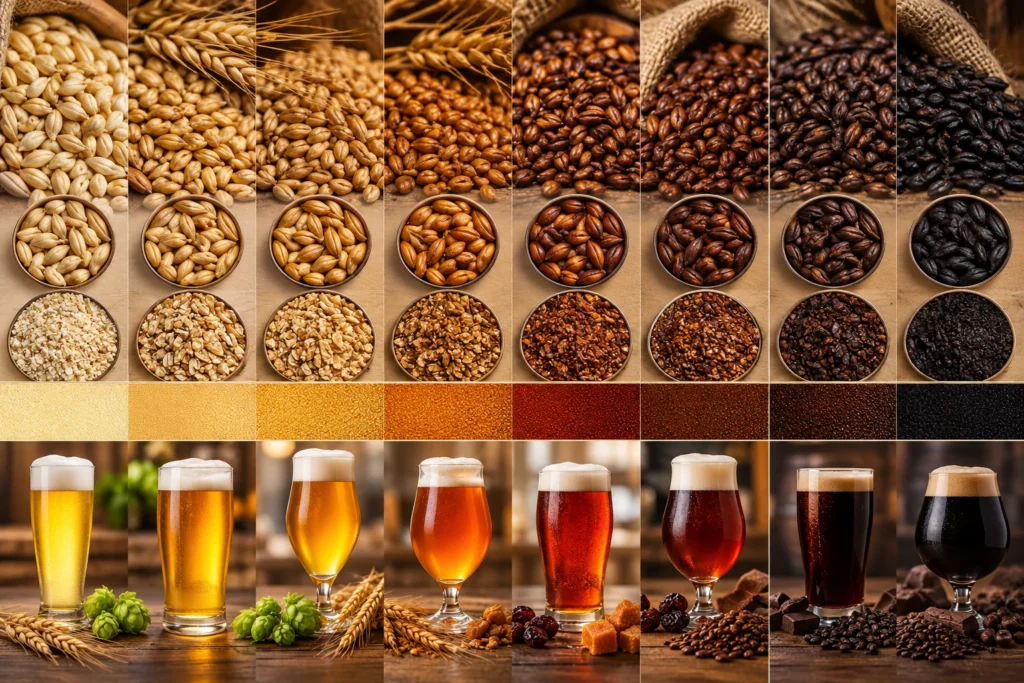
Malt is one of the four fundamental ingredients of beer, together with water, hops, and yeast. While hops may provide some of the most recognizable aromas in modern craft beer, malt creates the foundation on which the entire beer is built.
It provides the sugars required for fermentation, but its role goes much further. The malts you choose influence the color, body, sweetness, foam, mouthfeel, aroma, and overall flavor of the finished beer.
A crisp Pilsner, a malty Märzen, a caramel-rich Amber Ale, a creamy Stout, and a modern Hazy IPA can all begin with malted grain, yet taste completely different because of the grains selected and the way they are used.
For a beginner, the enormous selection of brewing malts can seem complicated. Pilsner, Pale Ale, Vienna, Munich, Crystal, Carapils, Chocolate, Carafa, roasted barley — what does each one actually do?
The easiest way to understand malt is not to memorize hundreds of products. Instead, learn the main types of malt used in homebrewing, understand what each category contributes, and then learn how to combine them.
This guide explains the fundamentals.
What Is Malt?
Most brewing malt is produced from barley, although wheat, rye, oats, and other cereal grains can also be malted.
A grain of barley contains a large reserve of starch. This starch is extremely valuable to a brewer because it can eventually become fermentable sugar.
However, brewing yeast cannot simply consume raw starch.
Before barley becomes useful for brewing, it goes through a process called malting.
During malting, the grain is soaked in water and allowed to begin germinating. This activates and develops enzymes and begins modifying the internal structure of the grain.
Before the barley grows into a new plant, germination is stopped by drying it in a kiln.
This creates malt.
The temperature, duration, moisture level, and roasting or kilning method used during production determine what kind of malt is produced.
A gently kilned malt may remain very pale and retain strong enzymatic activity.
A more intensely kilned malt develops deeper bread, biscuit, toast, and nutty flavors.
At still higher temperatures, the grain can develop caramel, chocolate, coffee, and deeply roasted characteristics.
This is why malt provides brewers with such a broad range of colors and flavors.
Why Is Malt So Important in Beer?
It is easy to think of malt simply as the ingredient that provides sugar for fermentation.
That is only part of its role.
Malt influences almost every important characteristic of beer.
Malt Provides Fermentable Sugars
During the mash, crushed malt is mixed with warm water.
Enzymes present in the malt break large starch molecules into smaller sugars.
Brewing yeast can ferment many of these sugars, converting them primarily into alcohol and carbon dioxide.
Without this conversion, conventional beer fermentation would not be possible.
This is why enzymatically active base malt normally makes up the majority of an all-grain recipe.
Malt Determines Much of the Beer’s Flavor
Different malts can create dramatically different flavors.
Depending on the malt and how it was produced, you may find characteristics such as:
- fresh grain
- white bread
- bread crust
- biscuit
- toast
- honey
- nuts
- caramel
- toffee
- dried fruit
- raisins
- dark sugar
- chocolate
- cocoa
- coffee
- roast
- smoke
A very pale lager may rely almost entirely on the delicate grain character of Pilsner Malt.
An English ale may use Maris Otter for a richer biscuit-like malt foundation.
A Belgian dark beer may contain Special B for raisins and dark dried-fruit notes.
A Stout may use roasted barley and Chocolate Malt for coffee, cocoa, and roast.
The brewer builds flavor by selecting malts that complement one another.
Malt Controls Beer Color
Malt is also the main source of beer color.
Pale base malts can produce beers ranging from straw yellow to gold.
Vienna and Munich malts can move the color toward deeper gold, amber, and copper.
Crystal and darker specialty malts can produce amber, red, brown, and deep mahogany tones.
Chocolate Malt, Black Malt, roasted barley, and other highly roasted grains can produce beers that appear almost completely black.
An important point for beginners is that a small amount of dark malt can have a very large effect on color.
You do not need a grain bill made primarily from dark malt to make a dark beer.
Malt Influences Body and Mouthfeel
Two beers with similar alcohol content can feel completely different in the mouth.
One may be light, crisp, and dry.
Another may feel full, soft, creamy, or silky.
Malt selection contributes to these differences.
Dextrin malts can support body and head retention.
Wheat can add protein and improve foam.
Oats can create a softer, silkier mouthfeel.
Crystal malts can increase the impression of fullness and sweetness.
The mash schedule also plays a major role, so malt selection and mash temperature should always be considered together.
Malt and Beer Foam
A stable head is not created by carbonation alone.
Proteins and other compounds from malt and grain contribute significantly to foam formation and retention.
Wheat is particularly useful for this reason, but barley, dextrin malts, and certain flaked grains can also help.
This is why a brewer may add a relatively small amount of wheat to a Pale Ale or IPA even when no obvious wheat flavor is desired.
The goal may simply be better foam and mouthfeel.
The Main Types of Malt Used in Homebrewing
For practical recipe design, brewing malts and grains can be divided into several broad categories:
- Base Malts
- Caramel and Crystal Malts
- Specialty Malts
- Roasted and Color Malts
- Malted and Flaked Grains / Adjuncts
These categories are not perfect scientific boundaries, and some products can overlap between groups, but they provide an excellent framework for learning recipe design.
1. Base Malts
Base malt is the foundation of most all-grain beer recipes.
It usually makes up approximately 70–100% of the grain bill, although some specialty recipes may fall outside this range.
Base malts provide:
- most of the fermentable extract
- enzymes required for starch conversion
- the fundamental malt flavor
- a large part of the beer’s color
Because they are kilned relatively gently, they retain enough enzymatic activity to convert their own starch during mashing.
Some base malts also have enough enzymatic power to help convert starch from adjuncts with little or no enzymatic activity.
Common Base Malts
Important examples include:
Pilsner Malt
Very pale and delicate, with clean grain, light bread, and subtle honey-like sweetness. It is a classic choice for Pilsner, Helles, Kölsch, Belgian beer, and many other pale styles.
Pale Ale Malt
Slightly richer and more deeply kilned than Pilsner Malt. It commonly provides bread, biscuit, and light toasted characteristics and works extremely well in Pale Ale, IPA, Porter, and many other ales.
Maris Otter
A classic British base malt with a richer, more distinctive malt character. It can contribute biscuit, bread crust, and subtle nutty flavors.
Golden Promise
A traditional Scottish barley variety with a soft, slightly sweet, clean malt profile. It has become popular in modern Pale Ale and IPA recipes as well.
Vienna Malt
Provides deeper golden color with bread, light toast, honey, and mild biscuit characteristics.
Munich Malt
Produces a much richer malt character, with bread crust, toast, and strong malty flavors. It is especially useful in Märzen, Bock, Dunkel, Vienna Lager, and other malt-forward beers.
Base malt selection alone can significantly change the personality of a beer.
2. Caramel and Crystal Malts
Crystal and Caramel Malts are primarily used to influence:
- sweetness
- body
- color
- caramel character
- flavor complexity
Unlike base malt, they generally have little useful enzymatic power.
During production, the moist grain is heated in a way that allows starch conversion to occur inside the kernel. Further heating develops caramelized sugars and increasingly intense flavors.
The result can range from delicate honey and light caramel to toffee, raisins, dark fruit, and burnt sugar.
Light Crystal Malts
Lighter varieties may provide:
- honey
- light caramel
- subtle sweetness
- gentle biscuit
These can work well in Pale Ale, Bitter, Amber Ale, and similar styles.
Medium Crystal Malts
Medium varieties move toward:
- caramel
- toffee
- toasted sugar
- bread crust
They are common in Amber Ale, ESB, Red Ale, Brown Ale, and traditional IPA recipes.
Dark Crystal Malts
Dark versions may produce:
- raisins
- dried fruit
- dark caramel
- burnt sugar
- molasses-like flavors
These are useful in stronger and darker beers but can easily dominate a recipe if used excessively.
What Do Crystal 20, 40, 60 and 120 Mean?
Crystal malt is often sold with numbers such as Crystal 20, Crystal 40, Crystal 60, or Crystal 120.
In products using this naming convention, the number usually refers approximately to the malt’s color in degrees Lovibond.
As the number increases, the malt generally becomes darker and its flavor changes.
A light Crystal malt may taste sweet and gently caramel-like.
A much darker Crystal malt can move toward dried fruit, raisins, burnt sugar, and molasses.
Always check the maltster’s specifications because products with similar names can differ.
3. Specialty Malts
Specialty malts are the seasoning of the grain bill.
They are generally used in smaller quantities to modify specific characteristics of the beer.
They can influence:
- malt aroma
- body
- foam
- mouthfeel
- toastiness
- color
- complexity
Examples include Carapils, Melanoidin Malt, Biscuit Malt, Victory Malt, Aromatic Malt, and Abbey Malt.
Carapils and Dextrin Malt
These pale specialty malts are commonly used to support body, mouthfeel, and head retention without adding large amounts of color or strong flavor.
They can be useful in Lager, Pilsner, Pale Ale, IPA, and Blonde Ale.
Melanoidin Malt
Melanoidin Malt produces an intense rich malt character with bread crust, honey, and toasted notes.
It can be particularly useful in Märzen, Bock, Vienna Lager, and other malt-forward beers.
Biscuit and Victory Malt
These malts provide dry toasted, cracker, biscuit, and nutty characteristics.
They can add complexity to Amber Ale, Brown Ale, Porter, and many other styles.
Aromatic Malt
Aromatic Malt contributes a powerful malt aroma with bread, honey, and rich malty flavors.
Because many specialty malts are intense, more is not necessarily better.
A small quantity may be enough to create the desired effect.
4. Roasted and Color Malts
Roasted malts are exposed to much higher temperatures during production.
They are responsible for many of the chocolate, coffee, roasted, and burnt characteristics associated with dark beer.
Common examples include:
- Pale Chocolate Malt
- Chocolate Malt
- Black Malt
- Carafa
- Carafa Special
- Roasted Barley
Technically, roasted barley is not malt because it is roasted without first being malted, but from a recipe-design perspective it is often discussed alongside roasted malts.
Pale Chocolate Malt
Pale Chocolate Malt provides softer chocolate, nuts, toast, and gentle coffee notes.
It is useful when a brewer wants chocolate complexity without an extremely aggressive roast character.
Chocolate Malt
Chocolate Malt produces deeper cocoa, dark chocolate, coffee, and roasted flavors.
It is common in Porter, Stout, Brown Ale, and other dark beers.
Black Malt
Black Malt is much more intensely roasted.
It can provide:
- very dark color
- strong coffee
- burnt toast
- dry roast
- sometimes smoky or ashy notes
Only small amounts may be required.
Roasted Barley
Roasted Barley is one of the classic ingredients of Irish Dry Stout.
It contributes:
- coffee
- dry roast
- burnt grain
- deep dark color
- a characteristic dry finish
Carafa Special
Dehusked or husk-reduced dark malts such as Carafa Special can provide dark color and roasted character with less harshness and astringency.
This makes them particularly useful for dark lagers and other beers where deep color is desired without aggressive burnt flavor.
5. Wheat, Rye and Flaked Grains
Not every grain in a beer recipe needs to be conventional malted barley.
Other grains can play an important role in body, foam, flavor, and texture.
Wheat Malt
Wheat Malt is high in protein and is excellent for improving foam formation and retention.
It contributes:
- soft grain character
- body
- creamy texture
- stable foam
It can make up a large part of the grain bill in Hefeweizen and other wheat beers.
In Pale Ale or IPA, much smaller quantities may be used simply to improve foam and mouthfeel.
Because wheat has no husk, very high percentages can make lautering more difficult.
Rye Malt
Rye provides a distinctive spicy grain character and can create a rich mouthfeel.
It is particularly suitable for:
- Rye IPA
- Roggenbier
- Saison
- specialty ales
Rye can make the mash sticky, especially at higher percentages, so it requires more attention during lautering.
Flaked Oats
Flaked oats are extremely popular in modern Hazy IPA and NEIPA.
They contribute:
- silky mouthfeel
- creaminess
- body
- haze
They are also a classic ingredient in Oatmeal Stout.
Flaked Wheat
Flaked wheat contributes protein, body, haze, and excellent foam stability.
It is commonly used in Witbier and modern hazy beer styles.
Flaked Barley
Flaked barley adds creaminess and body and can significantly improve head retention.
It is a traditional ingredient in Irish Stout.
Corn and Rice
Corn and rice are often misunderstood because they are sometimes associated only with inexpensive industrial lager.
However, they are legitimate brewing ingredients when used intentionally.
Corn can lighten the body and contribute a subtle sweetness.
Rice is very neutral and can make a beer lighter, cleaner, and drier.
The important question is not whether an ingredient is traditional, expensive, or fashionable.
The important question is:
What does it contribute to the beer?
How Much Specialty Malt Should You Use?
There is no single percentage that works for every recipe.
A good starting principle is:
Let the base malt build the beer and use specialty malt to make specific adjustments.
For example, a simple Pale Ale might contain:
- 90–95% base malt
- 5–10% specialty malt
A Hazy IPA might contain:
- base malt
- wheat
- oats
- possibly a small amount of dextrin malt
A Porter might contain:
- base malt
- Crystal Malt
- Chocolate Malt
- a small amount of darker roasted malt
A Stout might contain:
- base malt
- flaked barley or oats
- Roasted Barley
- Chocolate Malt
These are examples, not fixed formulas.
The correct amount depends on the character you want to create.
More Malts Do Not Automatically Make Better Beer
This is one of the most useful lessons when learning recipe design.
A beginner may look at ten different malts and think:
“If each one adds something good, using all of them should make an even better beer.”
Usually, it does not work that way.
When too many specialty malts are combined without a clear purpose, their individual characteristics can become difficult to distinguish.
The beer may simply taste generically “malty,” overly sweet, muddy, or unnecessarily complicated.
Some excellent beers contain only one malt.
Many outstanding recipes use only two or three.
Every malt in a recipe should ideally answer a simple question:
Why is it here?
If you cannot answer that question, the malt may not be necessary.
Malt Color: EBC, SRM and Lovibond
Malt specifications usually include a color value.
European maltsters commonly use EBC, while North American brewing frequently uses Lovibond (°L) for malt and SRM for finished beer color.
Higher values indicate darker color.
However, color should never be confused with flavor.
Two malts with similar color values may taste very different because they were produced using different processes.
Color is useful information, but it is only one part of malt selection.
What Is Diastatic Power?
Diastatic power describes a malt’s ability to enzymatically convert starch into fermentable sugars.
Base malts generally have sufficient enzymatic power to convert their own starch.
Some can also convert starch from adjunct grains.
Crystal, roasted, and many specialty malts have little or no useful enzymatic activity.
This becomes particularly important when a recipe contains a large amount of unmalted grain or other starch-rich adjuncts.
There must be enough enzymatically active base malt in the mash to achieve proper conversion.
For most ordinary homebrew recipes built primarily around base malt, this is rarely a problem.
Malt and Mash Temperature
The malt bill is only part of the equation.
Mash temperature can change how fermentable the resulting wort becomes.
As a general guideline, a mash around:
63–65°C
tends to favor a more fermentable wort, often producing a drier beer with a lower final gravity.
A mash around:
67–69°C
generally favors a less fermentable wort and can contribute to a fuller body and higher final gravity.
This means that exactly the same malt bill can produce noticeably different beer depending on how it is mashed.
Recipe design therefore involves both ingredient selection and process.
How to Choose Malt for Your First Recipes
When building a recipe, start with the style and the character you want in the glass.
For a clean pale lager, Pilsner Malt may provide almost everything you need.
For a Pale Ale or IPA, Pale Ale Malt can provide a clean but slightly richer foundation.
For a British ale, Maris Otter can create a more recognizable biscuit-like malt character.
For a maltier lager, Vienna or Munich Malt can add bread and toast.
If you want caramel, add an appropriate Crystal Malt.
If you want chocolate, consider Chocolate Malt.
If you want dry coffee-like roast, Roasted Barley may be appropriate.
If you want a silky mouthfeel, oats can help.
If you want stronger foam, wheat may be useful.
Think about the desired result first and choose the ingredient second.
Taste Your Malt
One of the simplest ways to become better at recipe design is also one of the most overlooked:
Taste the grain.
Before brewing, take a few kernels and chew them.
Taste Pilsner Malt.
Then taste Pale Ale Malt.
Compare Vienna with Munich.
Try Crystal Malt.
Then carefully taste Chocolate Malt and Roasted Barley.
The differences become immediately understandable.
Numbers and descriptions are useful, but tasting the actual ingredient creates a much stronger memory.
Over time, you begin to imagine the malt bill before the beer is even brewed.
Final Thoughts
Learning the different types of malt used in homebrewing is not about memorizing every malt available on the market.
It is about understanding their purpose.
Base malt provides the foundation and most of the fermentable extract.
Crystal and Caramel Malts add sweetness, body, color, and caramelized flavors.
Specialty malts allow smaller adjustments to malt aroma, toastiness, foam, and mouthfeel.
Roasted malts create chocolate, coffee, roast, and dark color.
Wheat, rye, oats, barley, corn, and rice allow the brewer to further shape texture, foam, dryness, and drinkability.
Once these basic groups become familiar, recipe design becomes much easier.
Instead of asking:
“Which malts should I put into my beer?”
start asking:
“What do I want this beer to taste and feel like — and which malt will help me achieve that?”
That change in thinking is one of the first steps from following recipes to creating your own beer.