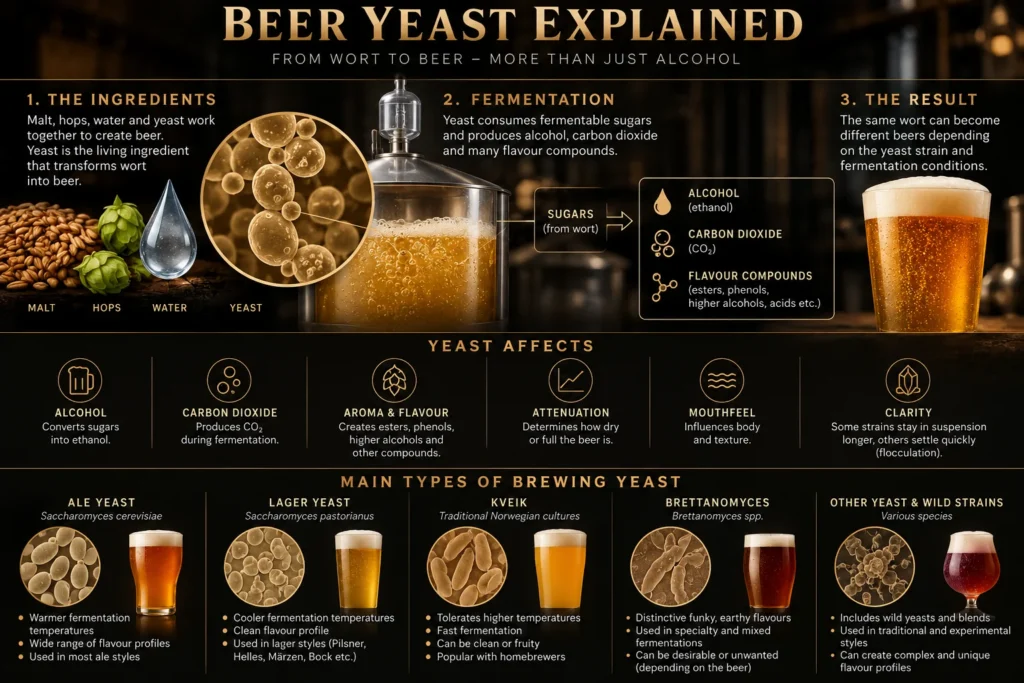
When people first start brewing beer, malt and hops usually get most of the attention. Malt determines much of the colour and body, hops provide bitterness and aroma, and water makes up the majority of the finished beer. Yeast can easily seem like the ingredient with the simplest job: add it to the wort and wait for fermentation.
But yeast is far more than a tool for producing alcohol.
Yeast is a living microorganism responsible for transforming wort into beer. During fermentation, it consumes fermentable sugars and produces alcohol and carbon dioxide, but at the same time it creates a wide range of flavour and aroma compounds. The yeast strain you choose, the temperature at which you ferment, the amount of yeast pitched, wort composition, oxygen availability and fermentation conditions can all influence the character of the finished beer.
The same wort fermented with two different yeast strains can become two noticeably different beers.
Understanding yeast is therefore one of the most useful steps a homebrewer can take toward producing better and, importantly, more consistent beer.
In this first article of the yeast series, we will look at what brewing yeast actually is, what happens during fermentation, the main families of beer yeast, and why yeast selection matters so much.
What Is Brewing Yeast?
Brewing yeast is a single-celled fungus capable of metabolising sugars present in wort.
In simplified terms, during alcoholic fermentation yeast converts fermentable sugars primarily into:
sugar → ethanol + carbon dioxide + energy
For a brewer, the visible results are familiar: gravity decreases, alcohol increases and carbon dioxide is produced.
The biology behind fermentation, however, is considerably more complex.
Yeast cells need nutrients, minerals and suitable environmental conditions to grow and remain healthy. During fermentation they also produce numerous compounds that influence the aroma and flavour of beer.
These can include:
- esters
- higher alcohols
- organic acids
- sulfur compounds
- phenolic compounds in certain strains
- glycerol
- various other fermentation by-products
Some are desirable in particular beer styles. Others can become unwanted when they appear in excessive amounts.
A fruity ester profile can be an important part of an English ale or Belgian beer. Banana and clove-like character is fundamental to many traditional German wheat beers. In a clean American-style pale ale, however, the brewer may want yeast character to remain restrained so that malt and hops dominate.
There is therefore no universally “best” beer yeast.
There is only yeast that is appropriate — or inappropriate — for the beer you are trying to make.
Yeast Does More Than Produce Alcohol
It is tempting to think of fermentation as a simple process where yeast consumes sugar until the beer reaches its final gravity.
For practical homebrewing, that explanation is not enough.
Yeast affects several important characteristics of beer:
Alcohol
Fermentation converts a portion of the wort’s fermentable sugars into ethanol.
How far fermentation proceeds depends partly on the composition of the wort and partly on the yeast strain.
Carbon Dioxide
CO₂ is another major product of alcoholic fermentation.
During open or airlocked fermentation much of it escapes. In sealed or pressure-fermented systems, more carbon dioxide can remain dissolved in the beer.
Aroma and Flavour
Yeast can contribute anything from subtle fruitiness to intense banana, spice, pepper, clove or other fermentation-derived characteristics.
In some beers yeast character is intentionally restrained.
In others, it is one of the defining features of the style.
Final Gravity and Dryness
Different yeast strains vary in their ability to ferment the sugars available in wort.
A highly attenuative yeast may produce a drier beer with a lower final gravity, while another strain may leave more residual extract and produce a fuller impression.
This characteristic is usually expressed as attenuation.
Mouthfeel
Yeast influences more than gravity alone. Fermentation products such as glycerol, together with the amount and type of residual extract left behind, can affect the perception of body and texture.
Clarity
Some strains remain suspended for a long time, while others rapidly clump together and settle after fermentation.
This behaviour is known as flocculation.
A highly flocculent English strain may produce clear beer relatively quickly. Other strains may require more time, cold conditioning or fining before the beer becomes bright.
The Main Types of Brewing Yeast
For homebrewers, brewing yeast can initially be divided into a few broad groups.
The two most familiar are ale yeast and lager yeast, but this simple division does not tell the whole story.
Ale Yeast – Saccharomyces cerevisiae
Most traditional ale fermentations use strains belonging to Saccharomyces cerevisiae.
Ale yeast generally performs well at warmer fermentation temperatures than traditional lager yeast, although the ideal range depends on the individual strain.
Common ale styles include:
- Pale Ale
- IPA
- Stout
- Porter
- English Bitter
- Brown Ale
- Belgian ales
- many wheat beers
But even within S. cerevisiae, strains can behave very differently.
A clean American ale strain may produce relatively little fermentation character, allowing hops to dominate.
An English strain may provide noticeable fruity esters and stronger flocculation.
A Belgian strain can create complex fruity and spicy characteristics.
A German wheat beer strain may produce the familiar banana-like and clove-like profile associated with Weissbier.
Calling all of these simply “ale yeast” therefore hides an enormous amount of diversity.
Lager Yeast – Saccharomyces pastorianus
Traditional lager brewing primarily relies on Saccharomyces pastorianus.
Lager strains are associated with fermentation at lower temperatures followed by a period of cold conditioning — lagering.
They are commonly used for styles such as:
- Pilsner
- Helles
- Märzen
- Vienna Lager
- Bock
- Dunkel
- Schwarzbier
A well-managed lager fermentation can produce a very clean flavour profile, allowing delicate malt and hop characteristics to remain clearly defined.
This does not mean lager yeast produces no flavour compounds. It does.
The objective is generally to manage fermentation so that the resulting profile suits the beer.
Modern brewing has also blurred some of the traditional boundaries. Certain contemporary lager strains can perform successfully at temperatures warmer than those historically associated with lager fermentation, particularly when manufacturers specifically select or recommend them for such conditions.
So the old rule that “ale means warm and lager means cold” remains useful as an introduction, but it should not be treated as an absolute law.
What About Kveik?
Kveik deserves separate attention because it challenged many assumptions about normal ale fermentation.
Kveik refers to traditional Norwegian farmhouse yeast cultures that have been maintained and reused by brewers over generations.
Many commercially available kveik cultures can ferment remarkably well at temperatures that would create excessive or undesirable fermentation character with many conventional brewing strains.
Depending on the culture or isolated strain, kveik can produce flavours ranging from relatively clean fermentation to pronounced citrus or fruity characteristics.
Its popularity among homebrewers is understandable.
High-temperature tolerance can make fermentation considerably easier for brewers who do not have precise temperature control, especially during warm weather.
But kveik should not simply be treated as “yeast that likes heat.” It comes from a particular farmhouse brewing tradition, and different kveik cultures and isolates can have very different characteristics.
We will examine kveik separately later in this series.
Wild Yeast and Brettanomyces
Not every yeast used in beer belongs to conventional Saccharomyces brewing strains.
One of the best-known examples is Brettanomyces.
Brettanomyces can produce highly distinctive flavours and aromas that may be desirable in certain specialty, mixed-fermentation and traditionally influenced beers.
Depending on the strain and fermentation conditions, its character can be described as fruity, funky, earthy, leathery or rustic.
In the right beer and under controlled conditions, this complexity can be intentional.
In a beer where Brettanomyces was never intended, however, its presence can represent contamination.
This illustrates an important brewing principle:
A microorganism is not automatically “good” or “bad” — context matters.
The same organism that contributes desirable complexity to one beer may ruin another.
Top-Fermenting and Bottom-Fermenting Yeast
You will frequently encounter the terms top-fermenting and bottom-fermenting yeast.
Historically:
- ale yeast is described as top-fermenting
- lager yeast is described as bottom-fermenting
These terms originate from traditional observations of fermentation behaviour.
They are useful descriptions, but they can also oversimplify what actually happens inside a fermenter. Yeast cells circulate throughout actively fermenting wort as CO₂, convection and fermentation activity keep the liquid moving.
Eventually yeast begins to flocculate and settle.
For a modern homebrewer, the more useful distinction is usually the yeast strain’s actual fermentation characteristics: preferred temperature range, attenuation, flocculation, flavour profile and suitability for a particular beer.
The Yeast Fermentation Cycle
Fermentation does not simply switch on when yeast is pitched and switch off when the airlock stops bubbling.
Yeast passes through several stages.
Understanding them makes it much easier to interpret what is happening inside your fermenter.
1. Lag Phase
After pitching, yeast begins adapting to its new environment.
Cells take up nutrients and prepare for growth and fermentation.
From the outside, it may appear that very little is happening.
This is why a fermenter that shows no obvious activity immediately after pitching should not automatically be considered a failed fermentation.
The duration of the lag phase depends on factors including:
- yeast health
- pitching rate
- wort temperature
- wort gravity
- oxygen availability
- nutrient availability
Healthy yeast pitched into suitable wort can begin showing signs of fermentation relatively quickly, but there is no universal number of hours that applies to every batch.
2. Growth and Active Fermentation
Yeast activity increases dramatically.
The brewer may see:
- vigorous bubbling
- a rising krausen
- rapid gravity reduction
- increasing temperature
- strong CO₂ production
This is often the most visually impressive stage of fermentation.
It is also one of the periods when temperature control matters most.
Fermentation itself generates heat. The temperature of actively fermenting beer can therefore be higher than the surrounding room temperature.
That difference can be significant enough to influence flavour development.
For this reason, controlling the beer temperature is more useful than simply knowing the temperature of the room.
3. Fermentation Slows
As fermentable sugars become depleted, fermentation activity decreases.
The krausen may begin to collapse and airlock activity may slow dramatically.
But this does not necessarily mean fermentation is finished.
Yeast remains active even when fermentation no longer looks dramatic.
This is one of the most common mistakes among beginning homebrewers: judging fermentation only by bubbles.
An airlock is not a gravity meter.
A leaking fermenter may show almost no bubbling while fermentation proceeds normally. Conversely, temperature or atmospheric pressure changes can move an airlock even after fermentation has largely finished.
4. Maturation and Conditioning
Toward the end of fermentation, yeast can continue processing fermentation by-products and the beer begins moving toward a more stable state.
Giving yeast adequate time at an appropriate temperature can therefore improve the finished beer.
This is why immediately chilling or packaging a beer simply because bubbling has stopped is not always a good idea.
Fermentation should be confirmed using gravity measurements, ideally showing that the expected final gravity has been reached and is stable.
Why Fermentation Temperature Matters So Much
If there is one lesson worth learning early, it is this:
The same yeast can produce very different beer at different temperatures.
Temperature influences:
- fermentation speed
- yeast growth
- ester production
- higher alcohol production
- sulfur expression
- attenuation behaviour
- overall fermentation character
Ferment too cold for a particular strain and fermentation may become sluggish or stall.
Ferment too warm and some strains may produce excessive esters, harsh higher alcohols or other unwanted flavours.
But “warmer is bad” is also an oversimplification.
Some yeast strains are deliberately fermented warmer because their characteristic flavours are desirable.
A Weissbier without expressive yeast character would lose much of what defines the style.
A Belgian ale fermented under conditions that suppress nearly all yeast expression could similarly become less interesting.
The goal is therefore not:
ferment as cold as possible.
The goal is:
ferment at a temperature appropriate for the yeast and the beer you want to produce.
Attenuation: How Far Will the Yeast Ferment?
One of the first specifications you will see on a yeast package is attenuation.
Apparent attenuation describes how much of the wort’s gravity has apparently been reduced during fermentation.
A simple homebrew calculation is:
Apparent Attenuation (%) = (OG − FG) ÷ (OG − 1) × 100
For example:
OG = 1.050
FG = 1.010
Then:
(1.050 − 1.010) ÷ (1.050 − 1.000) × 100 = 80%
Higher attenuation generally means a lower final gravity and a drier finished beer.
Lower attenuation generally leaves more residual extract and can contribute to a fuller impression.
However, the attenuation percentage printed on a yeast package is not a guaranteed final gravity.
The wort itself matters enormously.
Mash temperature, grain bill, adjuncts and the proportion of fermentable versus less-fermentable carbohydrates all influence where fermentation finishes.
If two beers use the same yeast but have very different wort composition, they do not necessarily finish at the same gravity.
Flocculation: Why Some Yeasts Clear Faster
Flocculation describes the tendency of yeast cells to aggregate and eventually settle out of suspension.
Brewing strains are often described as having:
- low flocculation
- medium flocculation
- high flocculation
Highly flocculent yeast can produce clear beer relatively quickly.
That sounds automatically desirable, but there is a trade-off.
If a strain drops out too readily under unfavourable conditions, fermentation performance can sometimes suffer before all the desired work is complete.
Low-flocculating strains remain suspended longer and may require more conditioning time before the beer clears.
Neither characteristic is inherently better.
It depends on the beer and the brewer’s objective.
Yeast and Beer Style
One of the easiest ways to understand the importance of yeast is to imagine using the wrong strain for a familiar beer.
Imagine fermenting the same pale wort with:
- a clean American ale strain
- a fruity English ale strain
- a German wheat beer strain
- a Belgian saison strain
- a lager strain
Even with an identical grain bill and hopping schedule, the resulting beers could be dramatically different.
That is why yeast selection should happen while designing the recipe, not as an afterthought once brewing is finished.
Ask yourself:
What do I want the yeast to contribute?
For a West Coast IPA, perhaps very little — clean fermentation can allow hop bitterness and aroma to dominate.
For an English Bitter, subtle fruity esters may be part of the desired character.
For a Weissbier, fermentation character is central to the beer.
For a Saison, yeast-derived fruitiness, spice and high attenuation can define much of the style.
For a traditional lager, clean fermentation and controlled maturation are essential.
Choosing yeast by asking this question is far more useful than simply buying whatever packet happens to be available.
Dry Yeast vs Liquid Yeast
Homebrewers can buy brewing yeast primarily in two forms: dry and liquid.
Both can produce excellent beer.
Modern dry brewing yeast has improved enormously and offers several practical advantages:
- long shelf life
- convenient storage
- easy pitching
- generally high cell counts
- wide availability
- good consistency
Liquid yeast offers access to a very broad range of strains and can be particularly useful when searching for a specific traditional fermentation profile.
The choice should not be based on the idea that liquid yeast is automatically “professional” while dry yeast is somehow inferior.
That is outdated thinking.
The more useful question is:
Which strain gives me the fermentation character I want, and can I provide the conditions it needs?
Dry versus liquid yeast deserves its own article, including starters, cell counts, storage and pitching practices, so we will examine it separately later in this series.
Pitching Rate: How Much Yeast Do You Need?
Pitching rate simply refers to the amount of yeast introduced into the wort.
Pitching too little healthy yeast can increase stress and may contribute to:
- longer lag times
- slow fermentation
- inconsistent attenuation
- unwanted fermentation character
But more yeast is not automatically better either.
Pitching rate interacts with beer strength, yeast strain, fermentation temperature and the desired flavour profile.
A standard-strength 20–25 litre ale and a high-gravity imperial stout do not necessarily have the same yeast requirements.
Lagers have traditionally been pitched at higher cell rates than comparable ales because of their cooler fermentation conditions.
This is another subject we will examine in detail later in the series.
For now, remember one principle:
Yeast quantity should match the wort and fermentation conditions rather than being chosen blindly by packet count.
Oxygen: Important at the Beginning, Unwanted Later
Oxygen has a complicated relationship with beer.
At the beginning of fermentation, yeast can use oxygen during the production of cell membrane components required for healthy growth.
After fermentation, however, oxygen becomes one of beer’s major enemies.
Excessive oxygen exposure during transfers, dry hopping, packaging or storage can accelerate oxidation and damage flavour and aroma.
This creates an important distinction:
Before fermentation: oxygen can be useful to yeast.
After fermentation: oxygen should generally be minimised.
This is particularly important for hop-forward beers, where oxidation can quickly reduce fresh hop character and alter colour and flavour.
Pressure Fermentation
Pressure fermentation has become increasingly accessible to homebrewers through pressure-capable fermenters and spunding valves.
Fermenting under pressure can influence yeast behaviour and the expression of certain fermentation compounds. It can also retain more CO₂ in the beer and make closed transfers easier.
However, pressure is not automatically beneficial in every situation.
Applying excessive pressure too early can affect yeast growth and fermentation performance. Different strains also respond differently to pressure.
A useful practical approach is to treat pressure as another fermentation variable — just like temperature — rather than assuming that more pressure produces better beer.
Pressure fermentation deserves its own detailed discussion later in this series.
How Do You Know Fermentation Is Finished?
Not from the airlock.
Not from the krausen.
Not because seven days have passed.
The reliable method is gravity measurement.
Measure the specific gravity and compare it with the expected final gravity for the recipe. If necessary, repeat the measurement after an appropriate interval.
If gravity remains stable and the beer has reached a reasonable final gravity for the wort and yeast being used, fermentation is likely complete.
For example:
OG: 1.052
Day 6: 1.012
Day 8: 1.012
That tells you far more than whether the airlock bubbles once every 30 seconds.
Hydrometers, refractometers and digital floating hydrometers can all help monitor fermentation, although refractometer readings after fermentation begins require alcohol correction.
Common Beginner Mistakes With Yeast
Many fermentation problems do not begin with a bad yeast packet. They begin with the way yeast is handled.
Some of the most common mistakes include:
- choosing yeast without considering the beer style
- fermenting according to room temperature rather than beer temperature
- pitching an inadequate amount of yeast into high-gravity wort
- making large or unnecessary temperature changes
- assuming airlock activity proves fermentation status
- packaging before gravity is stable
- exposing finished beer unnecessarily to oxygen
- ignoring the manufacturer’s recommended temperature range
- expecting the yeast manufacturer’s attenuation figure to predict an exact FG
- assuming every strain behaves the same way
Learning to control fermentation often improves beer more dramatically than buying another piece of brewing equipment.
Yeast Is an Ingredient, Not Just a Fermentation Tool
Malt, hops and water are selected because of what they contribute to beer.
Yeast should be treated exactly the same way.
Do not choose yeast only because:
“It ferments ales.”
Instead ask:
- How attenuative is it?
- How strongly does it flocculate?
- Is it clean or expressive?
- What flavours can it produce?
- What temperature range does it prefer?
- Does it suit the style?
- How does it behave under my fermentation conditions?
- Do I want the yeast to disappear into the background or become part of the beer’s identity?
Once you start thinking this way, yeast selection becomes part of recipe design rather than simply the final packet added at the end of brew day.
Final Thoughts
Yeast may be microscopic, but its effect on beer is enormous.
It determines far more than whether wort becomes alcoholic. Yeast influences attenuation, aroma, flavour, clarity, mouthfeel and the overall character of the finished beer.
For homebrewers, the most important lesson is simple:
Do not just choose a yeast that can ferment your wort. Choose a yeast that can create the beer you want.
Understanding attenuation, flocculation, temperature, pitching rate and fermentation behaviour gives you much greater control over the final result — and makes it easier to diagnose problems when fermentation does not behave as expected.
This article provides the foundation. In the rest of this series, we can go much deeper into individual yeast families, fermentation management and practical yeast handling.