Choosing yeast by simply reading “ale yeast” or “lager yeast” on the package is not enough.
Two yeast strains belonging to the same broad fermentation family can produce dramatically different beers.
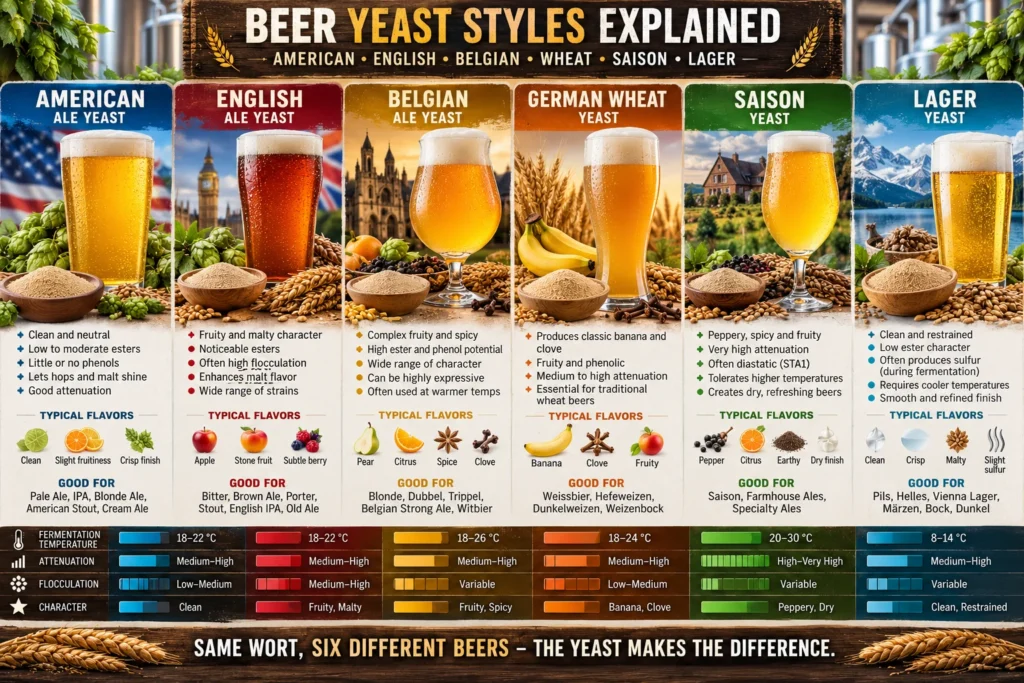
A clean American ale strain may allow hops and malt to dominate. An English strain can add fruitiness and enhance malt character. Belgian yeast may produce layers of fruit, spice and phenolic complexity. German wheat yeast can create unmistakable banana and clove aromas. Saison strains can produce dry, peppery and highly expressive beers, while lager yeast is generally selected for a cleaner and more restrained fermentation profile.
The wort may be similar.
The yeast can completely change the beer.
This is why yeast should not be treated merely as something that converts sugar into alcohol. Yeast is one of the major flavour-building ingredients in beer.
In this sixth article of our beer yeast series, we will explore the major yeast families used by homebrewers: American, English, Belgian, wheat, Saison and lager yeast. We will look at their typical flavour profiles, attenuation, flocculation, fermentation behaviour, suitable beer styles and the practical differences that matter when designing a recipe.
Yeast Families Are More Useful Than Simply “Ale” and “Lager”
As we discussed earlier in this series, brewing yeast is often divided into two broad groups:
Ale yeast – primarily Saccharomyces cerevisiae
and
Lager yeast – primarily Saccharomyces pastorianus
That biological distinction is useful, but it does not tell us what a beer will actually taste like.
Most American, English, Belgian, wheat and Saison strains are all forms of Saccharomyces cerevisiae.
Yet their fermentation character can be completely different.
Compare these beers:
- American IPA
- English Bitter
- Belgian Dubbel
- German Weissbier
- Saison
All can be fermented with yeasts belonging broadly to the ale family, but nobody would describe their yeast character as identical.
For recipe design, it is therefore useful to think not only about ale versus lager, but also about yeast families and fermentation character.
American Ale Yeast
American ale yeast is one of the most widely used yeast families in modern craft brewing and homebrewing.
Its defining characteristic is generally neutrality.
That does not mean the yeast contributes absolutely no flavour. Rather, the fermentation profile is usually restrained enough to allow other ingredients to remain at the centre of the beer.
This makes American ale yeast particularly useful when the brewer wants to showcase:
- hops
- malt
- water profile
- recipe structure
instead of obvious yeast-derived flavour.
What Does American Ale Yeast Taste Like?
Typical characteristics include:
- clean fermentation
- low to moderate ester production
- little or no phenolic character
- relatively neutral aroma
- crisp or moderately dry finish depending on the strain
- good attenuation in many strains
At controlled fermentation temperatures, some American strains can be extremely neutral.
At warmer temperatures, they may produce somewhat more fruitiness, but they are generally much less expressive than English, Belgian or wheat beer strains.
This makes them excellent background yeasts.
The yeast performs the fermentation while allowing the recipe itself to speak.
Which Beer Styles Work Well With American Ale Yeast?
American ale yeast is particularly well suited to hop-forward and clean modern styles such as:
- American Pale Ale
- American IPA
- West Coast IPA
- Double IPA
- American Blonde Ale
- American Amber Ale
- American Brown Ale
- American Porter
- American Stout
- Cream Ale
- many experimental craft beers
It can also work well whenever you deliberately want a neutral fermentation profile.
For example, if you have designed a Pale Ale around Cascade, Centennial and Citra, you may not want a highly fruity English or spicy Belgian yeast competing with those hops.
A clean American strain allows the hop combination to remain the main character.
American Yeast and Hop-Forward Beer
American ale yeast became particularly important with the rise of modern American craft beer.
Hop varieties such as Cascade, Centennial, Chinook, Amarillo, Citra, Simcoe and Mosaic can produce intense citrus, pine, tropical fruit and resinous aromas.
A neutral yeast gives those aromas space.
This is particularly important in beers such as West Coast IPA, where the brewer may want:
- clean fermentation
- high attenuation
- relatively dry finish
- strong hop expression
- limited yeast-derived fruitiness
However, not every IPA needs a neutral yeast.
Modern hazy IPA and NEIPA often use more expressive ale strains because yeast-derived fruitiness can complement tropical and citrus hop aromas.
The correct yeast therefore depends on the type of IPA you want to produce.
Attenuation and Flocculation of American Ale Yeast
There is no single attenuation or flocculation level shared by all American strains.
However, many popular American ale yeasts have:
medium to high attenuation
and:
low to medium or medium flocculation
depending on the strain.
A relatively attenuative strain can help produce a cleaner, drier beer.
Lower-flocculating strains may remain in suspension longer and require more conditioning time before the beer clears.
Others settle more efficiently.
This is why yeast should always be evaluated by the characteristics of the individual strain, not only by the label “American Ale”.
English Ale Yeast
English ale yeast is a very different tool.
Where many American strains are selected to remain in the background, traditional English strains are often expected to contribute directly to the character of the beer.
They may produce noticeable esters and can interact beautifully with British malt and hops.
Typical flavour descriptions may include:
- stone fruit
- pear
- apple
- red fruit
- subtle berry character
- light floral notes
- sometimes a slightly mineral impression
Not every English strain produces all of these flavours.
Some are relatively clean.
Others are highly expressive.
That diversity is part of what makes English yeast so interesting.
English Yeast and Malt Character
English ale yeast often works particularly well with malt-forward recipes.
Consider ingredients such as:
- Maris Otter
- Golden Promise
- Crystal malt
- Brown malt
- Chocolate malt
Combined with traditional English hops and an appropriate yeast strain, these ingredients can produce a depth of flavour that is difficult to reproduce simply by using a completely neutral fermentation.
The yeast may contribute a subtle fruity layer that integrates with:
- biscuit
- bread
- caramel
- toast
- nutty flavours
- dark fruit
from the malt.
This is one reason yeast choice is so important in traditional British beer.
Which Beer Styles Work Well With English Ale Yeast?
Depending on the strain, English yeast can be excellent for:
- Ordinary Bitter
- Best Bitter
- Extra Special Bitter
- English Pale Ale
- English IPA
- Mild
- Brown Ale
- Porter
- Stout
- Old Ale
- Barleywine
Certain English-derived strains are also widely used in modern hop-forward beers, including hazy IPA.
In those beers, the yeast’s fruity character can work together with modern hops rather than simply remaining in the background.
English Yeast and Flocculation
Many traditional English strains are famous for strong flocculation.
They can form large clumps and settle quickly after fermentation.
This can produce:
- rapid clarification
- compact yeast sediment
- easier transfer
- naturally bright beer
But very high flocculation can also create challenges.
Some strains may begin settling before fermentation is completely finished, particularly if conditions are not ideal.
Temperature management and adequate pitching become important.
A highly flocculent yeast is not automatically a better yeast.
As with attenuation, the ideal behaviour depends on the beer.
English Yeast and Attenuation
English strains vary considerably.
Some leave more residual body and sweetness, while others attenuate surprisingly well.
A strain with moderate attenuation can work beautifully in a Bitter or Brown Ale because the remaining body supports malt flavour.
But the same strain might leave an Imperial Stout or strong ale sweeter than intended.
This is why attenuation must be considered during recipe design.
Yeast choice and mash temperature work together.
A highly fermentable wort combined with an attenuative yeast may create a very dry beer.
A less fermentable wort combined with a lower-attenuating English strain may produce considerably more body.
Belgian Ale Yeast
Belgian brewing provides some of the clearest examples of yeast functioning as a major flavour ingredient.
In many Belgian beers, yeast character is not something to suppress.
It is one of the central features of the beer.
Belgian ale strains can produce complex combinations of:
- fruity esters
- spicy phenols
- pepper
- clove-like notes
- pear
- apple
- banana
- citrus
- stone fruit
- bubblegum-like notes in some strains
These compounds can interact with malt, sugar, hops and fermentation temperature to create remarkable complexity.
Belgian Yeast Is Not One Flavour
It is important not to think of “Belgian yeast” as a single flavour profile.
Belgium has an enormous brewing tradition with many different fermentation cultures.
A strain suited to a Belgian Witbier may behave very differently from one used for a Dubbel or a strong golden ale.
Belgian yeast families can range from relatively restrained to extremely expressive.
Some produce strong phenolic spice.
Others lean heavily toward fruit.
Some create a balance between the two.
The individual strain remains crucial.
Esters in Belgian Beer
Esters are among the most recognizable fermentation compounds produced by many Belgian yeasts.
Depending on the strain and fermentation conditions, they may create impressions of:
- banana
- pear
- apple
- orange
- stone fruit
- tropical fruit
- bubblegum
These flavours do not come from actual fruit.
They are compounds created during fermentation.
This is one of the fascinating aspects of yeast.
A beer made from malt, hops, water and yeast can develop aromas that strongly remind us of fruit even when no fruit was added.
Phenols in Belgian Beer
Many Belgian strains are also phenolic.
They may produce aromas and flavours reminiscent of:
- pepper
- clove
- spice
- herbs
- sometimes light smoky notes
The classic compound associated with clove-like character is 4-vinyl guaiacol.
Phenolic character is desirable in many Belgian and wheat beer styles.
In a clean American Pale Ale, however, the same character could be considered completely inappropriate.
Once again:
A flavour is not inherently good or bad. It depends on whether it belongs in the beer.
Which Beer Styles Use Belgian Yeast?
Depending on the strain:
- Belgian Blonde
- Belgian Pale Ale
- Dubbel
- Tripel
- Belgian Golden Strong Ale
- Belgian Dark Strong Ale
- Witbier
- Specialty Belgian Ale
- Trappist-style and abbey-style beers
can all rely heavily on yeast character.
In some of these beers, replacing the Belgian strain with a neutral American ale yeast would fundamentally change the identity of the beer.
The malt and hops might remain identical.
The beer would not.
Fermentation Temperature and Belgian Yeast
Temperature management is especially interesting with expressive Belgian strains.
Higher fermentation temperatures often increase the production or perception of fermentation-derived character.
But simply fermenting as hot as possible is not necessarily a good strategy.
Excessive heat can produce:
- harsh higher alcohols
- solvent-like character
- excessive esters
- unbalanced phenolics
- uncontrolled fermentation
A common approach is to begin fermentation within an appropriate range and allow the temperature to rise gradually as fermentation progresses.
The exact strategy depends on the strain.
With expressive yeast, temperature is not merely about preventing problems.
It becomes part of flavour design.
German Wheat Beer Yeast
Few yeast families demonstrate the power of fermentation character as clearly as traditional German wheat beer yeast.
A classic Weissbier or Hefeweizen may contain relatively simple ingredients:
- wheat malt
- barley malt
- restrained hopping
Yet the finished beer can smell strongly of:
banana and clove.
Those aromas are primarily created by yeast fermentation.
Without the appropriate yeast, a wheat-heavy wort does not automatically become a classic Weissbier.
Banana Character in Wheat Beer
The famous banana aroma in German wheat beer is strongly associated with:
isoamyl acetate
an ester also found in other fermentations.
The amount perceived in the beer depends on several variables, including:
- yeast strain
- fermentation temperature
- pitching rate
- wort composition
- oxygenation
- fermentation geometry and conditions
Some strains naturally emphasize banana more than others.
Therefore, choosing the correct wheat beer yeast is the first step.
Fermentation technique then adjusts the balance.
Clove Character in Wheat Beer
The characteristic clove aroma is associated primarily with:
4-vinyl guaiacol (4-VG).
Many traditional wheat beer strains are capable of producing this phenolic compound from precursors present in the wort.
The result can create the classic balance:
banana + clove
that defines much of traditional German wheat beer character.
Depending on the strain and fermentation conditions, one may dominate the other.
Wheat Malt Does Not Create Banana and Clove by Itself
This is an important distinction.
Wheat malt contributes:
- grain character
- proteins
- body
- foam stability
- texture
But the classic banana and clove profile of Weissbier is primarily associated with the fermentation behaviour of appropriate yeast strains.
If you ferment a wheat-heavy wort with a neutral American ale yeast, you may make an excellent wheat beer.
But it will not automatically taste like a traditional German Hefeweizen.
The yeast defines much of the style.
Which Styles Use Wheat Beer Yeast?
Traditional expressive wheat yeast is suitable for styles such as:
- Weissbier
- Hefeweizen
- Dunkelweizen
- Weizenbock
Other wheat beers may use completely different yeast.
For example, an American Wheat Beer often uses a relatively neutral American ale strain.
A Belgian Witbier typically uses a different expressive yeast culture and may also contain spices.
Therefore:
wheat in the grain bill does not automatically determine the yeast.
The intended beer style does.
Saison Yeast
Saison yeast deserves its own category because its fermentation behaviour can be dramatically different from many conventional ale strains.
Traditional Saison is associated with Belgian and northern French farmhouse brewing traditions, although the modern beer style has evolved far beyond its historical origins.
Saison yeast can produce a beer that is:
- highly attenuated
- very dry
- peppery
- spicy
- fruity
- complex
- refreshing
Despite significant flavour complexity, the finished beer can remain extremely drinkable because of its dry finish.
Why Is Saison So Dry?
Many Saison strains have very high apparent attenuation.
Some are diastatic strains, commonly associated with the STA1 gene.
These yeasts can produce enzymes that allow them to ferment carbohydrates that ordinary brewing yeast may leave behind.
The result can be an exceptionally low final gravity.
A Saison starting around:
OG 1.055
may finish far lower than a typical English ale brewed from a similar wort.
This can create a beer that feels light and dry despite having substantial alcohol content.
Diastatic Yeast Requires Special Attention
The ability of certain Saison strains to ferment more complex carbohydrates is useful when making Saison.
But it also creates an important brewery hygiene consideration.
If a diastatic yeast contaminates equipment intended for beers that should retain more residual extract, it may continue fermenting sugars that the intended yeast would normally leave behind.
Possible consequences include:
- unexpectedly low FG
- excessively dry beer
- overcarbonation
- excessive pressure in packaged beer
Good cleaning and sanitation are therefore particularly important when working with diastatic strains.
This is not a reason to avoid them.
It is a reason to understand what the yeast can do.
Saison Yeast and Temperature
Some Saison strains are famous for tolerating relatively high fermentation temperatures.
They can remain active at temperatures that would produce unpleasant flavours with many conventional ale strains.
However:
Saison yeast is not simply “ale yeast that likes heat.”
Different Saison strains behave differently.
Some perform well across broad temperature ranges.
Some can develop more fruitiness at higher temperatures.
Others emphasize peppery or phenolic character.
Certain traditional strains are also known for appearing to slow or stall under particular fermentation conditions before eventually continuing.
Again, strain-specific information matters.
Saison Flavour Profile
Typical Saison yeast character may include:
- black pepper
- white pepper
- clove-like spice
- citrus
- pear
- light stone fruit
- herbal impressions
- earthy complexity
- very dry finish
The best examples can be highly aromatic without becoming heavy.
This combination of expressive fermentation and high attenuation is one of the defining characteristics of the style.
Lager Yeast
Lager yeast represents another major brewing family.
Most brewing lager strains belong to:
Saccharomyces pastorianus
a hybrid yeast with ancestry from S. cerevisiae and the cold-tolerant S. eubayanus.
Lager yeast is traditionally associated with cooler fermentation and extended cold conditioning.
Its flavour contribution is generally more restrained than that of expressive ale strains.
But calling lager yeast flavourless would be incorrect.
What Does Lager Yeast Taste Like?
A well-managed lager fermentation can produce:
- clean malt expression
- clean hop expression
- restrained ester character
- crisp fermentation profile
- subtle sulfur during fermentation
- smooth, refined finish after conditioning
The goal is often balance and precision rather than obvious yeast-derived fruit or spice.
This means lager yeast can reveal the details of the recipe very clearly.
It can also reveal brewing mistakes.
There may be less expressive yeast character available to hide them.
Which Beer Styles Use Lager Yeast?
Lager yeast is used across a remarkably diverse range of styles:
- German Pils
- Czech-style Pale Lager
- Helles
- Dortmunder Export
- Vienna Lager
- Märzen
- Dunkel
- Schwarzbier
- Bock
- Doppelbock
- Baltic Porter in many traditional interpretations
- modern India Pale Lager and other craft lager styles
These beers can range from very pale and crisp to dark, malty and strong.
The common element is not colour.
It is the fermentation family and the type of character produced.
Lager Yeast and Sulfur
Some lager strains produce noticeable sulfur compounds during fermentation.
The fermenter may temporarily smell of:
- struck match
- sulfur
- egg-like compounds
This can alarm new lager brewers.
In many cases, much of this sulfur decreases as fermentation finishes and the beer conditions.
That does not mean every sulfur aroma should automatically be ignored.
Persistent or unusual sulfur can indicate fermentation problems.
But temporary sulfur production can be normal for certain lager strains.
Lagering Is Part of the Process
Traditional lager brewing does not end when primary fermentation stops.
Cold conditioning – lagering – allows the beer to mature at low temperature.
During this period:
- yeast settles
- suspended particles drop out
- beer becomes clearer
- flavours integrate
- certain rough fermentation characteristics may soften
- the overall profile becomes more refined
This is one reason lager fermentation has traditionally required more time than ordinary ale production.
Modern yeast strains and brewing techniques can shorten the process considerably, but cold conditioning can still provide important benefits.
Modern Lager Yeast Can Be Surprisingly Flexible
Not all lager yeast needs to be fermented at traditional cold temperatures.
Modern strains can sometimes produce remarkably clean beer at temperatures that older brewing advice would have considered too warm.
This has made lager brewing much more accessible to homebrewers.
Some modern lager strains can work effectively in the mid-teens Celsius or even warmer depending on the specific yeast and fermentation method.
Pressure fermentation can also help some brewers produce clean lager-style beers at elevated temperatures.
But this does not mean all lager strains behave the same way.
Always check the recommended range for the individual yeast.
Clean Yeast vs Expressive Yeast
One useful way to think about yeast selection is to ask:
Do I want the yeast in the foreground or the background?
For a West Coast IPA, you may want:
yeast in the background
and hops in the foreground.
For a Belgian Tripel:
yeast may be one of the main characters.
For Weissbier:
yeast character is essential to the style.
For Saison:
fermentation character and dryness define much of the beer.
For Helles:
the yeast should generally support rather than dominate the delicate malt character.
This simple question can make yeast selection much easier.
Yeast Character Is a Spectrum
It would be misleading to divide yeast into only two groups:
clean and expressive.
In reality, yeast character exists on a spectrum.
A rough conceptual scale might look like:
Very Clean → Clean/Fruity → Fruity → Fruity/Spicy → Highly Expressive
American ale strains often sit toward the clean end.
Many English strains occupy the clean-to-fruity middle.
Belgian strains can move strongly toward fruity and spicy.
German wheat strains can be extremely distinctive.
Saison strains can combine high attenuation with powerful spice and fruit character.
Lager strains generally remain restrained, but individual lager strains still differ significantly.
This spectrum is more useful than assuming every yeast in a country or category behaves identically.
Fermentation Temperature Can Move the Flavour Profile
The strain establishes the basic potential.
Fermentation conditions influence how that potential is expressed.
Temperature can affect:
- ester production
- higher alcohols
- sulfur compounds
- fermentation speed
- attenuation
- overall yeast character
For example, an expressive English strain fermented toward the cooler end of its range may produce a more restrained beer than the same strain fermented warmer.
A Belgian strain may become increasingly expressive as temperature rises.
A wheat beer strain may shift the perceived balance of its fermentation character.
But temperature cannot completely transform one yeast family into another.
A warm American ale yeast does not become Belgian yeast.
A cold Belgian strain does not become lager yeast.
Strain comes first. Temperature shapes the strain’s expression.
Pitching Rate Can Also Affect Yeast Character
As discussed in the previous article, the amount of yeast added to the wort can influence fermentation behaviour.
Underpitching may force greater yeast growth and can alter flavour production.
Overpitching may reduce some fermentation-derived character.
This becomes particularly relevant with expressive yeast.
For a very clean American ale, the goal may be predictable neutral fermentation.
For an English, Belgian or wheat beer, the brewer may deliberately care about how fermentation conditions affect ester production.
However, manipulating pitching rate for flavour should only come after understanding the strain.
Accidental underpitching is not sophisticated fermentation control.
Pressure Fermentation and Yeast Style
Pressure can suppress the production or perception of certain fermentation compounds, particularly esters.
This can be useful when the goal is a cleaner fermentation.
For example, pressure fermentation has become popular for some lager production.
But the same effect may be undesirable with a yeast selected specifically for expressive character.
If you choose a German wheat yeast because you want its fermentation character and then strongly suppress that character with pressure, you may be working against your own recipe.
Likewise, a Belgian or Saison strain may have been chosen specifically because of the flavours it creates.
The fermentation method should support the purpose of the yeast.
Choosing Yeast for an American Pale Ale
Suppose your recipe contains:
- Pale Malt
- a small amount of Carapils
- Cascade
- Centennial
- Citra
and your goal is a bright, hop-forward American Pale Ale.
A clean American ale strain is an obvious starting point.
Why?
Because you probably want:
citrus and hop aroma first, fermentation character second.
A highly phenolic Belgian strain could produce perfectly good beer from the same wort, but it would no longer taste like the Pale Ale you originally designed.
Choosing Yeast for an English Brown Ale
Now imagine:
- Maris Otter
- Crystal malt
- a small amount of Chocolate malt
- traditional English hops
A characterful English strain can add another layer:
- subtle fruit
- malt integration
- fuller impression
- traditional fermentation character
Using a very neutral American yeast might still produce a good Brown Ale.
But it may lack some of the fermentation character associated with traditional British examples.
Choosing Yeast for a Belgian Tripel
A Tripel recipe may contain a relatively simple grain bill.
Much of the complexity can come from:
- Belgian yeast
- fermentation temperature
- high attenuation
- alcohol
- subtle hopping
A neutral American strain could ferment the wort efficiently.
But the finished beer would lose much of what makes a Tripel recognizable.
Here, yeast is not simply a fermentation engine.
It is part of the recipe’s flavour architecture.
Choosing Yeast for Weissbier
For a traditional Weissbier, yeast selection is fundamental.
The brewer normally wants the characteristic balance of:
- banana
- clove
- soft fruit
- fermentation complexity
Using a neutral yeast would remove much of that identity.
The wheat malt remains important.
But wheat alone does not create Weissbier character.
Choosing Yeast for Saison
For Saison, the brewer may want:
- very high attenuation
- peppery phenolics
- fruity esters
- dry finish
- high drinkability
A neutral ale strain may produce a dry pale beer.
But it will not automatically produce the fermentation complexity expected from Saison.
A suitable Saison strain is therefore central to recipe design.
Choosing Yeast for Lager
For a classic lager, the brewer usually wants:
- clean fermentation
- restrained esters
- good attenuation
- appropriate sulfur behaviour
- crisp or smooth finish depending on the style
- compatibility with cold conditioning
The specific lager strain can then be selected according to the beer.
A German Pils may benefit from a different yeast character than a Czech-style lager or a malty Bock.
Even within the lager family, yeast choice matters.
One Wort, Six Different Beers
Imagine producing one simple pale wort from:
- pale malt
- moderate bitterness
- neutral water
- restrained hop aroma
Now divide it into six fermenters.
Ferment each one with a different yeast family.
American Ale Yeast
The result may be clean, crisp and neutral, with malt and hops clearly exposed.
English Ale Yeast
The same wort may become fruitier, softer and more fermentation-driven.
Belgian Ale Yeast
Fruit and spice may become major components of the aroma.
German Wheat Yeast
Banana and clove character could transform the beer completely.
Saison Yeast
The beer may become extremely dry, peppery, fruity and highly attenuated.
Lager Yeast
The result may be clean, restrained and crisp, particularly after cold conditioning.
The ingredients before fermentation were nearly identical.
The finished beers may taste as though they were built from completely different recipes.
That is the power of yeast selection.
Practical Comparison of Major Beer Yeast Families
| Yeast Family | Typical Character | Attenuation | Flocculation | Common Beer Styles |
|---|---|---|---|---|
| American Ale | Clean, neutral, lightly fruity | Medium–High | Low–Medium | Pale Ale, IPA, Blonde, American Stout |
| English Ale | Fruity, malty, estery | Medium–High, strain dependent | Often Medium–High | Bitter, Brown Ale, Porter, Stout, English IPA |
| Belgian Ale | Fruity, spicy, phenolic | Medium–High | Highly variable | Dubbel, Tripel, Belgian Blonde, Strong Ale |
| German Wheat | Banana, clove, fruity | Medium–High | Usually Low–Medium | Weissbier, Hefeweizen, Dunkelweizen, Weizenbock |
| Saison | Peppery, fruity, spicy, very dry | High–Very High | Variable | Saison, Farmhouse-style ales |
| Lager | Clean, restrained, sometimes sulfurous during fermentation | Medium–High | Variable | Pils, Helles, Vienna Lager, Märzen, Bock |
These are broad tendencies.
The specifications of the individual strain are always more important than the family name alone.
Do Yeast Brands Matter?
The brand matters less than the actual strain and its behaviour.
Different laboratories may offer strains with:
- similar origins
- similar fermentation characteristics
- very different commercial names
At the same time, two products both labelled “English Ale” can behave very differently.
When choosing yeast, look beyond the marketing name.
Check:
- recommended temperature range
- attenuation
- flocculation
- alcohol tolerance
- flavour description
- phenolic character
- diastatic status where relevant
- recommended beer styles
- pitching instructions
The manufacturer’s technical information can tell you much more than the front of the package.
Dry Yeast Has Changed Yeast Selection
In the past, brewers often needed liquid yeast to access a wide range of specialized strains.
That has changed dramatically.
Modern dry yeast is now available for many categories, including:
- clean American ale
- English ale
- Belgian ale
- wheat beer
- Saison
- lager
This gives homebrewers much greater flexibility.
Dry yeast also offers advantages such as:
- long shelf life
- convenient storage
- high cell counts
- easy pitching
- good consistency
Liquid yeast still offers an enormous range of specialized cultures, but the difference in variety has become much smaller than it once was.
The choice should therefore be based on the strain you want rather than the assumption that liquid yeast is automatically superior.
There Is No “Best” Beer Yeast
Homebrewers often ask:
What is the best yeast?
There is no useful universal answer.
The best yeast for a West Coast IPA may be completely wrong for a Weissbier.
The perfect English Bitter strain may be inappropriate for a German Pils.
A Saison strain capable of extremely high attenuation may be exactly what you want in one recipe and disastrous in another.
The better question is:
What yeast produces the fermentation character I want in this beer?
That question leads to better recipe design.
How to Choose a Yeast Strain
Before choosing yeast, ask yourself:
What style am I brewing?
Start with strains known to work well in that family of beer.
Do I want clean or expressive fermentation?
Decide whether yeast should stay in the background or contribute major flavour.
How dry should the beer finish?
Check attenuation and consider wort fermentability.
How clear should the beer become?
Consider flocculation and conditioning.
What fermentation temperature can I maintain?
Choose a strain suitable for your actual equipment and environment.
Do I want fruity or spicy character?
Look at ester and phenolic potential.
Am I fermenting under pressure?
Consider whether pressure will suppress character you actually want.
How strong is the beer?
Check alcohol tolerance and pitching requirements.
Is the strain diastatic?
This is particularly relevant for some Saison strains.
These questions are much more useful than simply asking whether a yeast is “good”.
Common Mistakes When Choosing Beer Yeast
Choosing yeast only by attenuation – attenuation matters, but flavour can be equally important.
Choosing the cleanest yeast for every beer – neutrality is not always desirable.
Using expressive yeast without considering temperature – Belgian, wheat and Saison strains can change dramatically with fermentation conditions.
Assuming every English strain is fruity – some are much cleaner than others.
Assuming every American strain is completely neutral – strains still differ.
Assuming all Belgian yeast tastes the same – Belgian brewing yeast is extraordinarily diverse.
Thinking wheat malt creates banana flavour – classic banana character primarily comes from yeast fermentation.
Treating Saison yeast like ordinary neutral ale yeast – some strains are highly attenuative and diastatic.
Assuming lager yeast is flavourless – clean does not mean flavourless.
Choosing yeast after designing the entire recipe – yeast should be considered during recipe design, not added as an afterthought.
Yeast Should Match the Beer You Imagine
Before brewing, imagine the finished beer.
Do you want a Pale Ale where Cascade and Citra dominate?
A clean American strain may be ideal.
Do you want an English Brown Ale with malt, caramel and subtle fruit working together?
An English strain may be better.
Do you want a Tripel with pear, spice and a dry alcoholic finish?
The Belgian yeast becomes central.
Do you want a Weissbier with banana and clove?
You need the appropriate wheat beer strain.
Do you want a peppery, extremely dry Saison?
Choose a suitable Saison yeast.
Do you want a clean Vienna Lager where toasted malt remains clearly defined?
Choose a lager strain that supports that profile.
Start with the beer you want to drink.
Then choose the yeast capable of creating it.
Yeast Is Part of the Recipe, Not a Footnote
A recipe might traditionally be written like this:
Malt: Pale Malt, Munich, Crystal
Hops: Cascade, Centennial
Yeast: Ale yeast
That final line is far too vague.
A more useful recipe considers:
Yeast family: American Ale
Strain character: clean, neutral
Attenuation: medium-high
Flocculation: medium
Fermentation temperature: appropriate strain-specific range
Desired role: allow hop character to dominate
Now yeast selection has become part of recipe design.
The same approach can be applied to English, Belgian, wheat, Saison and lager beers.
Final Thoughts
Beer yeast is not one ingredient with one flavour.
It is an enormous collection of strains capable of producing completely different fermentation profiles.
American ale yeast is often selected for clean fermentation that allows hops and malt to dominate.
English ale yeast can contribute fruitiness, malt integration and traditional ale character.
Belgian yeast can create complex combinations of esters and phenols, producing fruit, spice and unmistakable fermentation character.
German wheat beer yeast is responsible for much of the banana and clove profile that defines traditional Weissbier.
Saison yeast can combine expressive fruit and spice with exceptionally high attenuation and a very dry finish.
Lager yeast generally creates a cleaner, more restrained profile that allows precision, malt and hop balance to become the focus.
None of these families is inherently better than another.
They are different tools.
And just as a brewer chooses malt for flavour, hops for aroma and water chemistry for balance, yeast should be selected according to what it contributes to the finished beer.
The most important principle is simple:
Do not choose yeast only because it can ferment your beer. Choose yeast because it can create the beer you want to drink.