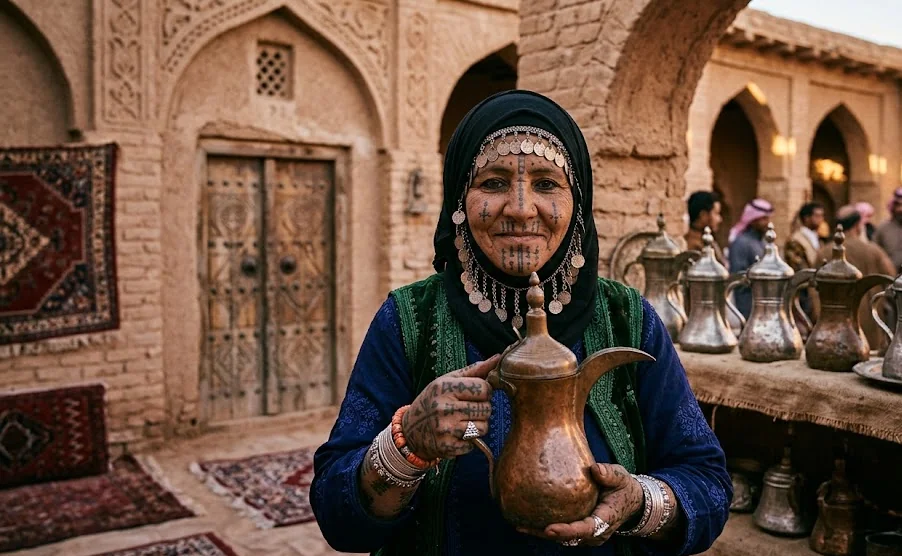
Arab tattoos – if you have ever wondered what kinds of tattoos can be found in Arab countries and the neighbouring regions of Southwest Asia, the answer is far more complex than it might first appear. Tattoo traditions in this part of the world have combined ornamentation, symbolism, beliefs connected with protection and healing, tribal identity and female beauty. At the same time, the Arab world is full of contrasts: some communities preserved tattoo traditions for generations, while in others permanent tattooing became strongly discouraged or rejected for religious and social reasons.
The earliest traces and interpretations
Some of the earliest representations associated with possible tattooing or scarification in Southwest Asia come from Mesopotamia.
During excavations conducted by Sir Leonard Woolley at Ur in 1929–1930, female figurines dating to the Ubaid period were discovered. Some carried black painted markings or small applied pieces of clay on the shoulders and other areas of the body.
Woolley interpreted these markings as possible representations of crude tattoos or decorative scars.
An important distinction must nevertheless be made: these figurines do not constitute direct evidence that people of the period were actually tattooed. Instead, they suggest that body decoration — whether through painting, tattooing, scarification or some other form of modification — was significant enough to be represented artistically.
Some of the figurines from Ur associated with this context have been dated to approximately 4500–4000 BC, making them more than six thousand years old.
One female figurine is shown nude, with small clay decorations on the shoulders and traces of colour. The exact meaning of these features remains open to archaeological interpretation.
Accounts by European travellers
Much clearer evidence for the existence of tattooing in the Arab world comes from European travellers’ accounts from the nineteenth century.
Several travellers described tattooed women in Iraq, Syria and other areas of the Middle East.
In 1827, the British traveller James Silk Buckingham, writing about his journeys through Mesopotamia, described people in Baghdad who specialised in decorating women’s bodies.
He mentioned wreath-like designs, bands and other ornaments placed on the chest, waist and other areas of the body, and noted that the process required several sessions.
His description is particularly interesting because it indicates that specialised professional tattooing already existed in early nineteenth-century Baghdad.
Other nineteenth-century travellers described women with bluish designs on the face, hands, legs, chest and ankles.
In some communities, such marks were regarded as attractive and formed a natural part of feminine appearance.
Henry Field and the study of body marking
Despite the many travel accounts, systematic documentation of traditional tattooing in Southwest Asia remained limited for a long time.
One of the major works on the subject is anthropologist Henry Field’s Body-Marking in Southwestern Asia, published in 1958.
The study examines several forms of body modification and decoration, including tattooing, branding, the use of henna and the application of kohl.
Field gathered information through research and travel in regions including Iraq, Iran, Syria, Egypt, the Caucasus and the Persian Gulf.
He believed that many forms of body marking had origins closely connected with ritual, religious and protective beliefs.
Before Field’s book appeared, Winifred Smeaton Thomas had already published a dedicated study of tattooing among the Arabs of Iraq in 1937.
Such studies have become particularly important because many of the traditions they documented began disappearing rapidly during the twentieth century.
Bedouins, Nawar and travelling communities
Older ethnographic accounts frequently mention Bedouin populations as well as travelling communities known as Nawar or Dom.
Older Western sources sometimes referred to these groups using terms that are now considered outdated or inaccurate. Modern scholarship generally prefers the specific names used by the communities themselves.
Bedouin women could carry elaborate tattoos on the face, chin, hands, arms and other parts of the body.
In some regions these tattoos were applied by specialised women, including travelling practitioners from Nawar or Dom communities.
The techniques could be passed from one generation to the next.
These traditions were not identical across the entire region.
Arab, Kurdish, Yazidi, Amazigh and other Middle Eastern and North African communities could use different motifs, meanings and tattooing techniques.
Nevertheless, many recurring elements can be found: dots, lines, geometric forms, plant and celestial symbols, and tattoos associated with beauty, protection, fertility or healing.
Tattoos in Iraq
Traditional tattooing was widespread in rural and tribal communities in Iraq during the first half of the twentieth century.
In everyday language, tattooing could be known as daqq or dagg, from a root meaning approximately “to strike”, “to beat” or “to tap”.
The name reflects the traditional method of application: the skin was repeatedly punctured, point by point.
Classical Arabic also uses the term washm for tattooing.
Traditional techniques could involve a single needle or groups of needles, while pigment was prepared from various natural substances.
In some areas soot, charcoal or other dark substances were mixed with liquid to produce the colouring material.
After healing, many traditional tattoos developed a characteristic blue-green or greyish-blue tone.
Traditional Iraqi tattoos were not purely decorative.
They could serve aesthetic, protective, medicinal, magical or identity-related purposes.
Today this tradition is increasingly endangered. Recent academic and cultural projects in Iraq have attempted to document the designs, stories and meanings of tattoos worn especially by older women in the country’s central and southern regions.
Decorative and healing tattoos
Ethnographic sources often distinguish between tattoos created for beauty and tattoos believed to have therapeutic purposes.
Decorative tattooing could cover larger areas and might include elaborate designs on the face, hands, arms, chest or legs.
Therapeutic tattoos were generally simpler.
They could be applied directly to the area where a person experienced pain.
For example, dots or small symbols might be tattooed around painful joints or areas affected by sprains.
Other tattoos were applied to the temples or forehead for headaches, or close to the eyes in the hope of relieving eye problems.
Tattooing was also used in some communities as a traditional treatment for rheumatic pain and other local complaints.
From the perspective of modern medicine, these practices should not be confused with scientifically demonstrated treatments. They belonged to traditional systems of belief and folk medicine.
Magical and protective tattoos
In many traditional communities tattooing also had a magical or protective role.
Certain marks were believed to protect the wearer from disease, evil spirits, the evil eye or bad luck.
Dots tattooed between the eyebrows or on the forehead could symbolically function as an amulet against the evil eye.
Other motifs were associated with fertility.
Women wishing to have children, or those who had experienced pregnancy loss, might receive small groups of dots or symbols on the abdomen, back or lower back.
Groups of three or five dots appear in some traditions.
Numbers themselves could also carry symbolic meaning.
A simple dot tattooed on a child might be considered protective and intended to keep away illness or misfortune.
Some accounts also mention a triangle formed from three dots tattooed on the palm, symbolically associated with fidelity and the relationship between spouses.
These interpretations should not, however, be generalised across the entire Arab world. Meanings could vary considerably from one tribe, village or region to another.
Tattooing as beauty
In many rural and Bedouin communities, female tattooing was regarded as beautiful.
The chin, forehead, cheeks and hands were among the most commonly tattooed areas.
A vertical line on the chin, groups of dots on the forehead or geometric designs on the hands could function as a form of permanent makeup and body ornament.
For some women, tattoos could indicate maturity, community membership or passage into a new stage of life.
In other cases, their role was simply aesthetic.
It is striking that designs later regarded by younger generations as old-fashioned or undesirable could, only a few decades earlier, have represented a local ideal of beauty.
Attitudes toward tattooing and the influence of religion
Why are traditional tattoos relatively uncommon today in many Arab societies?
One important explanation lies in the profound social and religious changes that took place during the twentieth century.
The settlement of formerly nomadic populations, urbanisation, expanding access to education, changing standards of female fashion and the influence of stricter religious interpretations all contributed to the decline of traditional tattooing.
Within Sunni Islam, the majority position among jurists considers permanent tattooing carried out by piercing the skin to be prohibited.
This interpretation is based, among other things, on hadith traditions condemning both the person who tattoos and the person who receives the tattoo.
It is important, however, not to present the Islamic world as completely uniform.
There are differences between legal schools and between Sunni and Shia traditions.
The Shia religious authority Ali al-Sistani, for example, considers subcutaneous tattooing permissible in itself and states that it does not prevent ritual purification such as wudu or ghusl.
For this reason, the simple statement that “Islam forbids tattoos” does not adequately represent the full complexity of the subject.
Beyond religious interpretation, social pressure can be equally important.
In some communities, a visible tattoo may be regarded as inappropriate, rebellious or incompatible with family values.
Henna – the accepted alternative
By contrast, body decoration using henna remains extremely common in many Arab, North African and South Asian regions.
Henna does not involve permanently placing pigment beneath the skin.
The dye stains the outer layer of the skin and gradually fades.
For this reason, henna decoration is fundamentally different from permanent tattooing.
Designs range from simple patterns on the fingers and palms to extremely elaborate compositions covering the hands and forearms.
Henna is frequently associated with weddings, celebrations, family events and different rites of passage.
In some societies, it has taken over part of the ornamental role once performed by permanent tattooing.
Generational change
During the second half of the twentieth century, traditional facial tattooing began to disappear increasingly quickly.
In many communities, younger women no longer continued the practices of their mothers and grandmothers.
Traditional tattoos gradually became associated mainly with women born in rural or tribal communities before the period of rapid modernisation.
Today, many of the remaining wearers of these traditional tattoos are elderly women.
At the same time, an interesting countertrend has developed: artists, researchers and members of younger generations are attempting to rediscover these symbols as part of their cultural heritage.
Among Kurdish communities, for example, the traditional deq tattoo has become the subject of documentation projects and a degree of cultural revival.
Recent projects in Iraq have also sought to record the stories of tattooed women before the tradition disappears completely.
Modern tattooing in the Arab world
The decline of traditional tattooing does not mean that modern tattoo culture has disappeared.
In major cities across the Middle East and North Africa, young people choose contemporary tattoos in much the same way as people do in Europe or North America.
The styles, however, are completely different from traditional daqq.
Today people may choose lettering, floral designs, minimalist tattoos, realism, blackwork, Japanese-inspired designs or symbols carrying personal meaning.
In some societies, tattoos are concealed beneath clothing, while in others they are becoming increasingly visible.
Their level of acceptance varies enormously depending on country, family, community, religion and social environment.
Lebanon, Morocco, Tunisia, certain urban areas of Iraq and other parts of the region have seen contemporary tattoo culture become more visible in recent decades, particularly among younger generations.
This does not mean, however, that tattooing is equally accepted everywhere.
From tribal tattooing to the modern studio
The difference between old traditional tattoos and modern professional tattooing is enormous from a technical point of view.
Traditional tattoos were made manually through repeated puncturing.
The tools could consist of a single needle or several simple needles, while pigment was gradually introduced into the skin.
There were no sterile disposable needles, electric tattoo machines, autoclaves or modern hygiene systems.
Pigments were made from locally available materials.
Professional contemporary tattooing uses entirely different equipment.
Modern machines allow much greater control over working speed and needle movement, needles are sterile and single-use, and professional tattoo inks are manufactured specifically for tattooing.
Gloves, barrier protection, surface disinfection and the prevention of cross-contamination are also fundamental standards in a professional studio.
Although the artistic aim — modifying and decorating the skin — may be similar, modern professional tattooing should not be confused with the traditional techniques used generations ago.
A world full of contradictions
The history of tattooing in the Arab world is fascinating precisely because of its contradictions.
At one point in history, tattoos could represent female beauty, fertility, health and protection from evil forces.
In other contexts, the same marks came to be regarded as old-fashioned, sinful or incompatible with modern society.
Today, an elderly woman living in an Iraqi village may still carry a tattoo on her chin that was applied seventy or eighty years ago, while in a modern tattoo studio in a major Middle Eastern city a young person may receive a tattoo using the latest generation of equipment.
The two tattoos may look completely different.
Yet both form part of the same universal human story: the desire to turn skin into a medium of expression.
Traditional Arab and Mesopotamian tattooing should therefore not be regarded merely as a curiosity from the past.
It is a form of cultural heritage that preserves in the skin the stories of communities, their beliefs, ideals of beauty, fears, hopes and identities.
And as the last generations who still carry these tattoos in their traditional form gradually disappear, documenting them becomes increasingly important.