Tattooist Craft Beer / Original Recipe Series
Old Oak
BRITISH BROWN ALE · BJCP 13B
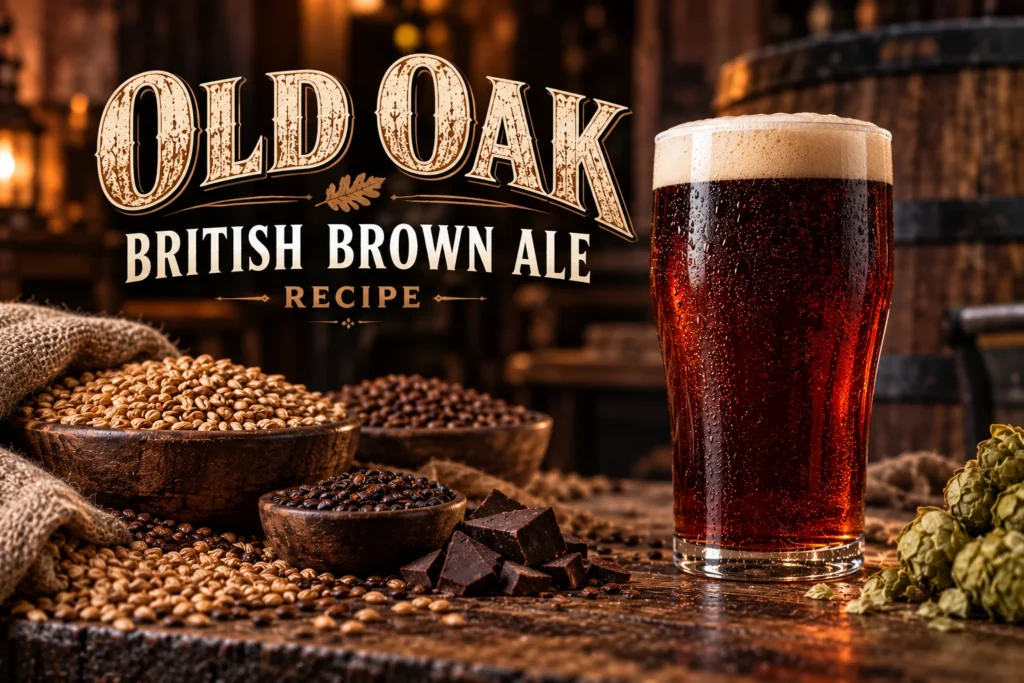
Inspired by the warmth of a traditional British pub, Old Oak brings together nutty Brown Malt, rich Maris Otter, delicate caramel and a subtle hint of chocolate. Smooth, balanced and beautifully drinkable, with a gently dry finish and classic British ale character.
Rooted in tradition. Crafted for the pint.
Some beers are designed to impress with intense hop aromas, extraordinary strength, or unusual ingredients. Others find their character in balance, subtlety, and the comforting richness of traditional malt.
Old Oak belongs to the second category.
This original British Brown Ale recipe takes inspiration from the atmosphere of a traditional English pub: dark wooden tables, a freshly poured pint, and a beer that rewards slow appreciation without demanding too much attention.
It is a malt-led, gently nutty brown ale with notes of toasted biscuits, fresh bread crust, restrained caramel, and a subtle chocolate finish.
The goal is not to produce a dark, heavily roasted Porter or a sweet dessert beer. Instead, Old Oak is designed to offer moderate malt richness, an approachable medium-light body, balanced bitterness, and satisfying drinkability.
The recipe is designed for 25 liters (6.6 US gallons) into the fermenter, assuming approximately 75% brewhouse efficiency.
All gravity, bitterness, color, and alcohol figures are calculated targets rather than results from a completed brew.
What Defines a British Brown Ale?
British Brown Ale is a traditional malt-focused style that combines the character of British base malt with restrained caramel, toasted grain, and delicate dark malt notes.
A good example can offer aromas reminiscent of toasted bread, biscuits, nuts, toffee, and light chocolate.
Despite its brown appearance, the style should not have the pronounced coffee-like roast intensity of a Porter.
Hop bitterness provides balance, while the earthy and floral qualities of traditional English hops may be present at low levels.
A British ale yeast can contribute delicate fruity esters, complementing the malt without overwhelming it.
The finish may range from slightly sweet to moderately dry, but the beer should remain approachable and easy to drink.
In Old Oak, the intended direction is particularly clear:
Nutty malt character, restrained caramel sweetness, gentle chocolate complexity, and a pleasantly balanced finish.
Old Oak: Beer Profile and Brewing Targets
| Beer Parameter | Recipe Target |
|---|---|
| Style | British Brown Ale · BJCP 13B |
| Batch Size | 25 L / 6.6 US gal |
| Original Gravity | ~1.048 |
| Final Gravity | ~1.011–1.012 |
| Alcohol | ~4.8% ABV |
| Bitterness | ~23–25 IBU |
| Color | ~28–32 EBC / 14–16 SRM |
| Efficiency | 75% assumed |
| Boil | 60 min |
| Carbonation | 2.0–2.2 volumes CO₂ |
The target original gravity is approximately 1.048, with an expected final gravity around 1.011–1.012.
This should produce approximately 4.7–4.9% ABV, depending on actual fermentation performance.
Bitterness is targeted around 23–25 IBU, while the expected color is approximately 28–32 EBC (14–16 SRM), assuming the specified malt colors.
The final beer should display a clear reddish-brown or chestnut color with a soft, off-white foam head.
Appearance
A clear, medium-to-deep reddish-brown ale with copper highlights under strong light.
The head should be off-white to lightly beige, with moderate foam retention.
Aroma
Fresh biscuits, lightly toasted bread, subtle nutty notes, and gentle caramel.
A restrained impression of cocoa and a faint fruity ester character may add complexity.
Flavor
Maris Otter provides the core bready-biscuit character.
Brown Malt introduces a pleasant toasted, nutty dimension.
Crystal Malt adds controlled caramel and toffee notes, while a small amount of Chocolate Malt provides depth without obvious roast bitterness.
Mouthfeel
Medium-light to medium body, smooth texture, and moderate carbonation.
Finish
Balanced, gently malty, and moderately dry, without lingering syrupy sweetness or harsh roasted flavors.
Old Oak should remain enjoyable throughout the glass rather than becoming tiring after the first few sips.
1. Building the Grain Bill
The grain bill contains four carefully selected malts.
There is no need for a long list of specialty grains when a small number of complementary ingredients can create the desired profile.
| Fermentable | Amount | Share |
|---|---|---|
| Maris Otter Pale Malt | 4.65 kg / 10.25 lb | 86.9% |
| Brown Malt | 0.30 kg / 0.66 lb | 5.6% |
| Medium Crystal Malt (120–150 EBC) | 0.32 kg / 0.71 lb | 6.0% |
| Chocolate Malt (800–1000 EBC) | 0.08 kg / 0.18 lb | 1.5% |
| Total Grain | 5.35 kg / 11.80 lb | 100% |
Maris Otter Pale Malt – 4.65 kg (10.25 lb)
Maris Otter is the foundation of Old Oak.
It accounts for approximately 87% of the total grain bill, providing the fermentable extract and a substantial part of the beer’s identity.
Its bready, biscuity, and gently nutty qualities are particularly useful in British ales.
Compared with a very neutral base malt, Maris Otter can give the finished beer more perceived malt depth without requiring excessive specialty grain.
This is important because Old Oak should feel traditionally malty, not overloaded with caramel.
Brown Malt – 0.30 kg (0.66 lb)
Brown Malt provides much of the recipe’s distinctive character.
At approximately 5.6% of the grain bill, it is intended to contribute toasted biscuit, dry bread crust, and delicate nutty complexity.
The choice of Brown Malt rather than Amber Malt is deliberate.
Brown Malt can produce a slightly more recognizable toasted and nutty flavor, although its precise character depends on the maltster.
Use a moderate-color, traditionally kilned Brown Malt rather than a very dark or heavily roasted substitute.
The objective is toast and nuts, not burnt coffee or ash.
If your supplier’s Brown Malt has a significantly different color or roast intensity, recalculate the beer’s color and consider adjusting its quantity.
Crystal Malt – 0.32 kg (0.71 lb)
Crystal Malt provides gentle caramel and toffee notes.
For this recipe, choose a medium Crystal Malt around 120–150 EBC.
At approximately 6% of the grain bill, it should provide enough sweetness and color to support the Brown Malt without making the beer cloying.
Using a very dark Crystal Malt could introduce stronger burnt-sugar, raisin, or dark fruit notes.
Those qualities may be welcome in other styles, but here we want a softer, classic brown ale.
Chocolate Malt – 0.08 kg (0.18 lb)
Only 80 grams of Chocolate Malt are included.
Its function is to deepen the brown color and introduce a subtle background chocolate note.
It should not dominate the flavor.
The recipe assumes a dark Chocolate Malt around 800–1000 EBC, so the exact specification matters.
If you are using a particularly intense version, the quantity may need to be reduced.
Why Not Add More Specialty Malts?
A British Brown Ale can become muddled when too many strongly flavored grains compete for attention.
Old Oak already has a complete malt structure:
- Maris Otter for bread and biscuit
- Brown Malt for nuts and toast
- Medium Crystal for gentle caramel
- Chocolate Malt for a restrained dark accent
Adding large amounts of additional roasted, caramelized, or heavily kilned grain would risk pushing the beer toward Porter or a sweeter specialty ale.
The best first batch is one in which the individual ingredients remain recognizable.
For a deeper explanation of grain selection and percentages, see our guide to building a malt bill.
2. Hop Selection: East Kent Goldings
East Kent Goldings is the only hop variety used in Old Oak.
This traditional British hop is an excellent match for a malt-forward brown ale.
Its earthy, floral, and softly herbal qualities can provide bitterness and subtle complexity without competing with the grain bill.
The recipe uses two additions.
The first addition at 60 minutes establishes most of the bitterness.
The second addition at 10 minutes provides a restrained layer of hop flavor and gentle aroma.
The bitterness should remain sufficient to balance caramel sweetness but should never dominate the finished beer.
| Hop | Amount | Timing | Purpose |
|---|---|---|---|
| East Kent Goldings · 5.0% AA | 45 g / 1.59 oz | 60 min | Bittering |
| East Kent Goldings · 5.0% AA | 10 g / 0.35 oz | 10 min | Gentle hop flavor |
| Total | 55 g / 1.94 oz | 60 min boil | ~23–25 IBU |
Planned Hop Schedule
East Kent Goldings, assuming 5.0% alpha acids:
- 45 g (1.59 oz) at 60 minutes
- 10 g (0.35 oz) at 10 minutes
Total: 55 g (1.94 oz)
The expected bitterness is approximately 23–25 IBU using a conventional calculation model, but the actual result depends on wort gravity, hop form, alpha acids, and the brewing system.
No dry hopping or whirlpool addition is necessary.
The hop profile should be supportive rather than prominent.
For readers interested in why timing matters, our hop addition timing guide explains the differences between early bittering and late aroma additions.
3. Brewing Water for a Balanced British Brown Ale
The water profile should complement the malt rather than emphasize sharp bitterness.
Old Oak is designed with a moderate calcium concentration, chloride-forward balance, and restrained sulfate.
This encourages a round malt impression without making the beer heavy or sweet.
| RO Water Parameter | Amount / Target |
|---|---|
| Total Brewing Water | 34 L / 9.0 US gal |
| Mash Water | 20 L / 5.28 US gal |
| Sparge Water | 14 L / 3.70 US gal |
| Gypsum (CaSO₄·2H₂O) | 2.0 g total |
| Calcium Chloride (CaCl₂·2H₂O) | 6.0 g total |
| Calcium | ~62 mg/L |
| Chloride | ~85 mg/L |
| Sulfate | ~33 mg/L |
| Target Room-Temp Mash pH | 5.3–5.4 |
Option A: Reverse Osmosis Water
Reverse osmosis water provides a convenient starting point because its initial mineral concentrations are normally low.
For approximately 34 liters (9.0 US gallons) of RO brewing water, the suggested mineral additions are:
- Calcium Chloride Dihydrate (CaCl₂·2H₂O): 6 g total
- Gypsum (CaSO₄·2H₂O): 2 g total
Assuming negligible starting minerals and complete dissolution, the approximate profile is:
- Calcium: 62 mg/L
- Chloride: 85 mg/L
- Sulfate: 33 mg/L
The chloride-forward balance is intended to support the recipe’s soft, malty character.
This does not mean that a high chloride-to-sulfate ratio automatically creates sweetness. Grain composition, fermentation, pH, and the absolute mineral concentrations also matter.
Mash pH and Alkalinity
Brown Malt, Crystal Malt, and Chocolate Malt can affect mash acidity.
With very low-alkalinity RO water, the resulting mash pH may be lower than expected.
For the first batch, aim for a room-temperature mash pH around 5.3–5.4.
Use a suitable brewing-water calculation and verify with a calibrated pH meter.
If the mash pH is too low, a calculated addition of food-grade sodium bicarbonate may be appropriate.
Do not automatically add a fixed amount of bicarbonate or brewing acid without checking the predicted or measured pH.
The minerals listed above assume the specified hydrated salt forms. Other commercial products may require different doses.
Option B: Tap, Well, or Spring Water
If you use your own water, first determine its calcium, magnesium, sodium, chloride, sulfate, and bicarbonate or alkalinity levels.
Some local waters already contain enough calcium and chloride for this recipe.
Adding the full RO-water mineral quantities to such water could produce an unnecessarily high concentration.
Adjust additions according to the actual starting profile.
Our Brewing Tools page provides brewing calculations that can help you develop and record your recipe.
For a more detailed explanation of water chemistry, read our chloride versus sulfate brewing guide.
4. Mash Schedule: Body Without Excessive Sweetness
Old Oak uses a single-infusion mash at 66°C (151°F) for 60 minutes.
This temperature offers a useful starting balance between fermentability and body.
The Crystal and Brown Malt already contribute flavor complexity, so there is no need to increase the mash temperature excessively.
An optional mash-out at 76°C (169°F) for 10 minutes can be performed if your system supports it.
Sparge using water around 76–77°C (169–171°F), while monitoring the actual wort conditions.
| Mash Step | Temperature | Duration |
|---|---|---|
| Single-Infusion Mash | 66°C / 151°F | 60 min |
| Optional Mash-Out | 76°C / 169°F | 10 min |
| Sparge | 76–77°C / 169–171°F | As required |
| Stage | Target |
|---|---|
| Yeast | SafAle S-04 |
| Pitch | Approx. 16–18 g |
| Main Fermentation | 18–19°C / 64–66°F |
| Finishing Stage | ~20°C / 68°F |
| Expected FG | 1.011–1.012 |
| Cold Crash | 2–4°C / 36–39°F, 2–3 days |
| Carbonation | 2.0–2.2 vol. CO₂ |
| Conditioning | Approx. 1–2 weeks |
Should We Use a Step Mash?
A step mash is not required for this recipe.
Modern, well-modified Maris Otter and the selected specialty malts can work effectively with a simple single-infusion schedule.
The first batch should prioritize repeatability.
More complex mashing methods can be explored later if a clear improvement is needed.
5. Brewing Water Volumes and Pre-Boil Planning
For the 25-liter batch, the initial water plan is:
- Total brewing water: 34 L
- Mash water: 20 L
- Sparge water: 14 L
- Estimated grain absorption: 4.55 L
- Expected pre-boil volume: 29.45 L
- Estimated evaporation: 3.5 L
- Kettle and trub loss: approximately 0.95 L
- Target into fermenter: 25 L
These are example values for a brewing system with moderate losses.
They are not universal equipment specifications.
If your own kettle evaporates more or less than the estimated 3.5 liters per hour, adjust the total water accordingly.
The key measurements are the actual pre-boil volume, gravity, and post-boil volume.
Accurate records will make the next batch easier to reproduce.
6. Boiling and Hop Additions
Boil the wort for 60 minutes.
Add 45 grams of East Kent Goldings at the beginning of the boil.
With 10 minutes remaining, add the final 10 grams.
No whirlpool hop addition is planned.
If your normal process includes kettle finings, follow the manufacturer’s instructions and record their use.
After the boil, chill the wort promptly to approximately 18–19°C (64–66°F).
Avoid unnecessary hot-side concentration changes and measure the final wort gravity.
The target original gravity is approximately 1.048.
The actual value will vary with brewhouse efficiency and wort concentration.
7. Choosing a Traditional British Ale Yeast
For the first Old Oak batch, the suggested yeast is SafAle S-04.
This is a practical, widely used British ale strain that can develop a suitable malt-focused fermentation profile and settle efficiently after fermentation.
An expressive British pub ale strain can also work very well, although attenuation and ester character may differ.
The primary recipe uses S-04 because it offers a straightforward, reproducible reference.
Yeast Pitching
Plan for approximately 16–18 g of fresh, correctly stored dry S-04 in the 25-liter batch, subject to the manufacturer’s current dosing recommendations.
Pitch into adequately prepared wort at the intended fermentation temperature.
Provide oxygen before pitching in a manner appropriate for the yeast and wort, while avoiding unnecessary oxygen exposure later in the process.
Fermentation Temperature
Begin around 18–19°C (64–66°F).
Maintain good temperature control during active fermentation.
As activity slows, allowing the beer temperature to rise gently toward 20°C (68°F) may help fermentation finish.
The expected final gravity is approximately 1.011–1.012, but the actual result will depend on yeast performance, grain extract, and mash conditions.
A small amount of fruity ester character is acceptable and may complement the nutty malt profile.
However, strong solvent-like alcohol notes or excessive fruity flavors would be undesirable.
Fermentation Time
Most active fermentation may occur within several days, but a fixed schedule cannot confirm that the beer is ready for packaging.
Allow approximately 8–12 days as an initial planning window, adjusting according to measured gravity and fermentation condition.
Confirm stable gravity before cold crashing or packaging.
8. Cold Crash and Conditioning
After fermentation is complete, cold crash the beer at approximately 2–4°C (36–39°F) for 2–3 days if suitable equipment is available.
This can help the yeast and suspended particles settle.
Unlike a lager, British Brown Ale does not require several weeks of cold lagering.
Nevertheless, it can benefit from a short conditioning period after packaging.
For the first batch, allow approximately one to two weeks of conditioning, as appropriate for the packaging method and carbonation progress.
The malt flavors may become more integrated during this period.
Avoid unnecessary oxygen exposure during transfers.
Closed transfer to a purged keg is useful when suitable equipment is available.
9. Carbonation and Packaging
For Old Oak, target approximately 2.0–2.2 volumes of CO₂.
This is slightly restrained compared with many highly carbonated modern pale ales.
The objective is a soft, comfortable mouthfeel that supports the malt rather than making the beer aggressively fizzy.
Kegging
Use a clean, sanitized and preferably CO₂-purged keg.
Set carbonation pressure according to the actual beer temperature and target CO₂ level.
Avoid unnecessary shaking and excessive agitation once carbonation has been achieved.
Bottling
If bottling, confirm that gravity is stable before adding priming sugar.
Calculate the sugar requirement using the actual packaged volume, relevant beer temperature, and desired carbonation level.
Leave appropriate headspace and use sound bottles designed for beer pressure.
Serving Temperature
A reasonable starting point is 9–12°C (48–54°F).
Serving the beer warmer than an ice-cold lager can help its biscuit, caramel, and nutty aromas become more noticeable.
Personal preference and serving conditions will influence the ideal temperature.
10. Tasting Old Oak: What Should the Finished Beer Offer?
Imagine a clear, reddish-brown pint under warm pub lighting.
An off-white head settles above the beer, releasing a gentle aroma of toasted bread, biscuits, and caramel.
The first sip introduces Maris Otter’s familiar malt richness.
The Brown Malt adds a drier toasted, slightly nutty layer.
Crystal Malt contributes a modest toffee-like sweetness, while Chocolate Malt remains in the background.
East Kent Goldings provides enough bitterness to keep the flavors balanced.
The beer should finish gently dry, without the heavy roasted character of a Porter or the residual sweetness of a dessert ale.
The overall impression should be that of a traditional British pint: characterful, satisfying, and easy to enjoy.
11. How to Refine the Second Batch
The first batch is an opportunity to understand how the ingredients work together.
Make small, controlled changes after measuring and tasting the beer.
If the Beer Tastes Too Sweet
Check the actual final gravity, yeast attenuation, mash temperature, and Crystal Malt contribution.
If fermentation completed normally, consider a small reduction in Crystal Malt rather than immediately increasing hop bitterness.
If the Nutty Character Is Too Weak
Examine the Brown Malt’s actual color and flavor specifications.
A slightly greater Brown Malt proportion may increase toasted grain notes.
However, excessive Brown Malt could make the beer feel dry, sharp, or overly roasted.
If the Beer Is Too Dark
Reduce the Chocolate Malt before making large changes to the grain bill.
Its primary role is color adjustment and background complexity.
If the Malt Flavor Seems Flat
Evaluate the freshness of the Maris Otter, the brewing-water profile, and fermentation conditions.
A stronger malt presence does not necessarily require adding more Crystal Malt.
If the Beer Has Too Much Fruity Ester Character
Check fermentation temperature, pitching quantity, and yeast health.
A traditional British ale may have some fruitiness, but the malt should remain the central feature.
If the Beer Feels Too Thin
Check the actual FG and carbonation level.
A slightly higher mash temperature or a carefully chosen grain adjustment may help.
Avoid introducing several new ingredients at once.
12. Developing a Reliable House Brown Ale
Old Oak is intended as a repeatable recipe rather than an exercise in unnecessary complexity.
A balanced British Brown Ale should show how much character can emerge from a thoughtful malt bill, a traditional English hop, and a dependable ale yeast.
Record the actual original gravity, final gravity, mash pH, fermentation temperatures, packaging volume, and sensory results.
Compare the final beer with the intended profile: nutty, biscuity, lightly caramelized, gently bitter, and easy to drink.
The next batch should build on those observations rather than replacing the whole recipe.
Old Oak is an original, calculated British Brown Ale recipe concept. It has not yet been brewed or independently tested; ingredient specifications and target values should be verified before the first brew.
A complete printable recipe card at the end of the article will bring together the ingredients, water additions, mash schedule, fermentation program, and brew-day measurements.
Rooted in tradition. Crafted for the pint.
Tattooist Craft Beer · Recipe Card
Old Oak
British Brown Ale · BJCP 13B · All-Grain · 25 L
| Malt | Amount | Percent |
|---|---|---|
| Maris Otter Pale Malt | 4.65 kg / 10.25 lb | 86.9% |
| Brown Malt | 0.30 kg / 0.66 lb | 5.6% |
| Medium Crystal Malt (120–150 EBC) | 0.32 kg / 0.71 lb | 6.0% |
| Chocolate Malt (800–1000 EBC) | 0.08 kg / 0.18 lb | 1.5% |
| Total | 5.35 kg / 11.80 lb | 100% |
| Total brewing water | 34 L / 8.98 US gal |
| Mash water | 20 L |
| Sparge water | 14 L |
| Expected pre-boil volume | 29.45 L |
| Expected post-boil volume | 25.95 L |
| Into fermenter | 25 L |
| RO Water Salts | Mash | Sparge |
|---|---|---|
| Gypsum (CaSO₄·2H₂O) | 1.2 g | 0.8 g |
| Calcium Chloride (CaCl₂·2H₂O) | 3.5 g | 2.5 g |
| Step | Temperature | Time |
|---|---|---|
| Single infusion | 66°C / 151°F | 60 min |
| Optional mash-out | 76°C / 169°F | 10 min |
| Sparge | 76–77°C / 169–171°F | As required |
| Hop | Amount | Timing |
|---|---|---|
| East Kent Goldings · 5.0% AA | 45 g / 1.59 oz | 60 min — bittering |
| East Kent Goldings · 5.0% AA | 10 g / 0.35 oz | 10 min — subtle hop flavor |
| Yeast | SafAle S-04 (British ale yeast) |
| Pitch | Approximately 16–18 g; verify manufacturer guidance |
| Main fermentation | 18–19°C / 64–66°F |
| Finishing stage | ~20°C / 68°F |
| Dry hop | No dry hopping |
| Cold crash | 2–4°C / 36–39°F, 2–3 days after stable FG |
| Carbonation | 2.0–2.2 volumes CO₂ |
| Conditioning | Approximately 1–2 weeks |
- Prepare and treat brewing water.
- Mash at 66°C for 60 minutes.
- Check mash pH using a cooled sample.
- Sparge and collect approximately 29.45 L.
- Measure pre-boil gravity and volume.
- Boil 60 minutes; add hops according to schedule.
- After the 60-minute boil, chill directly to 18–19°C.
- Chill promptly to pitching temperature.
- Transfer approximately 25 L into the fermenter.
- Measure OG, pitch yeast and control temperature.
- Ferment at 18–19°C; allow a gentle rise to ~20°C to finish.
- Confirm stable FG (target ~1.011–1.012); no dry hopping.
- Cold crash at 2–4°C for 2–3 days after stable FG.
- Package with low oxygen, carbonate to 2.0–2.2 volumes, and condition 1–2 weeks.