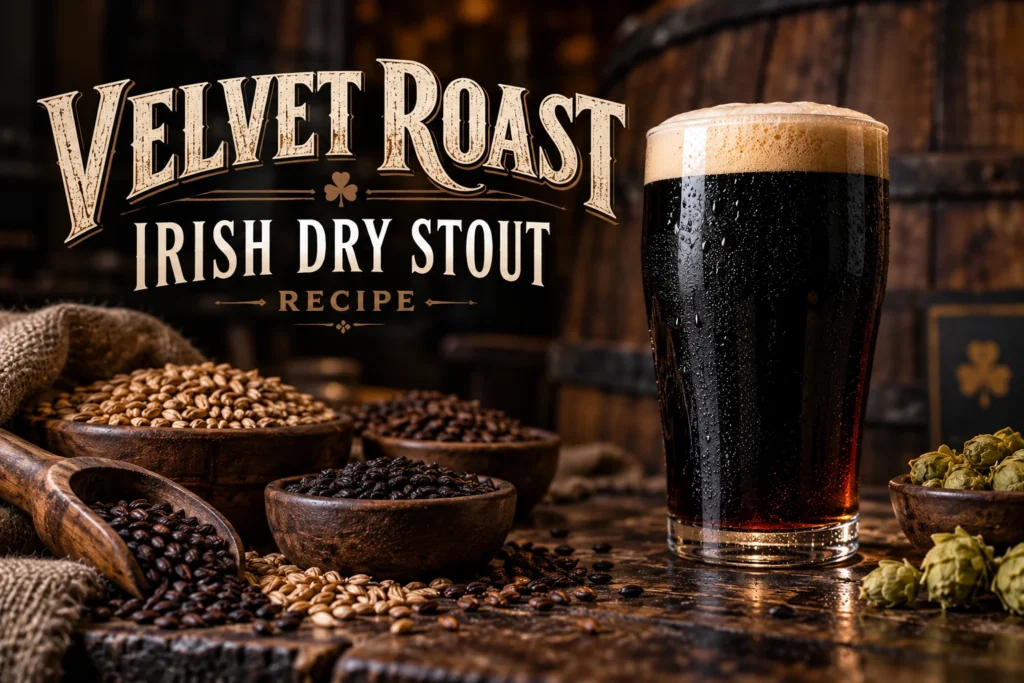
Tattooist Craft Beer / Original Recipe Series
Velvet Roast
IRISH DRY STOUT
Deep black, beautifully balanced and quietly complex. Velvet Roast combines smooth roasted barley, gentle coffee notes, a restrained touch of dark chocolate and a refreshingly dry finish. A traditional Irish stout crafted for flavor without heaviness.
Dark in color. Refined in character.
There is something remarkable about a well-made Irish Dry Stout. Its appearance suggests intensity: a nearly black body, a creamy head, and the unmistakable aroma of roasted grain. Yet the first sip can reveal a beer that is surprisingly light, smooth, and refreshing.
Velvet Roast is an original Irish Dry Stout recipe built around that contrast.
The goal is to create a classic dark beer with pronounced but controlled roasted character, subtle coffee and dark chocolate notes, balanced bitterness, and a relatively dry finish.
This is not a sweet dessert stout. It contains no lactose, vanilla, added coffee, or artificial flavoring.
Instead, the recipe relies on traditional brewing ingredients and careful fermentation to achieve a smooth, satisfying result.
Designed for a 25-liter (6.6 US gallon) batch, Velvet Roast uses Maris Otter Pale Malt, flaked barley, roasted barley, and a small amount of Chocolate Malt. East Kent Goldings provides balanced bitterness, while a traditional English ale yeast supports a clean, lightly expressive fermentation.
The recipe is designed around an estimated 75% brewhouse efficiency. All specifications are calculated targets, not measured results from a completed batch.
What Defines an Irish Dry Stout?
Irish Dry Stout is one of the most recognizable traditional dark beer styles.
Despite its deep color, it is usually a moderate-strength beer with a relatively light body and a firm, dry finish.
Roasted barley is often responsible for its distinctive coffee-like aroma and flavor. Flaked barley can contribute body and foam stability without adding significant sweetness.
The hop bitterness should balance the roasted grain rather than dominate the beer.
A successful example may taste gently bitter, dry, and roasted, with subtle notes reminiscent of coffee, cocoa, and dark bread crust.
The essential distinction is balance.
Too much dark grain can introduce harsh bitterness or astringency.
Too much caramel malt or excessive residual sweetness can make the beer feel more like a sweet stout or porter.
Velvet Roast is designed to sit between these extremes.
Velvet Roast: Beer Profile and Brewing Targets
| Parameter | Velvet Roast Target |
|---|---|
| Style | Irish Dry Stout (15B) |
| Batch Size | 25 L / 6.6 US gal |
| Original Gravity | ~1.042 |
| Final Gravity | ~1.009 |
| Alcohol | ~4.3% ABV |
| Bitterness | ~32 IBU |
| Color | ~65–75 EBC / 33–38 SRM |
| Efficiency | 75% assumed |
| Boil Time | 60 min |
| Carbonation | 1.8–2.0 vol. CO₂ |
The target original gravity is approximately 1.042, with an expected final gravity near 1.009.
This corresponds to an estimated alcohol content of approximately 4.3% ABV.
Bitterness is targeted around 32 IBU, with a deep black color and subtle reddish-brown highlights near the edge of the glass.
The estimated color is approximately 65–75 EBC (33–38 SRM), depending on the actual color specifications of the roasted grains.
The flavor should be clearly roasted but never aggressively burnt.
Expected Appearance
Nearly opaque black, with subtle ruby highlights under strong light. A persistent tan or light-brown foam head completes the appearance.
Expected Aroma
Freshly roasted coffee, restrained dark chocolate, gentle grain character, and perhaps a very subtle earthy or floral hop note.
Expected Flavor
Moderate roasted-barley character, firm but balanced bitterness, hints of coffee and cocoa, and very little lingering sweetness.
Expected Mouthfeel
Medium-light body with a smooth, slightly creamy impression.
Expected Finish
Relatively dry, clean, pleasantly roasted, and refreshing.
The recipe should produce an enjoyable stout both on standard CO₂ draft and in bottles, although its foam and mouthfeel will differ from those of a nitrogen-dispensed stout.
1. Building the Malt Bill: Dark Flavor Without Harshness
The grain bill is deliberately simple.
Each ingredient has a clear purpose, and none should overpower the rest.
Maris Otter Pale Malt – 3.60 kg
Maris Otter provides the foundation.
Compared with a very neutral base malt, it can offer a slightly richer, more biscuit-like and bready malt impression.
This supports the roasted barley without adding excessive sweetness.
At approximately 76% of the grain bill, it provides most of the fermentable extract.
Flaked Barley – 0.70 kg
Flaked barley contributes approximately 15% of the grain bill.
Its role is particularly important.
Flaked barley contains proteins and other grain components that can help develop body, improve foam retention, and contribute a smooth, creamy impression.
It does not automatically make a beer sweet.
That distinction matters in a dry stout, where we want some fullness in the mouthfeel without a sugary finish.
Because flaked barley does not supply the same enzymatic power as base malt, it relies on the Maris Otter portion for starch conversion.
Roasted Barley – 0.40 kg
Roasted barley gives Velvet Roast its stout identity.
It introduces the characteristic coffee-like aroma, dry roasted finish, and much of the beer’s dark color.
The amount represents approximately 8.4% of the total grain bill.
This is sufficient to create a clearly recognizable stout, while leaving room to manage roast intensity through mash conditions and water chemistry.
Roasted barley products can vary significantly in color and flavor intensity. The exact result should be checked using the maltster’s specifications.
Chocolate Malt – 0.05 kg
Only 50 grams of Chocolate Malt are included.
This small addition is intended to add a subtle background cocoa note and a little extra color complexity.
It should not transform the beer into a chocolate porter.
If the first batch produces too much dark chocolate character, this is the first ingredient I would consider removing.
Why No Crystal Malt or Lactose?
Crystal Malt would contribute caramel flavors and additional residual sweetness, which are not priorities in this dry stout.
Lactose would increase sweetness and body while moving the beer away from the intended traditional Irish Dry Stout profile.
The combination of Maris Otter, flaked barley, and roasted barley already provides the essential foundation.
Our guide to roasted malts explains how different dark grains influence roast intensity, color, and flavor.
2. Hop Selection: East Kent Goldings
| Fermentable | Amount | Percent |
|---|---|---|
| Maris Otter Pale Malt | 3.60 kg / 7.94 lb | 75.8% |
| Flaked Barley | 0.70 kg / 1.54 lb | 14.7% |
| Roasted Barley | 0.40 kg / 0.88 lb | 8.4% |
| Chocolate Malt | 0.05 kg / 0.11 lb | 1.1% |
| Total | 4.75 kg / 10.47 lb | 100% |
| Hop | Amount | Timing |
|---|---|---|
| East Kent Goldings · 5.5% AA | 55 g / 1.94 oz | 60 min boil |
| Total | 55 g / 1.94 oz | ~32 IBU estimated |
Velvet Roast uses East Kent Goldings (EKG) as its only hop variety.
This traditional English hop is well suited to a malt-driven stout.
Its earthy, floral, and gentle herbal characteristics can complement roasted malt without becoming a dominant aroma.
For the first batch, the recipe uses a single bittering addition at the beginning of the boil.
This creates a simple, predictable schedule and avoids unnecessary hop complexity.
Target Hop Schedule
- East Kent Goldings: 55 g (1.94 oz)
- Assumed alpha acid: 5.5%
- Addition time: 60 minutes
- Estimated bitterness: approximately 32 IBU
The calculated IBU depends on the actual alpha-acid value, boil gravity, batch volume, and hop utilization model.
If your EKG hops contain 4.5% or 6.5% alpha acids instead, calculate the required weight again before brewing.
No whirlpool or dry-hop addition is needed.
The focus should remain on the roasted grain, moderate bitterness, and clean finish.
3. Brewing Water for a Smooth Irish Stout
| Water Parameter | Amount / Target |
|---|---|
| Total RO Water | 35 L / 9.25 US gal |
| Mash Water | 19 L / 5.02 US gal |
| Sparge Water | 16 L / 4.23 US gal |
| Calcium Chloride Dihydrate | 5 g total |
| Gypsum Dihydrate | 3 g total |
| Calcium (Ca) | ~59 mg/L |
| Chloride (Cl) | ~69 mg/L |
| Sulfate (SO₄) | ~48 mg/L |
| Target Room-Temp Mash pH | 5.4–5.5 |
| Alkalinity Adjustment | Only after mash pH calculation |
Water treatment is especially important when brewing with highly roasted grains.
Dark roasted barley can significantly influence mash pH.
A water profile that works well for a pale lager or West Coast IPA may not produce the same results in a stout.
For Velvet Roast, the goal is to support the roasted flavor without increasing sharpness or harshness.
We want moderate calcium, a relatively balanced chloride-to-sulfate profile, and a mash pH that remains appropriate despite the dark grains.
Option A: Reverse Osmosis Water
RO water provides a useful low-mineral starting point.
For approximately 35 liters (9.25 US gallons) of brewing water, the initial mineral additions are:
- Calcium Chloride Dihydrate (CaCl₂·2H₂O): 5 g
- Gypsum (CaSO₄·2H₂O): 3 g
Assuming negligible residual minerals, this gives approximately:
- Calcium: 59 mg/L
- Chloride: 69 mg/L
- Sulfate: 48 mg/L
This is a moderate mineral profile designed to avoid emphasizing bitterness excessively.
However, mineral additions alone do not establish the correct mash pH.
The roasted grain may require additional alkalinity to prevent the mash from becoming overly acidic.
Use a target room-temperature mash pH of approximately 5.4–5.5 as a starting point for calculation and measurement.
If your predicted or measured pH is too low, a calculated addition of food-grade sodium bicarbonate may be appropriate.
Do not add sodium bicarbonate automatically. The correct dose depends on the actual malt colors, source water, mash volume, and alkalinity.
The salt quantities above assume the specified hydrated chemical forms.
Option B: Tap, Well, or Spring Water
If you use your own water, begin with a reliable water report.
You should know the calcium, magnesium, sodium, chloride, sulfate, and bicarbonate concentrations, or ideally the measured alkalinity.
Water containing some alkalinity may be advantageous for a dark beer, but excessive alkalinity can create other problems.
The correct treatment is based on the actual mash pH, not simply on the assumption that dark beer requires hard water.
Enter your available mineral values into the tools on our Brewing Tools page, using the functions available for water and recipe calculations.
For more background, our brewing water profile guide explains how source-water composition influences brewing decisions.
A Practical Method for Managing Harsh Roasted Flavor
Roast intensity is not controlled by water chemistry alone.
The freshness and type of roasted grain, milling, mash pH, extraction, and recipe proportions all contribute.
For the first batch, include the roasted barley and Chocolate Malt during the normal mash and measure the pH after the mash has stabilized.
If the finished beer tastes harsh, examine the pH and grain balance before making significant recipe changes.
A late addition of the roasted grains can be explored in a future batch, but it is not necessary for the first version of Velvet Roast.
4. Mash Schedule: Balancing Dryness and Body
Use a single-infusion mash at 65°C (149°F) for approximately 60 minutes.
This is a practical temperature for achieving good fermentability while retaining some body.
The flaked barley will help support mouthfeel, even though the recipe is designed to finish relatively dry.
An optional mash-out at 76°C (169°F) for 10 minutes can be used if appropriate for your equipment.
Sparge with water at approximately 76–77°C (169–171°F), while monitoring the actual process conditions.
The exact final gravity cannot be guaranteed from mash temperature alone.
Yeast attenuation, malt composition, fermentation health, and equipment accuracy are also important.
Avoid Excessively High Mash Temperatures
A significantly warmer mash could leave more residual extract and make the beer fuller or sweeter than intended.
That may work well for another stout style, but Velvet Roast is designed as a dry Irish Stout.
The aim is a smooth texture with restrained sweetness.
5. Boiling and Wort Preparation
The recipe uses a 60-minute boil.
Add all 55 g of East Kent Goldings at the beginning.
A single hop addition is sufficient because this recipe does not require a noticeable late-hop aroma.
The expected brewing-water requirement is approximately 35 liters, with the final volume adjusted for your equipment losses.
For an example system:
- Mash water: 19 L
- Sparge water: 16 L
- Estimated grain absorption: 4.7 L
- Expected pre-boil volume: 30.3 L
- Assumed boil-off: 4.0 L
- Estimated kettle and trub loss: 1.3 L
- Target wort into fermenter: 25 L
These figures are equipment-dependent estimates rather than universal constants.
Measure your actual pre-boil gravity and volume to refine the recipe for subsequent brews.
After boiling, chill promptly to the yeast pitching temperature.
6. Yeast Selection and Fermentation
| Mash Step | Temperature | Duration |
|---|---|---|
| Single-Infusion Mash | 65°C / 149°F | 60 min |
| Optional Mash-Out | 76°C / 169°F | 10 min |
| Sparge | 76–77°C / 169–171°F | As required |
| Stage | Target |
|---|---|
| Yeast | SafAle S-04 |
| Dry Yeast Pitch | Approx. 18 g |
| Main Fermentation | 18–19°C / 64–66°F |
| Finishing Stage | ~20°C / 68°F |
| Gravity Check | Confirm stable FG |
| Cold Crash | 2–4°C / 36–39°F for 2–3 days |
| Carbonation | 1.8–2.0 vol. CO₂ |
For Velvet Roast, I recommend SafAle S-04.
This traditional English ale yeast is a practical choice for a malt-forward stout, with good sedimentation characteristics and a fermentation profile that can complement roasted grain.
For a 25-liter batch, approximately 18 g of fresh, properly stored dry yeast is an appropriate starting pitch, subject to the manufacturer’s instructions and the actual wort gravity.
Fermentation Temperature
Start fermentation at approximately 18–19°C (64–66°F).
As fermentation slows, allow the beer temperature to rise gradually to approximately 20°C (68°F), provided fermentation remains healthy.
The expected final gravity is around 1.009, but the actual value may differ.
Do not cold crash merely because a fixed number of days has passed.
Confirm that gravity is stable and that fermentation has finished.
Fermentation Duration
A healthy fermentation may complete most activity within approximately 5–8 days, but the beer may need additional time to reach stable gravity and clean up fermentation by-products.
An initial planning window of approximately 8–12 days before cooling or packaging is reasonable.
Always follow actual gravity measurements rather than the calendar alone.
Should This Stout Be Fermented Under Pressure?
Pressure fermentation is not necessary.
For the first Velvet Roast batch, a conventional ale fermentation provides a straightforward reference.
Fermentation pressure may change yeast behavior and should not be used simply to accelerate the process.
If using a pressure-capable vessel, follow its safety limitations and the yeast’s appropriate fermentation conditions.
7. Cold Conditioning and Clarity
Unlike a lager, Irish Dry Stout does not require several weeks of cold lagering.
After confirming stable final gravity, cold crash at approximately 2–4°C (36–39°F) for 2–3 days if your equipment supports it.
This can improve yeast settling before packaging.
Because Velvet Roast is almost opaque, visual clarity is less apparent than it would be in a pale lager.
Nevertheless, good sedimentation and careful packaging remain valuable.
Avoid oxygen ingress when cooling or transferring the beer.
Dark beers are not immune to oxidation, and oxygen can dull the intended malt and roasted character.
8. Carbonation: Creamy Rather Than Overly Fizzy
For a conventionally carbonated Irish Dry Stout, target approximately 1.8–2.0 volumes of CO₂.
This is lower than the carbonation commonly used for a modern American IPA.
The goal is to support a smooth mouthfeel rather than create excessive prickly carbonation.
Kegging
Use a cleaned and purged keg and carbonate according to the actual beer temperature and desired CO₂ level.
A standard CO₂ system will not create the same dense cascading foam as a nitrogen-dispensed stout.
Nitrogen Dispense
A mixed-gas stout system can produce a distinctive tight, creamy head and smooth presentation.
However, the result depends on the gas mixture, stout faucet, restriction plate, serving pressure, and temperature.
A standard CO₂ keg is perfectly acceptable for this recipe, even though the visual result will differ.
Bottling
If bottling, calculate priming sugar based on the actual beer temperature, volume, and target carbonation.
Confirm stable final gravity before adding priming sugar and sealing bottles.
An ordinary bottled version can still be excellent, with a pleasant creamy impression from the flaked barley and foam-forming proteins.
9. The Finished Beer: What Should Velvet Roast Taste Like?
Pour the beer into a clean glass.
The color should appear almost completely black, with subtle brown or ruby highlights when held against strong light.
The foam should be creamy and tan-colored.
The aroma should suggest coffee, roasted barley, and restrained cocoa rather than burnt toast or ash.
The first sip should reveal moderate bitterness and a distinctive roast character.
The middle of the palate should feel smoother and slightly fuller than the beer’s relatively low alcohol content might suggest.
Then the finish should become dry and refreshing, with the roasted flavor fading gradually instead of leaving harsh astringency.
This contrast is what makes the recipe interesting.
A dark beer does not need to be heavy to feel complete.
10. How to Refine the Next Batch
A carefully designed recipe is the starting point, not the final word.
The first batch of Velvet Roast should establish a reliable baseline.
If the Roasted Flavor Is Too Harsh
Check mash pH, dark grain specifications, extraction conditions, and the finished beer’s overall balance.
Consider a small reduction in roasted barley or a change in how the roasted grains are added.
Avoid trying to solve every harshness issue by adding more sweetness.
If the Beer Tastes Too Thin
Check the actual final gravity and attenuation.
A slight mash-temperature adjustment or a small increase in flaked barley may improve the perceived body.
Make only one change at a time.
If the Beer Is Too Sweet
Confirm that fermentation completed properly.
Review the mash temperature, yeast health, and any unintended changes to the malt bill.
The recipe should not require lactose or large Crystal Malt additions.
If the Coffee Character Is Too Weak
Consider the roasted barley’s freshness, color, and sensory profile.
A small increase in roasted grain may be more useful than adding coffee directly.
If the Head Retention Is Disappointing
Check glass cleanliness, carbonation, flaked barley contribution, overall protein balance, and possible foam-negative residues.
A nitrogen dispense system can enhance presentation, but it is not a substitute for good brewing practices.
11. Brewing Notes and Repeatability
Record the actual original gravity, final gravity, mash pH, pre-boil volume, fermentation temperatures, packaging date, and tasting observations.
Pay particular attention to roast intensity, bitterness, and mouthfeel.
The most valuable improvement may be a small adjustment rather than a completely different recipe.
Velvet Roast is an original, calculated Irish Dry Stout recipe concept. It has not yet been brewed or independently tested, so its target values should be verified using your own ingredients and brewing system.
A complete printable recipe card can be placed at the end of this article, providing the grain bill, water additions, hop schedule, fermentation temperatures, and brew-day checklist in one convenient format.
Dark in color. Refined in character.
Tattooist Craft Beer · Recipe Card
Velvet Roast
Irish Dry Stout · All-Grain · 25 L
| Malt | Amount | Percent |
|---|---|---|
| Maris Otter Pale Malt | 3.60 kg / 7.94 lb | 75.8% |
| Flaked Barley | 0.70 kg / 1.54 lb | 14.7% |
| Roasted Barley | 0.40 kg / 0.88 lb | 8.4% |
| Chocolate Malt | 0.05 kg / 0.11 lb | 1.1% |
| Total | 4.75 kg / 10.47 lb | 100% |
| Total brewing water | 35 L / 9.25 US gal |
| Mash water | 19 L |
| Sparge water | 16 L |
| Expected pre-boil volume | 30.3 L |
| Expected post-boil volume | 26.3 L |
| Into fermenter | 25 L |
| RO Water Salts | Mash | Sparge |
|---|---|---|
| Gypsum (CaSO₄·2H₂O) | 1.6 g | 1.4 g |
| Calcium Chloride (CaCl₂·2H₂O) | 2.7 g | 2.3 g |
| Step | Temperature | Time |
|---|---|---|
| Single infusion | 65°C / 149°F | 60 min |
| Optional mash-out | 76°C / 169°F | 10 min |
| Sparge | 76–77°C / 169–171°F | As required |
| Hop | Amount | Timing |
|---|---|---|
| East Kent Goldings · 5.5% AA | 55 g / 1.94 oz | 60 min boil |
| Yeast | SafAle S-04 |
| Pitch | Approximately 18 g; verify manufacturer guidance |
| Main fermentation | 18–19°C / 64–66°F |
| Finishing stage | ~20°C / 68°F |
| Dry hopping | None |
| Cold crash | 2–4°C / 36–39°F, 2–3 days after stable gravity |
| Carbonation | 1.8–2.0 volumes CO₂ |
- Prepare and treat brewing water; check predicted mash pH.
- Mash at 65°C for 60 minutes with all grains.
- Measure mash pH using a cooled sample; adjust only if needed.
- Sparge and collect approximately 30.3 L.
- Measure pre-boil gravity and volume.
- Boil 60 minutes; add 55 g East Kent Goldings at 60 min.
- Finish the boil without whirlpool or dry-hop additions.
- Chill promptly to 18–19°C yeast pitching temperature.
- Transfer approximately 25 L into the fermenter.
- Measure OG, pitch S-04 and control fermentation at 18–19°C.
- Allow to rise to ~20°C as fermentation slows.
- Confirm stable final gravity before cooling.
- Cold crash at 2–4°C for approximately 2–3 days.
- Package with minimal oxygen exposure; carbonate to 1.8–2.0 vol CO₂.