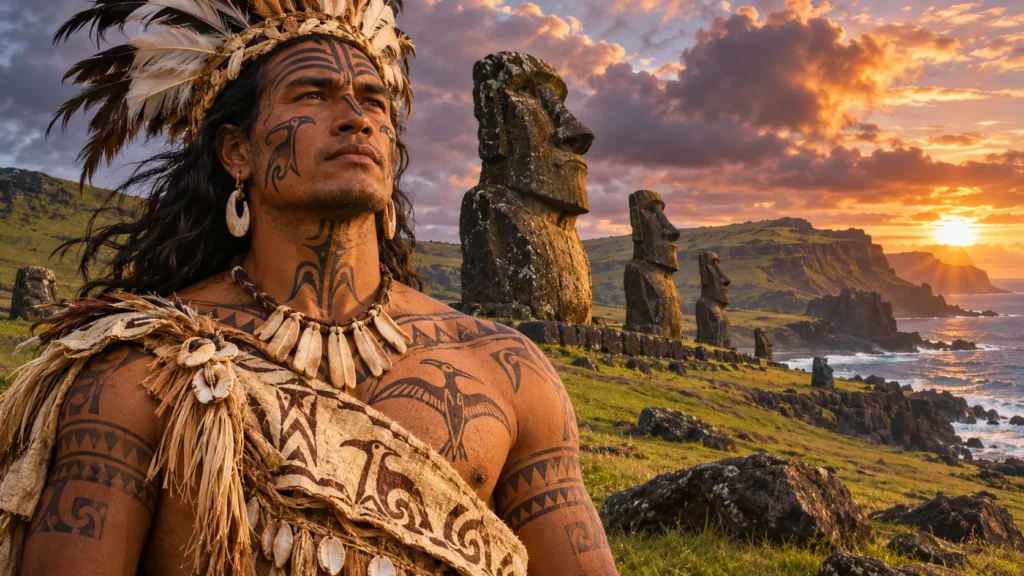
On April 5, 1722, Easter Sunday, the Dutch explorer Jacob Roggeveen was sailing across the southeastern Pacific Ocean when his expedition spotted a small volcanic island in the distance. The island would later become known as Easter Island, although its indigenous inhabitants know it as Rapa Nui.
A few days later, members of the expedition managed to land on the island, where they were astonished by the enormous moai stone statues, some standing several metres tall. These monumental sculptures represented the ancestors of the island’s inhabitants and played an important role in their religious and social life.
Easter Island appeared to have developed in almost complete isolation for centuries. However, the Rapa Nui people are of Polynesian origin, and their culture shares many characteristics with traditions found on other Pacific islands.
Among these traditions is the art of tattooing, which developed particularly rich symbolism on Easter Island.
Traditional Rapa Nui Tattoos
Rapa Nui art combines human (anthropomorphic) and animal (zoomorphic) figures in distinctive, almost surreal compositions. It is therefore not surprising that this artistic tradition inspired several European Surrealist painters, particularly Max Ernst, whose work sometimes incorporated motifs associated with Easter Island art, including birdman figures.
Over time, wood suitable for carving became increasingly scarce on the island. Cloth made from tree bark, known as tapa, was also highly valued.
Just as Hawaiian rulers wore cloaks made from red feathers to demonstrate their social status, tapa clothing may have carried special significance among the Rapa Nui elite.
According to some researchers, figures made from tapa cloth may have served as substitutes for wooden sculptures or possibly as symbolic representations of ancestral spirits.
Earlier museum research identified only five surviving figures decorated with painted designs, known as manu uru (also described in some sources as manu usu). These objects are preserved in museum collections, and their decorations often resemble traditional Rapa Nui tattoo motifs.
Tattooing was widespread throughout Polynesia and frequently indicated social status, family identity, warrior rank, or spiritual beliefs.
The face, neck, back, legs, arms, chest, and sometimes even the top of the head could be tattooed.
Traditional Rapa Nui tattooing tools resembled those used elsewhere in Polynesia.
A toothed comb made from bird or fish bone was attached at an angle to a wooden handle.
This tool, known as an uhi, was struck with a small wooden mallet, driving the teeth and their pigment into the skin.
Traditional Rapa Nui tattooing is also associated with the term ta kona in older ethnographic sources.
Tattoo pigment was traditionally obtained from burned ti leaves (Cordyline terminalis, now often classified as Cordyline fruticosa). The resulting black soot could be mixed with various plant juices, including juice from Solanum nigrum.
The ti plant also held spiritual significance in other Polynesian cultures. In Hawaii, for example, it was associated with high social status, divine power, and protection against evil spirits.
The Last Bearers of Traditional Rapa Nui Tattoos
Unfortunately, very few historical photographs and illustrations of original Rapa Nui tattoos have survived.
One of the best-known photographs was taken in the early 1870s by Madame Hoare, a photographer working in Tahiti.
The photograph shows a man traditionally referred to as Tepano, believed to have been a high-ranking Rapa Nui individual, with distinctive tattoos on his face and neck.
Older publications frequently identify him as Juan Tepano. However, more recent research has raised questions about the subject’s actual name and identity. A 2018 study suggested that he may instead have been Vaka Ariki, a prominent member of the Miru lineage.
The Swedish ethnographer Hjalmar Stolpe, who travelled through the Pacific during the 1880s, also studied the tattoos of the islanders. His portrait and profile illustrations of the man known as Tepano were published in 1899.
For many years, it was believed that only one historical photograph of a tattooed Rapa Nui man had survived. More recent archival research, however, has identified additional possible images of Rapa Nui men bearing traditional tattoos.
According to an ethnographic account from 1911, only four women among the island’s 228 inhabitants still wore traditional tattoos.
By around 1930, only two elderly women were mentioned among the known surviving tattoo bearers: Viriamo, the mother of Juan Tepano, and Ana Eva Hei, the wife of Atamu Te Kena, one of Easter Island’s last traditional rulers.
Neither woman’s body was completely covered in tattoos.
According to her own account, Viriamo had refused additional tattoos because she found the procedure too painful.
The younger Ana Eva Hei had received her tattoos from one of the last traditional tattoo masters.
The Meaning of Traditional Tattoo Designs
In general, Rapa Nui tattoos followed certain basic motifs that were preserved and passed down through generations.
However, these designs were not completely identical for every individual. Different families, lineages, and personal preferences could influence their appearance.
Some motifs were far more common and recognizable than others.
Both men and women frequently wore thick lines across their foreheads, sometimes extending towards the ears.
These lines were often curved and connected by series of larger dots. The terms humu and puraki appear in older descriptions in connection with such forehead and temple decorations.
Similar motifs can also be seen on tapa figures, although usually on a smaller scale and in more simplified forms.
Women sometimes wore a design known as pagaha’a below the ears. The name roughly suggests something heavy or hanging down.
The design consisted of a spindle-shaped form combined with a triangular element.
Based on an older name, pangehua, some researchers have suggested that these patterns may have been connected with fertility.
The word hua, in certain linguistic interpretations, can refer to a testicle or, figuratively, a male child.
However, this remains an ethnographic and linguistic interpretation rather than a universally established meaning.
Women also sometimes wore tattooed rings around their mouths, known as ngutu tika.
Some researchers have drawn parallels between these designs and Māori tattoo traditions.
Other patterns consisted of three vertical lines extending downward from the mouth and sometimes crossing the chin.
Such motifs can also be observed on surviving tapa figures.
The Ao Motif
On the back of the elderly woman Viriamo, between her shoulder blades, there was a distinctive ao motif.
In Rapa Nui culture, the term ao refers to a paddle-shaped ceremonial object associated with celebrations and ritual dances.
The tattoo also contained stylized elements resembling an eye and a nose.
Below the ao motif, a winding band extended across the lower part of Viriamo’s back and may have continued around her body.
These bands formed a continuous composition and may have been connected with dance, ceremonial clothing, or social status.
A similar decoration can be found on one surviving tapa figure, where it covers the waist and hips before ending in a bird motif.
It is possible that the ao patterns had ancient religious or social significance.
Because the term ao was also associated with ceremonial objects used by high-ranking leaders, some researchers have suggested that these tattoos may originally have been reserved for certain members of the elite.
However, this cannot be established with complete certainty.
Tepano’s Tattoos
The forehead tattoo of the man known as Tepano is referred to as retu.
The design consisted of approximately six to ten thick vertical lines.
According to early accounts, parallel lines and accompanying dots across the forehead were among the most frequently encountered facial tattoo patterns.
These designs were already mentioned by early European visitors.
The less visible tattoos, however, are equally fascinating.
On Tepano’s neck, beneath the chin, there was a stylized bird with an elongated body. Its wings were represented by a few short lines.
This motif represents a frigatebird.
The frigatebird also appears in the tattoo traditions of other Pacific cultures. In some interpretations, it is associated with warfare, hunting, power, and high social status.
Similar bird designs can be found on tapa figures.
Another bird motif, with outstretched wings formed by parallel lines, was described on the right side of Tepano’s back.
Birds played an especially important role in Rapa Nui symbolism.
Their significance can be observed not only in tattoos but also in the island’s religious traditions and rock carvings.
The Birdman and Makemake
One of the best-known figures in Rapa Nui religious tradition is the tangata manu, or Birdman.
The Birdman cult was closely associated with the creator deity Makemake, as well as seabirds and their eggs.
One of its most important ceremonial locations was Orongo, a settlement near the Rano Kau volcano.
During the ritual Birdman competition, participants travelled to the nearby islet of Motu Nui to obtain the first egg of the season laid by the sooty tern.
Finding the egg held great religious and social significance.
The person represented by the successful competitor could receive exceptional status and authority for a designated period.
The exact origins of the Birdman cult remain uncertain.
Although older accounts sometimes date its beginnings much earlier, possibly to the fourteenth century, archaeological investigations at Orongo have identified cult-related activities by the early seventeenth century. The tradition later gained particular importance during the eighteenth and nineteenth centuries.
In Rapa Nui mythology, Makemake is also associated with the creation of life and humanity.
Some traditional accounts include the goddess Haua in stories concerning the arrival of birds on the island.
Several versions of these myths have survived, and they should not be treated as a single, unchanging narrative.
Nevertheless, the combination of human and bird forms remains one of the most distinctive features of Rapa Nui art.
Sacred Skin
From the enormous moai statues to the tapa figures and the tattoos of the island’s indigenous inhabitants, Rapa Nui art was closely connected with religious beliefs and social life.
The moai represented ancestors, the Birdman held an important place in ceremonial traditions, and traditional tattoos could express identity, social rank, and spiritual connections.
In Rapa Nui tradition, some tattoos may also have been associated with the concept of mana, a form of sacred or supernatural power.
The designs placed on the skin were therefore much more than simple decoration.
They could become expressions of community membership, ancestral connections, social standing, and religious belief.
However, these meanings must always be understood within their historical and cultural context, as not every Rapa Nui tattoo carried the same symbolism.
During the second half of the nineteenth century, slave raids, disease, the arrival of missionaries, and major social changes severely affected the island’s traditional culture.
By the early twentieth century, traditional tattooing had almost completely disappeared in its original form.
Today, however, artists of Rapa Nui heritage are once again researching and reinterpreting ancestral motifs.
Traditional designs are finding a new place in contemporary tattoo art while also becoming important expressions of cultural identity and heritage preservation.
Rapa Nui tattooing is therefore not merely an unusual artistic tradition from an isolated island.
It is part of the history of a people who preserved the memory of their ancestors, their beliefs, and their connection with the sacred world through markings on the skin.