Tattooist Craft Beer / Original Recipe Series
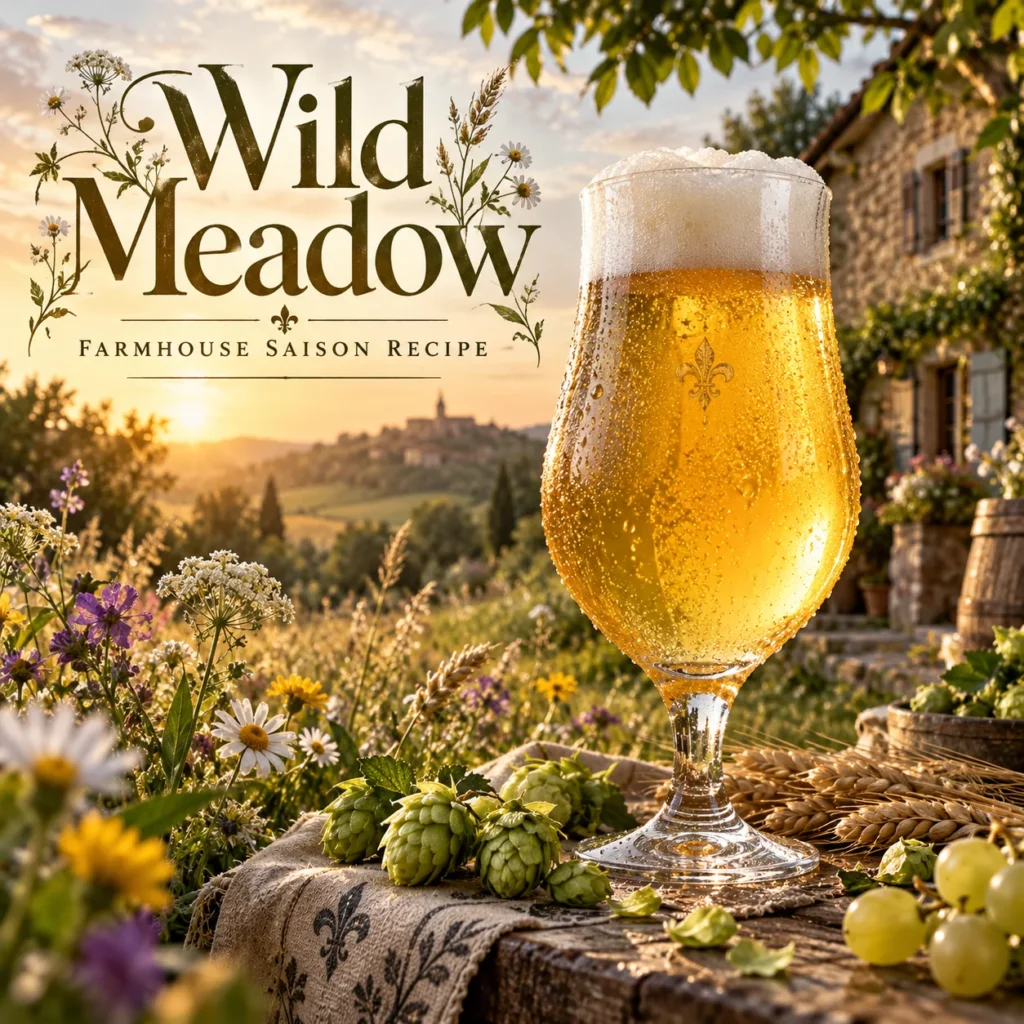
Wild Meadow
FARMHOUSE SAISON · BJCP 25B
Inspired by open meadows and rustic Belgian brewing traditions, Wild Meadow is a dry, highly refreshing Saison with peppery yeast character, gentle citrus, delicate white wine notes and lively carbonation. A farmhouse ale where expressive yeast takes the lead and hops provide balance.
Born from grain. Shaped by yeast. Inspired by nature.
A great Saison is not defined by excessive strength, heavy malt sweetness, or overwhelming hop aroma. Its character comes from something more expressive: the interaction between highly fermentable wort, distinctive yeast, delicate grain flavors, lively carbonation, and a remarkably dry finish.
Wild Meadow is an original Farmhouse Saison recipe created around these qualities.
Inspired by the rustic brewing traditions of Wallonia, Belgium, this beer combines a clean Pilsner malt foundation, a touch of Vienna Malt, a small portion of Wheat Malt, traditional Saaz hops, and a restrained addition of Nelson Sauvin.
The most important ingredient, however, is the Saison yeast.
The intended result is a refreshing golden ale with peppery fermentation character, subtle fruit esters, light citrus notes, a delicate white wine impression, and a crisp, dry finish.
Unlike a hop-driven New World Saison, Wild Meadow keeps its hop aroma in the background.
The goal is to let the yeast define the beer.
This original recipe is designed for 25 liters (6.6 US gallons) into the fermenter, assuming approximately 75% brewhouse efficiency.
All brewing specifications are calculated targets. The beer has not yet been brewed or independently tested.
What Defines a Traditional Saison?
Saison originated in the French-speaking region of Belgium, particularly Wallonia.
Historically associated with rural brewing traditions, it has developed into a broad family of distinctive Belgian ales.
Modern examples may vary considerably in strength, color, yeast expression, and hop character.
Nevertheless, a few characteristics remain especially important.
A standard-strength Saison should be highly attenuated, refreshing, relatively light-bodied, and strongly carbonated.
Its fermentation profile commonly introduces pepper-like phenols, fruity esters, and a rustic complexity that can make even a simple malt bill feel remarkably expressive.
Hop bitterness should provide balance, while hop aroma may contribute herbal, floral, spicy, or fruity notes.
The style is not necessarily sour, and it does not require added spices.
In fact, a carefully selected Saison yeast can produce enough complexity without coriander, peppercorns, citrus peel, or other botanical additions.
That is the approach behind Wild Meadow.
The recipe is intentionally simple because the fermentation should provide the complexity.
Wild Meadow: Beer Profile and Brewing Targets
| Beer Parameter | Recipe Target |
|---|---|
| Style | Saison · BJCP 25B |
| Strength / Color | Standard / Pale |
| Batch Size | 25 L / 6.6 US gal |
| Original Gravity | ~1.053 |
| Final Gravity | ~1.006 |
| Alcohol | ~6.1% ABV |
| Bitterness | ~25–27 IBU |
| Color | ~9–11 EBC / 4.5–5.5 SRM |
| Assumed Efficiency | 75% |
| Boil Time | 60 min |
| Carbonation | 2.7–3.0 vol. CO₂ |
Wild Meadow is designed as a standard-strength, pale Saison under BJCP category 25B.
The target original gravity is approximately 1.053, with an expected final gravity near 1.006.
If fermentation reaches these values, the resulting alcohol content will be approximately 6.1–6.2% ABV.
The estimated bitterness is approximately 25–27 IBU, assuming the specified hop alpha-acid percentages and a conventional Tinseth calculation.
The intended color is approximately 9–11 EBC (4.5–5.5 SRM), with the actual result dependent on malt specifications and brewing efficiency.
The beer should finish very dry while maintaining a lively and refreshing character.
Appearance
Pale gold to light golden-yellow, potentially with a faint warm hue from the Vienna Malt.
A dense white head and lively carbonation should reinforce the refreshing appearance.
Clarity may vary because Saison is not required to be brilliantly filtered.
Aroma
Peppery yeast notes, delicate citrus, soft orchard fruit, light floral character, and a restrained white wine-like impression from Nelson Sauvin.
Flavor
Light grain and fresh bread from Pilsner Malt, subtle biscuit depth from Vienna Malt, gentle wheat character, and expressive yeast-derived spice.
A moderate bitterness supports a very dry finish.
Mouthfeel
Light to medium-light body, high carbonation, and a crisp, lively texture.
Finish
Dry, refreshing, slightly peppery, and elegantly bitter, without heavy sweetness.
1. Designing the Grain Bill
The grain bill consists of only three malts.
The purpose is to create a highly fermentable wort that provides enough character to support the Saison yeast without competing with it.
| Fermentable | Amount | Share |
|---|---|---|
| Pilsner Malt | 4.95 kg / 10.91 lb | 85.3% |
| Vienna Malt | 0.55 kg / 1.21 lb | 9.5% |
| Wheat Malt | 0.30 kg / 0.66 lb | 5.2% |
| Total Grain | 5.80 kg / 12.79 lb | 100% |
Pilsner Malt – 4.95 kg
Pilsner Malt is the foundation of Wild Meadow.
It makes up approximately 85% of the grain bill.
Its light grainy sweetness, fresh cereal character, and relatively neutral malt profile make it an excellent choice for a pale Saison.
Because Saison yeast can generate considerable flavor complexity, a heavily characterful base malt is not necessary.
Pilsner Malt allows the fermentation profile to remain clearly recognizable.
It also helps produce the intended pale golden appearance.
Vienna Malt – 0.55 kg
Vienna Malt provides approximately 9.5% of the grain bill.
Its purpose is to introduce a restrained layer of fresh bread, gentle biscuit flavor, and subtle golden color.
This amount is enough to provide some malt character without making the beer heavy or overly rich.
Increasing Vienna Malt substantially could shift the balance away from the desired crisp, yeast-led character.
Wheat Malt – 0.30 kg
Wheat Malt represents approximately 5% of the grain bill.
It contributes a subtle grainy character and can support foam formation and retention.
The amount is deliberately small.
Wild Meadow is not intended to become a Belgian Witbier or a wheat-dominated ale.
Its identity should remain that of a dry, highly attenuated Saison.
Why No Crystal Malt or Lactose?
Crystal Malt could introduce caramel sweetness and flavor that would compete with the crisp finish.
Lactose would also be inappropriate for the intended dry character.
The three selected malts provide everything required for a balanced fermentation base.
For a deeper explanation of selecting and combining malt varieties, see our guide to building a malt bill.
2. Hop Selection: Saaz and Nelson Sauvin
Wild Meadow uses two hop varieties with complementary roles.
Saaz provides the traditional foundation. Nelson Sauvin adds a restrained modern accent.
The goal is not to transform the beer into a Belgian IPA.
| Hop | Amount | Timing | Purpose |
|---|---|---|---|
| Saaz · 3.5% AA | 50 g / 1.76 oz | 60 min | Primary bitterness |
| Saaz · 3.5% AA | 20 g / 0.71 oz | 15 min | Herbal, spicy flavor |
| Nelson Sauvin · 12% AA | 12 g / 0.42 oz | 10 min | Subtle fruity accent |
| Total Hops | 82 g / 2.89 oz | 60 min boil | ~25–27 IBU |
Saaz – The Traditional Character
Saaz is a classic continental hop associated with gentle spice, herbal complexity, and delicate floral aroma.
Its character can complement the peppery fermentation notes of Saison yeast.
The main bittering addition takes place at the beginning of the 60-minute boil.
A second, smaller addition at 15 minutes contributes subtle hop flavor.
Nelson Sauvin – A Delicate Fruity Accent
Nelson Sauvin is known for distinctive white wine-like, gooseberry, and tropical fruit associations.
In a heavily hopped beer, those characteristics can become extremely prominent.
For Wild Meadow, that would be undesirable.
We use only 12 grams at 10 minutes remaining in the boil.
This provides a subtle fruity note that should complement rather than dominate the fermentation character.
The result is intended to suggest a delicate wine-like freshness, not an intense modern IPA.
Hop Schedule
The planned additions are:
- Saaz, 3.5% AA: 50 g at 60 minutes
- Saaz, 3.5% AA: 20 g at 15 minutes
- Nelson Sauvin, 12% AA: 12 g at 10 minutes
The estimated combined bitterness is approximately 25–27 IBU using a conventional calculation method.
Actual bitterness depends on hop alpha-acid values, wort gravity, boil volume, and utilization.
No dry hopping is included in the first version.
This is a deliberate decision to protect the yeast-led character.
If a later batch needs more Nelson Sauvin expression, small late-hop adjustments can be explored without changing the basic recipe.
For more detail on utilization and aroma, read our hop addition timing guide.
3. Brewing Water for a Crisp and Dry Saison
| Water Parameter | Amount / Target |
|---|---|
| Total RO Water | 35 L / 9.25 US gal |
| Mash Water | 21 L / 5.55 US gal |
| Sparge Water | 14 L / 3.70 US gal |
| Gypsum (CaSO₄·2H₂O) | 5.0 g total |
| Calcium Chloride (CaCl₂·2H₂O) | 4.0 g total |
| Calcium | ~64 mg/L |
| Chloride | ~55 mg/L |
| Sulfate | ~80 mg/L |
| Target Room-Temp Mash pH | 5.2–5.4 |
| Acid Addition | Only after pH calculation |
The brewing water should support fermentability, balanced bitterness, and the crisp finish.
Wild Meadow uses a moderate-calcium profile with slightly more sulfate than chloride.
This balance can help the bitterness feel defined without becoming aggressive.
The recipe does not need the highly sulfate-forward water profile typically associated with some West Coast IPAs.
RO Water Starting Profile
For approximately 35 liters (9.25 US gallons) of reverse-osmosis brewing water, the planned additions are:
- Gypsum (CaSO₄·2H₂O): 5 g
- Calcium Chloride (CaCl₂·2H₂O): 4 g
Assuming negligible minerals in the starting water, this provides approximately:
- Calcium: 64 mg/L
- Chloride: 55 mg/L
- Sulfate: 80 mg/L
The intended result is a balanced, moderately sulfate-forward water profile.
Mash pH
For this pale malt bill, target a room-temperature mash pH of approximately 5.2–5.4.
Very low-mineral RO water may require an acid adjustment depending on the malt composition and its residual alkalinity.
However, the correct quantity cannot be determined from the recipe name or malt color alone.
Use a brewing-water calculation and verify the actual mash pH with a calibrated meter and a cooled sample.
If acid is required, calculate a measured addition rather than using a fixed amount for every brewing system.
Using Your Own Source Water
If you brew with tap, well, or spring water, begin with its actual mineral composition.
Pay attention to bicarbonate, calcium, magnesium, chloride, sulfate, and sodium.
Do not add the full RO-water salt quantities to water that already contains substantial mineral concentrations.
Our Brewing Water Profile guide explains how different minerals influence brewing decisions.
The Brewing Tools page can also help you work with relevant recipe and water calculations.
4. Mash Schedule: Building a Highly Fermentable Wort
One of the defining characteristics of a great Saison is its low final gravity.
To encourage fermentability, Wild Meadow uses a single-infusion mash at 64°C (147°F) for 75 minutes.
This slightly longer, relatively cool mash favors the development of a highly fermentable wort.
A 75-minute mash is a practical starting point, but full conversion and the final fermentability still depend on malt modification, crush, mash pH, and enzyme activity.
An optional mash-out at 76°C (169°F) for 10 minutes can be used.
Sparge at approximately 76–77°C (169–171°F), while respecting the operating limits of your system.
| Mash Step | Temperature | Duration |
|---|---|---|
| Single-Infusion Mash | 64°C / 147°F | 75 min |
| Optional Mash-Out | 76°C / 169°F | 10 min |
| Sparge | 76–77°C / 169–171°F | As required |
| Stage | Target |
|---|---|
| Yeast | WHC Lab Farmhouse Vibes |
| Pitch | 20–25 g dry yeast |
| Initial Fermentation | 20–21°C / 68–70°F |
| Later Fermentation | 24–25°C / 75–77°F |
| Gravity Target | ~1.006 FG |
| Completion | Stable gravity confirmed |
| Cold Crash (Optional) | 2–4°C / 36–39°F, 2–3 days |
| Carbonation | 2.7–3.0 volumes CO₂ |
Why Not Mash at 68–69°C?
A higher mash temperature would generally favor a less fermentable wort.
That can be useful in fuller-bodied beer styles but conflicts with the intended dry Saison profile.
The selected yeast may still ferment extensively because of its diastatic characteristics, but the lower mash temperature provides a suitable foundation.
Should We Add Table Sugar?
Some Saison recipes include sugar to help increase fermentability or alcohol content without adding more malt body.
Wild Meadow does not need it for the first batch.
The combination of an appropriate mash and a highly attenuative Saison yeast should already produce a dry beer.
Adding sugar would introduce another variable without a clear need.
5. Brewing Volumes and Boil Schedule
| Brewing Volume | Estimated Amount |
|---|---|
| Total Water | 35.0 L |
| Mash Water | 21.0 L |
| Sparge Water | 14.0 L |
| Grain Absorption | ~5.8 L |
| Pre-Boil Wort | ~29.2 L |
| Boil-Off (60 min) | ~3.2 L |
| Post-Boil Wort | ~26.0 L |
| Kettle & Trub Loss | ~1.0 L |
| Into Fermenter | 25.0 L |
For the 25-liter batch, the planned water requirement is approximately 35 liters.
A reasonable starting distribution is:
- Mash water: 21 L
- Sparge water: 14 L
- Estimated grain absorption: 5.8 L
- Expected pre-boil volume: 29.2 L
- Estimated evaporation: 3.2 L
- Estimated kettle and trub losses: 1.0 L
- Target into fermenter: 25 L
These are assumed values and should be adapted to actual equipment losses.
The 60-Minute Boil
Boil the wort for 60 minutes.
Add 50 g of Saaz at the beginning.
With 15 minutes remaining, add another 20 g of Saaz.
With 10 minutes remaining, add 12 g of Nelson Sauvin.
No whirlpool hop addition is required.
After the boil, chill promptly to approximately 20–21°C (68–70°F) for yeast pitching.
Measure actual volume and original gravity before fermentation.
Because this recipe contains a high proportion of Pilsner Malt, ensure a suitable wort boil. Some malt and equipment combinations may justify a longer boil; if so, recalculate the required water and hop utilization.
6. Yeast Selection: The Heart of Wild Meadow
The selected yeast is WHC Lab Farmhouse Vibes.
This is a diastatic Saison yeast developed for expressive fermentation and substantial attenuation.
Its character can include pepper-like phenols and fruity esters, providing much of the complexity of the finished beer.
The yeast’s contribution is essential.
Without an appropriate strain, the same malt and hop bill could produce a very different beer.
Pitching Rate
For a 25-liter batch, plan approximately 20–25 g of fresh dry Farmhouse Vibes yeast, following the manufacturer’s actual packaging and dosage recommendations.
Adequate pitching and healthy fermentation are important, especially because the target original gravity is approximately 1.053.
Fermentation Temperature
Pitch at approximately 20–21°C (68–70°F).
Keep the fermentation temperature controlled during the initial vigorous phase.
As fermentation progresses, gradually allow it to rise toward 24–25°C (75–77°F).
This temperature progression is intended to encourage a balanced expression of Saison-derived fruit and spice without creating unnecessarily aggressive fermentation conditions.
Avoid uncontrolled temperature spikes.
The temperature of the fermenting beer, not merely the surrounding room, is the important measurement.
Fermentation and Attenuation
The estimated final gravity is approximately 1.006, but Saison yeasts may attenuate more extensively than ordinary ale strains.
Wild Meadow’s fermentation may therefore reach a slightly lower FG.
A lower final gravity will increase alcohol content and dryness.
Do not assume fermentation is complete merely because visible airlock activity has stopped.
Measure gravity and verify that it remains stable.
The Diastatic Yeast Consideration
Farmhouse Vibes is a diastatic strain.
This is useful when producing a very dry Saison, but it also requires careful fermentation management and sanitation.
Diastatic yeast may continue breaking down and fermenting carbohydrates after ordinary ale yeast would have finished.
This creates particular concerns for premature bottling.
Never package this beer before fermentation has genuinely stabilized.
Use repeated gravity readings separated by several days, rather than relying exclusively on an estimated fermentation calendar.
Clean equipment thoroughly after fermentation, especially valves, seals, tubing, and other components that may retain yeast.
Good sanitation is essential to avoid carrying diastatic yeast into later batches where it is not wanted.
7. Fermentation Time and Cold Conditioning
A reasonable initial fermentation planning window is approximately 10–16 days, but the actual duration may be shorter or longer.
A diastatic Saison should be monitored for as long as necessary to confirm stable gravity.
Once fermentation is complete, a brief cold-conditioning period at approximately 2–4°C (36–39°F) for 2–3 days can help sediment settle.
However, this is optional.
Saison does not need to be brilliantly filtered.
A slightly rustic appearance is acceptable when the beer is otherwise healthy and properly fermented.
If cold crashing, prevent air or sanitizer from being sucked back into the fermenter.
Avoid oxygen exposure during transfer and packaging.
8. Carbonation: An Essential Part of Saison Character
Saison is traditionally a lively, highly carbonated style.
Wild Meadow is designed around approximately 2.7–3.0 volumes of CO₂.
This high carbonation is intentional.
It helps the beer feel crisp, highlights the refreshing finish, and supports a persistent foam head.
Kegging
For kegging, select a carbonation pressure appropriate for the actual beer temperature and target volumes.
Confirm that the keg, fittings, and serving system can safely handle the required pressure.
Bottling
For bottling, carefully calculate priming sugar using the actual beer volume, temperature history, and carbonation target.
Higher carbonation requires appropriately pressure-rated bottles.
Because this recipe uses diastatic yeast, stable final gravity is particularly important before bottling.
Do not use a fixed number of fermentation days as a substitute for gravity measurements.
Serving Temperature
Begin around 6–9°C (43–48°F).
This keeps the beer refreshing while allowing the yeast-driven fruit and spice aromas to remain noticeable.
9. Expected Tasting Profile
Wild Meadow should pour pale gold, with lively carbonation and a dense white head.
The aroma should begin with peppery yeast character, followed by delicate fruit and fresh grain.
The Saaz additions may contribute a restrained floral-spicy background.
Nelson Sauvin should introduce a subtle suggestion of white wine, gooseberry, or light citrus.
The first sip should feel refreshing and slightly grainy.
The yeast-driven pepper character should become more noticeable through the middle of the palate.
Moderate bitterness should then support a crisp, very dry finish.
The overall impression should be complex but not heavy.
Wild Meadow is intended to be expressive, not overwhelming.
10. How to Improve the Second Batch
The first brew should establish a baseline.
Changes should be guided by actual gravity readings, fermentation temperatures, and sensory observations.
If the Beer Is Not Dry Enough
First confirm that fermentation has genuinely finished.
Review yeast health, pitch rate, temperature management, and mash fermentability.
Do not automatically add more yeast before evaluating why attenuation is lower than expected.
If the Phenolic Character Is Too Strong
Consider a slightly more restrained fermentation-temperature progression.
Review the actual yeast behavior and fermentation conditions.
Remember that a peppery character is desirable, but it should remain pleasant and integrated.
If Nelson Sauvin Dominates
Reduce or remove the 10-minute Nelson addition in the next batch.
A traditional Saaz-only Saison is a perfectly reasonable alternative.
If the Beer Tastes Too Thin
Check final gravity, carbonation, and the overall balance.
High attenuation naturally produces a lighter body.
A small mash or grain adjustment may improve the mouthfeel, but the beer should not become sweet or heavy.
If the Malt Character Is Too Prominent
Consider reducing Vienna Malt slightly.
The base malt should provide support, not dominate the fermentation-derived aromas.
If the Beer Is Too Bitter
Check hop alpha acids, boil volumes, and actual utilization.
A highly attenuated Saison may taste more bitter than the numerical IBU figure suggests.
Reduce the main bittering addition slightly if necessary, but preserve enough bitterness to maintain the style’s refreshing character.
11. Developing a Repeatable House Saison
The purpose of Wild Meadow is to create a distinctive, repeatable Saison that celebrates fermentation character.
Its identity comes from the interaction of three simple malts, two carefully chosen hops, and a suitable yeast strain.
Record mash pH, original gravity, final gravity, fermentation temperatures, packaging date, actual carbonation, and tasting impressions.
Pay particular attention to the balance between peppery yeast notes, light fruit esters, Nelson Sauvin aroma, and the perception of dryness.
The first batch should provide enough information for careful refinement.
Wild Meadow is an original, calculated Farmhouse Saison recipe concept. It has not yet been brewed or independently tested. Actual results must be verified with the chosen ingredients, yeast, and brewing system.
The complete ingredient quantities, brewing schedule, fermentation program, and measurements can be included in the printable recipe card at the end of the article.
Born from grain. Shaped by yeast. Inspired by nature.