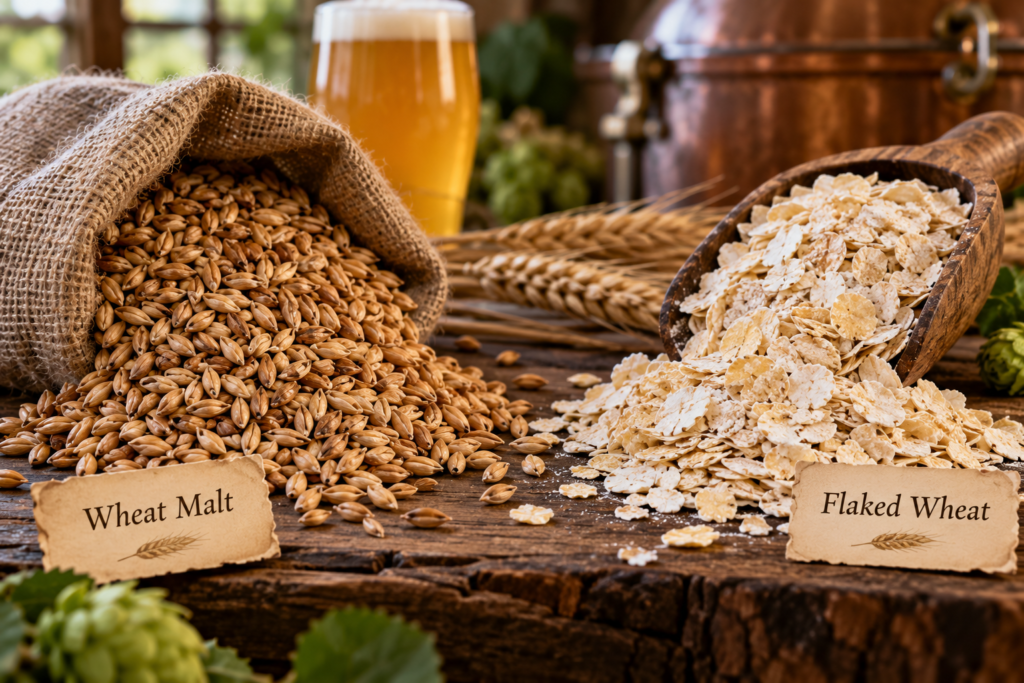
Wheat is one of the most useful ingredients available to homebrewers.
It can improve head retention, contribute protein, create a softer mouthfeel, support haze and, in the right beer style, provide a distinctive wheat character.
But when building a recipe, brewers often encounter two apparently similar ingredients:
Wheat Malt and Flaked Wheat.
They both come from wheat.
They can both improve foam.
They can both increase protein content.
And both can be used in styles ranging from Wheat Beer and Witbier to Saison, Sour and modern Hazy IPA.
But they are not the same ingredient.
The fundamental difference is simple:
Wheat Malt has been malted. Flaked Wheat has not.
That difference affects enzymes, flavor, starch conversion, mouthfeel, haze, recipe design and how much of each ingredient can comfortably be used.
In this guide, we will compare Wheat Malt and Flaked Wheat in detail and explain when you should choose one over the other.
What Is Wheat Malt?
Wheat Malt is wheat that has gone through the malting process.
The grain is allowed to germinate under controlled conditions and is then dried in a kiln.
This process modifies the grain and develops enzymes that can help convert starch into fermentable sugars during mashing.
In brewing terms, Wheat Malt behaves much more like a traditional brewing malt than raw or flaked wheat.
It contributes:
- fermentable extract;
- protein;
- foam stability;
- wheat flavor;
- body;
- enzymes.
Depending on the beer style, Wheat Malt can represent anything from a small supporting percentage to more than half of the entire grain bill.
What Is Flaked Wheat?
Flaked Wheat is generally unmalted wheat that has been processed so the starch becomes accessible during mashing.
The grain is heated and passed through rollers, producing the familiar flat flakes.
Because the starch has already been gelatinized during processing, most commercially produced Flaked Wheat can normally be added directly to the mash.
Unlike Wheat Malt, however, Flaked Wheat does not provide meaningful diastatic power.
It therefore relies on enzymes from other malts in the mash to convert its starches into sugars.
Flaked Wheat contributes:
- starch;
- protein;
- body;
- foam support;
- haze;
- soft grain character.
This makes it particularly useful in beers where texture, foam and haze are important.
Wheat Malt vs Flaked Wheat: Quick Comparison
| Characteristic | Wheat Malt | Flaked Wheat |
|---|---|---|
| Malted | Yes | No |
| Provides fermentable extract | Yes | Yes, after mash conversion |
| Contains useful enzymes | Yes | Essentially no |
| Requires enzymes from base malt | Less dependent | Yes |
| Wheat flavor | More defined | Softer, raw grain character |
| Protein contribution | High | High |
| Foam support | Excellent | Excellent |
| Haze contribution | Moderate to high | High |
| Mouthfeel | Smooth, grainy, bready | Soft, full, sometimes creamy |
| Typical usage | 5–70%+ | 5–30%+, depending on style |
| Common in German Wheat Beer | Yes | Usually no |
| Common in Witbier | Sometimes | Yes |
| Common in Hazy IPA | Yes | Yes |
| Common in Sour Beer | Yes | Yes |
The most important difference is therefore not simply flavor.
It is the fact that Wheat Malt is enzymatically active malt, while Flaked Wheat is an unmalted adjunct that depends on enzymes elsewhere in the grain bill.
How Wheat Malt Is Made
The production of Wheat Malt follows the same basic principles used for barley malt.
First, the wheat absorbs water.
The grain begins to germinate.
During germination, the internal structure of the kernel changes and enzymes develop.
The maltster then stops germination by drying the grain in a kiln.
The resulting malt is suitable for brewing and contains enzymes capable of participating in starch conversion during the mash.
Kilning also influences flavor and color.
Most standard Wheat Malt is relatively pale and contributes delicate flavors such as:
- fresh bread;
- dough;
- cereal;
- light grain.
The result is noticeably different from the more neutral starch-and-protein contribution of many unmalted wheat products.
How Flaked Wheat Is Made
Flaked Wheat skips the malting stage.
Instead, wheat is processed using heat and pressure and flattened into flakes.
This treatment gelatinizes the starch.
Gelatinization is important because enzymes need access to the starch before they can break it down efficiently.
With commercially flaked wheat, this step has already been performed.
That means it can usually be added directly to the mash without a separate cereal mash.
However, gelatinized starch is not the same thing as converted starch.
The enzymes still need to break those starch molecules down into smaller sugars.
Because Flaked Wheat has little or no useful enzymatic power of its own, those enzymes must come primarily from the base malt.
Does Wheat Malt Have Diastatic Power?
Yes.
Wheat Malt generally contains enough enzymatic activity to contribute significantly to starch conversion.
The exact diastatic power depends on the maltster and product.
This is one reason Wheat Malt can be used at very high percentages in traditional Wheat Beer.
The mash still normally contains barley malt as well, but Wheat Malt is not simply an enzymatically inactive adjunct.
It participates in conversion.
This is an important difference from Flaked Wheat.
Does Flaked Wheat Have Diastatic Power?
For practical recipe design, treat Flaked Wheat as having no useful diastatic power.
It contributes starch that must be converted by enzymes supplied by other malted grains.
In most normal recipes this is not a problem.
If your recipe contains a large percentage of modern Pilsner or Pale Ale Malt, there is usually sufficient enzymatic power to convert a moderate addition of Flaked Wheat.
Problems become more likely when the recipe contains:
- very large amounts of unmalted grain;
- large amounts of low-enzyme specialty malt;
- heavily kilned malts;
- insufficient base malt.
This is why the enzymatic power of the entire grain bill matters.
Which Has More Flavor?
Wheat Malt usually has the more recognizable malted-wheat character.
It can provide:
- bread;
- dough;
- cereal;
- mild sweetness;
- fresh grain.
Flaked Wheat tends to be more neutral.
Its contribution is often perceived more through texture, haze and grain character than through a strong, obvious flavor.
It may contribute:
- soft cereal;
- raw grain;
- subtle wheat;
- light dough.
If you want the wheat itself to become part of the flavor profile, Wheat Malt is often the better choice.
If you mainly want protein, foam, haze and texture, Flaked Wheat may be more appropriate.
Which Produces Better Foam?
Both can be excellent for foam.
Wheat naturally contains relatively high levels of foam-positive proteins.
This is why small amounts of wheat are sometimes added even to beers that are not intended to taste like wheat.
For example, a brewer may add a modest amount of Wheat Malt to:
- Pale Ale;
- IPA;
- Blonde Ale;
- Saison
primarily to support head formation and retention.
Flaked Wheat can provide similar benefits.
The difference between them should therefore not be reduced to:
Wheat Malt = foam
and
Flaked Wheat = haze.
Both can influence both characteristics.
Recipe composition, mash schedule, fermentation, carbonation, glass cleanliness and many other factors also affect foam stability.
Which Creates More Haze?
Flaked Wheat is generally the stronger choice when permanent or stable haze is desirable.
Its combination of protein and starch can contribute significantly to haze formation.
This is useful in styles such as:
- Witbier;
- Hazy IPA;
- NEIPA;
- some Sour beers.
Wheat Malt can also create haze, especially when used in large quantities.
Traditional Hefeweizen, for example, is certainly not known for brilliant clarity.
But in modern hazy beer recipe design, Flaked Wheat is often selected specifically for its protein and haze contribution.
Wheat Malt vs Flaked Wheat in Hazy IPA
Both ingredients can work extremely well in Hazy IPA.
They simply perform slightly different roles.
Wheat Malt can provide:
- protein;
- foam;
- fermentable extract;
- subtle wheat flavor;
- structural support.
Flaked Wheat can provide:
- protein;
- haze;
- fuller texture;
- soft grain character.
A brewer does not necessarily have to choose only one.
Many successful Hazy IPA recipes combine:
- base malt;
- Wheat Malt;
- Flaked Oats;
- Flaked Wheat.
For example, a grain bill might contain:
70–80% base malt
with the remaining portion divided between wheat and oats.
But more adjunct grain is not automatically better.
Excessive quantities can make the mash difficult to filter and the beer unnecessarily heavy.
Wheat Malt vs Flaked Wheat in NEIPA
NEIPA recipes often use wheat and oats to create the characteristic soft texture and hazy appearance.
Wheat Malt is useful when you want to retain a strong fermentable malt component while increasing protein.
Flaked Wheat is useful when you want more emphasis on:
- haze;
- softness;
- protein;
- mouthfeel.
Flaked Oats can then add another layer of creamy texture.
A combination such as:
- Pale Ale Malt;
- Wheat Malt;
- Flaked Oats
is already enough to produce an excellent NEIPA base.
Flaked Wheat can be added when even more wheat-derived protein or haze is desired.
There is no requirement to use every hazy-beer ingredient in the same recipe.
Wheat Malt vs Flaked Wheat in Witbier
This is where Flaked Wheat becomes particularly important.
Traditional Belgian Witbier commonly uses a substantial percentage of unmalted wheat.
Flaked Wheat provides a convenient homebrewing version of this ingredient because it can normally be mashed directly with the barley malt.
It contributes:
- characteristic graininess;
- protein;
- haze;
- body;
- foam.
A typical Witbier grain bill might contain a large percentage of Pilsner Malt together with a substantial amount of unmalted wheat.
Wheat Malt can certainly produce a good wheat beer, but it creates a somewhat different character.
If the goal is a more traditional Witbier profile, unmalted wheat is generally the more characteristic choice.
Wheat Malt vs Flaked Wheat in German Wheat Beer
For German-style Weissbier or Hefeweizen, Wheat Malt is the traditional choice.
These beers often contain at least half of their grain bill as malted wheat.
A simple grain bill might contain:
- 50–70% Wheat Malt;
- 30–50% Pilsner Malt.
Small amounts of Vienna or Munich Malt may sometimes be added for additional malt depth.
Flaked Wheat is not normally the defining wheat ingredient in traditional German Wheat Beer.
If you want the classic style, choose Wheat Malt.
Wheat Malt vs Flaked Wheat in Saison
Both can work.
A modest amount of Wheat Malt can contribute:
- foam;
- light bread;
- dryness perception;
- grain complexity.
Flaked Wheat can provide:
- rustic grain character;
- protein;
- haze;
- body.
Which one is better depends on the Saison you want.
For a cleaner, more malt-driven Saison, Wheat Malt may be preferable.
For a rustic, grainy or intentionally hazy Saison, unmalted wheat can be very effective.
Wheat Malt vs Flaked Wheat in Sour Beer
Both ingredients are common in Sour Beer.
Wheat Malt provides fermentable extract, protein and wheat character.
Flaked Wheat contributes protein, starch and texture and can work particularly well in traditional or mixed-fermentation-inspired recipes.
For fruit Sour beers, a simple combination of:
- Pale or Pilsner Malt;
- Wheat Malt or Flaked Wheat;
- optional oats
can provide an excellent neutral base for fruit and acidity.
The grain bill does not need to be complicated.
How Much Wheat Malt Should You Use?
The correct amount depends strongly on the beer style.
5–10%
At this level, Wheat Malt is usually a supporting ingredient.
It can improve:
- foam;
- head retention;
- body;
- grain complexity.
Useful in Pale Ale, IPA, Blonde Ale and Saison.
10–30%
The wheat contribution becomes more significant.
Expect more:
- protein;
- body;
- wheat flavor;
- haze potential.
This range works well in many modern ales and specialty beers.
40–70%+
Now wheat becomes a defining ingredient.
This is typical territory for:
- Hefeweizen;
- Weissbier;
- other wheat-focused beers.
At high percentages, mash filtration becomes more important because wheat does not have the same husk structure as barley.
How Much Flaked Wheat Should You Use?
Again, the correct amount depends on the goal.
5–10%
A subtle addition.
Useful for:
- foam;
- protein;
- light haze;
- texture.
10–20%
The effect becomes much more noticeable.
Useful in:
- Hazy IPA;
- NEIPA;
- Saison;
- Sour;
- Witbier-inspired recipes.
20–40%+
Now Flaked Wheat becomes a major structural component of the beer.
This can be appropriate in Witbier and certain traditional or experimental wheat-based beers.
However, the higher the percentage of Flaked Wheat, the more attention must be paid to:
- enzymatic power;
- mash consistency;
- filtration;
- rice hulls.
Can You Brew With 100% Wheat Malt?
Technically, malted wheat can provide fermentable extract and enzymes.
But brewing a 100% Wheat Malt beer creates practical problems.
The biggest problem is filtration.
Barley malt contains husks that help form a porous grain bed during lautering.
Wheat lacks these husks.
With extremely high percentages of wheat, the grain bed can become compact and difficult to drain.
For most homebrewers, combining Wheat Malt with barley malt is much easier.
Rice hulls can also help considerably.
Can You Brew With 100% Flaked Wheat?
Not with a normal mash unless an external enzyme source is supplied.
Flaked Wheat does not provide enough enzymes to convert all of its own starch.
A normal recipe therefore needs a substantial amount of enzymatically active base malt.
Even if external enzymes were used, a 100% Flaked Wheat mash would create substantial practical filtration challenges.
For ordinary homebrewing, Flaked Wheat should be considered an adjunct used alongside base malt.
Do You Need Rice Hulls?
Not always.
But they can become extremely useful as wheat percentages increase.
Neither Wheat Malt nor Flaked Wheat provides the barley husks that help create a good filter bed.
Large amounts can therefore increase the risk of:
- slow runoff;
- stuck mash;
- stuck sparge;
- compact grain bed.
Rice hulls add physical structure without adding meaningful flavor, color or fermentable extract.
A useful starting range is approximately:
2–5% of the grain weight.
They are particularly helpful when using combinations of:
- wheat;
- oats;
- rye;
- other huskless grains.
Does Flaked Wheat Need to Be Milled?
Usually, no.
Commercial Flaked Wheat has already been flattened and processed.
It can generally be added directly to the mash.
Running it through the mill is normally unnecessary and may simply produce more flour.
Wheat Malt, on the other hand, should be crushed before mashing.
Because wheat kernels are smaller and harder than barley malt, the ideal mill gap may differ slightly from the setting used for barley.
The goal is still the same:
break the grain sufficiently to expose the interior without turning everything into flour.
Does Flaked Wheat Need a Cereal Mash?
Commercial brewing flakes are normally pre-gelatinized.
That means a separate cereal mash is generally unnecessary.
They can usually be added directly to the main mash.
This is one of the reasons flaked grains are so convenient for homebrewers.
Raw whole wheat is different.
If you are using an ingredient that has not already been gelatinized, processing requirements may change.
Always check the supplier’s information when using an unfamiliar raw grain product.
Does Wheat Change Mash Efficiency?
It can.
Wheat Malt has good extract potential, so it does not automatically reduce efficiency.
However, high percentages of wheat can affect the physical behavior of the mash.
Poor lautering or an overly compact grain bed may reduce practical brewhouse efficiency even when starch conversion itself is successful.
Flaked Wheat can also contribute good extract when properly converted.
But large amounts can make the mash thicker and more difficult to handle.
Therefore, when efficiency drops in a wheat-heavy recipe, the problem is not necessarily the extract potential of the wheat.
It may be the mash and lautering process.
Wheat and Mash Thickness
Large amounts of wheat, oats or other huskless grains can make the mash feel thicker and more compact.
Good recirculation becomes particularly important in brewing systems that rely on wort flowing continuously through the grain bed.
If flow becomes too restricted, do not automatically increase pump speed.
Excessive suction can compact the grain bed even more.
Instead:
- reduce the flow;
- stir carefully if appropriate;
- use rice hulls;
- make sure the grain crush is not excessively fine.
Mash mechanics matter just as much as ingredient selection.
Wheat Malt vs Flaked Wheat for Head Retention
If your only goal is improving foam, either ingredient can work.
A modest addition of Wheat Malt is often the simplest solution because it also contributes fermentable extract and enzymes.
Flaked Wheat is useful when you also want:
- haze;
- fuller texture;
- unmalted grain character.
However, poor foam should not automatically be treated by adding more wheat.
Foam can also be affected by:
- insufficient carbonation;
- glass contamination;
- excessive oils or fats;
- fermentation conditions;
- recipe balance;
- serving technique.
Wheat helps, but it cannot correct every foam problem.
Wheat Malt vs Flaked Wheat for Body
For a clean, slightly fuller grain character, Wheat Malt works very well.
For a softer and more obviously protein-rich texture, Flaked Wheat may have a stronger effect.
But if the primary goal is creamy mouthfeel, Flaked Oats may be even more appropriate.
Think of them as different tools:
Wheat Malt: structure + fermentability + wheat character.
Flaked Wheat: protein + haze + texture.
Flaked Oats: softness + creaminess.
They overlap, but they are not identical.
Can You Use Wheat Malt and Flaked Wheat Together?
Absolutely.
In fact, this can be an excellent approach.
Wheat Malt can provide:
- fermentable extract;
- enzymes;
- wheat flavor;
- protein.
Flaked Wheat can add:
- additional protein;
- haze;
- texture;
- unmalted grain character.
For example, a modern Hazy IPA might use:
- 70% Pale Ale Malt;
- 15% Wheat Malt;
- 10% Flaked Oats;
- 5% Flaked Wheat.
This is only an example, not a universal formula.
The important point is that each ingredient has a clear purpose.
Wheat Malt vs Flaked Wheat vs Flaked Oats
These three ingredients frequently appear together, especially in modern Hazy IPA recipes.
Their roles overlap, but each has a different emphasis.
| Ingredient | Main Strength | Flavor | Haze | Mouthfeel | Enzymes |
|---|---|---|---|---|---|
| Wheat Malt | Structure + foam | Bready, grainy | Medium–High | Smooth | Yes |
| Flaked Wheat | Protein + haze | Soft grain | High | Full | No |
| Flaked Oats | Soft mouthfeel | Mild oat | Medium–High | Creamy | No |
If the beer feels thin, oats may help.
If foam is weak, wheat may help.
If stable haze and protein are important, Flaked Wheat may help.
But recipe design should always consider the entire grain bill rather than treating each ingredient as a separate solution.
Which One Should You Choose?
Choose Wheat Malt when you want:
- wheat flavor;
- fermentable extract;
- enzymatic contribution;
- strong foam;
- traditional German Wheat Beer character;
- a wheat ingredient that can make up a large part of the grain bill.
Choose Flaked Wheat when you want:
- unmalted wheat character;
- more protein;
- stable haze;
- fuller texture;
- traditional Witbier-like grain character;
- an adjunct for Hazy IPA, Sour or Saison.
Choose both when they perform different roles in the same recipe.
Common Mistake: Treating Them as Interchangeable
One of the easiest mistakes is replacing Wheat Malt with Flaked Wheat gram-for-gram without considering the rest of the recipe.
Sometimes this works.
Sometimes it does not.
For example, replacing 5% Wheat Malt with 5% Flaked Wheat in a Pale Ale will probably not create a serious conversion problem.
Replacing 60% Wheat Malt with 60% Flaked Wheat in a Hefeweizen recipe is a completely different situation.
Now you have dramatically changed:
- enzymatic power;
- malt character;
- mash behavior;
- filtration;
- style authenticity.
Ingredients that come from the same grain are not automatically interchangeable.
Another Common Mistake: Using Too Much for Haze
Modern Hazy IPA has encouraged some brewers to treat wheat and oats as though more is always better.
It is not.
A beer does not need 40% oats and wheat simply because it is supposed to be hazy.
Excessive amounts can create:
- difficult lautering;
- excessive viscosity;
- heavy mouthfeel;
- reduced drinkability;
- fermentation and clarification challenges.
Haze should be part of the beer’s structure, not the only goal of the grain bill.
Start with moderate percentages and increase them only when you know what you want to change.
A Simple Experiment for Homebrewers
One of the best ways to understand the difference is to brew two small batches.
Keep everything identical:
- same base malt;
- same hops;
- same yeast;
- same water;
- same mash temperature;
- same fermentation.
In Batch A, use:
15% Wheat Malt.
In Batch B, use:
15% Flaked Wheat.
Then compare:
- aroma;
- flavor;
- foam;
- haze;
- body;
- mouthfeel;
- attenuation;
- mash behavior.
The difference is much easier to understand in the glass than in a malt specification sheet.
Wheat Malt vs Flaked Wheat: Final Comparison
| Question | Better Choice |
|---|---|
| Traditional Hefeweizen | Wheat Malt |
| Traditional Witbier character | Flaked Wheat / unmalted wheat |
| Strong wheat flavor | Wheat Malt |
| Maximum enzymatic contribution | Wheat Malt |
| Stable haze | Flaked Wheat |
| Foam support | Both |
| Hazy IPA | Both can work |
| NEIPA | Both can work |
| Sour Beer | Both can work |
| High-percentage wheat grain bill | Wheat Malt |
| Unmalted grain character | Flaked Wheat |
| Simple 5–10% foam addition | Wheat Malt is often easiest |
Final Thoughts
Wheat Malt and Flaked Wheat may come from the same grain, but they are different brewing ingredients.
The most important distinction is straightforward:
Wheat Malt is malted and enzymatically active.
Flaked Wheat is unmalted and relies on enzymes from other malts for starch conversion.
From there, their roles begin to separate.
Wheat Malt is ideal when you want fermentable extract, wheat flavor, foam and the ability to use wheat as a major component of the grain bill.
Flaked Wheat is especially useful when you want protein, haze, texture and the character of unmalted wheat.
Neither is universally better.
The right choice depends on the beer you are trying to create.
For Hefeweizen, Wheat Malt is the obvious choice.
For traditional Witbier, unmalted wheat is more characteristic.
For Hazy IPA, NEIPA, Saison and Sour Beer, either ingredient—or a combination of both—can work beautifully.
As with most brewing ingredients, the best question is not:
“Which one is better?”
It is:
“What do I want this ingredient to do in my beer?”
Once you can answer that, choosing between Wheat Malt and Flaked Wheat becomes easy.