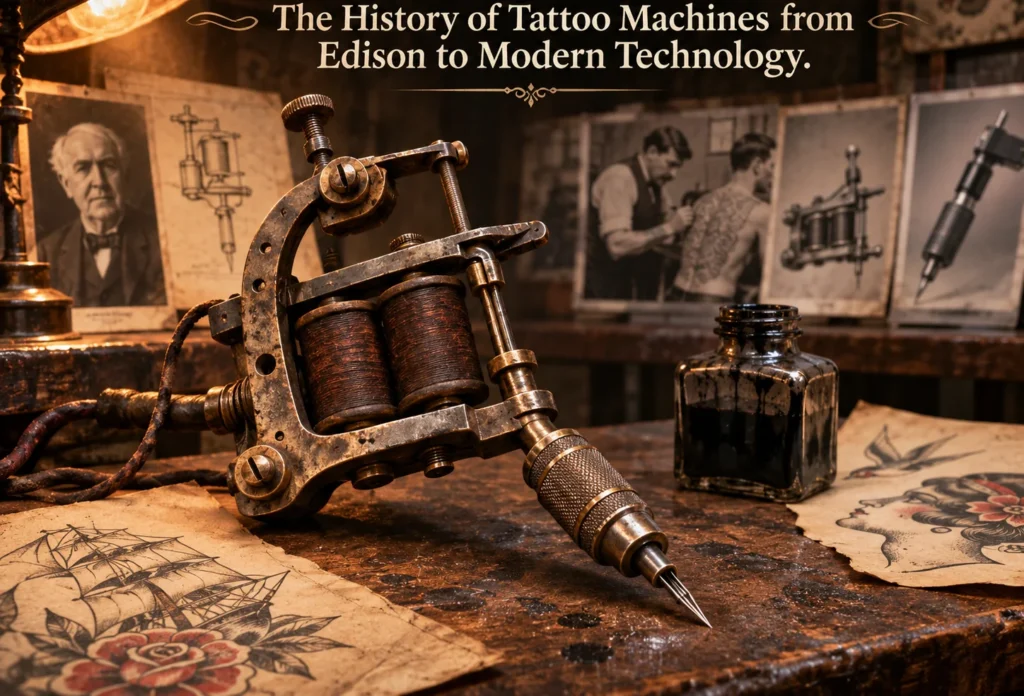
Today, a tattoo machine is a highly refined piece of equipment, often equipped with digital controls, interchangeable needle cartridges, and wireless power systems. Some modern machines offer adjustable stroke lengths, sophisticated motor control, and ergonomic designs that would have been unimaginable to tattoo artists just a few decades ago. Yet few people realize that the history of tattoo machines can be traced back to a nineteenth-century office invention: Thomas Edison’s electric pen. From heavy, experimental mechanisms to electromagnetic coil machines, rotary systems, and modern wireless tattoo pens, the technology has undergone a remarkable transformation. This is the story of that evolution, the inventors who shaped it, and a small part of my own journey as a tattoo artist.
The Early History of Tattoo Machines
Tattooing has existed for thousands of years, but the history of electrically powered tattoo machines is much more recent.
Before mechanical tattoo machines appeared, tattoos were created entirely by hand.
Different cultures developed specialized tools made from bone, metal, wood, thorns, and other natural materials to introduce pigment beneath the skin.
Some techniques involved manually puncturing the skin with a needle or group of needles. Others used a separate striking tool to drive a comb-like instrument into the skin.
The fundamental principle remained the same: pigment had to be deposited in the appropriate layer of the skin, primarily the dermis, for the tattoo to remain permanent.
These traditional techniques did not disappear with the invention of electric machines.
Today, stick and poke tattoos and professional hand poke tattooing continue to exist alongside modern machine tattooing, although traditional cultural practices and contemporary hand poke techniques should not be treated as identical.
During the nineteenth century, advances in electricity and mechanical engineering created entirely new possibilities.
Inventors began developing devices capable of producing rapid, repetitive, and increasingly controllable movements.
These developments eventually led to the birth of the electric tattoo machine.
Alessandro Volta – The Beginning of Continuous Electric Power
An important starting point in this story is 1800, when the Italian physicist and chemist Alessandro Volta (1745–1827) introduced the voltaic pile.
This was one of the earliest devices capable of supplying a relatively continuous electric current.
Volta built his invention by stacking alternating metal discs, such as zinc and copper, separated by material soaked in an electrolyte.
The invention fundamentally changed the possibilities of electrical experimentation.
Previously, researchers had largely relied on static electricity and short electrical discharges.
Volta’s device provided a more sustained source of electricity, allowing scientists and engineers to investigate a much wider range of electrical phenomena.
The later development of electric motors, electromagnets, and electrically powered machinery depended on advances in reliable power supplies.
Tattoo machines would eventually benefit from those discoveries as well.
Volta did not invent a tattoo machine, of course. His achievement was one of the foundations of the electrical technologies that would make such machines possible.
Hans Christian Ørsted and the Discovery of Electromagnetism
The next major development occurred in 1820.
Danish physicist and chemist Hans Christian Ørsted (1777–1851) discovered that an electric current produces a magnetic effect.
During his experiments, he observed that an electric current flowing through a wire could deflect a nearby compass needle.
This demonstrated a connection between electricity and magnetism.
The discovery became a fundamental part of the development of electromagnets, electric motors, and numerous electrically powered mechanisms.
For tattoo machines, the importance of this principle is particularly clear.
The traditional coil tattoo machine uses electromagnets to operate a moving armature, which in turn drives the tattoo needle.
Some older accounts place Ørsted’s discovery in 1819, but the historically documented year is 1820.
Thomas Edison – The Office Invention That Changed Tattooing
The direct technological predecessor of the modern electric tattoo machine was one of the lesser-known inventions of Thomas Alva Edison (1847–1931).
In 1876, Edison patented an electrically powered pen designed to simplify the duplication of written documents.
The device became known as the electric pen.
On August 8, 1876, Edison received US Patent 180,857, covering an improvement in autographic printing.
How Did Edison’s Electric Pen Work?
The electric pen contained a rapidly moving needle that produced tiny perforations in paper.
A person could write or draw with the device much like an ordinary pen, while the needle continuously punctured the paper along the intended lines.
The perforated sheet then served as a stencil.
Ink was applied through the perforations onto another sheet of paper, allowing multiple copies of the original writing or drawing to be produced.
The invention was intended to make office work more efficient.
Edison had not designed the device for tattooing.
However, from the perspective of a tattoo artist, its most important feature was obvious:
the machine could move a needle rapidly and repeatedly.
That was precisely the kind of mechanical movement needed for an electrically powered tattoo machine.
Edison’s Improved Stencil Pen of 1877
Edison continued developing his original invention.
On November 6, 1877, he received another patent, US 196,747, for an improved stencil pen.
This version used a different operating principle from the earlier motor-driven mechanism.
Instead of relying on the original rotary drive, it employed an electromagnetic system to produce a rapidly vibrating motion.
A flexible metal component, an electrical contact, and an electromagnet worked together to create repeated movement.
The mechanism interrupted and restored the electrical circuit as part of its operating cycle.
This arrangement had important similarities to the operating principle of later electromagnetic tattoo machines.
Interestingly, Edison’s two designs were connected to different directions in tattoo machine development:
- Motor-driven tattoo machines using rotary motion.
- Electromagnetic machines using a rapidly moving armature.
Both principles remain recognizable in modern tattooing equipment, although today’s machines are vastly more refined.
Samuel O’Reilly – The First Patented Electric Tattoo Machine
One of the most important figures in tattoo machine history is Samuel F. O’Reilly, a tattoo artist who worked in New York City.
Relatively little reliable biographical information about O’Reilly survives.
Much of what we know comes from contemporary newspaper reports, city directories, legal records, and later historical research.
Albert Parry’s 1933 book, Tattoo: Secrets of a Strange Art, is also an important historical source.
Available records indicate that O’Reilly was born in Connecticut and entered the United States Navy around 1875.
According to his own accounts, he learned tattooing while serving in the Navy.
After leaving military service, he returned to Waterbury, Connecticut, where he became involved in a burglary case and spent time in prison.
By the 1880s, he was active in the New York area.
A Brooklyn city directory from 1886 listed him as an operator.
An 1888 newspaper article mentioned a tattoo artist named James O’Reilly at the Chatham Square Museum. Historians have suggested that this may have been a confusion involving Samuel’s first name, although it cannot be established with complete certainty.
By 1890, a newspaper report clearly identified O’Reilly as a tattoo artist and attraction associated with the Chatham Square Museum.
This part of New York would become an important location in the development of American tattooing.
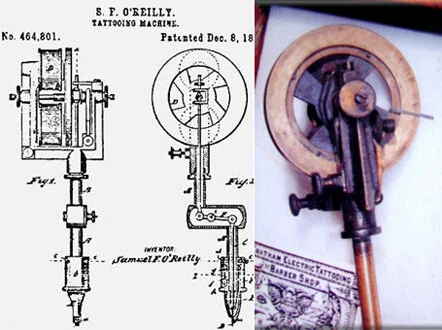
December 8, 1891 – A Historic Patent
O’Reilly recognized that the mechanical principle behind Edison’s electric pen could be adapted for tattooing.
He modified the equipment so that a needle could introduce pigment into human skin instead of perforating paper.
On July 16, 1891, he filed a patent application.
The patent was granted on December 8, 1891.
Its number was:
US 464,801 – Tattooing Machine
This is widely recognized as the first officially patented American electric tattoo machine.
O’Reilly’s design incorporated modified needle-guiding components and an ink reservoir.
Its electrically powered mechanism allowed the needle to move much faster than a traditional hand-operated tool.
According to a Smithsonian historical account, the device was capable of producing approximately 50 punctures per second.
That represented an enormous technological advancement.
Mechanizing the repeated movement of the needle made tattooing potentially faster and more consistent.
The development marked an important turning point in the history of professional tattoo equipment.
How Similar Was It to Modern Tattoo Machines?
O’Reilly’s machine was not the classic two-coil electromagnetic design familiar to many traditional tattoo artists today.
His early mechanism belonged to the motor-driven family of designs, converting powered mechanical motion into repetitive needle movement.
In that sense, it can also be regarded as an important predecessor of later rotary tattoo machines.
It is important, however, to distinguish between the first patented electric tattoo machine and the first experimental mechanical tattooing device.
Mechanical experiments had existed before O’Reilly.
His major contribution was creating and officially patenting a practical electrical device designed specifically for tattooing.
O’Reilly’s Legacy and the Patent Dispute
The new equipment attracted attention among tattoo artists working in New York.
The ability to tattoo more quickly was particularly attractive to professionals creating large designs for circus performers and tattooed attractions.
However, there is no conclusive evidence that O’Reilly established a large-scale manufacturing operation for his patented machine.
Research published by the Tattoo Archive indicates that reliable records of mass production or widespread sales of the patented design have not survived.
A historical example of the mechanism has survived, although it is incomplete.
Around 1899, a patent dispute developed between O’Reilly and another New York tattoo artist, Elmer Getchell.
The dispute attracted enough attention that The New York Times published an article entitled “Tattoo Artist at War” on February 6, 1900.
Samuel O’Reilly died in 1909.
His contribution to tattoo machine history, however, remains important.
Charles Wagner and the Development of Electromagnetic Tattoo Machines
After O’Reilly, another New York tattoo artist became an influential figure in machine development.
His name was Charles “Charlie” Wagner.
Wagner worked for many years around New York’s Bowery district.
Alongside tattooing, he also supplied tattoo equipment.
On August 23, 1904, he received a patent for his own tattooing device.
Patent number:
US 768,413 – Tattooing Device
Wagner’s design contributed to the development of electrically operated tattoo machines using electromagnetic principles.
His mechanism incorporated electromagnets, a moving armature, a needle-driving rod, springs, and adjustable components.
Several of these mechanical principles would continue to influence traditional tattoo machines.
The ability to control the relationship between the electromagnetic mechanism and needle movement was particularly important.
However, it would be inaccurate to claim that Wagner invented the first two-coil tattoo machine.
Other electromagnetic experiments and patents had already appeared during the late nineteenth century, including developments in Britain.
Wagner’s importance lies in improving and adapting electromagnetic mechanisms for practical tattooing.
Percy Waters – A Major Figure in the History of Coil Machines
Tattoo machines continued to develop throughout the early twentieth century.
One particularly influential figure was Percy Waters, a tattoo artist and equipment supplier based in Detroit, Michigan.
Waters was not only interested in tattooing as an artistic activity.
He also understood the importance of producing and supplying reliable professional equipment.
His work contributed to the standardization and commercial distribution of tattoo machines.
On January 30, 1929, Waters filed a patent application for an electric tattooing device.
The patent was issued on August 13, 1929.
Patent number:
US 1,724,812 – Electric Tattooing Device
The machine represented an important development in the evolution of electromagnetic tattoo equipment using two coils.
What Made Waters’ Machine Important?
The design incorporated several features associated with classic coil machines:
- Two electromagnetic coils.
- A supporting frame.
- A moving armature assembly.
- Needle-driving components.
- A manually operated switch.
- Protective components associated with electrical sparking.
- A construction intended for repeated professional use.
The device reflected the growing demand for practical and commercially reproducible tattoo equipment.
The Henry Ford Museum preserves historical materials associated with Percy Waters, including tattoo machines, drawings, and other objects connected with his career.
Waters played a significant role in making professional tattoo equipment more accessible.
It would nevertheless be incorrect to say that he was the only person who manufactured and sold patented tattoo machines.
Other tattoo artists, builders, and suppliers were also active during this period.
His importance came from combining technical development, manufacturing, equipment sales, and tattooing into a successful professional operation.
How Does a Traditional Coil Tattoo Machine Work?
The operating principle of the traditional coil tattoo machine is relatively simple, although achieving a well-balanced setup requires considerable mechanical understanding.
At the center of the mechanism are the electromagnetic coils.
When electric current passes through the coils, a magnetic field is created.
This magnetic field attracts a moving metal component called the armature bar.
The armature bar is connected to the needle bar, allowing the movement to be transmitted to the tattoo needle.
As the mechanism moves, the electrical contact opens.
The magnetic field then collapses or weakens, and the spring system returns the armature toward its original position.
When electrical contact is restored, the cycle begins again.
This process repeats rapidly while the machine operates.
Main Components of a Coil Tattoo Machine
| Component | Function |
|---|---|
| Electromagnetic coils | Generate the magnetic field |
| Armature bar | Moves in response to the magnetic force |
| Front spring | Participates in the contact and return mechanism |
| Rear spring | Supports armature movement and spring action |
| Contact screw | Helps establish and adjust electrical contact |
| Frame | Supports the mechanical assembly |
| Needle bar | Transfers movement to the needle group |
| Tube and grip | Guide the needle and provide a handhold |
| Power supply | Provides electrical energy |
One of the defining characteristics of traditional coil machines is their mechanical adjustability.
Depending on the design, an experienced tattoo artist can adjust the spring system, contact arrangement, and other mechanical relationships.
These adjustments influence how the machine behaves under different operating conditions.
A properly configured coil machine can be an extremely effective and reliable professional tool.
Incorrect adjustments, however, may result in inconsistent movement, unnecessary vibration, or excessive trauma to the skin.
A Real Coil Machine from My Collection
I still have equipment from the era when traditional coil machines were the standard tools in professional tattooing.
One example is my vintage brass coil tattoo machine from 2009.
Its substantial brass frame, electromagnetic mechanism, and unmistakably mechanical character illustrate how different older professional machines feel compared with modern lightweight rotary pens.
Machines like this are not merely historical objects to me.
They represent years of actual tattooing experience.
Carol “Smokey” Nightingale and the Adjustable Tattoo Machine
Another important patent appeared in 1979.
Carol “Smokey” Nightingale was a Canadian-born tattoo artist who later worked in the United States.
He became involved in tattooing during the 1950s and developed a strong interest in mechanical improvements.
On May 16, 1978, he filed a patent application for an electrical marking device.
The patent was granted on July 3, 1979.
Patent number:
US 4,159,659 – Electrical Marking Device
Nightingale’s machine incorporated several adjustable and individually assembled components.
Its design included modifications to the electromagnetic mechanism, moving assemblies, needle guidance, and other structural elements.
The aim was to provide improved adjustability and practical control.
Interestingly, historical research published by the Tattoo Archive suggests that the patented model may never have entered commercial mass production.
This illustrates an important point in engineering history.
An innovative patented design does not necessarily become a commercially successful product.
Nevertheless, such developments contribute to the broader evolution of equipment and can inspire other machine builders.
The Evolution of Rotary Tattoo Machines
The development of tattoo machines was never limited to electromagnetic coil systems.
Motor-driven rotary tattoo machines continued to evolve alongside them.
A rotary machine uses an electric motor to generate mechanical movement.
A mechanism such as an eccentric drive or cam converts the motor’s rotary motion into the repeated movement required to operate the tattoo needle.
One important difference from traditional electromagnetic tattoo machines is that most rotary systems do not require the same contact-screw-based electrical interruption mechanism.
Depending on the construction, this can reduce the number of mechanical adjustments and provide a smoother operating character.
Characteristics of Rotary Tattoo Machines
Depending on the model, rotary machines may offer:
- Lower overall weight.
- Reduced vibration.
- Quieter operation.
- Simpler everyday handling.
- Fewer regular mechanical adjustments.
- Compatibility with different needle systems.
- Greater versatility for certain working styles.
These characteristics should not be treated as universal advantages of every rotary machine.
Motor quality, transmission design, weight distribution, balance, and needle configuration all influence performance.
A well-built coil machine can still be an excellent choice for particular types of tattooing.
The best machine is not determined solely by the type of drive system.
The Arrival of Modern Pen Tattoo Machines
During the 2000s, tattoo equipment development accelerated once again.
Manufacturers began placing greater emphasis on ergonomics, reduced weight, modular construction, and interchangeable needle systems.
An important milestone came in 2007, when the German company Cheyenne introduced its HAWK system.
The HAWK became an influential development in the modern rotary and cartridge-based tattoo equipment market.
Cartridge technology allowed tattoo artists to change complete needle modules instead of assembling traditional needle bars and tubes individually for every configuration.
Later pen-style machines integrated the motor, transmission, and grip into a cylindrical body resembling a thick writing pen.
This significantly changed how artists held and controlled tattoo equipment.
Modern pen machines are available with different motors, transmission mechanisms, stroke lengths, grip designs, and electronic control systems.
What Is a Tattoo Needle Cartridge?
A tattoo cartridge is a replaceable needle module.
The needle group moves inside its own housing and is driven by the machine through a compatible mechanism.
Cartridges are manufactured in numerous configurations, including:
- Round Liner (RL).
- Round Shader (RS).
- Magnum (M).
- Curved Magnum (CM).
- Other specialized configurations.
One of the main practical advantages is the ability to change needle configurations quickly.
An artist can move between different types of work without replacing a complete traditional tube-and-needle assembly.
From a hygiene perspective, membrane-equipped cartridges are particularly important.
The membrane is designed to reduce the possibility of fluids and contaminants travelling backward into the machine’s internal mechanism.
However, not all cartridges provide the same level of protection.
Compatibility, construction quality, and the manufacturer’s documented protective features should always be checked.
Coil vs. Rotary vs. Pen Tattoo Machines
| Feature | Coil Machine | Rotary Machine | Pen Machine |
|---|---|---|---|
| Drive principle | Electromagnetic | Motor-driven | Usually motor-driven |
| Typical design | Traditional open frame | Various configurations | Cylindrical pen-shaped body |
| Mechanical adjustments | Often extensive | Design-dependent | Model-dependent |
| Needle system | Traditionally needle bar | Needle bar or cartridge | Usually cartridge |
| Noise and vibration | Often more pronounced | Often lower | Often lower |
| Power source | Usually external supply | External or battery | External or battery |
| Maintenance | May require mechanical tuning | Generally simpler | Often modular |
It is important to understand that pen is primarily a description of machine form and construction, not an entirely separate operating principle.
Most modern pen machines use rotary technology.
Other mechanical solutions are possible, however.
Stroke Length – Why Does It Matter?
One of the most frequently discussed technical specifications of modern tattoo machines is stroke length.
Stroke length describes the range of movement of the needle-driving mechanism during a complete operating cycle.
It is not the same as the depth to which the needle penetrates the skin.
These two measurements are often confused.
For example, a machine with a 4.0 mm stroke does not automatically insert the needle 4.0 mm into the skin.
The actual working depth depends on several factors:
- Needle protrusion.
- Position of the machine relative to the skin.
- Hand movement and pressure.
- Skin stretching.
- Skin characteristics.
- Tattooing technique.
Different stroke lengths can produce different working characteristics.
Many modern machines offer stroke lengths around 2.5–4.5 mm, while some provide shorter or longer options.
These figures are examples of commonly available configurations, not universal requirements.
Shorter strokes are often associated with softer shading techniques, while longer strokes are frequently used for bold lining or efficient color packing.
However, stroke length alone does not determine performance.
Motor behavior, needle configuration, transmission design, and the artist’s technique are equally important.
Voltage, Frequency, and Needle Movement
When discussing tattoo machine performance, artists frequently refer to voltage, speed, and frequency.
These concepts are related, but they are not interchangeable.
Voltage (V) describes an electrical parameter of the machine’s power supply.
Frequency (Hz) can describe the number of repeated mechanical cycles per second.
Rotational speed (RPM) describes the number of revolutions completed by a motor per minute.
Stroke length describes the travel of the needle-driving mechanism.
In a rotary machine, motor speed and needle movement frequency may be directly related, but the precise relationship depends on the transmission design.
Increasing voltage does not produce identical results in every tattoo machine.
Some modern systems include electronic motor regulation intended to maintain more consistent performance under changing loads.
For this reason, there is no universal voltage setting suitable for every machine, cartridge, and tattooing technique.
The correct operating parameters must follow the equipment manufacturer’s specifications and the artist’s professional understanding of the machine.
Wireless Tattoo Machines
One of the most significant practical developments in contemporary tattoo equipment is the widespread adoption of battery-powered systems.
Older machines generally depended on external power supplies connected by cables.
Modern wireless tattoo pens may contain integrated batteries or detachable battery-and-control modules.
Some machines also provide electronic displays, programmable settings, operating modes, and digital motor regulation.
The greatest advantage of a wireless system is freedom of movement.
The absence of a power cable can make it easier to position the hand, move around the client, and organize the working area.
However, battery-powered machines also have limitations:
- Additional battery weight.
- Limited operating time.
- Charging requirements.
- Potential heat generation.
- Electronic component durability.
- Long-term battery replacement considerations.
The most expensive machine or the one with the longest list of features is not automatically the best choice.
A suitable professional machine should perform reliably, feel balanced in the artist’s hand, and match the intended tattooing technique.
Tattoo Machine Technology and Hygiene
A history of tattoo equipment would be incomplete without discussing the development of hygiene and infection prevention.
During the earliest decades of electric tattooing, the profession did not have the same equipment standards or infection-control systems available today.
Modern professional tattooing requires much more than a reliable machine.
It also requires a carefully managed working environment.
The European standard EN 17169:2020 addresses safe and hygienic tattooing practices.
Important considerations include:
- Sterile, single-use tattoo needles or cartridges.
- Appropriate surface cleaning and disinfection.
- Prevention of cross-contamination.
- Correct reprocessing of reusable equipment.
- Hand hygiene.
- Appropriate protective barriers and equipment.
- Safe handling and disposal of contaminated materials.
Tattoo inks are also subject to chemical restrictions in the European Union under the REACH framework.
Important parts of these restrictions began applying on January 4, 2022, with an extended transition period for certain pigments until January 4, 2023.
The evolution of tattoo equipment therefore involves more than faster motors and lighter machine bodies.
It also includes safer working practices, improved control, and reduced risks for artists and clients.
My First Tattoo Machine – Built from a Walkman Motor
For me, the history of tattoo machines is not only a story of old patents and famous inventors.
My own journey began with a very primitive machine.
I built my first tattoo machine sometime around the mid-1990s.
At that time, I had never actually seen a real professional tattoo machine.
There were no online tutorials showing me how such equipment worked, and professional tattoo supplies were not easily available to me.
But I had an old, broken Walkman.
The device no longer worked properly, although its small electric motor was still functional.
I removed the motor and attached it to the body of a ballpoint pen.
And just like that, I had my first homemade tattoo machine.
Naturally, that primitive construction cannot be compared with professional tattoo equipment available today.
It lacked precision, proper regulation, and the ability to control the working process to modern standards.
But at the time, it meant a great deal to me.
It was my first real experience of turning a simple electric motor into a mechanism capable of producing repeated movement for tattooing.
I Wasn’t the Only One Starting This Way
Around that time, I met several friends who were also interested in tattooing.
Interestingly, their homemade machines were built on very similar principles.
Small electric motors were already available from electronics and component shops.
Everything else came down to creativity, experimentation, and whatever materials we could find.
Everyone tried to build something functional from the parts available to them.
There were different motors, pen bodies, improvised mounts, and countless little adjustments.
We did not have access to the enormous selection of tattoo machines, cartridges, and accessories available today.
Much of what we learned came from experimenting and exchanging ideas with one another.
Looking back, I naturally see those early experiments very differently.
Such homemade devices did not meet modern technical or hygiene requirements, and I would never recommend using improvised equipment on human skin.
Nevertheless, they remain part of my personal history.
Those primitive machines were the starting point of a journey that eventually became a genuine passion and profession.
2007 – My First Professional Tattoo Machine
I received my first real professional tattoo machine in 2007.
It was a gift from my brother-in-law, who was living in England at the time.
That moment marked an important turning point in my work.
From the very first time I used it, I could feel the difference compared with the homemade machines I had previously worked with.
The professional equipment provided a much more predictable working experience.
The needle movement, balance, handling, and overall feel of the machine were completely different.
That was when I truly began to appreciate how much the right equipment can mean to a tattoo artist.
From that point onward, I gradually upgraded my tools.
As tattoo technology continued to evolve, I tried to keep up with new developments.
I acquired newer generations of machines, experimented with different systems, and slowly developed my own working methods.
The journey from my first Walkman-powered construction to professional tattoo equipment was a long one.
And throughout those years, the entire world of tattooing was changing as well.
I have kept a number of machines from different periods of my career.
Some of them can now be seen in my personal collection of professional tattoo machines, where I describe their history, construction, condition, and the experiences connected with them.
What the Evolution of Tattoo Machines Taught Me
When I think about my first homemade machine and compare it with today’s technology, the difference is almost unbelievable.
A modern wireless tattoo pen can offer functions and levels of control that would have been difficult for us to imagine back then.
But years of working with different equipment have also taught me something important.
A good tattoo machine matters, but a good machine alone does not make someone a good tattoo artist.
The machine is a tool.
The final result still depends on the artist’s knowledge, hand control, experience, technical understanding, and artistic ability.
An expensive machine does not automatically create clean lines.
A digital display cannot teach someone how to understand or handle the skin.
And the latest wireless system cannot replace professional experience.
At the same time, appropriate equipment can make it easier to work consistently, comfortably, and with greater control.
Technical progress is worth following, but the fundamental skills of tattooing should never be forgotten.
The Future of Tattoo Machines
Tattoo machine development has not stopped.
Manufacturers continue working on improvements in motor technology, needle movement, electronics, thermal management, and ergonomics.
Several areas are likely to remain important:
- Lighter and better-balanced machine bodies.
- More efficient battery systems.
- Improved electronic motor control.
- More consistent performance under changing loads.
- Better cartridge and membrane designs.
- Easier cleaning and maintenance.
- Improved ergonomics and reduced hand fatigue.
Many of these developments already exist in some form.
They should therefore be understood as continuing directions of improvement rather than entirely speculative future inventions.
The machines of tomorrow may become more efficient and sophisticated, but the fundamental principle of tattooing is unlikely to change.
A needle must introduce pigment into the appropriate layer of the skin in a controlled way.
The progress lies in how accurately, safely, and comfortably that can be achieved.
Conclusion – More Than 130 Years of Tattoo Machine Innovation
More than 130 years have passed since Samuel O’Reilly received his historic patent in 1891.
During that time, tattoo machines have evolved from experimental electrical mechanisms into highly refined professional tools.
Thomas Edison’s office invention unexpectedly became part of the history of an artistic profession.
Samuel O’Reilly, Charles Wagner, Percy Waters, Carol Nightingale, and many other inventors, builders, and tattoo artists contributed to the development of the equipment.
Traditional coil machines were joined by increasingly sophisticated rotary systems, followed by modern pen designs, cartridge technology, and wireless power solutions.
Today, tattoo artists can choose from an enormous selection of professional machines with different designs, specifications, and price ranges.
Building your own equipment is no longer a necessity.
For me, however, the history of tattoo machine technology will always be connected with my own beginnings.
A small motor taken from a broken Walkman.
The body of a ballpoint pen.
A few friends with the same interest in tattooing.
And the first professional tattoo machine I received as a gift in 2007.
Perhaps that is why tattoo machines still fascinate me.
Behind every new design, I recognize the same curiosity that once inspired me to take apart an old motor and try to build a working machine from it:
How can we make a tool better, so that the artist can bring an idea to life with greater precision?
Technology changes. Machines evolve. Techniques become more refined.
But behind every tattoo there is still a human hand, professional experience, and a passion for creating something meaningful.