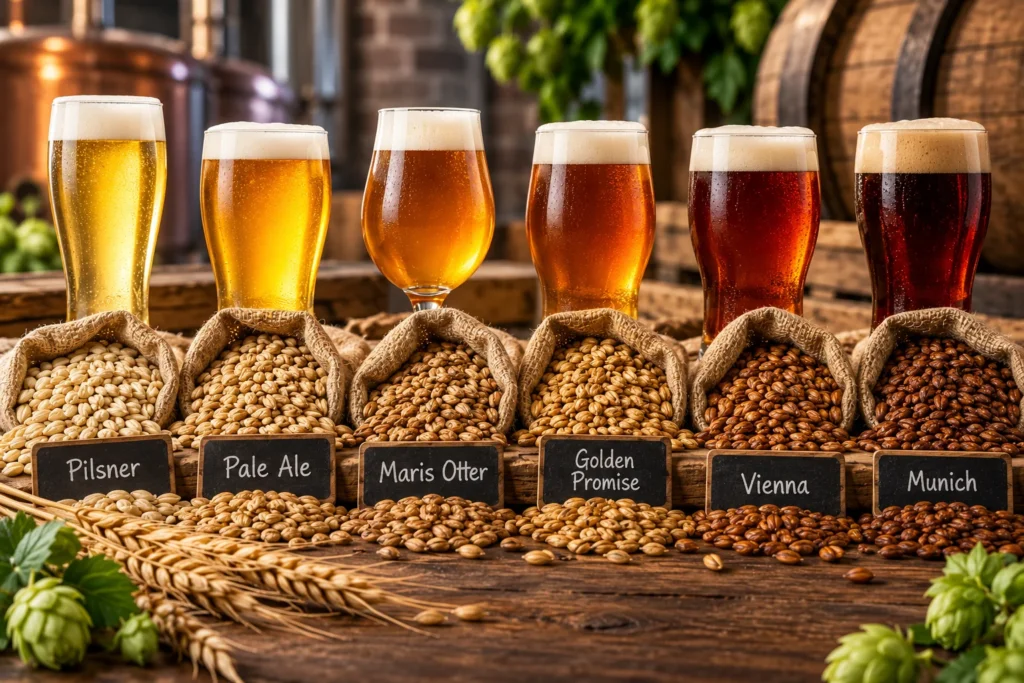
Base malt is the foundation of almost every all-grain beer recipe.
It usually makes up the largest part of the grain bill and provides most of the starch that will eventually become fermentable sugar. But choosing a base malt is not simply a technical decision.
The base malt also creates the background flavor on which hops, yeast, specialty malts, and every other ingredient must work.
Change the base malt and you can change the personality of the beer.
A clean Pilsner Malt, a slightly richer Pale Ale Malt, a biscuit-like Maris Otter, a soft Golden Promise, a toasted Vienna Malt, and a deeply malty Munich Malt may all perform the same fundamental job in the mash, but they do not produce the same beer.
Understanding these differences is an important step toward designing your own recipes.
What Is a Base Malt?
A base malt is a lightly or moderately kilned malt with enough enzymatic activity to convert its starch into sugars during mashing.
In most beer recipes, base malt represents approximately:
70–100% of the total grain bill.
Some beers can be brewed almost entirely from one base malt.
Other recipes combine a base malt with specialty malts, roasted grains, wheat, oats, rye, or other adjuncts.
Base malt performs three particularly important functions:
- it supplies most of the starch and extract
- it provides enzymes for starch conversion
- it establishes the fundamental malt character of the beer
This makes the choice of base malt far more important than its large percentage alone might suggest.
Why Does Base Malt Contain Enzymes?
Barley contains starch, but yeast cannot directly ferment starch.
During malting, germination activates enzymes inside the grain. Some of these enzymes remain active after kilning.
During the mash, these enzymes break starch into smaller sugars.
Two of the most important groups involved in starch conversion are alpha-amylase and beta-amylase.
Their activity is affected by several factors, including:
- mash temperature
- mash pH
- mash duration
- malt modification
- the enzymatic strength of the malt
This is one reason base malts are treated differently from heavily roasted or caramelized malts.
Higher kilning and roasting temperatures progressively reduce or destroy enzymatic activity.
Base malts are therefore produced carefully enough to develop flavor while preserving sufficient enzymes for brewing.
Can You Brew Beer With 100% Base Malt?
Absolutely.
In fact, brewing a simple beer with a single base malt is one of the best ways to learn what that malt actually tastes like.
A beer made from 100% Pilsner Malt will reveal the delicate grain and bread character of that malt.
A 100% Vienna beer will be noticeably richer, more golden, and more toasted.
A beer based heavily on Munich Malt can become intensely malty and bread-like.
Single-malt beers can also demonstrate an important lesson:
A complex beer does not always require a complex grain bill.
Specialty malts are useful tools, but they should not automatically be added to every recipe.
Sometimes the character you want can come from the base malt itself.
Pilsner Malt
Pilsner Malt is one of the palest and most widely used base malts in brewing.
It is strongly associated with European lager brewing, but its usefulness extends far beyond Pilsner.
Flavor Profile
Pilsner Malt typically contributes:
- fresh grain
- light bread
- cracker
- subtle honey
- mild malt sweetness
Its character is generally clean and delicate.
This makes it especially useful when the brewer does not want the malt to dominate the beer.
Color
Pilsner Malt is very pale and is ideal for producing straw-colored and light golden beers.
Exact color depends on the maltster, but it is usually among the palest base malts available.
Typical Uses
Pilsner Malt works particularly well in:
- German Pilsner
- Czech Pilsner
- Munich Helles
- Kölsch
- Belgian Blonde
- Saison
- Belgian Strong Ale
- Wheat Beer
- light lager
It can also be used in IPA and Pale Ale when a very clean and pale malt base is desired.
How Much Can You Use?
Pilsner Malt can make up:
up to 100% of the grain bill.
It can also be combined with Vienna, Munich, wheat, specialty malts, or other grains to create greater complexity.
When Should You Choose Pilsner Malt?
Choose Pilsner Malt when you want:
- very pale color
- clean malt character
- crisp drinkability
- delicate grain flavor
- hops or yeast to remain prominent
It is one of the most versatile malts a homebrewer can keep in stock.
Pale Ale Malt
Pale Ale Malt is another extremely versatile base malt.
Compared with Pilsner Malt, it is generally kilned slightly more intensely.
This produces somewhat deeper color and a richer malt character.
Flavor Profile
Typical characteristics include:
- bread
- biscuit
- crackers
- mild toast
- gentle nutty notes
- clean malt sweetness
The difference from Pilsner Malt may seem subtle when tasting the raw grain, but it can become much more noticeable in the finished beer.
Typical Uses
Pale Ale Malt is an excellent base for:
- Pale Ale
- American Pale Ale
- IPA
- Double IPA
- Amber Ale
- Brown Ale
- Porter
- Stout
It is one of the easiest base malts to use when developing your own ale recipes.
How Much Can You Use?
Pale Ale Malt can easily make up:
80–100% of the grain bill
and may be used at 100% in simple recipes.
It also provides an excellent foundation for specialty malts.
When Should You Choose Pale Ale Malt?
Choose it when you want more malt character than a very pale Pilsner Malt but still need a relatively neutral and flexible foundation.
For many homebrewers, Pale Ale Malt is an excellent general-purpose base malt.
Pilsner Malt vs Pale Ale Malt
These two malts can sometimes be substituted for one another, but they are not identical.
In simple terms:
Pilsner Malt tends to be paler, lighter, and more delicate.
Pale Ale Malt tends to be slightly darker, richer, and more bread- or biscuit-like.
If you are brewing a crisp German Pilsner, Pilsner Malt is usually the natural choice.
If you are brewing an American Pale Ale or IPA, Pale Ale Malt may provide a slightly stronger malt foundation.
However, modern brewing does not require rigid rules.
A Pale Ale can be made with Pilsner Malt.
An IPA can use Pilsner Malt.
A lager can contain Pale Ale Malt if the brewer deliberately wants a richer malt character.
The question is always:
What character do you want in the finished beer?
Maris Otter
Maris Otter is one of the most famous British malting barley varieties.
It is particularly associated with traditional British ale brewing and is valued for having considerably more character than many neutral base malts.
Flavor Profile
Maris Otter commonly contributes:
- biscuit
- bread
- bread crust
- light toast
- subtle nuts
- rich malt
The flavor is often described as fuller and more distinctive than standard Pale Ale Malt.
Typical Uses
Maris Otter works particularly well in:
- English Bitter
- Best Bitter
- ESB
- English Pale Ale
- English IPA
- Porter
- Stout
- Barley Wine
- Strong Ale
It can also be used successfully in modern American-style Pale Ale and IPA when a richer malt background is desired.
How Much Can You Use?
Maris Otter can be used as:
up to 100% of the grain bill.
A simple Maris Otter-based beer can have surprising depth without requiring large amounts of specialty malt.
When Should You Choose Maris Otter?
Use Maris Otter when you want the base malt itself to be clearly noticeable.
If the beer should have a rich British malt backbone rather than a very neutral grain foundation, Maris Otter is an excellent choice.
Golden Promise
Golden Promise is another famous British base malt, originally associated with a Scottish barley variety.
It has become popular far beyond traditional Scottish brewing.
Modern craft brewers also use it in hop-forward beer because its malt character can support aromatic hops without overwhelming them.
Flavor Profile
Golden Promise can contribute:
- soft malt sweetness
- light biscuit
- gentle bread
- subtle nuts
- clean grain
Compared with Maris Otter, it is often perceived as somewhat softer and less intensely biscuit-like.
The exact character will depend on the maltster and brewing process.
Typical Uses
Golden Promise can work beautifully in:
- Pale Ale
- IPA
- Scottish Ale
- Golden Ale
- Strong Ale
It can also form part of a more complex malt bill.
How Much Can You Use?
Golden Promise can be used as:
up to 100% of the base malt or grain bill
in suitable recipes.
It is particularly interesting for brewers who want more character than a neutral base malt without moving toward an intensely toasted profile.
Maris Otter vs Golden Promise
These two malts are often discussed together because both are premium British base malts with more personality than many standard pale malts.
A useful generalization is:
Maris Otter: richer, biscuit-like, bread crust, traditional British character.
Golden Promise: softer, slightly sweeter, clean, gently biscuit-like.
These are not absolute rules.
Maltster, crop, brewing water, mash profile, yeast, and the rest of the recipe all influence what you ultimately taste.
The best way to understand the difference is to brew similar recipes using each malt.
Vienna Malt
Vienna Malt sits between pale base malt and the deeper malt character associated with Munich Malt.
It is one of the most useful ingredients for adding malt depth without making a beer heavily sweet or excessively dark.
Flavor Profile
Vienna Malt can contribute:
- fresh bread
- toast
- biscuit
- honey
- gentle nuts
- rich grain
It produces a warmer and more noticeable malt character than Pilsner Malt.
Color
Vienna Malt produces a deeper golden-to-amber color.
Even without Crystal Malt, it can create an attractive warm beer color.
Typical Uses
Vienna Malt is traditionally associated with:
- Vienna Lager
- Märzen
- Festbier
- Bock
- Altbier
- Amber Lager
It can also be used in:
- Pale Ale
- IPA
- Amber Ale
- specialty ales
Small or moderate additions of Vienna Malt can add malt complexity to otherwise simple recipes.
How Much Can You Use?
Depending on the exact product, Vienna Malt can often make up:
10–100% of the grain bill.
It generally retains sufficient enzymatic activity to function as a base malt.
Always check the maltster’s specification if using an unfamiliar product as the majority of the grain bill.
Munich Malt
Munich Malt takes malt intensity another step further.
It is more strongly kilned than Pilsner, Pale Ale, or Vienna Malt and is designed to create a rich malt-forward character.
Flavor Profile
Munich Malt can contribute:
- bread
- bread crust
- toast
- rich malt
- nuts
- subtle caramel-like impressions
Its character can become very pronounced at higher percentages.
Munich I and Munich II
Many maltsters offer lighter and darker versions commonly described as:
Munich I
and
Munich II
Munich I is generally lighter and somewhat more versatile.
Munich II is usually darker and more intensely malty.
However, these names are not universal specifications.
The exact color, enzymatic strength, and recommended usage can vary considerably between maltsters.
Always check the technical data for the actual product being used.
Typical Uses
Munich Malt is especially useful in:
- Munich Dunkel
- Bock
- Doppelbock
- Märzen
- Vienna Lager
- Altbier
- dark lager
- malt-forward ales
Smaller quantities can also add malt depth to Pale Ale, IPA, Amber Ale, and other styles.
How Much Can You Use?
This depends heavily on the exact Munich Malt.
Lighter Munich malts may be suitable for a very large percentage of the grain bill and sometimes even 100%.
Darker Munich malts can have lower enzymatic strength and may be better combined with Pilsner or another strong base malt.
For this reason, Munich Malt is one of the cases where reading the maltster’s technical specifications is particularly important.
Vienna Malt vs Munich Malt
Vienna and Munich are sometimes confused because both produce a richer malt character than Pilsner Malt.
The easiest way to think about them is as a progression:
Pilsner → Pale Ale → Vienna → Munich
This is not a perfect scientific scale, but it is useful for understanding increasing malt intensity.
Vienna generally provides:
- lighter toast
- bread
- honey
- warm golden color
Munich generally provides:
- deeper bread crust
- stronger toast
- richer malt
- darker color
Vienna can add depth while remaining relatively elegant and drinkable.
Munich pushes the beer toward a more obviously malt-forward character.
Two-Row Malt
The term two-row describes barley in which kernels grow in two rows along the grain head.
Two-row barley is widely used in modern brewing, particularly in North America.
Many familiar base malts are produced from two-row barley varieties.
Characteristics
Modern two-row brewing malt typically provides:
- good extract potential
- sufficient enzymatic strength
- relatively clean grain flavor
- moderate protein levels
Generic American Two-Row is often intentionally neutral.
This makes it a useful base for hop-forward beers where the brewer wants the hops and yeast to provide most of the flavor.
Typical Uses
Two-Row can be used in:
- American Pale Ale
- IPA
- Double IPA
- Blonde Ale
- Amber Ale
- Porter
- Stout
It can generally form the vast majority or all of the grain bill.
Six-Row Malt
Six-row barley has six rows of kernels around the grain head.
Historically, it played an important role in North American brewing.
Six-row malt traditionally has:
- higher protein
- smaller kernels
- stronger enzymatic potential
- a somewhat grainier character
Its high enzymatic power made it especially useful in recipes containing substantial amounts of adjunct grains such as corn or rice.
Modern brewing has reduced the need for Six-Row in many situations, but understanding it remains useful because it explains part of the history of American lager production.
What Is Diastatic Power?
When comparing base malts, you may encounter the term diastatic power.
Diastatic power describes the enzymatic strength available to convert starch into sugars during mashing.
A malt with high diastatic power can convert its own starch and may have enough enzymatic capacity left to help convert other starch-rich ingredients.
This is particularly important when using significant quantities of:
- unmalted grain
- flaked corn
- rice
- oats
- wheat
- other adjuncts with little enzymatic power
A recipe containing mostly modern base malt will usually have enough enzymatic strength without requiring complicated calculations.
But when adjunct percentages become high, diastatic power becomes increasingly important.
Does More Enzymatic Power Mean Better Malt?
No.
High diastatic power is a technical characteristic, not a measure of malt quality or flavor.
A highly enzymatic malt may be excellent for converting adjunct-heavy recipes.
A lower-power malt may provide a richer flavor that is perfect for another beer.
The goal is not to find the malt with the highest number.
The goal is to choose a malt with the characteristics required by the recipe.
How Base Malt Affects Original Gravity
Because base malt provides most of the extract, its quantity has a major influence on the beer’s Original Gravity (OG).
More base malt generally means more potential sugar in the wort and therefore the possibility of higher alcohol content.
However, the actual amount of extract obtained depends on several factors:
- malt extract potential
- crush quality
- mash efficiency
- mash temperature
- mash pH
- water-to-grain ratio
- lautering efficiency
- brewing equipment
Two brewers can therefore use exactly the same amount of malt and still obtain different Original Gravity readings.
This is why recipes should be adjusted to the efficiency of the individual brewing system.
Base Malt and Mash Temperature
Choosing the correct base malt is only part of controlling the final beer.
Mash temperature influences which carbohydrates are created during starch conversion.
As a general guideline:
63–65°C tends to produce a more fermentable wort.
The resulting beer will generally finish drier and may have a lower Final Gravity.
Around:
66°C
you often find a useful middle ground between fermentability and body.
At approximately:
67–69°C
the wort generally becomes less fermentable, potentially producing a fuller-bodied beer with a higher Final Gravity.
This means that a rich malt such as Maris Otter or Munich does not automatically require a high mash temperature.
If the grain bill is already rich, a lower mash temperature may sometimes help maintain drinkability.
Recipe design is about balance.
Can You Mix Different Base Malts?
Yes, and this is one of the most useful techniques in recipe design.
You do not have to choose only one.
For example:
Pilsner + Vienna
can create a clean lager foundation with additional bread and toast.
Pilsner + Munich
can provide a pale fermentable base with a much stronger malt character.
Pale Ale + Maris Otter
can add British malt richness without making Maris Otter the entire base.
Pale Ale + Golden Promise
can produce a soft but flavorful base for Pale Ale or IPA.
Pilsner + Wheat Malt
is fundamental to many wheat beers.
The percentages can be adjusted according to how strongly you want the secondary malt to influence the beer.
Choosing a Base Malt for IPA
Modern IPA gives the brewer several options.
If you want the hops to dominate with a clean background:
Pilsner Malt or neutral Pale Malt
can work extremely well.
If you want a little more bread and biscuit beneath the hops:
Pale Ale Malt
is a natural choice.
For richer British character:
Maris Otter
works particularly well.
For a softer malt profile supporting fruity hops:
Golden Promise
can be excellent.
Small amounts of Vienna or Munich can also add complexity, but they should be used intentionally.
In a heavily hopped beer, adding more malt complexity does not always improve the result.
Sometimes a simple malt base gives the hops more room to express themselves.
Choosing a Base Malt for Pale Ale
Pale Ale is particularly flexible.
A clean American Pale Ale may use Pale Ale Malt or Two-Row.
A British Pale Ale may use Maris Otter.
A richer modern interpretation might use Pale Ale Malt with a small amount of Vienna.
The decision should depend on whether you want:
- neutral grain
- bread
- biscuit
- toast
- rich British malt
rather than simply following the malt used in someone else’s recipe.
Choosing a Base Malt for Lager
For most pale European lagers, Pilsner Malt is the natural starting point.
A Helles may combine Pilsner with a small amount of Munich.
Vienna Lager can use large quantities of Vienna Malt.
Märzen can combine Pilsner, Vienna, and Munich.
Dunkel may use Munich as a major part of the grain bill.
The progression from Pilsner through Vienna to Munich gives lager brewers a powerful way to increase malt intensity without relying heavily on Crystal Malt.
Choosing a Base Malt for Porter and Stout
Dark beer does not require a dark base malt.
In fact, the majority of a Porter or Stout grain bill is normally still pale base malt.
The dark color and roasted flavors come from relatively small quantities of roasted ingredients.
Good base malt options include:
- Pale Ale Malt
- Maris Otter
- Two-Row
- occasionally Pilsner Malt
Maris Otter can be particularly effective when a richer English malt backbone is desired.
The base malt provides the fermentable foundation while Chocolate Malt, Roasted Barley, Black Malt, and other specialty grains create the dark character.
A Practical Base Malt Comparison
| Base Malt | General Character | Malt Intensity | Typical Uses | Can Be Main Base? |
|---|---|---|---|---|
| Pilsner | Clean, grainy, light bread, subtle honey | Light | Pilsner, Helles, Kölsch, Belgian beer | Yes |
| Pale Ale | Bread, biscuit, mild toast | Light–Medium | Pale Ale, IPA, Porter, Stout | Yes |
| Maris Otter | Biscuit, bread crust, nuts, rich malt | Medium | Bitter, ESB, English IPA, Porter | Yes |
| Golden Promise | Soft malt, gentle sweetness, biscuit | Medium | Pale Ale, IPA, Scottish Ale | Yes |
| Vienna | Bread, honey, light toast | Medium | Vienna Lager, Märzen, Amber Lager | Yes |
| Munich I | Rich bread, toast, malt | Medium–High | Märzen, Bock, Dunkel | Usually* |
| Munich II | Deep bread crust, strong malt, toast | High | Dunkel, Bock, dark lager | Product dependent* |
| Two-Row | Clean, neutral grain | Light | American Pale Ale, IPA, many ales | Yes |
| Six-Row | Grainy, higher protein, strong enzymes | Light–Medium | Adjunct-heavy traditional recipes | Yes |
* Always check the maltster’s specifications when Munich Malt makes up a large proportion of the grain bill.
Which Base Malt Should a Beginner Buy?
If you mainly brew ales, a good Pale Ale Malt is probably the most versatile starting point.
It can be used for:
- Pale Ale
- IPA
- Amber Ale
- Brown Ale
- Porter
- Stout
If you mainly brew pale lagers, Belgian beers, or very light styles, Pilsner Malt may be more useful.
If you enjoy British beer, Maris Otter is worth trying.
If you prefer malt-forward German and Central European styles, keeping Vienna and Munich Malt available opens up many possibilities.
There is no single best base malt.
There is only the malt that best fits the beer you want to make.
A Simple Experiment Every Homebrewer Should Try
One of the best ways to learn base malt is to conduct a simple comparison.
Brew several very small batches using the same:
Change only the base malt.
For example:
Batch 1 – Pilsner Malt
Batch 2 – Pale Ale Malt
Batch 3 – Maris Otter
Batch 4 – Vienna Malt
Once fermented, taste the beers side by side.
The differences become much easier to recognize than when reading descriptions.
You will begin to understand what “biscuit,” “bread crust,” “clean grain,” and “rich malt” actually mean in the glass.
This type of experiment is one of the fastest ways to improve recipe-design skills.
Final Thoughts
Base malt is not simply the ingredient that fills the largest percentage of a recipe.
It is the foundation of the beer.
Pilsner Malt creates a pale, delicate and clean base.
Pale Ale Malt introduces slightly more bread and biscuit.
Maris Otter creates a richer traditional British malt character.
Golden Promise provides a soft and slightly sweet malt foundation.
Vienna Malt brings bread, honey, and gentle toast.
Munich Malt pushes the beer toward deep, rich malt and bread-crust flavors.
Two-Row can provide a clean and versatile foundation, while Six-Row has historically offered strong enzymatic power for adjunct-heavy brewing.
There is no universally superior base malt.
The right question is not:
“Which base malt is the best?”
It is:
“Which base malt creates the foundation that this particular beer needs?”
Once you begin choosing base malt according to the desired flavor rather than simply copying a recipe, you are already moving from following recipes toward designing beer.